Program Day 1
Wednesday, June 24, 2026
20.00-21.30
@ SPUI25 & Online
19:30 pm 🔓 Doors open
20.00 - 21.30 (Spui25 & Online) 🎤
Speakers: Ned Rossiter, Tiziana Terranova, Yuk Hui, Anna-Verena Nosthoff
Introduction: Marc Tuters and Geert Lovink.
Chair: Jernej Markelj
Artificial intelligence, platform consolidation, geopolitical struggles over digital infrastructure, and increasingly polarized online cultures have transformed the terrain of public life. Critique of digital systems is no longer confined to specialists. But what comes after diagnosis? A conversation organized by the Institute of Network Cultures. For over two decades, the Institute of Network Cultures has critically engaged with digital culture through research, artistic experimentation, and para-academic forms of public engagement. How have the conditions for critique changed? If earlier moments of network culture were shaped by promises of openness, participation, and distributed organization, the present conjuncture raises more difficult questions. What forms of critique remain possible when digital infrastructures increasingly mediate politics, labor, culture, and knowledge? Has the object of critique itself shifted — from websites and social platforms to AI systems, synthetic media, logistics, and new forms of algorithmic governance?
At the same time, the institutional conditions for critique have also changed. As universities and cultural institutions face increasing pressures of precarity, quantification, and commercialization, para-academic spaces such as the Institute of Network Cultures have taken on renewed significance. But how can critical and experimental spaces sustain themselves while maintaining autonomy?
As the opening event of the Institute of Network Culture’s Exit Fest — marking a moment of institutional transition as INC reimagines its future beyond the university — this event brings together leading thinkers in media theory and critical network cultures. The conversation reflects on platform power, the changing conditions of critique, and the institutional and collective forms through which critique might still be sustained — both within and beyond the university.
* Registration Needed! Register here
The Wednesday evening event is fully booked, but you can still register for the waiting list.
Program Day 2
Thursday, June 25, 2026
10:00-19:00
@ OT301 & Online
9:30 am 🔓 Doors open
10.00 - 12.00 (Studio & Online) 🎤
With: Vladan Joler, Rosa Menkman, Lesia Kulchynska, Cade Diehm, Miriam Rasch, Silvio Lorusso
Chair: Geert Lovink
In this panoramic session we bring together six grand theorists, critics and artists we all love and admire. Over the years they have been linked to the Institute of Network Cultures and will present their current research. The Exit Fest celebrates their urgent investigations, which are both critical and speculative, political and aesthetic, dealing with both the deep and superficial, pop and obscure aspects of today’s digital condition. What brings them together is that they all inquire digital forms of power.
↓ Talk Descriptions ↓
Vladan Joler
Highly speculative and post-practical social tactics and strategies for the age of AI-techno-totalitarianism. This ongoing, still-raw project investigates how invisibility might be redefined within systems that no longer rely on simple surveillance, but on continuous learning, prediction, and adaptation. It develops a series of practical and post-practical tactics, drawn from art, mathematics, logic, signal processing, and philosophy, that aim to destabilize these systems from within.
Rosa Menkman
Images are non static objects, that may be redefined many times, across versions, systems, formats, platforms, and use, before they reach an audience. As a result, contemporary image theory has been expanding its vocabulary for these image types coined by artists as well as theorists: technical images, operational images, poor images, platformed images, synthetic images, invisible images, algorithmic images, to name just a few. Some image types name genres, others describe modes of circulation, while others define images according to the technical, cultural, or institutional conditions in which they appear. Consequently, these terms may be used to describe the same image, but will understand it as entirely different objects because they use different theoretical or descriptive work. The proliferation of image types, each coined to refer to a specific meaning, possibility and compromise, signals an deficit in contemporary image theory.
Lesia Kulchynska
Is there anything in common between esoteric practices of dream manifesting, the platform economy, and military violence? In my talk, I will speculate on the death drive as a governing principle of the image-based platform economy. Departing from the triangular relations of desire, lack, and image, I will reflect on how the proliferation of desire-charged images breeds apocalyptic fantasies, devastates reality, and encourages self-destruction, and how the war industry thrives in this environment.
Cade Diehm
Once in a lifetime, the water flows underground and the house you are standing in turns out not to be your house. You wake to daily, unthinkable, accountability-free atrocities powered by men who used to be podcasters, shitposters and crypto billionaires. As they plant a Palantir flag on the ruins and call it the future; you reach for your allies and close your hand on dust. And you may ask yourself: how did I get here? You got here because at the moment the internet went fully mask off, the organisations that promised they were your allies went down like a house of cards. After a seven-year research programme at New Design Congress (2018) that anticipated the present, Cade’s current and future work is framed squarely in the Para-Real—a condition in which digital interface and material reality collapse into each other until the border between them stops holding, and the two begin bruising each other’s bodies. His R&D Lab Para-Real Ltd. (2025) is a hardened ‘exilic’ post-institution, built to confront the gap between what is said to be happening and what is actually happening in the brittle digital society. There is no separating the digital from the real. We have all been made to step into the Para-Real. When the servers go dark, what and who survives is determined by who built what. Cade’s work rests on a single thesis: there are exits everywhere, but you must build them yourself.
Miriam Rasch
Enter ghosts. It’s no secret that our every move and (e)motion, and many of our thoughts too, are snared in, chopped up, sold on, and discarded. Tracking technologies are both too big and too boring to think about, ubiquitous and cold as they are. Among the systems (and their critiques), it’s difficult to feel like a person anymore. But who is on the receiving end? What is it like to be a “user”? - one of the worst words in internet parlance, as bad as the “humans are algorithms”-meme. Once you know, you can start to figure out what it means to be something else. For this, I turn to a first-person view and draw on the philosophical concept of experience. This adds an ethical and even a sensual dimension to questions that are usually approached primarily from systemic, political, or economic perspectives. Who gets to experience - that strange interplay of doing something and being done - and what?
Silvio Lorusso
In this presentation, Silvio Lorusso will interrogate his personal history of publishing experimentation, intertwined with that of the Institute of Network Cultures, against the backdrop of a media environment where doomscrolling, slop and propaganda reign supreme, and where the weird has been all but normalized. What can some cheap, artistic print-on-demand books tell us about the automatic churning of politically polarized bait content?
13.00 - 14.30 (Studio & Online) 🎤
With: Andreas Treske, Michael Dieter, Antonia Hernández, and Konfluxus Collective
Chair: Tommaso Campagna and Jordi Viader Guerrero.
Online video has moved from being a discrete media form to becoming an inescapble condition of daily life. Long and short form video are now the mediatic building block of the internet, shaping how we learn, publish, gather, remember, work, and organize, but also how we coceive and build inrfatructures and practices for digital communication. If the web is built on text (code), this text is nevertheless written to store, process, and distribute moving images that, in turn, bring about diverse practices of production and spectatroship. This panel asks how can we study and use online video critically as a publishing and tactical tool once the social internet is understood as large-scale audiovisual infrastructure.
↓ Talk Descriptions ↓
Andreas Treske
We are not watching the videosphere. We are dwelling inside it, blindly, by default. The only question is whether we build the conditions for conscious dwelling or keep breathing until there is nothing left to breathe.
Michael Dieter
StreamArt updates histories of video art, tactical television, feedback and liveness, and confronts the processing of culture into measurable signals by late platformism. In this presentation, I follow the stream through the interface gates of the corporate stack into phases of capture, mixing, chroma-keying, compression and laddering. How are bodies, rooms, images and enunciations technically treated by these optimized systems? What imaginaries can be found in the frayed edges of the live composited glitch and the sacrificial colour green?
Antonia Hernández
Since 1996, when Jennifer Ringley began broadcasting over the early Internet, play (or art, or erotic play) has been a mode of engagement, exploration, and development for live streaming. Approaching play as an experiential event, this presentation highlights its central role in reclaiming live-streaming technologies and practices.
Konfluxus
On April 12th, Hungary held its most consequential election that ended Orbán’s 16 year regime. Rather than waiting for the results in isolation, the Konfluxus collective organised a stream art event at Gólya, a co-operated bar and community house at Budapest, gathering locals and artists across borders, including participants who could not travel safely to Budapest in person. In the presentation members of the collective recount their experiences leading up to the election event, what happened during the broadcast and what it revealed about the tactical uses of web-based livestreaming.
13:00 - 14:30 (Cinema) 🎤
With: Gianmarco Christofari, Annalisa Pelizza, Sebastian Giessmann and Klara Debeljak
Chair: Geert Lovink
What can our take on digital sovereignty be? The top-down Brussels policy term has nothing to do with bottom-up organization, distributed agency or autonomy. “Digital sovereignty” is now on the brink of becoming a mere argumentative game of techno-geopolitics and geoeconomy. It is time to reclaim and remake the term in the tradition of MoneyLab! INC blogger Gianmarco Cristofari will open this session and introduce the Latin-American debates on digital sovereignty with a brief genealogy of free software and presenting its various sides, with his main point being PIX, the Brazilian payment infrastructure. Media theoretician Sebastian Giessmann will talk about the Digital Euro and its current political uphill battle, juxtaposing it with its rival consumerist sibling Wero. Are we in need of digital cash any longer? SSTS scholar Annalisa Pelizza will discuss infrastructuring for digital identification as a co-emergence of technologies, new subjects and orders of governance. This reveals a more complex understanding of sovereignty than what is claimed with European sovereignty; one that calls for addition, rather than subtraction. Artist and writer Klara Debeljak is focused on alternatives. For her, infrastructural speculation hope-core can provide options of what to do if audience members prefer not to engage in these top-down regimes, or seek generative ways to think beyond increasingly oppressive gentrification of our lived realities both online and off.
↓ Talk Descriptions ↓
Gianmarco Christofari
What if the most radical digital infrastructure in the world today was built not by a startup, not by a tech giant, but by a central bank? This paper takes Pix — Brazil’s instant payment system, used by over 150 million people in fewer than five years — seriously as a political provocation: evidence that the state can occupy the foundational layer of the digital economy, expel Big Tech intermediaries, and produce inclusion at a scale that decades of market-led innovation never approached.
Drawing on 25 interviews conducted in Latin America, the paper asks what Pix enables us to think that the dominant imaginaries of the digital economy actively foreclose. Against the Silicon Valley imaginary in which platforms are by definition private, and against the European regulatory imaginary in which the best the public sector can do is constrain corporate power after the fact, Pix proposes a third imaginary: the state not as regulator, not as investor, but as operator.
The paper situates this within the broader struggle over digital sovereignty in Latin America, where the dependency question has never gone away, and where a distinct political tradition — the pueblo in the gramscian sense of the social block of the oppressed — makes possible institutional forms that Anglo-American political imagination struggles even to name. Pix forces us to confront the possibility that the the demand to build public digital infrastructure from above, ahead of consensus, and without democratic design, may be the condition of possibility for emancipation from below.
Annalisa Pelizza
Contemporary developments in digital identity and identification reveal as a co-emergence of technologies, new subjects and orders of governance. This also shows a more complex understanding of sovereignty than what is claimed with European sovereignty; one that calls for addition, rather than subtraction.
Sebastian Giessmann
Central Bank Digital Currencies (CBDCs) might as well have been our new media of monetary cooperation. And they still can be, at the least in the case of the Digital Euro. Since 2023, I have repeatedly advocated for real digital cash, financial inclusion and new public payment infrastructure for all of Europe. While we, finally, expect a political decision by the European Parliament in July, the D€ is facing competition from WERO, a pan-European PayPal competitor. Geopolitical claims for monetary sovereignty mix with twisted hopes for digital sovereignty and independence. So what can MoneyLab do next? The Austrians of Ja, Panik might have known it early on: “Dance the ECB, swing die Staatsfinanzen … sing ihnen ihre Melodien, zwing sie zum Tanzen.”
Klara Debeljak
Klara Debeljak will present a meta hope-core publication she recently edited and co-authored titled Speculative Infrastructures, Outposts in Collapsing Reality. The anthology centers on Klara Debeljak’s original concept of “speculative infrastructures,” which she defines as networks and collectives that challenge dominant techno-social systems through creative, real-world practices and imagine new ways of organizing, ownership, and resistance—often from within or alongside existing institutions. Speculative Infrastructures, Outposts in Collapsing Realities weaves examples of autonomous internet and spatial infrastructures as well as speculative and feminist/science fiction perspectives. From DIY publishing practices in Amsterdam to Ramallah, radio initiatives from Vis to Topolò, Klaras presentation contextualizes various forms of resistance against the gentrification of both urban spaces and the web.
14.30-16:00 (Cinema Bar) 🙋🏻
Hosted by Anya Shchetvina and Nathalie Fridzema
15:00-16:30 (Studio & Online) 📺
With Geert Lovink, Ned Rossiter, Ciro d’Aniello, Antonia Hernández, Noah Pellikaan, Deniz Buga
Curated by Giovanni Rossetti
Inspired by Filmhuis Cavia VHS Archive Jam Sessions, participants will introduce and screen video fragments from their personal archives, presenting examples of tactical media that connect with their own practices. From a surreal video produced by an Amsterdam pirate radio station to the Yes Men, from Telestreet to an intervention on Chaturbate and the UvA student protests for Palestine, the session offers a series of glimpses into the histories and contemporary expressions of tactical media.
16:30 -17:00 (Cinema) 🎭
Curated by Laura Mrksa and Slutty Urbanism Collective (Letizia Chiappini and Valeria Ferrari)
It is an immersive installation and live performance exploring the entanglement of rest, digital consumption, and algorithmic influence on contemporary attention. Weaving Through Screens explores such relationships, interrogating scrolling and weaving as ways to build interconnectedness, networks of care and collective responsibility. Doomscrolling is a form of productive unrest: it engages our attention and distracts us, collectively contributing to an idiotic machine learning process that feeds a chain of algorithms stored elsewhere, owned by someone else. Conversely, weaving can be seen as unproductive rest; as a manufacturing practice, it creates a tangible web that stems directly from our hands. Weaving is simultaneously producing and waiting; it is inefficient production, as it is slow, ancient and silent. While we are supposed to rest in our beds, our brains, fingers, and eyes are magnetised by devices designed for the incessant consumption and production of data. We consume content and time, rotting in bed, our brains in an endless succession of snapshots of pleasure, entangled in addictive screen behaviour.
We invite the audience to collective doomscroll and enjoy the installation. The performance is meant to delve into concepts, scroll, reflect, and rest in a space of intimacy in which the imaginarium of a bed is mobilised against the productive unrest and constant production of data. The bed is the stage on which scrolling and weaving take place. The algorithm is whispering while the screens are revealing our deepest and secret desires and addictions…
17:00 - 19:00 (Studio) 🙋🏻
After 22 years at the Amsterdam University of Applied Sciences, the INC will continue as an independent, member-run association. At the Exit Fest, we will have our very first general assembly, which is open to all aspiring members (including researchers, writers, collaborators, and supporters). Join us if you’re interested in being a part of INC’s future, and discuss with us what we should do together moving forward.
Program Day 3
Friday, June 26, 2026
10:00-03:00
@OT301/Online
9:30 am 🔓 Doors open
10.00 - 11.45 (Studio & Online) 🎤
With: Kate A. Babin, Francesco Barchiesi, Dunja Nešović and İdil Galip
Chair: Chloë Arkenbout
What do the manosphere & incels, femcels, and queer reality TV fans have in common? In this panel, we will discuss multiple identity processes and narratives around them, that are shaped inside of the platform; from those who are encouraged to hate women ‘in the name of loving women’, women who resent men and use that to their advantage, and queer women loving queer women who are affected by heteronormative stereotypes. But mostly: how do we remain caring as these processes unfold? How do we queer them to foster a sense of belonging rather than alienation?
↓ Talk Descriptions ↓
Kate A. Babin and Francesco Barchiesi
Framing incel culture within it, we present a brief genealogy of heteropessimism — examining how incels, femcels, heteropessimistic prophets and redpill gurus exist under the same discursive conditions of patriarchal heteronormativity. Through this exploration, we consider how queer thought and theory can break open these paradigms.
Dunja Nešović
This presentation examines how ambiguous lesbian representation in The Real Housewives of Beverly Hills serves as a motor for transmedia narrative production and consumption. By tracing this narrative across different media sites and tellers, I will address the aesthetic, discursive, and economic frameworks underpinning its narrativization.
İdil Galip
This short talk reads two opposed affective publics that have taken shape in contemporary women’s digital cultures: femcel imaginaries, an inward-looking world of nihilistic ressentiment, and girltheory, a radically optimistic palliative to anti-politics. Holding both against recent accounts of the digital “mirror-worlds” (Klein; Tolentino; Banet-Weiser and Kay), I ask whether we can treat these publics as containers of experiential knowledge of patriarchy, as moral categories of better and worse ways of being, or as the chaotic reflections of (post)post-feminism.
10:00 - 12.15 (Cinema Bar) 🙋🏻
Facilitated by Eke Rebergen and Jordi Viader Guerrero
⚠️ Registration Required
Register here:
With a focus on the Dutch landscape of activism, refusal, and counter-experimentation, we invite everyone to co-conspire and strategize. How to strengthen the somewhat scattered but defiant field of creative resistance?
As new developments amount to violent military technologies, further ecological destruction, techno-fascist cyberbosses, and much AI slop and hype bullshit, let’s together sketch out the richest and boldest possible vision of creative resistance, map different strands and radical positions, and recombine and reinforce practical tactics. We will bring sketchy maps, loads of zines, existing efforts and schemes. Please bring yours too!
And let’s look ahead. What does this field need? For legitimization? For organizing? So it’s sustainable? For better care? For new forms of radicalisation? And who to engage? What should be next targets to fight?
13:00 - 14:00 (Studio & Online) 🎤
With: Inte Gloerich, Alessandro Y. Longo, MACAO (Virginia Roghi, Emanuele Braga, Federico Aldovisi),and Patricia de Vries
Chair: Sepp Eckenhaussen.
We hone in on one of the INC’s top priorities: the struggle against the precarity of artistic work and the design of new economies. With MoneyLab, MyCreativity, and Creative Reset, we have closely followed the developments in cultural politics, crypto, and the gig economy, always looking for the next big thing. At the Exit Fest, we continue this productive critical attitude. We explore the three areas where we see the most organizational energy today: basic income, cultural cooperativism, and artist-run media.
By the way… this session celebrates the publication of three books: Sepp Eckenhaussen’s Goodbye Poverty Jetset: How Art Workers Make Solidarity Economies, Inte Gloerich’s Imaginaries of Immutable Truth, and MACAO’s Archiving the Ungovernable. You’ll hear more about this momentous MoneyLab material from the authors, and you can pick up your copies at the Mini Book Fair.
13:00 - 13:30 (Cinema) 🎭
With: Laura Subiratsand Diana Milán
As centralized digital platforms homogenize the online experience, old-web aesthetics such as Internet Core and Webcore are re-emerging. Far from mere netstalgia, this research proposes understanding this return as a form of cultural critique and an act of resistance.
Internet Core arises as an affective and visual response to the hegemony of platform capitalism, defending aesthetics as a form of critique. In this context, platforms like Neocities become living labs of this digital counterculture, allowing users to reclaim creative and technical control over their online spaces.
This presentation will explore these ideas through practice-based research with Neocities, demonstrating how the act of building a “personal webpage” in HTML and CSS has become a political statement and an artistic practice, questioning the role of the user in the age of artificial intelligence and automated content production.
14:00- 14:45 (Studio & Online) 🙋🏻
Quizmasters: Inte Gloerich & Patricia de Vries
Do you know your Platform Cooperativism from your Decentralised Finance? Can you answer trivia questions on the INC’s work on Creative Digital Labour, Admin Punk, Universal Basic Income, and the BlokeChain? Put your expertise to the test! Join the one and only MoneyLab & MyCreativity Quiz, celebrating 13 years of radical ideas, critical art, and digital activism. Compete to win the grand prize of $1,000!
15.15 - 17.00 (Studio & Online) 🎤
With: Morgane Billuart, Sophie Publig, Sofi Xian, and Klaudia Orczykowska
Chair: Ruben Stoffelen & Mela Miekus
So much content flows through our devices–it’s like everything, everywhere, all at once. How can we meaningfully discuss aesthetics when we’re caught in an overwhelming swarm of images at all times? Can we identify some dominant trends and movements within what we are seeing? What cultural conditions do these aesthetics emerge from and push for? From slop to girl online to niche subcultures and SoundCloud rap, we will discuss the current images, personas, and affects that dominate the internet.
↓ Talk Descriptions ↓
Morgane Billuart
Intellectual production increasingly appears unable to exist outside systems of visibility, circulating instead within economies structured by attention and influence. Critical and analytical ideas now move through platforms that reward not only rigor but also speed and visual coherence. This shift calls for a closer examination of the formats and incentives that shape contemporary intellectual production: from short-form content such as Instagram reels, which accelerate visibility and recognition, to long-form essays that sustain depth and critical engagement. Within this evolving landscape, intellectual practice becomes inseparable from mediation and exposure. How are ideas transformed by the formats through which they circulate? What happens when, in attempting to make thought legible to platform audiences, the thinker gradually becomes indistinguishable from the very structures they sought to resist: the monstrous figure produced by the platform itself?
Sofi Xian
Frutiger Aero continues to make its waves online. But why? We examine its relationship with an increasingly legible consumer aesthetic of the AI age: the Cute Alien Liquid Intelligence and challenge the narrative of ‘Frutiger Aero’ as ‘Gen Z nostalgia’ and as an affective collective reminder of unfulfilled promises
Sophie Publig
Contemporary discourse treats slop as evidence of platform decay, AI oversaturation, and the exhaustion of visual culture. This talk approaches slop as a productive aesthetic condition that drives the multiplication of fragmented subgenres. Reading slop through multiplication foregrounds emergence, mutation, and genre production as key dynamics of digital cultures.
Moving across fruit slop, weirdcore, religious slop, theoryslop, lore slop, and girlslop, the talk maps slop as a site of aesthetic differentiation. Slop aesthetics reveal how recursive media like memes and brain rot produce new formal tendencies, narrative structures, and even modes of coming-together online.
Klaudia Orczykowska
Pop on #Adderall explores how contemporary digital culture shapes attention, affect, and self-expression amid constant connectivity and overstimulation. Moving between personal memoir, music culture, and critical theory, the presentation traces how platforms like TikTok and SoundCloud produce new forms of aesthetic circulation, identity performance, and “hyperactive” cultural production. The talk situates these dynamics within everyday media experience, asking what kinds of subjectivity and meaning emerge when life is continuously mediated through algorithmic feeds and accelerated cultural feedback loops.
17:30 -18:00 (Cinema) 🎭
Curated by Laura Mrksa and Slutty Urbanism Collective (Letizia Chiappini and Valeria Ferrari)
It is an immersive installation and live performance exploring the entanglement of rest, digital consumption, and algorithmic influence on contemporary attention. Weaving Through Screens explores such relationships, interrogating scrolling and weaving as ways to build interconnectedness, networks of care and collective responsibility. Doomscrolling is a form of productive unrest: it engages our attention and distracts us, collectively contributing to an idiotic machine learning process that feeds a chain of algorithms stored elsewhere, owned by someone else. Conversely, weaving can be seen as unproductive rest; as a manufacturing practice, it creates a tangible web that stems directly from our hands. Weaving is simultaneously producing and waiting; it is inefficient production, as it is slow, ancient and silent. While we are supposed to rest in our beds, our brains, fingers, and eyes are magnetised by devices designed for the incessant consumption and production of data. We consume content and time, rotting in bed, our brains in an endless succession of snapshots of pleasure, entangled in addictive screen behaviour.
We invite the audience to collective doomscroll and enjoy the installation. The performance is meant to delve into concepts, scroll, reflect, and rest in a space of intimacy in which the imaginarium of a bed is mobilised against the productive unrest and constant production of data. The bed is the stage on which scrolling and weaving take place. The algorithm is whispering while the screens are revealing our deepest and secret desires and addictions…
17:30 - 18:30 (Studio & Online) 🎤
With: Ruben Stoffelen, Mela Miekus, Tommaso Campagna, Chloë Arkenbout, Sepp Eckenhaussen, Giovanni Rossetti and Geert Lovink
Many people have asked us what is going to happen with the INC archives, and where the organization is headed in the future. In this concluding session, the current INC core team will try to answer these questions as well as we can. We will first of all give an overview of all the archiving efforts of the past 18 months regarding the Wordpress website, the move of videos from Vimeo to Internet Archive, and the preservation of the website by the Royal Library in the Hague. We will also update you all about the move to the UvA Humanities Venture Lab, early September. But even more important is the collective effort to find funding, which will be related to the outcome of the Spui25 debate and the General Assembly, which we will try to summarize.
20:30-22:00 (Studio, Cinema & Online) 🎭🔊
With: Ksenia Ryback, Dasha Hetmanova, Martina Raponi, Donatella Della Ratta, Noura Tafeche, Gabriel Vigliensoni and THE VOID.
Moderated by Chloë Arkenbout
Weaponised Media: Streaming Performances brings together lecture performance, live video essay, music and live coding to experiment with different formats for thinking through media, conflict and control. Across the program, artists examine filtration, surveillance, speculative violence, image constellations and geolocated sound archives, asking how images, sounds and data can expose power, disturb dominant narratives and carry memory across unstable conditions.
↓ Talk Descriptions ↓
Ksenia Rybak and Daria Hetmanova
In October 2023, the Russian Federation established a special border regime for Ukrainian citizens. Since then, individuals attempting to reach their hometowns in the Russian-occupied territories of Ukraine have only one entry point – Sheremetyevo Airport in Moscow. Alongside what have become “routine” border control procedures for visitors traveling through this airport, Ukrainian citizens have to undergo a process of “filtration”, which consists of a series of invasive procedures, such as screening and extraction of their biometric and digital data, conducted by the Russian Federal Security Service. Those rendered ‘suspicious’ during this process risk facing a ban on entry for up to 50 years, resulting in a lifetime deportation from the Russian Federation, and, in turn, from their occupied hometowns. At the same time, the incorporation of filtration practices into supposedly ‘ordinary’ border control procedures has mitigated and softened the violence of Russian technologies of occupation.
This project employs animation, 3D-modeling, and zine-making to test the ways in which grassroots projects situated at the intersection of investigative practices and theoretical reflections could analyze the state’s practices of surveillance and management of life under occupation. In this project, we zoom in and out of a broader network of elements situated far beyond the airport’s interrogation rooms, concealed in the airport’s faceless corridors. Through a performative lecture, we will engage with the video work made collaboratively with a spatial researcher and architect, Natasha Pereverzina, and present the research results, published as a zine created in dialogue with an artist and graphic designer, Stefania Bodnia.
Martina Raponi
Fannypack Music: the most resilient, flexible, portable meta-genre. Minimum Production, Maximum Mess!
Donatella Della Ratta, Noura Tafeche, Daniel Leix Palumbo (Music) and THE VOID (Live Visual)
A performance lecture in two voices, School of the Image: Constellations explores how images generate meaning through the dynamic relations they establish with one another. Drawing on Walter Benjamin’s notion of the constellation, the artist duo inhabits a field/counter-field structure — observing, contradicting, and completing each other — to trace how images think, remember, and connect across time, space and contexts.
Noura Tafeche’s research project is granted by the Italian Council program (14th edition, 2025) and promoted by the Directorate-General for Contemporary Creativity of the Italian Ministry of Culture.
Research Project Granted By

Gabriel Vigliensoni
Field (Before and After) is a sound and music performance that uses geolocation coordinates from active conflict zones. Rather than retrieving sounds of war, the piece surfaces recordings of everyday life tagged to those same places in the Freesound community archive. In parallel, fragments from my own music are played, processed, and deformed in real time. These two layers unfold together: sounds from places that are closer than they seem, and a private archive coming apart. Neither narrates the other.
Party
Friday, June 26, 2026
22:30-03:00
@OT301
22:30-23:30 edj & mdj (Dj)
23:30-00:00 Hunter (Live)
00:00-01:00 Ostrex (Dj)
01:00-02:00 Human Observer b2b Burchhhha (Hybrid)
02:00-03:00 Power Switch (Dj)
. ★⋆. ࿐࿔ Hope to see you there!
Parallel Activities
26 June, 17.00-23:00 (OT301 Cinema Bar)📚
///// Micro Book Fair /////
With: Outline, HumDrumPress, Nero & MACAO, Xpub, Spookstad, Hothead, Visual Methodologies Collective, Aksioma, Set Margins, Sleepy Press
On Friday in parallel to the evening program, a Micro Book Fair will take place. Independent cultural publishers from the INC network will present their publications.
Make sure to bring some cash and a big bag to take those beautiful publications home!
25-26 June (Around OT301) 🕹️
///// Installations /////
By Elena Zaghis, Giulia Timis, August Kasa Sundgaard, Caitlin Van Bommel
Collaborators: Shao-Chun Hsu (fabrication), Claudio Castro Chaponan (coding)
Pictures: Shao-Chun Hsu
V.I.B.E explores the rise of “vibe culture” as a dominant mode of sense-making in the post-truth era, through a speculative electoral campaign and interactive installation. In a media landscape characterized by algorithmic bubbles and short-form video content, rational discourse is being threatened by ambiently spread propaganda—vibes. Critically engaging with the memetic strategies of contemporary far-right movements, the project investigates how hyper-online weaponized aesthetics normalize violence and advance authoritarianism through affectual manipulation.
By Alex Zakkas
Video, 14’
Educators in a Dutch university of applied sciences were told that AI is inevitable and given a training called “Playground” to get used to it. This video collects some of the corridor talks that thought otherwise. Quotes from a series of interviews are recomposed as one conversation between four voice actors. The images are taken from found videos of corporate team-building sessions.
From June 25th at 16:30 till June 26 at 20:30 (OT Cinema) 🕹️📺
By Slutty Urbanism (Letizia Chiappini, Valeria Ferrari) and Laura Mrksa
Installation bed/fitness balls (woven by Laura)
Sound: Gropina – Zeno Poggioni
It is an immersive installation and live performance exploring the entanglement of rest, digital consumption, and algorithmic influence on contemporary attention. Weaving Through Screens explores such relationships, interrogating scrolling and weaving as ways to build interconnectedness, networks of care and collective responsibility. Doomscrolling is a form of productive unrest: it engages our attention and distracts us, collectively contributing to an idiotic machine learning process that feeds a chain of algorithms stored elsewhere, owned by someone else. Conversely, weaving can be seen as unproductive rest; as a manufacturing practice, it creates a tangible web that stems directly from our hands. Weaving is simultaneously producing and waiting; it is inefficient production, as it is slow, ancient and silent. While we are supposed to rest in our beds, our brains, fingers, and eyes are magnetised by devices designed for the incessant consumption and production of data. We consume content and time, rotting in bed, our brains in an endless succession of snapshots of pleasure, entangled in addictive screen behaviour. We invite the audience to collective doomscroll and enjoy the installation. The performance is meant to delve into concepts, scroll, reflect, and rest in a space of intimacy in which the imaginarium of a bed is mobilised against the productive unrest and constant production of data. The bed is the stage on which scrolling and weaving take place. The algorithm is whispering while the screens are revealing our deepest and secret desires and addictions…
- Thursday 25th - 16:30 & Friday 26th - 17:30
During Breaks (Studio/Cinema) 📺
///// Breaks Screenings /////
INC Archival Material
Beautiful World: A Film by Mieke Gerritzen
P.A.R.K. 4d Tv Cd Rom Twaalf Uur Puur Beeld En Geluid\
ScreeningVertical by Nathan George
Reality_Hacking
Cyberpunk VHS
And more…
Day2 and Day3
digicamlove.nl Meet-Up
Bring your own forgotten digital point & shoots and let’s take pictures together, some digicams might be available in the space… look around..
Download INC
Bring your own HDD/SSD/USB Stick and download any publication, video, or image from the (finally) full INC archive! The archive will circulate from hand to hand… You might need to chat with the nerdy people.
(Before, during and After the Fest) 🗺️
///// Suggestions /////
Esoteric Media reading group (Online)
Monday, June 22
2:00 PM - 4:00 PM GMT+2
Organized by Sara Gelao, Jakko Kemper, and Amir Vudka (UvA).
The Esoteric Media reading group (ASCA, Amsterdam) invites researchers Sophie Publig and Mikkel Rørbo to discuss their latest publication: Digital Occultism (Aksioma, 2026).
The book aims to explore the occult epistemologies of the digital present. Tracing the emergence of fictions from early internet cultures to contemporary platform environments, it examines how they produce material realities, how politics operate as psychological warfare, and how desires are engineered through algorithmic feedback.
For inquiries and reading material: s.gelao@uva.nl
//////////
IMPAKT (Utrecht)
Saturday 27 June,
19:30–21:00
Art & Activism On Tech-Authoritarianism
Artist Talk by Paolo Cirio
Art & Activism on Tech-Authoritarianism, artist talk by Paolo Cirio at Impakt in Utrecht. Paolo Cirio is known for his critical investigations into technology, power, surveillance and society. He will discuss how art can expose and challenge hidden power structures embedded in our digital society — from facial recognition and the data economy to digital rights and online manipulation.
//////////
Framer Framed (Amsterdam)
19 Jun – 30 Aug 2026
Wild Waters
Exhibition
From 19 June to 30 August 2026, Framer Framed presents Wild Waters: Dams and Deltas After Modernity, curated by Àngels Miralda. The exhibition examines water as both a life-sustaining resource and an instrument of political power, tracing the ways hydraulic infrastructures have shaped landscapes, histories and systems of environmental exploitation across different geographies.
///////
Internet Archive Europe (Amsterdam)
Thursday, June 25
4:00 PM - 6:00 PM
Internet Archive Europe
Borrel
Please join the Internet Archive Europe for our Friday afternoon borrel.
There will be drinks and nibbles, interesting conversations and a presentation at 16:00.
We look forward to your presence and hope you will join us.
–
TV
Practical information
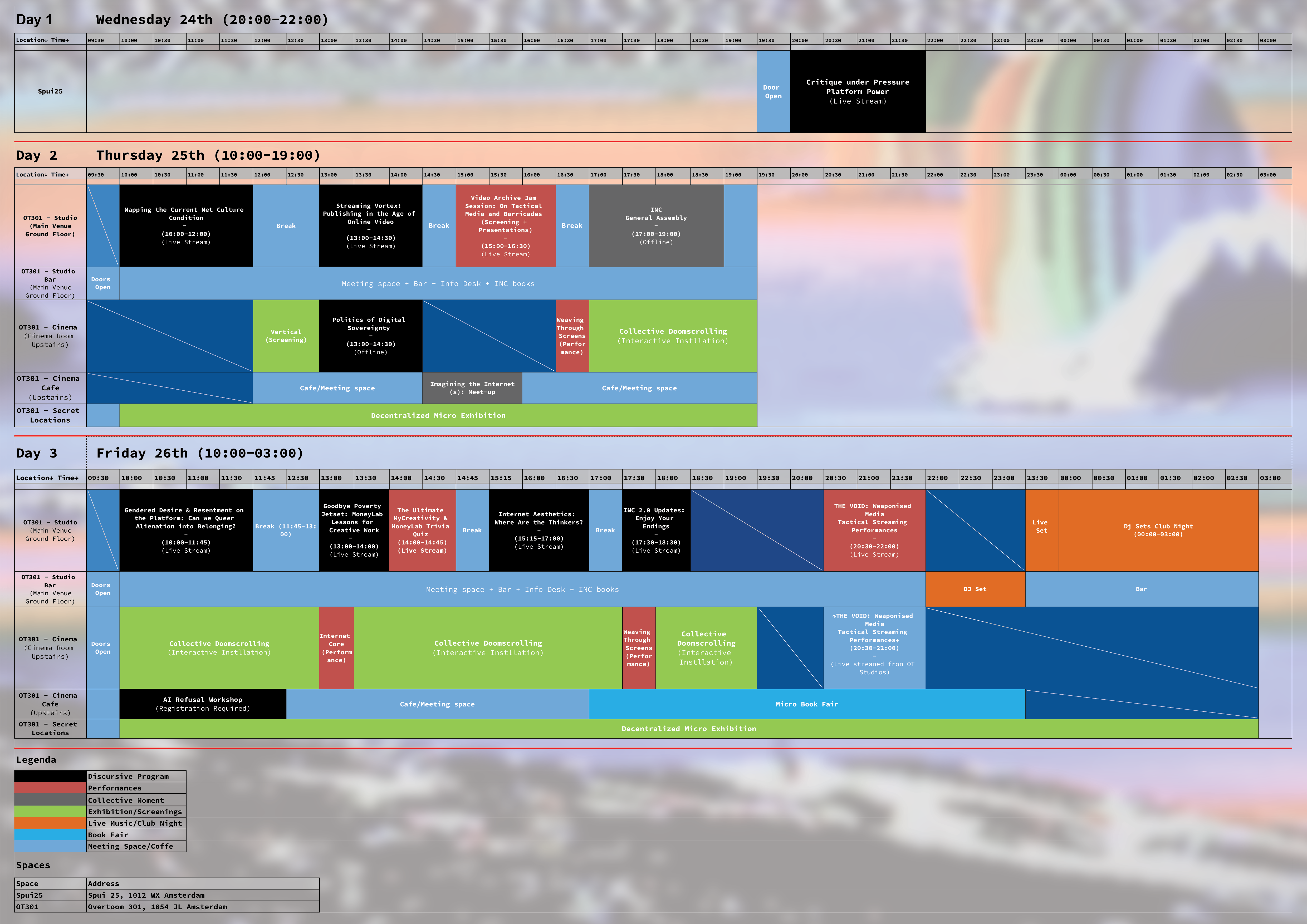
You can view the full event calendar inside the livestream player. Click on any current or past event to watch it.
You can also use the chat and the different streaming functions inside the player.
Important
Not every session will be streamed. Some parts of the program take place in parallel rooms.
Please check the timetable for the full overview.
Credits
The livestream is curated by THE VOID and streamed on The Inbetween, an online event space developed by The Hmm, a platform for internet cultures based in Amsterdam.
Support INC
Donate to the INC
As you all know by now: from September 1, 2026 INC will depart from the Amsterdam polytech HvA and continue onwards as an independent cultural organization. As we enter this period of uncertainty with zero euros and zero jobs, we want to express our gratitude to the community and everyone that has contributed to INC in any capacity over the last 22 years—we wouldn’t have gotten here without you.
In anticipation of our departure, we have slowly but surely been laying the groundwork for INC 2.0. It goes without saying that we rely on our community now more than ever, especially as we part ways with the institutional infrastructure which facilitated our output over these past two decades. We face this challenge head-on, though, and want to maintain the critical research and speculative experimentation in the field of network cultures independently and collectively. As a result, we’re setting up a community-based infrastructure and donation option to cover the costs required for the baseline of INC to stay operational (think of our website, various subscriptions to third-party services we rely on, and compensating labor and contributions). We kindly ask everyone to consider contributing via the donation link below:
Donate here.
This donation link unfortunately only works for ideal/wero payments, this is our bank information for manual payments:
Vereniging voor Netwerkcultuur
NL29 INGB 0120 1290 51
(BIC/SWIFT: INGBNL2A)
Become a member of the Network Cultures Association
As part of our legal restructuring, we are moving forward as an association, this gives us the option to have official members. As a member, you attend a general assembly once a year, discuss urgent topics and projects we can take on, and contribute a monthly membership fee which will go towards the costs listed above. You will essentially partake in the democratic governance structure of INC 2.0. As we await an official membership registration form, we are already taking application via the form linked below. We look forward to building our community with you!
Become a member here.
Thank you <3.
Bios
Alessandro Y. Longo
Alessandro Y. Longo is a researcher, writer, and cultural organizer based between Berlin and Turin. He’s a PhD candidate at DREST (Italian Doctoral School of Religious Studies), where he investigates the emergence of synthetic intimacy on AI companionship platforms. Alessandro is the initiator and maintainer of REINCANTAMENTO, an independent research and publishing group exploring technology, radical imagination, and rituals through the lens of re-enchantment. He also acts as user researcher on Shared Visions, a Creative Europe-funded cooperative art platform adopting Web3 infrastructure, and has spent several years contributing to cooperative protocol design and blockchain governance through Curve Labs and Circles Coop.
Andreas Treske
Andreas Treske is an author, and filmmaker living in Ankara, Turkey.In 2015 he published Video Theory. Online Video Aesthetics or the Afterlife of Video. with Transcript. In 2025 the INC published “Heaven’s Delight: On the Pleasures of Audiovisual Practices.” Since 2008 he has been involved in the Video Vortex network.
Anna-Verena Nosthoff
Anna-Verena Nosthoff is Junior Professor of Ethics of Digitalisation at the University of Oldenburg and Co-Director of the Critical Data Lab at Humboldt University Berlin. Her work examines platform power, AI, cybernetics, and digital governance, with particular attention to Big Tech, political subjectivity, and contemporary forms of technological control.
Annalisa Pelizza
Annalisa Pelizza is professor of science and technology studies and information studies at the University of Bologna and University of Aarhus. She researches and teaches about how vulnerabilities are created through identification infrastructures, long-term transformations in modern institutions prompted by digital infrastructures, ontologies and interoperability. With the INC she has published the book Communities at a Crossroads, on Ars Electronica’s digital communities.
Antonia Hernández
Antonia Hernández is an artist and an assistant professor in the Department of Communication at Concordia University in Montreal. Through a combination of theoretical investigation and art-based practices,Hernández explores the poetics of governance and the domestic side of platforms. She is currently working on “A Liquid Frontier,” a paper opera addressing water financialization and resistance in Chile.
Anya Shchetvina
Anya Shchetvina is a PhD candidate in Media Studies at the Humboldt-Universität zu Berlin. She is a coordinator of Matter of Imagination and co-editor of Imagining the Internet(s): A Collaborative Glossary. In the past, she has coordinated The club for internet and society enthusiasts in Moscow, facilitating critical pedagogical and research projects, as well as public discussions related to internet studies.
Burchhhha
Zeynep Burça Oral, a.k.a. Burchhhha, is an Amsterdam based performance media sound dj noise image text vocalist musician artist working with communication, media, and disgust. She likes positioning her audience in an uncomfortable place, while still letting them enjoy her colourful superficiality. You can find her burrowing around different underground scenes, and nestled between absurdity and naivety.
Cade Diehm
Cade Diehm (IE/AU) is a researcher, author, founder of New Design Congress (DE, 2018) and Para-Real Ltd (IE, 2025), and a founding member of Modal Collective (2025). Over a thirteen year career, Cade has developed a forensic practice capable of piercing opaque systems of power to make sense of their structural function. His work moves between security, digital identity, AI, cultural memory, political risk, and game systems, building tools and frameworks for understanding how digital systems produce material consequences. Cade’s expertise has informed projects across major institutions and civil society organisations – including the European Parliament, the Pontifical Academy of Sciences, PEN America and others – and his team frequently collaborates with research institutions, civil society, technology firms and environmental groups. Cade serves on the executive board of the Australian and New Zealand Society for Ecological Economics and the observer board of the Digital Credentials for Europe (DC4EU), a European Union Digital Europe Programme pilot.
Chloë Arkenbout
Chloë Arkenbout has been part of the core team of the Institute of Network Cultures since 2020. Their personal research centers on what it means to be (in)visible in the (semi)digital public sphere, discussing the political and emotional dimensions of subjects such as comment discussions, call-out culture, shadow banning, conflict & care in social movements, and political memes. She also co-edited the three Critical Meme Readers that INC published in 2021, 2022 and 2024, and Fragments of Tactical Media, published in 2026. Additionally, she works as a teacher at the Communication and Multimedia Design program at the Amsterdam University of Applied Sciences and she volunteers at COC Nederland, the oldest still-existing LGBTQAI+ rights group in the world. Before joining the INC, she worked as an independent journalist and communications specialist, focusing on cultural and societal projects.
Ciro d’Aniello
Cultural activist and visual artist based in Bologna since the mid-1990s, working in video media, independent television and cultural activism. Contributor to Radio Alice, co-founder of OrfeoTV and the Telestreet network.
Daniel Leix Palumbo
Daniel Leix Palumbo is a musician and PhD researcher at the Centre for Media and Journalism Studies and the Department of Language, Technology and Culture at the University of Groningen. As a solo sound artist and with the band Fernweh, he has worked on installations, performances, audio & video documentaries, commissioned by various organisations, among which are the Institute of Network Cultures, Amsterdam Alternative, Fundacion Princesa de Asturias, Palazzo Reale Milano and Fondazione Palazzo Strozzi.
Daria Hetmanova
Daria Hetmanova is currently pursuing their PhD at the School of Communication at Simon Fraser University, Canada. Operating at the intersection of science & technology studies and critical border studies, Daria’s current project focuses on mapping—both spatially and temporally— the Russian-established system of “filtration” of Ukrainian civilians during Russia’s war against Ukraine. Daria’s work was featured at Cashmere Radio and Mariupol Memory Park, as well as presented at PHI Montreal, Institute for Human Sciences in Vienna.
Deniz Buga
Deniz was born in Istanbul and currently lives in Amsterdam. Their film, video, and photography work focuses on urbanism, minority politics, and queer stances. Their work was presented at various film festivals and museums, including the San Sebastian Film Festival, Oxford Modern Art Museum, Centre Pompidou, and C/O Berlin. Buga was a resident artist at Rijksakademie, Amsterdam.
Diana Millán
Diana Millán (they/he/she). Artist and predoctoral researcher (PDIF/FPU) at UAM, Madrid, and main researcher at the Internet Core project (INC). They have carried out research stays at the University of Applied Sciences (Amsterdam), the Center for Digital Cultures (Lüneburg-Berlin), and the Universidad Autónoma Metropolitana (Lerma-Mexico City). Their Internet Core theory reflects on a new stage in internet art in the face of platform brutality.
Donatella Della Ratta
Donatella Della Ratta is a writer, performer, and curator specializing in networked media, with a focus on the Arab world. She is a former Affiliate of the Berkman Klein Center for Internet and Society at Harvard University, currently teaching Media Studies at John Cabot University, Rome. From 2007 to 2013, she served as Arab world community manager for the international organization Creative Commons. Her research on generative AI earned her the Italian Ministry of Culture ‘Italian Council’ award 2024-25. She is developing her concept of ‘speculative violence’ across multiple formats, ranging from a book to the lecture performance Ask Me for Those Unborn Promises That May Seem Unlikely to Happen in the Natural developed in collaboration with The Void collective.
Dunja Nešović
Dunja Nešović is a PhD candidate in Communication Studies at Concordia University in Montréal, Canada. Her doctoral research investigates the mediation of lesbian desire in the convergent digital media environment, with a focus on (reality) television and social media.
edj
edj grew up organising electronic music events in small-town Switzerland, founded a children’s keyboard punk orchestra, and somehow ended up remote deejaying for LA’s beloved dublab.com. Eclectic by nature, synth-obsessed by choice. Catch his annual end-of-year mix if you know where to look.
Eke Rebergen
Eke Rebergen is a PhD candidate at ASCA (University of Amsterdam) and part of the Cultural and Creative Industry research group of CARADT (Avans University of Applied Sciences). His research focuses on creative resistance in relation to algorithmic technologies. He looks at radical philosophies to inform design politics, art activism and critical design projects that creatively challenge and oppose. He developed and coordinated workshops and design projects for practical engagement and has taught accompanying philosophy and design theory courses.
Emanuele Braga
See MACAO.
Federico Aldovisi
See MACAO.
Francesco Barchiesi
Francesco Barchiesi (he/him) is a Postgraduate Researcher at the University of Birmingham (UK). His research investigates the genealogy of incel culture to understand non-radicalising trajectories for youth masculinities, both online and offline.
Gabriel Vigliensoni
Gabriel Vigliensoni is an electronic music artist, performer, and researcher whose work explores the creative affordances of machine learning in the context of sound and music making. He holds a PhD in Music Technology from McGill University and is an Assistant Professor in Creative AI at Concordia University.
Geert Lovink
Geert Lovink is the founder of the Institute of Network Cultures and Professor of Art and Network Cultures at the University of Amsterdam. His work spans tactical media, organized networks, platform critique, and alternative forms of publishing and digital organization. He is the author of numerous books on internet culture and networked media.
Gianmarco Christofari
Gianmarco Cristofari is a data protection lawyer and a socio-legal researcher that over the last decade has been working on platformization. With INC, he published the book The Politics of Platformization and the interview series on the development of digital soveregnty in Latin America ‘Digital Tribulations’. He holds a Phd in Global Studies from the University of Macerata and has worked at New York University and the University of Palermo. Currently, he is researching public platform alternatives, state platformization, and the rise of China as in the longue durée of capitalist development.
Giovanni Rossetti
Giovanni Rossetti is a media researcher, activist, and cultural programmer. He is interested in how different media systems organize and shape visibility, and preserve or exclude political and activist histories. In his practice, he experiments with participatory methods to activate dormant archives and collectively produce new readings and uses of materials. He is active in several community spaces in Amsterdam, including Filmhuis Cavia and ]LAG( hacklab.
Human Observer
Human Observer is a multimedia artist and organiser based in Amsterdam. He grew up on internet core music and vinyls found in his parent’s collection and will be playing some of those at Exit Fest <3
Hunter Nassar
Hunter Nassar is an audio and performance artist based in The Hague whose practice questions permanence in space, systems theory and situated listening. He takes inspiration from media, ecology, history of spaces and experimental sound practices. He is currently studying at the art science department at the KABK and co-organising Mushroom Radio.
İdil Galip
Idil Galip (she/her) is a writer, researcher and teacher. Her work explores the meme as foundational infrastructure of contemporary culture and politics, revealing how memetic media form new publics, dictate the rhythms of attention, and act as an ideological battleground.
Inte Gloerich
Inte Gloerich is postdoctoral researcher at the Visual Methodologies Collective (Amsterdam University of Applied Sciences) and at the Antwerp Media in Society Centre (University of Antwerp). She likes to critically, creatively, and collaboratively reimagine emerging technology from decolonial, feminist, and ecological perspectives. She has also been hanging around the Institute of Network Cultures for more than a decade.
Jernej Markelj
Jernej Markelj is a Lecturer in New Media and Digital Culture at the University of Amsterdam. His research focuses on affective politics of digital media, agentic imaginaries of AI, and online gend
Jordi Viader Guerrero
Jordi Viader Guerrero (he/him) is a practice-based researcher working across philosophy of technology, media theory, and technological design. His research engages with dissenting participatory design practices, activist media, and the intersections of media theory and digital culture. Jordi is a co-founder of THE VOID, a research project at the Institute of Network Cultures exploring tactical uses of online video for political action and artistic research.
Kate A. Babin
Kate A. Babin (she/her) is a Postgraduate Researcher at Coventry University. She works with and through feminist affect theory and applies a methodological approach of critical empathy to researching anti-feminist networked publics. Her ongoing dissertation project examines the affective constructions of race, neurodiversity and the body within a ‘blackpilled’ misogynist incel forum.
Klara Debeljak
Klara Debeljak is a researcher and artist working at the intersection of writing, design, and video. Her practice explores internet infrastructures and the potential for interventions in the algorithmic structures of reality. She has presented her work in group exhibitions across Europe and West Africa, including at UNFAIR (Amsterdam), the Dakar OFF Biennale and the Museum of Contemporary Art (Ljubljana). Her texts have been published in Designers Write, Nero Editions, Kajet, Disenz and Makery and have been translated into Italian and French. She has moderated discussions on technology and visibility for the IMPAKT Festival, and her essay Theory of the Chrono-Ghettos received the Designers Write award. Since 2021, she has been a researcher at the Institute of Network Cultures in Amsterdam, and in 2024 she began a two-year residency at Švicarija in Ljubljana, where she is developing a project on digital gentrification and speculative infrastructures.
Klaudia Orczykowska
klaudia orczykowska (orczi96) is a recovered egirl — designer, researcher, and writer based in the hague & online ★ retired dj, music lover. exploring contemporary (online) storytelling. her work moves between visual forms, fiction & non-fiction writing, and sound design.
Konfluxus
Konfluxus is a Budapest-based stream art collective producing experimental live broadcasts and hybrid networked events since 2024. It started as a 24-hour solidarity act at the Intermedia department of the Hungarian University of Fine Arts, when students joined UKRAiNATV with a stream commemorating the second anniversary of Russian invasion and full-scale war in Ukraine. Following that initial connection the collective practiced stream art as a means of creating alternative hybrid meeting spaces for artists in the hostile environment of the Orbán regime. Nowadays the collective is focused on building self-hosted sustainable infrastructures in close collaboration with the Stream Art Network.
Ksenia Rybak
Ksenia Rybak is a researcher, writer, and curator based in Kyiv, Ukraine. She studied media art history and critical media theory within Media Arts Cultures EMJMD. Her work focuses on the intersections of technology, space, and violence. Combining investigative research, media theory, and visual methodologies, she has contributed to projects including the Mariupol Drama Theatre Spatial Archive with the Center for Spatial Technologies and Forensis/Forensic Architecture, and research With Bricks, Not Bombs within the collective Scarcity investigating Mariupol reconstruction under occupation. She is currently a research fellow at the University of Siegen’s CRC 1187 “Media of Cooperation,” where she is conducting research on Russian filtration politics at Sheremetyevo Airport in collaboration with Daria Hetmanova and Natasha Pereverzina.
Laura Mrksa
Laura Mrksa (Croatia, 1992) is a slow designer in a fast-paced world, working from Amsterdam. Her design practice revolves around the transformation of everyday objects, predominantly furniture, as a means of exploring concepts related to materialism, consumerism, and individualism. At the moment, the focus of her practice is directed towards crafting objects that engage with the notion of rest. Within this theme, Laura adopts a comprehensive research approach, exploring urgent social realities such as workplace pressures and the impact of social media on our daily lives. Simultaneously, she delves into the design sector’s imperative to create slow and meaningful spaces and encounters. Her dominant design tool is weaving, and she has developed a technique inspired by net-repairing methods used by women in fishing communities, emphasizing care, patience, and often invisible labor. Without set patterns, each piece evolves intuitively, escaping the binary code of loombased weaving, and turning the process into a slow, meditative dialogue between chance and intention.
Laura Subirats
Laura Subirats is an artist and researcher whose practice focuses on processes of accumulation and excess within personal archives, both virtual and non-virtual. Her work investigates how data saturation reshapes our relationship with memory and identity. She is currently a PhD candidate at BAU, Centre Universitari d’Arts i Disseny de Barcelona, with the project Silly Archiving: on Backlog, Buffering and Data Hoarding, and is a long-term artist-in-residence at Hangar, Barcelona. She is also conducting a research stay at the Institute of Network Cultures in Amsterdam.
Lesia Kulchynska
Lesia Kulchynska is a curator and researcher in media and visual studies, currently based in Amsterdam. She holds a PhD in Film Studies and has worked as a researcher at the Pinchuk Art Center and as a curator at the Visual Culture Research Center in Kyiv. She was a Fulbright Scholar at New York University (2018-2019), a postdoctoral fellow of Bibliotheca Hertziana – Max Planck Institute of Art History (2022-2024), and was a fellow for six months at the Netherlands Institute for Advanced Study (2024-2025). She is also an affiliated researcher at the Amsterdam School for Cultural Analysis at the University of Amsterdam. Her current research is on the visuality of violence during the Russian War on Ukraine.
Letizia Chiappini
Letizia Chiappini is an assistant professor of urban sociology and digital geography in the Department of Behavioural, Management, and Social Sciences at the University of Twente. Letizia holds a joint PhD from the University of Milan-Bicocca and the University of Amsterdam. Her research interests focus on processes of digitization, digital literacy, and their effects on urban spaces and society. She is a co-founder of the Slutty Urbanism collective, which is part of the Austrian Pavilion at the 2021 Venice Architecture Biennale with an artistic, written, and photographic contribution titled “Glitches in Platform Urbanism.” Letizia writes for various local and international magazines in the Netherlands and Italy.
MACAO
MACAO is an independent centre for art, culture, and research. Rejecting the creative industries model, it treats artistic production as a tool for social transformation, political critique, and experimental forms of governance. Its research focuses on labour conditions in the cultural sector, the right to the city, and new organisational and technological models for cultural production. MACAO runs a cross-disciplinary programme spanning performing arts, cinema, visual arts, design, literature, new media, and civic assemblies. It is coordinated through an open assembly of artists and activists. At the INC Exit Fest, MACAO is represented by Federico Aldovisi, Emanuele Braga, and Virginia Roghi.
Marc Tuters
Marc Tuters is Assistant Professor of Media Studies at the University of Amsterdam and co-director of the Open Intelligence Lab. His research focuses on platform cultures, propaganda, conspiracy theories, and digital infrastructures, with particular attention to online political movements and media ecologies.
Martina Raponi
Martina Raponi is a writer and artist researching noise and the unheard through writing, sound performance, expanded reality, interactive installations, and workshop activations. She published two books: “Psofotopias. Noise: Sounding Out the Unheard” (Auditorium, 2025) and “Strategie del Rumore. Interferenze tra Arte Filosofia e Underground” (Auditorium, 2015). Martina is co-founder of noiserr, an interdisciplinary research group focused on noise. With artist [M] Dudeck, Martina founded the Ansible Institute, a transitory speculative fiction laboratory. She is part of N.R.U. (Noise Research Union) with Sonia de Jager, Cécile Malaspina, Miguel Prado Casanova, Inigo Wilkins, and Mattin. Martina is an art theory tutor and sound researcher at the Willem de Kooning Academy in Rotterdam and PhD candidate at ASCA, Univeristeit van Amsterdam. http://noiserr.xyz/
Mela Miekus
Mela Miekus is an Amsterdam-based writer and researcher with a background in art theory and curating. Her research practice centres around contemporary art and internet cultures with a focus on mediated figure design, the politics of aesthetics, and online girlhood. She holds a Master’s in Curating Art and Cultures from the University of Amsterdam (2025). She was a curator-in-training at the Stedelijk Museum Amsterdam (2024-25). As of 2025, she is a researcher at the Institute of Network Cultures.
Michael Dieter
Michael Dieter is an interdisciplinary researcher with a focus on interface critique, app studies, tactical media, technological aesthetics and media genealogies concerned with socio-political organization, labour and infrastructural power. He is based at the Centre for Interdisciplinary Methodologies, University of Warwick.
Miriam Rasch
Miriam Rasch is a philosopher and essayist. She writes books and articles about literature, technology, ethics, and digital culture and works as research educator and coordinator for the Willem de Kooning Academy in Rotterdam. From 2012-2020, she was part of the Institute of Network Cultures. There, she published the open access experimental essay collection Shadowbook: Writing Through the Digital, 2014-2018. In 2020, she published Frictie: Ethiek in tijden van dataïsme (De Bezige Bij), which was awarded the annual Socrates Cup for the best philosophical book in the Dutch language. With her WdKA colleagues, she wrote Hands on Research for Artists, Designers & Educators (Set Margins’, 2024). Her latest book, about the ethics of listening in polarised times, will come out in an English edition at Columbia University Press this fall as Listening. For more see, www.miriamrasch.nl
Morgane Billuart
Morgane Billuart is a writer, researcher, and storyteller whose work navigates the intersection of critical inquiry and narrative practice. Her practice spans writing, visual media, and sound, exploring how technology shapes contemporary modes of imagination, perception, and social relation. She is an affiliated researcher at the Institute of Network Cultures and the New Center for Research and Practice, and co-hosts the podcast GirlEmployee with Carmen Lael Hines. Her written works include The Heat of Others (2026), Cycles, Becoming the Product (2025), and The Sacred and the Doomed (2024), reflecting a sustained engagement with the material, ethical, and cultural entanglements of technology in contemporary life.
Nathalie Fridzema
Nathalie Fridzema is a PhD candidate at the Centre for Media and Journalism Studies at the University of Groningen. She is coordinator of Matter of Imagination and co-editor of Imagining the Internet(s): A Collaborative Glossary. Her research examines the cultural history of the early Dutch web (1994–2004), with a focus on web imaginaries, everyday practices, and regional histories often overlooked in dominant accounts of internet history.
Ned Rossiter
Ned Rossiter is Professor at the Institute for Culture and Society, Western Sydney University, and a theorist of media infrastructures, logistics, and organized networks. His work examines how digital systems reorganize labor, institutions, and political life, with particular attention to automation, platform economies, and new forms of organization.
Noah Pellikaan
Noah Pellikaan is an activist, a student at the University of Amsterdam, and an alumnus of Portland Community College (Focus Award: Global Studies). Noah has held a number of roles in the past such as: wilderness Search and Rescue first responder, shop steward with United Food and Commercial Workers Local 555, Chief Campaign Strategist with Albert Lee for U.S. Congress 2020, postal worker, wait staff, safety commissioner, committee member, dishwasher, courtesy clerk, barista, delegate, representative, volunteer, subject, detainee, and inmate. Noah is a researcher focused on generative change-making practices at the Institute of Network Cultures working primarily with the ongoing research project Tactical Media Room: Palestine.
Noura Tafeche
Noura Tafeche is a visual artist, onomaturge, and independent researcher whose practice moves across archival methods, laboratory-based processes, video, installation, neologisms and drawing. She graduated in New Media Art from the Brera Academy of Fine Arts, with a particular focus on net.art, however, her most formative experience has been The Influencers Festival, Barcelona. Her research explores visual culture and its techno-political entanglements, with particular attention to digital militarism, online aesthetics, internet hyper-niches, and non-Anglophone meme cultures. She also examines the use of synthetic images in institutional neo-propaganda strategies. She has exhibited, lectured, and led laboratories at Aksioma (Ljubljana), Medialab Matadero (Madrid), transmediale (Berlin), Disruption Network Lab (Berlin), Fotomuseum Winterthur (Winterthur), Impakt (Utrecht), Foto Colectania (Barcelona), Design Museum (Helsinki), Tainan Art Museum (Tainan), Tomorrow Maybe (Hong Kong), TheWrong Biennale (internet), Aarhus Kunsthal (Aarhus), Triennale Milano (Milano), Pirelli HangarBicocca (Milano), Almanac Inn (Turin), Mattatoio (Roma), Dutch Art Institute (Arnhem), Institute of Network Cultures (Amsterdam), and the European Union Representative Centre (Al Quds, Palestine).
Patricia de Vries
Patricia de Vries leads the Art & Spatial Praxis research group at the Gerrit Rietveld Academie, where she explores artistic and academic interventions within spatial, institutional, and digital enclosures. She also serves as the programme director of ARIAS, a platform that fosters research through the Arts and Sciences. From 2013 to 2020, she worked as a researcher and project coordinator at the Institute of Network Cultures in Amsterdam. She was the project lead for MoneyLab — before Inte took over. Her work focused on the connections among art, theory, and activism, particularly regarding algorithms and digital financial infrastructures.
Rosa Menkman
Rosa Menkman is a Dutch artist and researcher of resolutions. Her work focuses on noise artifacts resulting from accidents in both analog and digital media.
Ruben Stoffelen
Ruben Stoffelen is an Amsterdam based writer and independent researcher who holds a research master degree in Cultural Analysis from the University of Amsterdam and is working at the Institute of Network Cultures. His research ranges from networked subcultures and visual culture to infrastructure and the built environment, whilst underscoring digital culture and agency.
Sebastian Giessmann
Sebastian Giessmann does Media, Theory and Culture at the Universities of Siegen and Cologne. Out now: Das Kreditkarten-Buch: Geschichte und Theorie des digitalen Bezahlens. Kulturverlag Kadmos, 2026. Still there: The Connectivity of Things: Network Cultures since 1832. MIT Press, 2024. Sebastian is blogging proudly since 2006 at www.netzeundnetzwerke.de.
Sepp Eckenhaussen
Sepp Eckenhaussen is an artwriter, researcher, and organiser based in Amsterdam. He works at the Institute of Network Cultures and the Caradt research group of the St.Joost Academy of Art & Design. From 2020 to 2023, Sepp co-directed Platform BK, an activist think tank that researches the role of art in society and takes action to improve art policy in the Netherlands. He is the author of Goodbye Poverty Jetset: How Art Workers Make Solidarity Economies (HumDrumPress, 2026).
Silvio Lorusso
Silvio Lorusso is an Italian writer, artist and designer based in Lisbon, Portugal. He published Entreprecariat (Onomatopee, 2019) and What Design Can’t Do (Set Margins’, 2023). He is editor of the Magma series for Krisis Publishing. Lorusso is an assistant professor at Lusófona University in Lisbon and a tutor in the Information Design department at Design Academy Eindhoven. He holds a PhD in Design Sciences from Iuav University of Venice. See: https://silviolorusso.com.
Sofi Xian
Sofi Xian (冼納然) is a researcher, cultural theorist, and multimedia artist based in Rotterdam, NL. Drawing on computational linguistics, experimental photography, cinema studies, and sound art, she maps the semiotic terrain of consumer culture, with particular focus on marginal, naïve, and forgotten cultural detritus as reservoirs of emergent aesthetics and ambient meaning. A founding member of the Consumer Aesthetics Research Institute, she pioneered the field of consumer aesthetics and co-coined the term Frutiger Aero. She founded digicam.love in 2018 and holds an MA in Linguistics (Text Mining) from the Vrije Universiteit Amsterdam.
Sophie Publig
Sophie Publig is an internet archaeologist and Senior Scientist at the Weibel Institute for Digital Cultures, University of Applied Arts Vienna. Her research moves across critical posthumanism, digital cultures, and aesthetics, analyzing phenomena from meme ecologies to networked subjectivities to internet folklore. She has co-written Digital Occultism (2026, Aksioma) with Mikkel Rørbo.
Tiziana Terranova
Tiziana Terranova is Professor of Cultural Studies and Digital Media Theory at the University of Naples “L’Orientale.” A major theorist of network culture and digital capitalism, her work explores digital labor, automation, platform economies, and the digital commons. She is the author of Network Culture (2004) and After the Internet (2022).
Tommaso Campagna
Tommaso Campagna is a practice-based researcher in media studies and a videographer. He is a researcher and editor at the Institute of Network Cultures. His work examines the technical and political dimensions of online video, publishing, and tactical media. He recently co-edited /expub | exploring expanded publishing/, a book which examines contemporary debates around experimental publishing. He also co-curates THE VOID, a research project and video studio that produces live streams, video essays, and audiovisual publications in collaboration with artists, activists, and academics. Finally, Tommaso’s greatest achievement is the editing of this very booklet.
Valeria Ferrari
Valeria Ferrari is a researcher in law and technology at the Universidad Complutense de Madrid. She completed her PhD at the University of Amsterdam, Institute of Information Law. Her work investigates policy discourses around technology and the relationship between legal change and digital cultures. She is member of Slutty Urbanism, a collective that brings together feminist activism and critical urbanism.
Virginia Roghi
See MACAO.
Vladan Joler
Vladan Joler is an academic, researcher and artist whose work blends critical and system design, data investigations, counter-cartography, data visualization, and numerous other disciplines. He explores and visualizes different technical and social aspects of algorithmic transparency, digital labour exploitation, invisible infrastructures and many other contemporary phenomena in the intersection between technology and society.
Yuk Hui
Yuk Hui is Professor of Philosophy at Erasmus University Rotterdam and one of the leading contemporary philosophers of technology. Known for his concept of cosmotechnics, his work explores the relationship between technology, culture, ecology, and planetary futures, challenging universal understandings of technological development.
Zeno Poggioni
Living in the city of Amsterdam Gropina is one of the figures behind Paesaggi Records. A label that focuses on trying to bring to reality adventurous, evocative, and spaced-out records and tapes. Currently, he spends his time working at Rush Hour Records or making music in his studio in Amsterdam Oost. Every so often you can catch him playing records in various locations and countries and on independent web radios.