Foreword
Geert Lovink
‘I believe in the possibility of tactical media; this conviction motivates my effort to trace its imperfections and perversions’ after Frantz Fanon.
At the time of its invention in the 1990s, ‘tactical media’ unfolded in an age of expansion of the digital, when networks and interactivity thrived, and neo-liberal globalization was hegemonic. Back then, digital and analogue coexisted and were mixed, much like the real and the virtual. In this reader, we examine how the tactical media concept progressed since then and is currently redesigning itself—this time under duress.
The part-activist, part-artistic practices gathered here showcase a will to experiment, often in conservative, regressive circumstances. Boredom, anger and despair are real. Appearances are not what they seem. Why am I feeling so fake today? The fragmentary nature of dissident media should not be read as a sign of weakness or defeat. They are signs of life amid stagnation. How do we stream together? What tools do we need for our collaboration?
Let’s face it. Movements and protest campaigns today feel an unarticulated need to use dominant social media platforms. Instead of building parallel alternative media, the social pressure to remain present on socials feels unavoidable. Instead of an exodus, we’re stuck. Instead of moral condemnation, corporate media prevail. It is still politically correct to use Instagram, in particular in contemporary art circles. There’s no digital underground or dark forest. If only. This is why INC is presenting a patchwork of minor media practices here, under the modest sign of ‘fragments’.
In Chaos and the Automaton, Franco Berardi states:
‘Fascism is a pathology of identity, hitting those who are too weak to accept the idea that identity is ever-changing and multifarious, and too frightened by their own uncertainty and ambivalence. ’
Antifa, or rather Nonfa, media that can overcome the fear and rage Berardi talks about have yet to emerge. Their birth has been postponed. I envision they approach us from the future and unfold overnight. The coming collective means of expression will be playful, cozy, hybrid, expanded, one-off and temporary, ready to disappear whenever time is up.
Another discussion is the continued use of the term ‘media’ (as in social media and tactical media). To me, much as the term ‘enlightenment’, the media is an incomplete project worth pursuing. A yet-to-be-developed Dialectics of Media will take feedback seriously and learn from the past. The aim of this reader is to bring together insights from activists and other misfits, amidst setbacks, regression, stagnation, and crisis, to turn the entropic forces upside down. Media mediate, and that takes time. In situations where we ran out of time, there is no easy way to reduce media to a slow, nostalgic infrastructure of the past, just because faster technologies were introduced. What do we gain from instant mediation? Who benefits from the lack of reflection? Instead of a boring interface and invisible algorithms, we need an editorial aesthetics that demands time from us. In defense of the media. What does it mean when we state, in variation of Foucault and Todorov, that mediation is an attitude, rather than a phase in history? Metaphors and terms matter. Some are tired, others fire up the collective imagination. Which meme brings you out on the street? Instead of complaining about the ADHD-stricken Gen Z, middle-of-the-road millennials and reactionary boomers, it is remarkable to see the ever-growing arsenal of activist media tactics unfolding worldwide. The good news is that all channels can and will be connected with the tools at hand.
This reader, produced in 2025-26, months before its own exit from the Polytech HvA, where it was embedded for 22 years, does not present an overall strategy. Neither does it try to historically contextualize tactical media. The essays and reports have been collected solely to share experiences. Unrest scales up, revolts go viral, and yet, the tactical subversions gathered here are not yet strong enough to overcome the self-obsessed surveillance platforms. This is a thick wall that tactical media initiatives run up against. Despite this limitation, the Institute of Network Cultures felt it necessary to gather inspiring tactical initiatives that defy the depressing logic of platforms. The tales of the tactical collected here contain seeds of a connectivity to come, a configuration of the techno-social that, at times, sails the waves of noise, always ready to find and express meaning. ‘Hört auf zu heulen; es hat erst angefangen” is a 1980s slogan that calls on us to stop complaining about the same old social media. We’re only at the dawn of the polycrisis.
Introduction
Fragments of Tactical Media
Chloë Arkenbout, Kate A. Babin, Tommaso Campagna and Sepp Eckenhaussen
On the night of 24 November 1999, during the Seattle WTO protests, Indymedia.org went live for the first time.1 People crowded around folding tables to upload shaky camcorder clips, write reports, and publish posts. Right then and there, a loose network of people with cheap tools made their own media, tactically pushed against the mainstream broadcast order, and claimed a place in the global conversation. A synergetic rush of energy, collectively channeled into the aether. A sense that something new was taking shape in the digital sphere. A network shaped by the people. Tactical media in practice.
Things have changed since those early days. Today, a single livestream from Gaza or from a protest camp in Belgrade can pull in more viewers in minutes than many Indymedia nodes received in a week. People can use the outreach of platforms like TikTok, Instagram, and YouTube if they know how to cut through noise, ride the algorithm when it helps, and slip around it when it doesn’t. But the ground is not the same. We have transitioned from the network to the feed. Early internet culture imagined the network as something you could navigate on your own terms. You could wander through archives, forums, link lists, and other small sites. Today, most of us live inside the feed, a constant stream that decides the order of events, the tempo, and the reach. The feed collapses attention into a single timeline and turns media into an endless present. Gaining visibility is possible, and sometimes it is huge, but always on terms set elsewhere. Virality is easy, while infrastructure control is impossible. And yet, tactical media is still urgent. Because the need for independent media, obfuscation tools, and safe spaces to organize has not faded. On the contrary, they are more relevant now than they were thirty years ago. Of course, today, tactical media looks different from before. That’s the point. They are fluid, adaptive, sharp, timely… tactical.
It was never a theory. Tactical media was a name that came after the practice, shaped by the people who were already doing it. The term surfaced around the first Next Five Minutes gatherings in Amsterdam in 1993, an international festival on tactical television, where artists, activists, and hackers pushed cheap tools and open networks to see how far they could bend them.2 In 1997, Garcia and Lovink, drawing on Michel de Certeau’s notion of the ‘tactics of the weak’, described tactical media as cheap DIY media used by people cut out of mainstream culture to push subversive and non-commercial aims.3 These tactics played out in short, focused acts like guerrilla media, detournement, and art-activist pranks. Groups like Critical Art Ensemble, RTMark, The Yes Men, Electronic Disturbance Theater, and many others took whatever tools they had and inserted noise into broadcast and early web spaces.
The idea was simple. Acting in the gaps. Repurposing what is available. Striking where the system is slow. Tactical media took that everyday logic and pushed it into the media field. The tactic mattered more than the medium, and the temporary breach mattered more than building institutions. (One of the reasons to be cautious toward tactical media today.) New social figures rose to prominence online: the hacker, the prankster, the camcorder kamikaze. Tactical media blurred the lines between art, activism, and daily resistance. It was a time when the internet still felt like a gap—a playground or sandbox waiting to be filled with meaning, social relations, politics, and aesthetics. It looked for a moment as if the media were not a fixed machine controlled from above, but something one could intervene in from below.
Today, we write with a different proposition. It is clear that the internet is no longer, and perhaps never was, separate from capitalist reality, but rather is its continuation, its intensification. The original tactical approach of celebration of speed, chaos, and temporality has been completely absorbed. In a feed-shaped environment, tactics do not just disrupt, they can be recruited. As Kluitenberg warns, ‘These tactics were fully appropriated… in the service of an entirely strategic political agenda.’4 The platforms that dominate our communication are extractive, restrictive, and often openly repressive. The original dream of a global network of resistance has not vanished entirely, but it has transformed, shrunk, and scattered into smaller, more intimate experiments.
This book was born from a specific inquiry into that transformation. When we launched the open call for submissions, we were emerging from a two-year project at the Institute of Network Cultures called the Tactical Media Room. Starting with our larger community during the full-scale invasion of Ukraine in 2022, and continuing through the ongoing genocide in Palestine, the protests in Serbia, and student encampments in Europe and the USA. The project’s concept was straightforward: to create a dedicated space where activists and researchers could narrate conflicts from their own perspectives. We organized physical and hybrid meetups to coordinate both publishing content and building concrete actions.
We kept publishing diaries, articles, and livestreams, but through the years, the sense of urgency changed. In practice, we realize that the crises we reacted to never gave way to reconstituted normalcy. On the contrary, the stack of crises kept growing. Wars, genocides, climate catastrophes, and recessions piled up—not even to mention the everyday reality of gender-based violence and racism. Moreover, we knew that these crises are interconnected. There is no global warming without colonialism and no capitalism without patriarchy. However, the complexity of this stack of crises makes tackling them as a whole a rather daunting practice. Crisis upon crisis has generated mobilization and agency, but also an overwhelming sense of impossibility and powerlessness. We can see nearly everything, broadcast more than ever before, but what can we actually do with media?
This paralysis is not coincidental; it is structural. It is the result of decades of incessant compounding of platform power in the hands of a few tech broligarchs. Platform capitalism has advanced toward violent surveillance, political regression, and default brutality. Platforms no longer simply distract, but wound, exposing the violent nature they previously tried to hide.5 Even activist paralysis is baked in. Our attention, our data, and even our political anguish are treated as resources to be mined. This system demands constant affective labor, or the uncompensated emotional work of bearing witness and fighting misinformation on their terms, which inevitably leads to exhaustion and activist burnout. The moral bankruptcy of free software and its co-option by big tech has left us with fewer viable alternatives than we imagined possible in the early 2000s.
So what now? How can we use media in tactical ways when ‘the line dividing the symbolic and material aspects of mobilization, becomes less clear when digital technologies are both the means of expression and the expression itself’?6 If we need a diversity of practices and tactics for the many struggles and urgencies we face, can we at least share common (digital) tools? If we can draw any conclusions from the contributions in this reader, it’s that tactical media today looks radically different from its early incarnation. The internationalist force of Indymedia has transformed into more intimate forms of resistance toward media consumption. Some look familiar, like local radio and community platforms. Others stretch the field, from knitting as infrastructure work to slutty urbanism and anti-engagement strategies that refuse the scroll.
These practices do not promise the next Instagram killer or the search engine that will topple Google. Instead, they work at a different scale: toward local experiences, small communities, and small tech. Small isn’t a retreat. (At least not always.) It’s a shift toward collective paths that can actually work. A testing ground for new forms and media that may or may not someday lead to a system overhaul. We will cross that bridge when we get there.
This shift reveals a subtle but profound change from the original definition of tactical media. Where it was initially understood as fleeting, temporary, and opportunistic, a tactic used in the moment, the practices represented in this book demonstrate a different approach. They are not one-off interventions but rather attempts at slow, strategic infrastructure-building; they are tactics that aspire to become enduring practice, refusing the platform’s logic of rapid obsolescence and immediate scale.
There is a peculiar contradiction in the formats that these tactical infrastructures adopt. A surprisingly large number of the experiments and practices in this book take forms that resemble older media like radio and TV. It would be easy, but also mistaken, to describe these retroforms as media nostalgia. Instead, the stream artists and pirate radiocasters described recognize that in the age of platformed media, one does not tune in or out, but undergoes eternal, non-negotiable information overload. In other words, good old content flow is back, stronger and more immediate than ever.7 Building TV or radio media is thus not a regressive practice, but a way to weaponize the format of the feed against itself. The algorithmic timeline is a hostile broadcast channel that must be disturbed, stretched, or redirected. From careless consumption to culture jamming. From virality to slow punk. From data transparency to smudgy nichecore. By intervening directly inside the stream, these tactics reclaim the ‘liveness’ that defined early tactical media, creating moments of friction within the very machinery of extraction.
And although we see trends and common interests, there is no uniformity in the infrastructural or formal features of the projects shared with you in this collection. Some build local networks and small tech infrastructures. Others use the major platforms with a clear understanding of the risks and limits. The point is not purity. One does not build a self-contained media island in the platform sea. If anything, the shared underlying principle is a stubborn insistence on platform promiscuity; a refusal to be locked in, logged on, and sold off for data parts. The tedious maintenance of an autonomous server and the opportunistic approach of platform hopping are equally valid in the struggle against the platform lock-in effect. The point is paying attention to what we do, why we do it, what works under which conditions, and which trade-offs we accept.
Beyond the platform lock-in effect, the tactical terrain is vast, and treading on it is rewarding. The reader of this book will encounter information smuggling as media ecology, experiments in networked feminism, anti-colonial meme communities, community radio as commons practice, TikTok streams from Gaza, and forking as political practice. Each contribution represents not a solution but an approach to navigating the contradiction of organizing resistance within the very systems that enable oppression. An imaginative testimony to the knowledge that another world is possible.
But the question that haunts this collection, the one we cannot fully answer, is whether these local experiences can create new futures on their own, or whether we need to find ways to organize, amplify, and scale them. The promised globalist reach of early internet activism turned out to be a trap, a seduction that mirrored the logic of the platforms we now oppose. Today, early tactical media formations like flashmobs and temporary autonomous zones strike as nearly indistinguishable from hegemonic platform virality. Like memes, they suddenly appear, catch attention (and clicks?), and disappear without leaving a mark. Calling them subversive or even radical seems laughable. And yet… The mechanism of the organized network or organet remains our best weapon against a techno-feudal internet. To fight a system based on extraction, we do not need a single global platform; we need a federation of strong, hyperlocal nodes. Today, the organet returns not as a tool for global reach, but as a necessity for local survival. These local practices are better understood as durable cells in a network of nets, rather than nodes in a singular global body. The task is no longer to scale up, but to scale across. Yet without some form of coordination, some sharing of common tools for common causes, we risk fragmentation and isolation.
Perhaps this is the real tactical question for today: not how to build the next Indymedia, but how to connect the knitters with the radio collectives, the meme communities with the mesh networks, the data activists with the performance artists. How to share strategies, reflections, experiences, and tools across struggles without recreating the centralized infrastructures that failed us. How to broadcast glimmers of hope without going back to concepts that no longer hold, or perhaps by going back to them differently.
Glimmers of Hope
In assembling this collection, with the risk of sounding cringe, we hope that tactical media can offer glimmers of hope. We understand hope not as naïve optimism that encourages passivity or as a promise of technological salvation, but as a catalyst to ignite action. As Rebecca Solnit writes: ‘It’s important to say what hope is not: hope doesn’t mean denying realities. It is not the belief that everything was or will be fine. […] Hope locates itself in the premise that we don’t know what will happen, and that in the spaciousness of uncertainty, there is room to act.’8 In a similar spirit, Hannah Proctor articulates hope as a fragile, hard-won capacity to continue acting together even when infrastructures fail, movements fracture, and defeats accumulate. ‘Hope not just as a feeling, but as a practice—something you do rather than just something you experience.’9 She reminds us that political desire often begins in moments when another world briefly feels possible. Yet she also cautions that clinging to a purified or triumphant image of hope can itself become destructive. Instead, she argues for communities to acknowledge exhaustion, grief, and the emotional debris of struggle while still committing to organization as a practice of care and endurance. And so do we.
Our aim with this collection is to amplify the shared practices where, despite the horrors of our time and despite the challenges of late platform capitalism, people keep intervening, sabotaging, refusing, building, trying, repairing, and imagining together. Proctor would not claim digital technology to be either a source of hope or despair, as, according to her, the real question is: what would a more liberated future look like? If anything, we hope (see what we did there) this reader is a source to spark enthusiasm to keep fighting for that future.
Fragments for Inspiration
A collection of unruly, tactical media practices is, by definition, fragmentary. We celebrate this diversity of angles, for a rejection of an overly polished environment or a lack of forced cohesiveness is a tactic in and of itself. As you’ll soon read in In the belly of the meme: Tactical dissemination in the Arab and diasporic digital sphere (p.167), a chaotic or messy aesthetic directly counters the sterilized facade encouraged by mainstream platforms. In their article, Tafeche and Kharma introduce us to two meme-makers creating from Arab-diasporic positionalities, illustrating how memes and meme communities have the potential to carve out spaces for those who might otherwise feel disconnected, the many cultural fragments within the memes functioning ‘as relational threads linking diasporic backgrounds’. The messiness and contradictions within these memes reflect the complexity and nuance of the cultural and political realities of their creators and their audiences.
Several authors in this book insist that on an organizational level, too, acknowledging the complexities of the crises we face is vital, and should be reflected in the modes of organizing and cultural production in order to be effective. In the text Forking For Future? The Case of the Extinction Rebellion – Just Stop Oil Split (p.259) Manconi and Gambetta reveal, through a connection to the idea of forking in open-source communities, how conflict within organized social movements can lead to what they call a socio-political fork. A split that has the potential to strengthen and expand a movement, a fracture that does not diminish it. In Offener Kanal Europa: Can a TV channel save public access? (p.71 ), Nora Spiekermann and Giacomo Marinsalta detail their artistic response to urban financialization, interrupting the cold, sanitized nature of public spaces born from neoliberal privatization with their own version of messiness. Live performance broadcasts and talk shows designed to connect with neighbors and neighborhoods, turning polished ‘products’ into environments that are actually lived in. Public spaces with identities that are formed through their imperfections. As the authors put it, these interruptions and glitches work to fracture ‘the seamless order of a rendered city shaped by financial interests.’ In both of these texts, friction and fragmentation are the generative forces.
A further, admittedly crude reason to for us lean into fragmentation, is the sheer, overwhelming, beautiful amount of tactical media practices today. In addition to the editorial contributions we have also added a Tactical Media Repository (p.279), highlighting this even further. Here, you will find a collage of more tactics, facing off crises by utilizing a range of strategies and tools. To name a few: Tommi Marmo provides a workshop guide to understanding decentralization through knitting in Knitting Our Internet (p.317). Learning Palestine (p.291) is a collective that works with multiple forms of knowledge dissemination – new and old – to prevent the limitations of corporate-controlled networks. Or Tools Against Surveillance Capitalism (p.309) by xvendetta, provides a set of concrete alternatives to platform monopolies that can be used to de-google our lives.
While the tactics gathered in the repository are brief and intended to offer more resources, the articles reflect extensively on their lived experience and experimentation. They show how such approaches take shape in practice, across different contexts and forms of collective work. Jack O’Grady, for example, examines how we can tear ourselves away from the endless scroll in Disrupting the Doomscroll: Tactics for the Collective Reclamation of Attention from within the Content Machine (p.121). We learn about Denise Sumi’s experience at The Island School of Social Autonomy and how their pedagogical model can inform collective reconstruction and radical local autonomies for communities in Convivial Tools for Worlds to Come: The Island School of Social Autonomy (p.217). Alongside the Cashmere Radio broadcast recording, Matilda Jones describes how experimental audio can capture the heart of on-the-ground mutual aid in The polyphonic potential of mutual aid collectives: Sounding solidarity in experimental audio (p.51). And in Remember to remember (p.23), Wanderlynne Selva acquaints us with an unpublished manifesto through poetic memory, a rewriting of dpadua’s 2009 technopolitical warning, they prompt us to remember each other, remember magic, and the necessity of concrete openness within and outside of technology. They remind us to hope. And this hope – along with the slow tangible collective action that invokes it – is a throughline in all the texts we’ve assembled here.
Staying in the Middle
This book doesn’t offer solutions, nor does it claim to be an exhaustive overview of tactical media today. These contributions offer fragments of strategies, reflections, experiences, and tools that help sustain the everyday labor of mediated resistance. There are countless experiments, projects, and practices happening across the world that aren’t documented here. What this collection offers instead is something equally important: a loud call for more of this research, more documentation, more sharing of tactics and tools. It’s an introduction to a concept that, now more than ever, is urgent.
Because if we’ve learned anything from the past two decades, it’s that we cannot afford to let these experiments disappear into the noise of platform feeds, to let these practices remain isolated and undocumented. The work of mapping, connecting, and amplifying tactical media practices is not academic luxury; it’s rather a political necessity. Every radio collective that shuts down without sharing its knowledge, every alternative platform that vanishes without documenting what worked and what didn’t, every community tool that remains invisible to other communities fighting similar battles, represents a loss we can’t afford.
This book is not a beginning, but it is not an ending either. We are happy with the messy middle; to stay with the tactics. We call on our fellow researchers, activists, and artists to do the same: document your experiments, share your failures, connect your practices. The urgencies remain. The crises stack higher. But the tactics have changed, become more personal, more local, more weird. And in that weirdness, in that refusal to scale according to platform logic, something else becomes possible: not a solution, but a crossroad of practices changing the media landscape.
-
(1) Part of the anti-globalization movement, 50,000 activists gathered to protest a World Trade Organization conference and subsequently ‘set the tone for the mass mobilizations of the 21st century’. From Chandler Dandridge, ‘The Legacy of the “Battle of Seattle”’, Jacobin, June 2024, https://jacobin.com/2024/06/battle-of-seattle-protest-wto. ↩
-
(2) Next 5 Minutes was an international festival and conference for tactical media organized by a diverse ad-hoc coalition of media institutions and practitioners in Amsterdam and Rotterdam. Four editions were organized between 1993 and 2003. More info: https://monoskop.org/Next_5_Minutes. ↩
-
(3) David Garcia and Geert Lovink, ‘The ABC of Tactical Media‘, 1997, https://www.sholetteseminars.com/wp-content/uploads/2018/03/The-ABC-of-Tactical-Media.pdf. ↩
-
(4) Eric Kluitenberg, in Michael Dieter, David Garcia, Alexandra Barancová, Eric Kluitenberg, and Rob Batterbee, Echoes of Tactical Media (recorded 10 July 2024), p. 9. ↩
-
(5) Geert Lovink, Platform Brutality: Closing Down Internet Toxicity, Amsterdam: Valiz, 2025. ↩
-
(6) Leah Lievrouw, Alternative and Activist New Media, Cambridge: Polity Press, 2024. ↩
-
(7) Anna Kornbluh, Immediacy: Or the Style of Too Late Capitalism, Verso, 2024. ↩
-
(8) Rebecca Solnit, Hope in the Dark: Untold Histories, Wild Possibilities, updated ed., Chicago: Haymarket Books, 2016. This quote was shared in the Cafe Saarein Signal group and feels meaningful to share here. ↩
-
(9) Hannah Proctor, quoted in Chloë Arkenbout, ‘Paranoia and Guilt: A Conversation with Hannah Proctor about the Emotions of Political Defeat and Digital Media’, Institute of Network Cultures, 26 March 2025. ↩
Remember to remember
Wanderlynne Selva
We are still around
We reassemble to share echoes of a manifesto drafted, but never quite finished. The original author, Daniel Pádua aka dpadua,1 was a Brazilian activist and technologist, a self-described net artisan, and our relative. Cancer took his life in 2009. Too early for him, too early for the many people who miss his presence to this day. It happened on the 20th of November, Dia de Zumbi dos Palmares.2 On that day, many of dpadua’s hundreds of friends and admirers were in São Paulo for the second edition of the Digital Culture Forum. Others were in Chapada dos Veadeiros for the Popular Cultures Festival, and others still felt his loss across the continents. On that evening, all of us decided to sing, play, and dance in his honor. We refused to give in to pure sadness. Partying is our language of cultural resistance, and he always gave a great example of such. His presence and influence are still felt among us. Encantou-se, mas ainda está por aí.
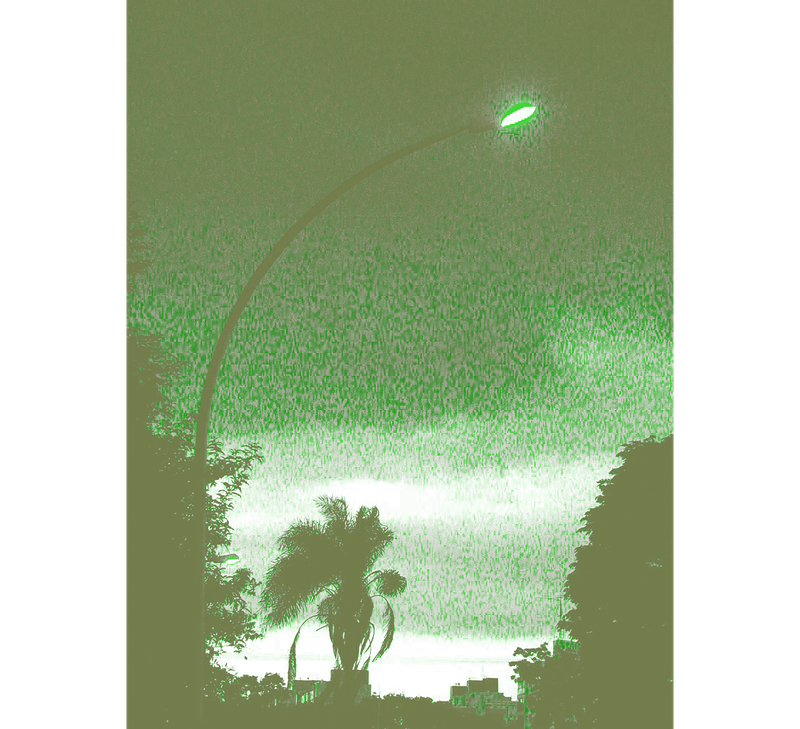
Photo CC-BY-SA by Daniel Pádua: ‘Storms of the past. Every now and then the sky threatens to fall, but a little bit of light is already enough to guide someone’3
The title of dpadua’s manifesto was ‘Remember the code’. Fifteen years after his departure, that call feels ever more necessary. We hear it in our dreams, when we meditate, when we whisper to ourselves about the state of the world and ponder how to survive the tidal changes around us.
That unfinished manifesto was never published. Versions have circulated among peers, perhaps a couple of mailing lists too. As the author never considered the manifesto quite finished, we will respect that and not share that version further. But we did read it. And we feel that its core is even more relevant nowadays. In times of greed and selfishness, it reminds us of the protagonism of collective power, the importance of affection and trust. It tells us to embrace life, acknowledging the pain and the delight of every chaotic and imperfect trace of each of us. The text you read now depicts our poetic memory of that other text.
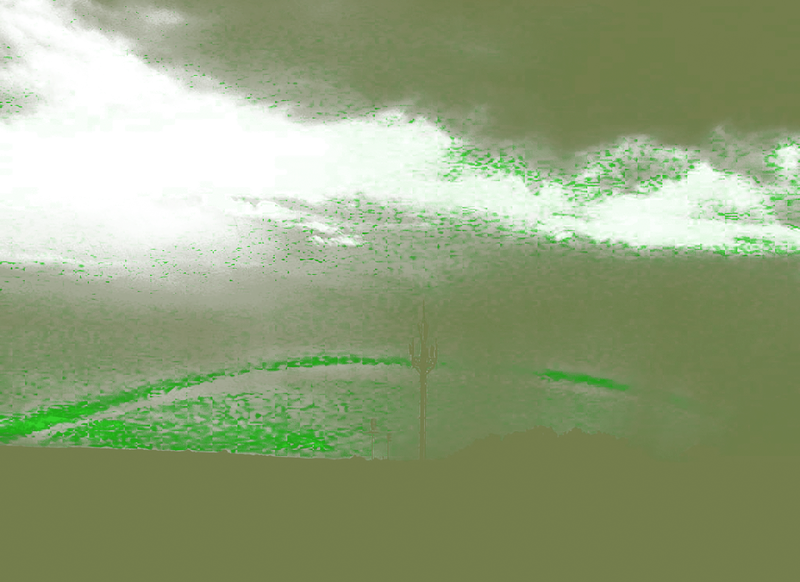
Photo CC-BY-SA by Daniel Pádua: ‘Everything in the world is in motion. We exercise our senses to perceive as many details of the hustle and bustle as we can.’4
Code is all around
A lot is said about digital technologies. They are scary – and exciting. They change everything, and yet everything – at best – remains essentially the same. They liberate, and they further enslave. They expose power structures, while helping to maintain and reinforce such structures in smarter ways. Those ambiguities may as well be foundational to any human development. However, the quasi-theological dueling of hype and opposition, between integrated experts and apocalyptic ones, tends to drive discussions away from a crucial point.
Individuating technologies implies complex and largely unacknowledged choices. Such choices reflect technical, politico-ideological, economic, and cultural conditions of individuals, groups, and society at large. Even though it’s difficult to have a comprehensive enough overview, there are concrete decisions pointing to enclosure and restrictions, to segregation and control. And there are just as well other choices geared towards inclusion, flexibility, and long-term dependability.
‘Os especialistas não param de surgir’, Daniel wrote, and we read it again in 2025. Experts keep popping up. Life coaches convince people of the most bizarre and unimaginable practices to hack their living conditions. Shameless self-proclaimed ‘influencers’ share hollow nonsense seeking sheer attention and in result profits. Who would have imagined the internet becoming a gated community with large walls, built around each capitalized and proprietary social network? You can sell your iris-print in exchange for… nothing, really. Some justify destroying the planet with the excuse of colonizing Mars. They offer ready-made formulas, a monoculture of narratives, enabling the telessequestro de imaginários livres. The remote kidnapping of the free imaginaries.
Did you feed your custom-crafted algorithm today? Did you intentionally decide to sabotage it?
The key to discussing what it means to be tactical in present times lies in the title of that manifesto: ‘remember the code’, originally in English and quite ambiguous to translate easily to Portuguese. By then, it was likely written as a critique of the initiatives and policies that claimed to support open-source but never contributed with code, documentation, or any significant support whatsoever. It was a nuanced take on the idea of openness and how it was exercised, understood, and practiced. The truth is in code, he wrote. The truth is encoded, we add now, as we re-translate his words to English. A verdade está codificada. Mind the code. Don’t forget the code.
We are aware that the role of coding in this sense may sound a bit naive and somewhat obsolete. A bit of heroism, perhaps overrated for current times. We don’t ignore the pervasiveness of power structures, the seemingly inescapable conditions of capitalism realism. There is little that an individual can do about it. Especially the prototypical main character of cyberpunk stories—white, cisgender, of European origins, sometimes neurodivergent, hopefully socially and environmentally conscious even if by chance. To us, though, cyberpunk works best as scenario composition, not necessarily character description. And the core strength of its stories is not the mastering of technology, but its collective and critical appropriation: becoming able to socially adapt to changing conditions. We are interested in the supporting characters, human or not, who save the protagonist after hope disappears. For them – for us – coding is not computer programming. It is a way to interpret trends and shape responses collectively. Code as meta-code.
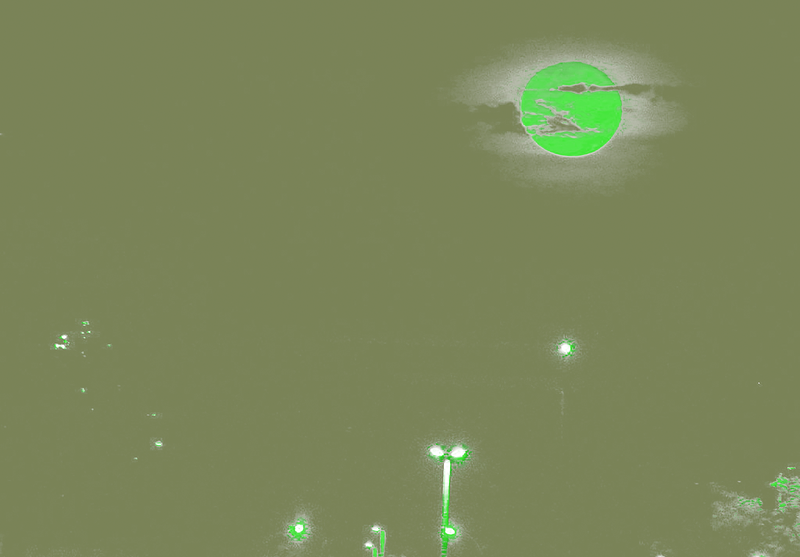
Photo CC-BY-SA by Daniel Pádua: ‘What’s the meaning of this? Look around and reflect.’5
Stories of defeat
A lot has happened during the fifteen years since Daniel scribbled those words. Assange, Snowden and Manning; Cambridge Analytica, hyper-targeting, Brexit and Trump; Me Too; Bolsonaro and the digital militias; Black Lives Matter; COVID; Musk, X, and again (or still) Trump. Crypto bubbles and NFTs. Sleeping Giants. Automated drone warfare. LLMs and transformer bots. Chip espionage. Tariff wars. Ongoing international scheming for rare earths and critical minerals. All that, and a lot more. Meanwhile, crucial reflection about – and engagement around – concrete openness has all but disappeared from public conversations about the present and future of technology. Over those years, we were defeated again and again, and yet decided – again and again – to keep re-telling our stories, so that at least our defeat does not mean anyone’s victory. To keep postponing the end of the world, as Ailton Krenak teaches us to.
Daniel also taught us something: that we can become the fantastic creatures we desire to be. Not the viral content, not the hype of influence, not the high standards of consumption. But a trickster-like situated remix of Clarke’s third law – ‘any sufficiently advanced technology is indistinguishable from magic’. We occasionally call our kind of technology TecnoMagia – if for nothing else at least to cover our tracks, as electric Curupiras with feet pointing backwards. The artifact is just a disguise, for our magic is different: caring for one another, connecting beyond screens and bits, challenging our perspective at all times, and thus changing reality. Indistinguishable, indeed.
For all those reasons, we need to remember the code: the collective seed-bags allowing us to re-tell stories, to renew hope, and to regenerate futures. And this here text is a call to us all: remember to remember the code.
-
(1) As of mid-2025, Daniel Pádua’s entry on the Portuguese-language Wikipedia is classified as spammy or non-neutral. For this reason, the following link may have been removed in the future: https://pt.wikipedia.org/wiki/Daniel_P%C3%A1dua. The internet archive has copies of it. ↩
-
(2) Zumbi dos Palmares was a Brazilian quilombola from the 1600s, leading the resistance of enslaved people against European colonial power. The supposed day of his death and final defeat is celebrated as Black Awareness Day in Brazil. ↩
-
(3) Source: https://www.flickr.com/photos/imaginarios/2089424536/in/photostream ↩
-
(4) Source: https://www.flickr.com/photos/imaginarios/2200708194/in/photostream ↩
-
(5) Source: https://www.flickr.com/photos/imaginarios/2063954035/in/photostream ↩
Broadcasting Resistance
Broadcasting Resistance
An Incomplete Proto-History of Tactical Video
Jordi Viader Guerrero
During the 1990s, 2000s, and up to the early 2010s, the user-generated internet was in many ways regraded as a democratic advancement over the one-way and ‘authoritarian’ regimes of 20th century mass media. The broadcast model of radio and television was framed as a regressive enemy that networked communications would end. The hopes for a self-organized and bottom-up participatory culture were placed on the technological development of networked communications. High on techno-determinism, the 2000s era of techno-optimism saw in networked technologies the kernel for a horizontal political culture of participation or, better yet, cooperation between autonomous agents.
I bring up this well-known narrative for two purposes: First, I want to highlight that the link between alternative media production and current networked technologies, such as machine learning, is not a far-fetched one. Both are techno-political proposals to assemble the online media ecologies of so-called user-generated content. They are both an answer to the question of how to approach our current state of generalized media production. And, in fact, they both take the diagram of the network, although implemented at different levels, as a starting point to produce modes or organizations different from top-down models of information/media production, processing, and distribution. For the alternative and tactical media producers I wish to address, the network appeared to be the evolution to the broadcast model, allowing the masses of passive spectators to ‘broadcast themselves’ even if the receiving audience was itself not massive. A narrative that today strikes almost tragic after networked technologies, from the platformized internet to neural networks, have brought about the further centralization and concentration of power and control into the hands of the few.1
Second, and performing a movement away from techno-determinism and towards the matrix of social relations underlying technological development, I wish to argue that, while networked technologies do present an opportunity to reorganize social relations bottom-up, practices of self-organization existed way before their technological abstraction. Mirroring Matteo Pasquinelli’s recent social history of AI,2 Henry Jenkins argued years earlier that it was not Web 2.0 that allowed people to create self-organized media initiatives. Instead, people were broadcasting themselves way before YouTube showed up:
If YouTube seems to have sprung up overnight, it is because so many groups were ready for something like YouTube; they already had communities of practice that supported the production of DIY media, already evolved video genres and built social networks through which such videos could flow.3
To put it differently, the social network of cooperative relations came before its diagramming. Moreover, Jenkins gives several examples to make the case that the culture the user-generated web profited from had its roots specifically in countercultural and grassroots media initiatives. By pointing this out, he asserts that ‘by reclaiming what happened before YouTube, we may have a basis for judging how well YouTube really is serving the cause of participatory culture’.4 Like Pasquinelli, Jenkins makes the case for social cooperation preceding the technology that captures and abstracts it for future replication, scaling, and, ultimately, profit.
I would like to mention some of the activist and participatory video practices that came before the platformized internet to position them as a vector in the buried matrix of social relations from where machine learning emerges form. I wish to resurface this layer to argue that an alternative to AI, understood as the subsuming eye of the master, can emerge from retelling its history otherwise. This history is not one of inevitable technical developments from powerful corporate and state actors, but a messy and non-linear conjunction of cultural techniques that intersect with those of participatory and tactical media.5 By viewing this history as one of unrealized potentials, I want to frame the low-tech, self-organized initiatives of tactical media (within which I wish to include THE VOID) not only as sharing a genealogy with today’s power concentrating corporate AI, but as alternative sociotechnical assemblages of what an artificial intelligence or better yet, a media ecology, that lets us ‘shape and reassert control over our lives’6 could be.
I will now concentrate on three historical examples that are relevant for THE VOID but are definitely not exhaustive of the wide array of cybernetically-inspired video activism tactics that held media production as a radical act: Paul Ryan’s and Michael Shamberg’s Guerilla Television7 in the context of the cybernetic counterculture of the early 1970s in the US, the urban television initiatives in Italy during the early 2000s, and the squatter-led, community access, local televisions of 1970s and 80s in Amsterdam. These latter two are connected to a larger movement of tactical television (later on renamed tactical media) that coalesced around the Next 5 Minutes Festivals8 starting in 1993.
All of these are examples of video activism that saw in community-led video-making not only the potential of recording and distributing alternative dissident content, but also the possibility of creating new social relations based on cooperation. Video—an assemblage linking cameras, magnetic tape, cable TV infrastructure, and cathode ray TV sets—was regarded as a diagram triggering new self-organized/cybernetic social relations.
Guerrilla Television and the Failures of the Mediatic Battlefield
Michael Shamberg and Paul Ryan were both founders of the countercultural video activist collective, the Raindance Corporation. One of the many groups in New York’s DIY media scene, the Raindance Corporation published a regular journal titled Radical Software.9 The journal effectively documented this scene and theorized about the political possibilities of democratized video-making afforded by the introduction of relatively cheap videotape recorders in the 1970s.10 For the Raindance Corporation, video allowed people to revert the flow of media production enabling them to see themselves and their everyday lives on the TV screen. Video is thus a tool for self-representation, reflexivity, and self-correction. It was a very literal Foucauldian ‘technology of the self’, although not a disciplinary one: the relatively simple gesture of recording oneself was a way to give oneself an image, thus defining one’s own parameters of existence among others. Ryan wrote an algorithm for this experimental video practice of reflexivity:
Taping something new with yourself is a part uncontained.
To replay the tape for yourself is to contain it in your perceptual system.
Taping yourself playing with the replay is to contain both on a new tape.
To replay for oneself tape of self with tape of self is to contain that process in a new dimension…11
Through video, everyone would be able to represent and enact a recursive process of electronic mediation. A process of constant differentiation through which a static unexamined subject became a flow of subjectivating subjects. Paul Ryan gave this process an image, the Klein worm, an organic-looking and almost visceral schema that depicts reversible relations between inside and outside (and are another inspirational example for THE VOID’s diagraming practices). Drawn by artist Claude Ponsot and named after Klein bottles, a non-orientable surface that has no inside nor outside, every Klein worm paradoxically contains itself. Consequently, the relation between contained and container is not a static one but one of constant becoming.
Ryan introduced these diagrams in his text ‘Cybernetic Guerrilla Warfare’, published in 1971 on the third issue of Radical Software. As the title of the article suggests, Ryan, himself a radical video practitioner, was influenced by cybernetic ideas of self-regulating and self-organizing systems. An assistant to Marshall McLuhan, Ryan regarded himself as an activist version of the media guru/theorist. Not only had he wanted to analyze and critique media, but also transform it.12
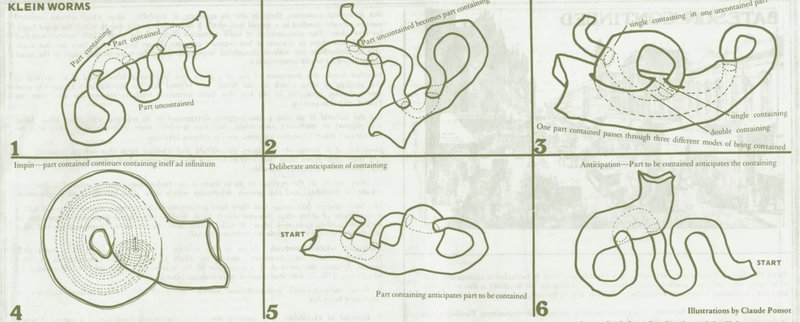
Klein Worms drawn by Claude Ponsot for Paul Ryan’s ‘Cybernetic Guerrilla Warfare’.13
In his article, Ryan presents these worms just after mentioning Warren McCulloch’s (yes, that notorious Cold War engineer, MIT person, and theoretical inventor of the perceptron) problem of emergent orders from multiplicity:
The problem that I’m up against is the problem of organization of many components, each of which is a living thing, each of which in some sense, senses the world, each of which tells others what it has sensed, and somehow a couple million of these cells get themselves organized enough to commit the whole organism.14
For Ryan these worms are an attempt to display abstraction without subsumption. The organization of multiple parts into a whole without reducing them to that totality. This is because the totality is not expressed via a self-perpetuating circle, an infinitely large grid, or a progressively ascending spiral, but an ugly worm. As Brian Holmes puts it:
What one sees, in varying configurations each time, is a whole with emergent parts that split off and are then reintegrated, only to emerge again without ever being fully subsumed. This is quite different from a dialectic that constructs its higher unities through the suppression and sublation of opposites. The underlying notion appears to be that of cooperation without subordination, within a social whole whose differences go on differing.15
For the time being, I would just like to pin that cyberniticians (Cold War proto-AI engineers) as well as countercultural video makers were both invested in the same ideas, not only regarding emergent orders that keep on differing, but also cooperation without subordination, and abstraction without subsumption.
Viewed from the vantage point of the 2020s, these promises of recursivity16 and differentiation seem way too grand for the all-too-mundane selfies, vlogs, Twitch streams, or YouTube video essays. However, this is not the entire picture of the cybernetic hopes of video. In his seminal text Guerrilla Television,17 Michael Shamberg’s and the Raindance Corporation’s views on television were not limited to the electronic improvement of the self. Video feedback loops were only one part of a larger ecological critique of video production’s political economy. For the Raindance Corporation, Guerrilla Television was a tactic to fight ‘the beast’ of the broadcasting system.18
Inspired by Marshall McLuhan and Gregory Bateson’s ecological theories of the mind, the Raindance Corporation understood that each form of media produces an ecology or environment in which humans are in constantly evolving symbiotic relationships with machines. The broadcasting system beast was a specific form of media ecology that ‘has to lust after huge numbers of people per program to stay alive, […] producing a crowd-pleasing mentality and a collective mass consciousness that reduces diversity […] [The beast] has no capacity for feedback, […] its one-way transmitters helping to “condition passivity”’.19
The potential of video didn’t rest on broadcasting the ‘right’ kind of content, but on the possibility for every citizen to produce, distribute, and access their own content through video tapes and cable TV. As media theorist William Merrin explains:
Shamberg’s goal was the creation of a popular movement of ‘community video’: an ‘indigenous production’ without professional mediation, in which local groups shoot, edit, and present their own footage, directly expressing their own concerns. ‘Guerrilla Television is grassroots television […] it works with people, not from up above them’, helping to produce a new network, community consciousness, and an ‘information structure’.20
Merrin’s article ‘Still Fighting the Beast: Guerrilla Television and the Limits of YouTube’, points out that the Raindance Corporation applied the language of cybernetics and computation (feedback, self-organization, and self-processing) to media production in order to articulate a critique of broadcasting and imagine a radically democratic media ecology. I wish to point out once again that this is the same cybernetic jargon that a few decades prior guided the development of the perceptron with the intention to create an alternative model of bottom-up, topological computation. This vocabulary also implied changing the site for tactics of resistance and organizing away from the labor-centric strikes and mass protests to a struggle that plays out in the territory of information and media. A shift that also mirrors the alleged immaterialization of cognition and military strategies in the work of cold war AI engineers like Warren McCulloh and Walter Pitts,21 or communication in general in Claude Shannon’s theory of information.22
Even if it hasn’t lived up to all its promises, especially those regarding the ownership of the means of distribution, Web 2.0’s participatory culture can be linked back to the media ecology Guerrilla Television wanted to achieve. And, making an even greater historical and conceptual leap, to the topological computational paradigm of neural networks. It’s kind of obvious today that participatory culture and neural networks feed into each other: participatory culture produces the cultural conditions and desires to produce content that will later be used to train the network and will be deployed to produce digital environments (algorithmic social media) and content (slop), that will further encourage content production and consumption. The advent of machine learning has successfully leveraged what social media platforms captured, networks of bottom-up localized production, and transformed it into a fundamental part of a privatized, global, production-driven, digital media ecology.
Nevertheless, this cooption is not obvious nor necessary. There is nothing inherent to participatory cultures that calls for data intensive computation and social relations mimicking the factory plant’s conveyor belt, neither is there causal connection between platformization and user-created content. That is, participatory culture enjoys an autonomy towards networked technologies. As the Italian autonomist Marxist movement has noted, while capital needs labor for its reproduction, the inverse doesn’t hold true.23 Analogously, while networked technologies of abstraction de facto act as a mechanism for the reproduction of participatory cultures, the latter can survive and thrive without the former.
If community video and Web 2.0’s participatory cultures haven’t lived up to their cybernetic emancipatory promises, it was precisely because of the high hopes they placed on the cybernetic jargon of abstraction. A blind faith in diagrams and structures rather than the living ecology of practices that activate them. This surreptitiously shifted community media’s goal from ‘fighting the beast’ to producing a totalizing system of cybernetic loops of subjectivation (it is not hard to see how you go from here to infinite scrolling feeds) that relegated the problem of distribution and archiving to a new version of that same beast.24
But this doesn’t mean that the problem lies solely in technologies of abstraction and that we should wholly reject them. It is rather about the social relations we want to vessel through them. What do we want technology for? Designed by whom and addressed to whom?
TeleStreet or Nostalgia for Early 00s Progressive Techno-optimism
In a similar way to the Raindance Corporation and its Guerrilla Television, the Telestreet movement25 in Italy during the early 2000s sought to counter the RAI-Mediaset media monopoly. Starting in the summer of 2002 with Franco Berardi’s Bologna-based OrfeoTV, Telestreet was a network of tactical pirate television stations broadcasting lo-fi videos for few hours a week using a 1000 €, 400-meter-range equipment.

Stills from the 2005 documentary Telestreet: The Italian Media Jacking Movement.26
From today’s platformized present, the early 2000s look like a heated yet bustling period for independent media. IndyMedia,27 an open publishing network of activist journalist collectives that emerged after the police repression of the protests against the 1999 Seattle WTO Ministerial Conference, was quickly expanding into global community. Two years later, in the summer of 2001, media activists and independent journalists from around the world, including those of IndyMedia, put together a media center at the Genoa Social Forum.28
The Genoa Social Forum was a counter summit organized by a network of movements, civil society associations, unions, and political parties to protest capitalist globalization during the G8 summit taking place simultaneously in the Italian port city. It’s not hard to see how this counter summit represented a high point of what networked communications could achieve: civil society and grassroots initiatives now had the means to build global bridges. This time not for commerce and geopolitical strategizing as the leaders of the post-war order had done for decades, but for international solidarity and collective action.
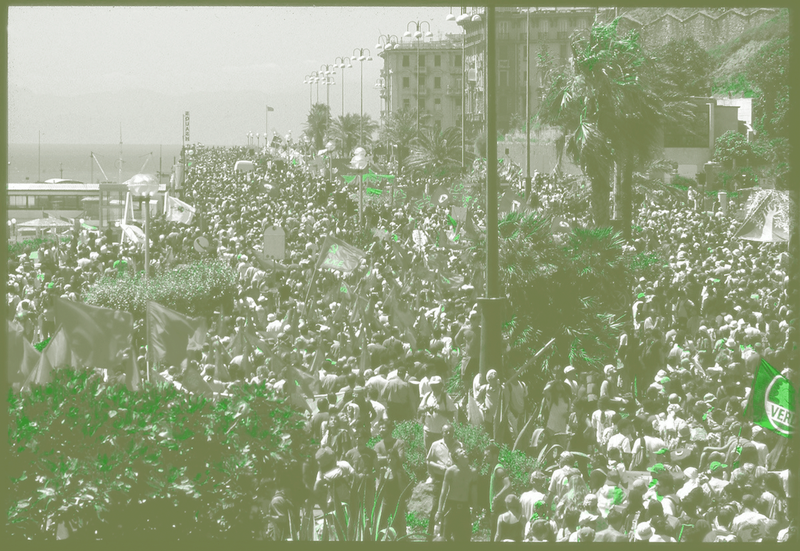
Demonstration of 21 July 2001 on the Corso Italia during the Genoa Social Forum. Michele Ferraris, CC BY-SA 4.0, via Wikimedia Commons.
Nevertheless, these days of gatherings and protest are nowadays notoriously remembered, once again, for the violent police repression of the mass protests of the 20th and 21st of July. And, importantly, for the unjustified police assault to the media center, located in the Pascoli School and the Pertini-Díaz school, where activists and organizers were sleeping.29 These were still the times before cameraphone witness-activism but, as media activists, the victims knew the importance of heavily documenting what happened. The events in Genoa represent an early case of the kind of hybrid political confrontations that are now commonplace: violence against media producers that produce media to counter violence. While cybernetic guerrilla warfare made class struggle immaterial, the assault to the Pertini-Díaz school as well as today’s smartphones standing against police batons, remind us that the struggle for a new media ecology has always had a very real, material ground.
Against this backdrop of agitation and repression, but also optimism about the new ways political action can hybridize with media production, the Telestreet network was born. In an edited volume on media activism from 2002,30 Matteo Pasquinelli writes on the theoretical and political aspirations of this community television movement. Focusing on UrbanTV, another Bologna-based Telestreet initiative he was part of, he distinguishes community television from (American) public-access television initiatives. This meant that TV was not only a tool for the free access information via publicly owned (state owned) channels. TV was not an accessory communication channel for a pre-existing society, but the vessel through which communities and their corresponding subjectivities are produced bottom-up. In contrast to the to the liberal American slogan ‘Information wants to be free’, Pasquinelli brings up the autonomist-favorite notion of the ‘General Intellect’ from Marx’s Fragment on the Machines31 and proclaims that ‘Information wants to be General Intellect’. So he advances that the issue at stake in community TV is reclaiming the autonomy of the technological and symbolic means of social production.32
Reclaiming the means of social production begs for autonomously managed media production, distribution, and archiving infrastructure at a local/urban level. TV’s ability to weave a social fabric is deeply linked to a local context, which was, as the name UrbanTV suggest, urban. A local and community-managed TV network was the means to reopen the apartment buildings in the dormitory city sprawls that TV itself had closed decades ago.33 At its grandest, community TV was advanced as the way to (at last!) build a bottom-up ‘Europe of the cities’.34 A call to action made, ironically, during the historical turning point that consolidated today’s bureaucratic EU of the non-sovereign nations.
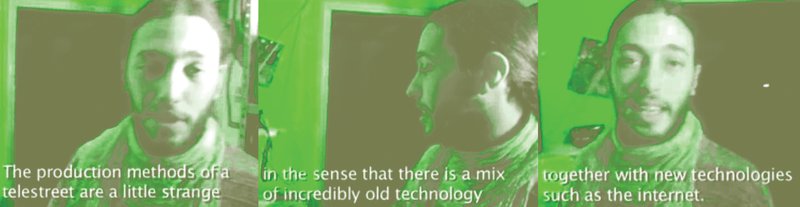
Interview with TeleAut, a TeleStreet station that used to broadcast from a squatted apartment building in Rome to the neighborhood of San Lorenzo. Interview extracted from the 2005 documentary Telestreet: The Italian Media Jacking Movement.35
Paradoxically, this early 2000s version of reterritorialization or the ‘go touch grass’ meme was heavily mediatized by the deterritorializing technology it was fighting against. One might argue that the master’s tools will never dismantle the master’s house, yet I think that this mediatic optimism provides us with an insight that is difficult to shrug at: the Telestreet movement was able to see how TV was full of inactivated potentialities. This is true of any technology or media form; use exceeds design intention.
UrbanTV and Telestreet saw in community television an opportunity not only to reclaim the communications infrastructure that the state, and increasingly the private sector, held a monopoly of, but also an ‘alternative transmission schema, a different collective narrative, new content not as much informational but as motors of desire and community’.36 An insight that Pasquinelli will repeat twenty years later in his social history of AI and that also inspires the main argument of this essay: connecting the untapped potentialities of machine learning with those of tactical and participatory video. It is then not only about technological infrastructure, an affair seemingly reserved to hackers and tech bros, but also about socially and ideologically rearticulating it to produce a new imaginary superstructure. Producing new diagrams at, both, the infra- and the supra- level.
The Ground We Stand On: The Remains of Amsterdam’s Pirate Media Ecology
To close this incomplete and brief, but hopefully politically progressive, proto-history of cybernetic video, I would like to mention the squatter-led community media initiatives in the Amsterdam of the 1970s, 80s, and 90s. Pasquinelli continuously references community television in the Netherlands as an example of what could be done in Italy. Brian Holmes also goes back to this movement when narrating the tactical television scene of the 90’s.37 David Garcia writes that, what started as a pirate radio movement to organize the flourishing Amsterdam squatter movement against evictions in the 70s, eventually transformed into a robust media scene publishing newspapers, zines, and broadcasting television in the 1980s.
Anyone visiting Amsterdam in the 70’s and early 80’s would have found a [sic] that some of the best places in town were the squatted bars and clubs and if they had stayed longer and looked deeper they would have also found a vivid squatter’s media, of news papers, zines, pirate radio stations, and television.38
At the time, the Netherlands was one of the few countries with wide-spread access to cable television, regarded a public good rather than luxury for profit service as in many other countries. The squatter movement polemically and illegally took advantage of this situation to broadcast their own transmissions.
What’s interesting to me here is that the popularity of their programming led to the creation of a legal framework to regulate it, Open Channel, and an authority to oversee it, SALTO. According to Garcia ‘[SALTO’s] statutory obligation is to make the open channel culturally representative. In other words, ensure that the main ethnic and social groups and movements are visible.’39 He then proceeds to make the community-access vs public-access TV distinction that Pasquinelli deems key to untap television’s political potential: ‘It is this approach is that distinguishes community access from public access which is open to anybody and is based on a simple first come first served principal. Public access is the dominant system in the US, the birthplace of open channels on cable’.
SALTO still exists today, and it is now firmly embedded in the traditional media landscape of the city. It provides a valuable service ‘support[ing] programme makers with broadcasting on the radio stations and television channels through affordable broadcasting facilities, technical support and training’.40 In many ways, it is an example of a successful yet somewhat disappointing institutionalization of a bottom-up initiative. I want to underline this movement from grassroots cooperation to regulation and institutionalization—that can be seen as cooption—to historically restate Pasquinelli’s point of the sociomorphism of technology. In this case, technology not only understood as a device or a collection of devices, but an assemblage composed of diverse institutions, social groups, political projects and ideologies, technical artifacts and infrastructures.
The histories of Amsterdam’s squatter TV stations, Italian Telestreet, and American Guerrilla Television, show how these technological assemblages often intersect with highly politicized social movements that, more often than not, are in a conflictual relation with the powers that be, even if they’re later absorbed by them. This portrays a different picture of technological design and development: design tables, academic labs, control rooms, ethical committees or parliamentary hearings are not necessarily at the center of all technological design processes. The relations that get abstracted into diagrams by professional designers extract from specific cultures, minor media ecologies, whose practices tend to have a political motivation.
Reclaiming the Tools of the Master?
This shift in perspective is somewhat of a provocation: the technological world we live in is as much a result of big technological corporations that have monopolized the control over the communities of practice of technological design, as of the politically engaged self-organized initiatives that use technology as instruments against oppression, vessels for community-making, or networks for support and solidarity. My hope is that making explicit the link between these two histories partially saves the latter from being solely regarded as the not-to-be-trusted tools of the master. Current machine learning is undoubtedly embedded in a capitalist mode of production, and it is definitely not neutral nor a-ideological. Yet, it is the product of a multiplicity of not necessarily coherent nor linear historical processes and not the direct result of a monolithic master plan. More than inherent politics or values, the non-neutrality of technological tools means that they have a conflicting, contingent, and messy history.
However, highlighting these alternative histories and untapped potentialities does not imply taking today’s AI ideology at face value. The above provocation is not a wholehearted acceptance of the technologies that came out from the heyday of cybernetics, but a demonstration that they can be something different to what they are today precisely because they have already been something different. For these media activist movements, the key technological advancements were radio, video, television, and the internet, not large language or diffusion models implemented in deep neural networks.
My guess is that this is not only due to these groups using the technologies available at the time, but that this is also an implicit techno-political decision. Media activism requires articulating a technological assemblage in some ways over others. Frank Rosenblatt was already implementing cybernetic ideas of self-organization into hardware almost two decades prior to Guerrilla Television’s publication. Yet, for the Raindance Corporation implementing recursive feedback loops was not about creating a system for trait reduction, categorization, identification, and prediction. It was rather about fighting The Beast and its monopoly over perception to allow for the emergence of a different media ecology. Their concerns were not placed on emulating the human ability for prediction or correctly targeting military projectiles,41but as the UrbanTV manifesto42 underlines years later, on producing different modes of relating to one another.
Participatory video production culture is ever more crucial for predictive machine learning systems. Terabytes of online video are used as training data for energy-intensive solutions to questionable design problems. When framed within the assumptions and expectations of AI, a participatory media ecology turns out to be just a moment subsumed to an assemblage that reinterprets media production as data production and, therefore, defines the producer solely as a user or a motor for the latter. The community-making potential of localized televisions is replaced by the repetitive prompting of globe-spanning infrastructures. This assemblage displaces the tactical non-user/video activist as a node of action and privileges the software-maker/designer/engineer, the corporate stakeholder, and, more recently, the tech ethicist as the ‘humans-in-the-loop’.
So, what is there to save from AI? Not its aspirations of becoming a general-purpose, consumer-facing technology, but its proto-history: the interconnected participatory initiatives it has captured. The task is then about resurfacing these obscured elements to completely rearrange this assemblage into something else. To connect parts differently and produce new diagrams. From an automated master’s eye to a network of cooperating urban televisions.
Writing this in 2024 (and published in 2026), the Amsterdam of the 80s or the Bologna of the 2000s appear as nostalgic memories of a time full of political potential. At THE VOID we’re still too attached to platformized services and institutional contexts to sincerely claim that we are tactically parasitizing on existing infrastructure while resisting capitalist capture. The ‘creative’ culture we live in, either online or localized in Amsterdam, seems too constrained by the institutions and platforms it depends on even when trying to overcome them. The promises of DYI video have long been fulfilled by the user-created internet, so what’s the point of cultivating new participatory and activist media cultures today after their exhaustion? Isn’t everything that’s uploaded to the internet ending up as training data on perpetually heating data centers? What should we do different to avoid cooption?
First, as the UrbanTV manifesto noted, it’s not that much about creating the right type of content. Second, and this is my addition, I believe that this is not a design problem. It’s not about nudging other people somewhere else to do this or that using technology: designing just the right integrated tech solution to get the common citizen into video activism. It is also not about designing the right, fair, or value-driven machine learning model, but about practicing the kind of social relations we want to have in the first place and then, maybe, abstracting them with technology. How do we create a social infrastructure of cooperation rather than that of identification, targeting, prediction, and micro-managing that the platformization of the social web, and now AI, have created? The politics of design processes have still much to learn from the politics of self-organization.
Our diagrams for THE VOID are not necessarily a blueprint to scale-up our operations, but a way of creating our own shared habits over our tools. Paths of action that will enable us to go live once again. But more than trying to provide a fixed workflow, our congealed know-how in a diagram is a reminder of what self-organization is all about: gathering collective forces to make the improbable happen again. That even if the past feels unrepeatable now, it probably also felt unattainable back then.
-
(1) For an acute critique of the network as a decentralized and emancipatory structure for information and society, see Alexander R. Galloway, Protocol: How Control Exists after Decentralization, MIT Press paperback ed., Leonardo, MIT Press, 2006. ↩
-
(2) See Matteo Pasquinelli, The Eye of the Master: A Social History of Artificial Intelligence, Verso, 2023. ↩
-
(3) Henry Jenkins, ‘What Happened Before YouTube’, in YouTube: Online Video and Participatory Culture, by Jean Burgess and Joshua Green, Digital Media and Society Series, Polity, 2009, 110. ↩
-
(4) Jenkins, ‘What Happened Before YouTube’, 125. ↩
-
(5) This argument is heavily inspired by Kevin Driscoll’s alternative history of the internet as social space centering amateur electronic bulletin board systems over the military ARPA Net. Moreover, after writing this piece I came across Michael Goddard’s book Guerrilla Networks, which not only exhaustively delves into the histories of the very same countercultural and minor media ecologies I touch upon more superficially, but also shares this (an)archeological presupposition that any given technological or media assemblage is contingent and not the endpoint of a necessary teleological development. See Kevin Driscoll, The Modem World: A Prehistory of Social Media, London: Yale University Press, 2022; Michael Goddard, Guerrilla Networks: An Anarchaeology of 1970s Radical Media Ecologies, 1st ed., Amsterdam University Press, 2018, https://doi.org/10.5117/9789089648891. ↩
-
(6) Raindance Corporation, ‘Introduction’, Radical Software 1, no. 1, 1970. ↩
-
(7) Michael Shamberg and Raindance Corporation, Guerrilla Television, Holt, Rinehart, and Winston, 1971, https://archive.org/details/guerrillatelevis0000sham/page/n5/mode/2up. ↩
-
(8) ‘Next 5 Minutes :: Festival of Tactical Media’, accessed 22 October 2025, http://www.tacticalmediafiles.net/n5m4/about.jsp_jsessionid=CB33EFD6BD1CEC159F2D91004C23AB1C-jsessionid=CB33EFD6BD1CEC159F2D91004C23AB1C.html. ↩
-
(9) ‘Radical Software’, accessed 23 October 2025, https://www.radicalsoftware.org/e/index.html. ↩
-
(10) For a more detailed exploration of this scene, see Andrew Roach, ‘Guerrilla Television’, Community Media, n.d., accessed October 22, 2025, https://communitymedia.network/a-brief-history-of-diy-tv/guerrilla-television/. ↩
-
(11) Quoted in Brian Holmes, ‘Tactical Television. Movement Media in the Nineties’, Regarding Spectatorship, 2015, https://web.archive.org/web/20240702152258/http://www.regardingspectatorship.net/tactical-television-movement-media-in-the-nineties/. ↩
-
(12) See William Merrin, ‘Still Fighting “the Beast”: Guerrilla Television and the Limits of YouTube’, Cultural Politics 8, no. 1 (2012): 97-119, https://doi.org/10.1215/17432197-1572012; Brian Holmes, ‘Tactical Television. Movement Media in the Nineties’. ↩
-
(13) Paul Ryan, ‘Cybernetic Guerrilla Warfare’, Radical Software 1, no. 3, 1971,https://www.radicalsoftware.org/volume1nr3/pdf/VOLUME1NR3_art01.pdf. ↩
-
(14) Ryan, ‘Cybernetic Guerrilla Warfare’, 1. ↩
-
(15) Holmes, ‘Tactical Television. Movement Media in the Nineties’. ↩
-
(16) It’s interesting to note here that recursivity or recursion, a recurring theme in the history of philosophy from Proclus to Hegel, Yuk Hui, and Douglas Hofstadter, which was later ‘secularized’ by information and communication sciences as the cybernetic feedback loop, is too an algorithmic technique in computer programming (the ability for a program to call itself), and is currently heralded by AGI simps as a first sign of artificial consciousness awakening. ↩
-
(17) Shamberg and Raindance Corporation, Guerrilla Television. ↩
-
(18) Merrin, ‘Still Fighting “the Beast”’. ↩
-
(19) Shamberg and Raindance Corporation, Guerrilla Television; quoted in Merrin, ‘Still Fighting “the Beast”’, 103. ↩
-
(20) Merrin, ‘Still Fighting “the Beast”’, 104. ↩
-
(21) For a detailed intellectual and technical history of how cybernetics shifted ideas of mind and communication to informational paradigms, see Orit Halpern, Beautiful Data: A History of Vision and Reason since 1945, Experimental Futures, Duke University Press, 2014. ↩
-
(22) See Colin Koopman, ‘Information before information theory: The politics of data beyond the perspective of communication’, New Media & Society 21, no. 6 (2019): 1326-43, https://doi.org/10.1177/1461444818820300. ↩
-
(23) Nick Dyer-Witheford, Autonomist Marxism, Treason Press, 2004, 7, https://libcom.org/library/autonomist-marxism-information-society-nick-witheford. ↩
-
(24) Although, in the case of THE VOID, our production techniques are still highly attached to the tools, both hardware and software, of corporate giants. ↩
-
(25) Telestreet - Il network delle Tv di Strada, 21 June 2002, https://www.telestreet.it/. ↩
-
(26) Telestreet: The Italian Media Jacking Movement (directed by And_, produced by Tim Parish, 2005), 7:44, http://archive.org/details/telestreet2. ↩
-
(27) ‘Indymedia.Org’, accessed 23 October 2025, https://indymedia.org/. ↩
-
(28) Francesco Martone, ‘From Genoa to Today’, Transnational Institute, 19 July 2024, https://www.tni.org/en/article/from-genoa-to-today. ↩
-
(29) For a recounting of these events (in Italian or Spanish) see Teresa ‘Ze’ Paoli, ‘Indymedia Italia: Bologna, Genova, Palestina’, in Media Activism: Strategie e Pratiche Della Comunicazione Indipendente, ed. Matteo Pasquinelli (DeriveApprodi, 2002), https://monoskop.org/images/1/19/Pasquinelli_Matteo_cur_Media_Activism_Strategie_e_pratiche_della_comunicazione_indipendente_2002.pdf; Matteo Pasquinelli (ed.), MEDIACTIVISMO: Estrategias y Practicas de La Comunicacion Independiente (DeriveApprodi, 2002), https://monoskop.org/images/5/54/Pasquinelli_Matteo_cur_Mediactivismo_2003_ES.pdf. ↩
-
(30) Matteo Pasquinelli (ed.), Media Activism: Strategie e Pratiche Della Comunicazione Indipendente, DeriveApprodi, 2002, https://monoskop.org/images/1/19/Pasquinelli_Matteo_cur_Media_Activism_Strategie_e_pratiche_della_comunicazione_indipendente_2002.pdf; Pasquinelli (ed.), MEDIACTIVISMO: Estrategias y Practicas de La Comunicacion Independiente, DeriveApprodi, 2002, https://monoskop.org/images/5/54/Pasquinelli_Matteo_cur_Mediactivismo_2003_ES.pdf. ↩
-
(31) Karl Marx, Grundrisse, Penguin Press, 1993. ↩
-
(32) Pasquinelli (ed.), MEDIACTIVISMO: Estrategias y Practicas de La Comunicacion Independiente, 14. ↩
-
(33) Pasquinelli (ed.), MEDIACTIVISMO: Estrategias y Practicas de La Comunicacion Independiente, 143. ↩
-
(34) Pasquinelli (ed.), MEDIACTIVISMO: Estrategias y Practicas de La Comunicacion Independiente, 142. ↩
-
(35) Telestreet: The Italian Media Jacking Movement (directed by And_, produced by Tim Parish, 2005). ↩
-
(36) Pasquinelli (ed.), MEDIACTIVISMO: Estrategias y Practicas de La Comunicacion Independiente, 16. (Translation own.) ↩
-
(37) Brian Holmes, ‘Tactical Television. Movement Media in the Nineties’. ↩
-
(38) David Garcia, ‘A Pirate Utopia for Tactical Television’, Tactical Media Files, 15 September 2012, http://www.tacticalmediafiles.net/articles/3568/A-Pirate-Utopia-for-Tactical-Television. ↩
-
(39) Garcia, ‘A Pirate Utopia for Tactical Television’. ↩
-
(40) ‘SALTO Amsterdam - Over “Open Access”’, SALTO, n.d., accessed 3 September 2025, https://www.salto.nl/over/. (Translation own.) ↩
-
(41) See Peter Galison, ‘The Ontology of the Enemy: Norbert Wiener and the Cybernetic Vision’, Critical Inquiry 21, no. 1 (1994): 228-66; Bernard Dionysius Geoghegan, ‘An Ecology of Operations: Vigilance, Radar, and the Birth of the Computer Screen’, Representations 147, no. 1 (2019): 59-95, https://doi.org/10.1525/rep.2019.147.1.59. ↩
-
(42) Matteo Pasquinelli, ‘Manifesto of Urban Televisions’, Subsol, 17 February 2003, http://subsol.c3.hu/subsol_2/contributors3/pasquinellitext.html. ↩
The polyphonic potential of mutual aid collectives
Sounding solidarity in experimental audio
Matilda Jones
Yellow-vested personnel are turfing out anyone who looks like they might be homeless, using drugs or generally ‘lowering the tone’ on the trains or platforms. I am sitting opposite someone sleeping in a U8 carriage. At U-Bahnhof Boddinstrasse, they are awoken by security and pulled off the train.
Zurück bleiben bitte.
I first encountered Soli Cooking upon moving to the Berlin district of Neukölln in the Spring of 2022. Short for solidarity, ‘Soli’ is a community-based mutual aid group that cooks and distributes hot meals once a week, free of charge, to anyone who wants or needs them at the local train and underground station, S+U-Bahnhof Hermanstrasse. Despite having lived in the city for several years, my arrival in this specific neighborhood was marked by a confrontation with homelessness, addiction, and drug use. This is the context in which Soli operates, although it must be said that many people who accept the food are not necessarily out of work, unhoused or dependent on illicit substances.1 An amorphous mix of over one-hundred people – friends, neighbors, colleagues and comrades – the collective is sustained by the voluntary labor of the un-/underemployed: artists, freelancers, academics and laid-off tech-workers. In March 2024, a few of us got together to record an experimental interview/documentary about the project for my co-hosted show Trouble in Paradise on Cashmere Radio. A blend of different voices, local field recordings, and snippets of self-composed electronic music, this crafted soundwork comprises the intricate assemblages of a pre-record (via production techniques such as montage, stereo-panning, interspersal and overlay), as well as capturing a potent sense of liveness that arises from convivial congregation in urban space.
The necessity of Soli’s work is easily established by situating the mutual aid collective in the broader context of Neukölln. Stigmatized as a dangerous ‘ghetto’ containing ‘no-go areas’, this traditionally multicultural, low-income district is subject to much racist media commentary surrounding issues of drugs, criminality and so-called ‘failed integration’.2 As well as being extremely diverse – up to 28% of inhabitants hold a foreign passport – the borough is one of the most densely populated areas in the whole of Germany.3 In addition to refugees from the Middle East and lately Ukraine, white Germans, Turkish-Germans and Turkish-Turks live alongside immigrants from Eastern Europe and various Western countries.4 I myself am from the UK. It is also worth mentioning that, in addition to a significant Romani community in the north of the borough,5 the area around Sonnenallee has the largest Palestinian population in Europe.6 Although Neukölln is home to a large working class population, over the past ten to fifteen years lower-income demographics have been increasingly priced-out of the more central and desirable Altbauviertel7 toward the southern edges.8 In line with the continuing onslaught of gentrification and rising rents, the district remains subject to both racist stereotyping and stringent policing.9
Beneath the streets chugs the U8 underground line. This southerly section of the line – spanning roughly from U-Bahnhof Moritzplatz (in Kreuzberg) to the terminus at Hermannstrasse – is notorious for its association with poverty, homelessness, and substance use.10 Due to the presence of hard drugs such as heroin and crack cocaine, this stretch of the U8 has been subject to much political scrutiny, with the city’s transport authority Berliner Verkehrsbetriebe (BVG) and Christian Democrat Mayor Kai Wegner announcing a drive to ensure ‘increased safety and cleanliness’ of the stations, with a miraculous 700,000 euros allocated to the project and a promise of support from the police.11 Amidst this fraught social context, Soli Cooking (inherent to its name) enacts and embodies a project of care and solidarity in opposition to gentrification, inequality, social cleansing, and an increasingly hostile police presence. Formed in March 2020 by local chef Sarah Crane amid the outbreak of the COVID-19 pandemic, the collective has since distributed – if approximate spreadsheet figures are to be believed – over five-thousand meals. Since the project began, the need for these meals has only intensified, as living costs have soared and city budgets (including services combatting addiction and homelessness) have been slashed.12
In the soundwork about the project, the grim realities of this urban setting are rendered alongside a more hopeful everyday conviviality. The rumble of tube trains, the roaring traffic and the multilingual chatter are not merely an affected aural backdrop, but essential to capturing the actuality of the scene. As a polyvocal sound collage, foregrounding various peoples’ experiences of participating in the collective, the soundwork captures the process of collective organizing by encompassing a sense of The Intimate, The Virtual and The Public. First broadcast on Cashmere Radio in April 2024, a collectively run community radio station also sustained by the work of volunteers, the piece is indicative of an era bereft of social and cultural funding, yet also testament to the significance of collaborative and creative solidarity in opposition to the brutality of fiscal austerity.
The Intimate
[clatter of mic]
Finn: Um, it’s recording already and you can just see how it sounds with this new…
Sam: Yeah, it sounds good… There’s quite a lot of background…
Finn: Yeah…
Sam: I guess that’s inevitable.
[….]
Sam: Oh my god, you can hear my stomach
[…]
[a different setting is faded in: sounds of a kitchen – extractor fan, chopping food, running water etc]
Sarah: [Laughing]
Finn: Just checking if the levels are… correct
Sarah: Does it go? It works?
Finn: Yeah, it works13
As the soundwork begins, the setting up of the microphone across various locations conjures, both the polyphonic (characterized by multiple voices) and the polychronic (rendering the impression of multiple events occurring at the same time).14 This overlaying of parallel settings not only establishes the audio’s experimentalism (which, despite containing resonances of a traditional interview, presents a frenetic patchwork of noise and voices), but also sounds the social relations between members of the collective in a way that emphasizes physical presence. Conveying the rough-around-the-edges/DIY nature of community radio and grassroots organizing, the shuffle and clatter of the microphone equally summons a sense of anticipation, a behind-the-scenes sonic-glimpse into the moment before the broadcast has officially begun. Calling attention to the medium of recorded audio, adjustments to, for example, the mic’s gain are accompanied by casual chatter and laughter in terms that accentuate an experience that is physical and embodied. In addition to the background noises of the kitchen (running water, the chopping of vegetables and the clatter of pots and pans), participant Sam’s admission that (through the attached headphones) the mic is capturing the faint signal of his rumbling tummy – ‘you can hear my stomach’15 – typifies this sense of physicality to a guttural (also humorous) extent. Thus recalling Stacey Copeland’s discussion of the amplified voice as ‘an intimate aural medium [that] carries with it the possibilities for a deep affective experience’,16 the audio renders the personal, convivial and physical connection between various group members within and across time and space.
This sense of physical presence is important because the sonic mediation of this social connection occurs in a context plagued by ever-rising depression, anxiety, isolation, and loneliness.17 Following Molly Robson’s research on the relationship between podcasting and parasocial studies, it’s clear that listeners turn to audio in order to ‘compensate for a lack of social benefits usually acquired in real-world relationships’.18 From this perspective, the sonic mediation of Soli’s intimate, joyful and embodied social relations is particular to a societal moment in which people are spending increasing amounts of time on social media as a diversion from the stress and distress of life under capitalism.19 Within an immiserated social climate, the sonic representation of collective, convivial intimacy between real people in the physical realm serves an important political function. Especially given the localized context of the Cashmere Radio broadcast – whereby like-minded listeners are most probably tuning in from the same city – this sounding of local communality becomes a mobilizing invocation to join in and participate. Indeed, at the end of the segment, radio listeners were encouraged to reach out and get involved with the project.
This intersection of sound, solidarity and public space summons Brandon LaBelle’s notion of ‘sonic agency’, which is conceived as a means of:
…enabling new conceptualizations of the public sphere and expressions of emancipatory practices - to consider how particular subjects and bodies, individuals and collectivities creatively negotiate systems of domination.20
Emphasizing both the ‘generative’ nature of sound and the extent to which subjectivity is ‘agitated by the listening sense’,21 LaBelle merges this question of political interpellation with the notion of potentiality. Considering how sound reverberates from and through individual subjects and out, into and across the public sphere, his work foregrounds the significance of the sonic to formations of solidarity and the forging of ‘alternative futures’.22 Situating the source of these agentive reverberations of resistance in the ‘acoustics of assembly’ or physical communion, Sonic Agency thus foregrounds the epistemological significance of sounding as a mode that is not only inherently oppositional but also distinctly embodied.23
Yet, given the reality of a time-pressed existence under capitalism, whereby subjection to wage labor diminishes the remaining hours available for leisure, rest, and political activity, this physical, intimate and embodied experience of joyful communion is only one aspect of collective organizing. Aside from LaBelle’s emphasis on the ‘acoustics of assembly’, the collective work of – as he describes – ‘creatively negotiat[ing] systems of domination’ is fundamentally reliant on remote forms of virtual connection. Despite the atomizing effects of social media, it would be foolish to ignore the efficacy of digital platforms as an organizational tool. Probing the sounding of virtual collaboration via Telegram, Google Sheets, and WhatsApp voice notes, a key aspect to my discussion of this soundwork foregrounds Soli’s use of digital communication. While the grim necessity of such digital dependencies is pitted against the value of physical presence (whereby noise of laughter and other non-linguistic forms of vocal utterance harness the desire for connection in a way that subverts neoliberal modes of parasociality), the reading aloud of group-chat messages and spreadsheet quantities is deconstructed as a mediation of collaborative labor that does not resort to capitalist logics of productivity.
The Virtual
Spreadsheet quote: September 18th: thirty-two portions of lentil diavolo, with baked potato and coriander dressing…
Spreadsheet quote: … food for the ride home and had an easier time dispensing it on the ride home than in front of S-Bahn Hermannstrasse. 24th of August: replaced oil, distro cart-wheel fell off and needs a new nut and bolt…
[Laughter]
Sam: Oh dear
Spreadsheet quote: 28th of August: fastest distro ever! Ten minutes everything was gone. Asked why we weren’t there last week. Need to bring more take-away bags next time. Would be great to have serviettes.24
The laughter in the middle of this excerpt – a silly reaction to the missing nut and bolt of the collective’s cart used to transport and distribute the portions – is another example of how such non-linguistic forms of vocal utterance mediate (/harness a desire for) social connection. However, what I want to draw attention to here is the information recited from the columns of Soli’s shared Google spreadsheet. This spreadsheet is the lifeblood of the project, used to log and organize every aspect of the weekly operation: who’s doing what, how much money is owed to whom, which resources are available and so on. I attribute the idea of including it to participant, scholar, and radio maker Sam Dolbear. While recording, Dolbear suggested we read the document aloud. What followed was an incantatory listing of the types of meals, cost of ingredients, and number of portions Soli prepared and distributed throughout the year of 2023:
Spreadsheet quote: March 6th: twenty-two portions of roast vegetables with potato mash, feta and herb blend. March 13th: dahl with rice and roasted potatoes. March 20th: twenty-four portions of potato gratin, veg stew with herbs and feta. April 10th: thirty portions of dahl with rice and a carrot-radish pickle. April 17th: thirty portions of mujadara with beetroot salad, yogurt and coriander sauce.25
Theorizing the concept of ‘the list’ in a co-authored chapter, it turns out that prior to our recording Dolbear had already given much thought to this inventory mode. Acknowledging the banal practicality of the list ‘when decisions have to be made, structure is needed, or instructions must be followed’, his chapter also locates ‘something ritualized, magical, invocative [in] the act of making a list’.26 As well as documenting individual productivity, the sense of repetition engendered by the form of the list synthesizes these weekly tasks into the work of the collective:
Spreadsheet quote: July the 24th: thirty portions of black bean stew with lime-pickled radish, red onions and cucumber, served on… […]
Spreadsheet quote: A few people stopped by from the street to ask what we were doing, would be good to have a donations jar for passers-by. Quiet on distro cause it was the bank holiday.
Spreadsheet quote: August 14th: fifteen portions of root vegetable coconut casserole, rice and pickled cucumber.
Spreadsheet quote: Police had moved people on earlier that afternoon so it was quiet, we walked down Hermannstrasse towards Leinestrasse to find people. Also, a lot of people wanted bags.27
By reading aloud the notes and messages of other participants, the spreadsheet quotes present a narration of collectivized labor – from the sorting of leftovers to concerns about police presence. This articulation of the spreadsheet’s virtual log was thus a useful way of including Soli participants that did not want to be heard on the radio: sounding each other’s words as a collective, this vocalization of the virtual becomes a sonic manifestation of the everyday labor of mutual organizing.
Another aspect to this vocalization of the virtual is the inclusion of instant messaging voice memos from WhatsApp and Telegram. Soli participants who were unavailable for the group recordings were encouraged to send an audio clip of themselves reflecting on their work as part of the collective. Again, this aspect of polychrony – or, the simple fact of not being available at the same time – is testament to the hectic reality of city life amid work and social commitments. Nevertheless, in contrast to the group recordings (in the kitchen for example), this alternative option gave people the freedom to prepare what they wanted to say and record it in their own time:
Corinna: When you live in a big city, you walk around with kind of some walls up. And… part of that is to protect yourself, and part of that is just because you feel awkward and uncomfortable maybe, talking to strangers. Unless there’s a bridge for you to connect with them. And the great thing about handing out food is that that food is a bridge.28
Ben: I think solidarity and charity can look very different. Charity can have this er… dimension of one-sidedness, where someone is clearly the recipient of support and the other is clearly the benefactor. That can be good and I don’t mean to put it down, but… I think solidarity reimagines that relationship a bit. I think it ideally moves to a place more of common action, thinking like: how can we recognize how our struggles might be entangled or overlapping? And, it feels… like it opens up the range of er, possibilities to help one another, and kind of blurs the line of er, this one-dimensional or one-directional model of care that charity might sometimes entail.29
In this patchwork audio interview, the accounts of these participants are heard as part of a tapestry of voices, a chain of reflections that counters other renderings of online realms (such as the frenetic scroll). Although still products of the digital age – inevitably subject to the system Jodie Dean has described as ‘communicative capitalism’ – these voice messages do not succumb to the obsessive immediacy of continuous feedback loops encapsulated by social media news feeds.30 The colloquial ‘er’, ‘like’ and ‘kind of’ express an alternative virtual mode that is reflective rather than reflexive. In this respect, the voice memos render a digital subjectivity that has not yet been ‘captured’ or coopted by the demands of capital.31 While the instant-messaging voice memo (as opposed to the alt-moded answerphone) is generally regarded as a means of communication limited to close, intimate attachments,32 these musings on the Soli collective are not overly individualized or confessional, but explicitly politicized instances of personal reflection on the meaning of collective action. Contrasting with other forms of political organizing that replicate hierarchical cultures of celebrity – by, for example, using social media networks to ‘center charismatic individuals and hide the realities of mass participation’ – the voices of the Soli participants engaged in mutual aid work give audibility to the often unseen and ‘devalued’ aspects of social organizing and reproductive labor.33
Furthermore, although originally submitted as single waveforms of clean acousmatic speech, in the final production the vocal tracks are bedded by field recordings of the streets and tunnels of Neukölln. Heard amidst a rumbling engine or the whirring doors of a departing tube-train, the voices become rooted in a tangible locality. Subsequently, this vocalization of the virtual not only enables the sounding of polyphonic potential, but presents listeners with a sonic on-the-go expression of how the collective functions day-to-day: remote, amorphous, a-synchronous and – although hyper-local in its material attention to the micro-geography of Neukölln, dispersed – with an impact that reverberates out and across Berlin.
The Public
The inclusion of these messages impacted the sonic composition because, compiled alongside the more lo-fi recording of the kitchen – clashing pans, running water and extractor fans – the lone voices were comparably much better sound quality. Mitigating this disparity, I overlaid field recordings of the Neukölln public (captured on streets and tube platforms) with brief musical inserts of recurring synthesizer motifs.
Listening to these swirling arpeggiators, bassy drones and resonant sound effects – grasping at a sonic link toward the city’s wider public – it is tempting to draw a parallel between these synthy motifs and the liberatory spirit of Berlin club culture. Such an impulse, however, obscures the extent to which the city’s techno scene is largely, not only ‘apolitical, anti-ideological [and] hedonistic’,34 but also imbricated in a whitewashed narrative that perpetuates a simultaneous appropriation and disavowal of Afro-diasporic musical traditions.35 Signaling Jean-Hughes Kabuiku’s attention to the Berlin Clubcommission’s ‘complicity in landlordism’,36 it is impossible to ignore the degree to which the coopted and commodified cultures of dance music now function hand in hand with the gentrifying machine rampaging the city. As the weekend rolls around, spectacles of a gritty urban public – the scenes of homelessness, addiction and poverty that line the U8 platforms – become an edgy backdrop for an increasingly elite set of international partygoers.37 Notwithstanding the visibility and acceptance of LGBTQI* people – which should not be downplayed – concessions made to include at least the optics of racial diversity generally disregard local communities of the city’s long-standing immigrant populations.38
Thus refuting any direct affinity with the ceaseless, ever-commercializing thump of Berlin techno, the soundwork’s playful invocation of electronic music rather recalls Rob Young’s discussion of the way in which millennial glitch music ‘reflects the depletion of “natural” rhythms in the city experience’.39 In this reconfigured hearing, the use of glitch sounds are detected amid the murmuring drones and repetitive arpeggiations, gesturing toward a sonic error: the stunted, misdirected connotations of a worn-out techno-utopianism. Void of an anxious kick-drum – mid and treble frequencies sound out toward a lightness that neither erases nor coopts the bassy rumble of passing traffic. Overlaid with participants’ voices and the everyday sounds of urban living, the sense of synchronicity engendered by these overlapping waveforms enables these electronic sounds to thus become integrated into a sonic impression of the city’s wider public.
As outlined above, the sound of Soli’s collaboration is the noisy backdrop of Hermannstrasse: growling autos, multilingual-pedestrian chatter and the subterranean rattle of tube trains punctuate the collective’s work of shopping, cooking, cleaning, and distribution. As the background noise of the city pervades the audio, the microphone’s proximity to the street is embraced. Quoted in the opening excerpt above, participant Sam’s observation that ‘there’s a lot of background [noise]’ becomes an explicit indication of this fact. Countering R. Murray Schafer’s notion of ‘clairaudience’ or ‘clear hearing’ as an exclusivist ideal that ‘admonishes the “unnatural” sounds of the “loud” industrialized world’,40 the exterior noises of the street or train stations sound the process of mutual aid work as collective labor that takes place in so-called ‘low-fi’ urban environments.41 Following Annie Goh’s critique of Schafer’s work,42 it is significant to note that his privileging of the ‘natural soundscape’ above the cacophony of the urban din reinforces the implicit hierarchies of Western dualisms and conjures a distinctly individualized ‘listening subject [who is] normatively white, European and masculine’.43 Without wishing to celebrate the noise or indeed the pollution that emits from up to four lanes of inner-city traffic, my emphasis on the sounding of collectivity nonetheless pinpoints the importance of sounding the urban din as a signifier of broader sociality. Of course, the car is for many reasons an unfitting emblem of such sociality, so – leaving aside discussions surrounding the impact of the A100 Autobahn extension upon Berlin neighborhoods, not to mention the lobbying power of the German motor industry44 – I round off by circling back to the Öffis45; specifically, the contested space of Berlin’s U8.
Particularly during the winter months, much of Soli’s food is distributed inside the underground stations of the U8. Barrier-free (you don’t need a ticket to enter), these platforms are not simply transient spaces for passengers to pass through, but unofficial sites of shelter and congregation for people who are unhoused, experiencing addiction and other forms of exclusion and precarity. It is common to see people winding their way through train carriages, traversing the length of platforms, requesting cash, collecting plastic bottles to deposit, seeking something to eat or drink. However, as noted above, this Neukölln section of the U8 underground line is currently subject to a brutal regime of social cleansing, which in turn directly impacts Soli’s distribution:
Sarah: There were always police or like BVG or cops in the station, and sometimes you get to a station and there’s no one there and obviously it’s just been […] like they’ve just chucked everyone out. But there used to never never never be that at [S+U-Bahnhof] Hermannstrasse. […] And then there were suddenly police patrols like all the time.46
Spreadsheet quote: Police had moved people on earlier that afternoon so it was quiet.47
Spreadsheet quote: The Deutsche Bahn Sicherheit people came by, they said what we’re doing was great, however we shouldn’t allow people to eat in front of the entrance. We can distribute, but the people shouldn’t eat there. Otherwise we can’t do what we’re doing.48
Sarah’s testimony and the subsequent spreadsheet quotes capture a widespread sense (among the collective) that these police clear-outs of people experiencing homelessness and/or addiction on the U8 trains and platforms are, around the time of recording in March 2024, occurring with increasingly regularity (a hunch that fits with the measures announced by the city’s transport authority BVG in February that same year).49 Despite the hint of sympathy from some Deutsche Bahn security guards, there persists a generalized sense that the people Soli is attempting to help exist beyond the realm of public acceptability. Un-ticketed, unhoused, undesirable: neoliberal consensus demands that such people are ‘not part of the public’.50 As noted by Karen Foster and Dale Spencer, adhering to a ‘cultural script of disgust’,51 the abjection of people experiencing addiction and homelessness is predicated on a politically determined existence ‘beyond the scope of the possible, the tolerable, the thinkable’.52
This soundwork does not feature such voices, but rather – perhaps lamentably so – a more privileged array of English-speaking internationals, such as myself. To quote Gayatri Chakravorty Spivak on the unspeaking subaltern, ‘the intellectual is complicit in the persistent constitution of Other as the Self’s shadow’.53 This sentiment also arises in Julia Kristeva’s contention that ‘The abject has only one quality of the object—that of being opposed to I’: in this construction, the Self-Other opposition facilitates the Self’s subjectivation.54 Yet, as this article has attested, where possible this experimental soundwork presents listeners with an attempt to decenter individual voices, sounding instead the Soli participants as members of a collective who believe that solidaristic action in aid of society’s most marginalized constitutes a reckoning with the reality of what it means to occupy the Berlin public. Refusing the ‘cultural script of disgust’, this solidarity recognizes the way in which – despite very real differences stemming from, for example, race and/or class inequities – we are all victims of a system that predisposes us to increasing atomization and precarity. My use of first-person plural here is cautious but deliberate: in making this point, I by no means wish to equate the struggles of those traumatized by poverty, displacement, war, persecution and genocide with the anxious apathy of more upwardly mobile individuals with secure claims to EU residence/citizenship, but rather locate a shared cause in opposition to the alienation, immiseration and injustice that impacts society as a whole (albeit in vastly different ways). In light of the fact that EU and US-American immigrants have been threatened with deportation due to their role in protest movements for the liberation of Gaza, a key internationalist dimension emerges when one considers this move as a deliberate attempt by Berlin authorities to impede solidarity with the city’s Muslim communities (who are routinely subject to deportation threats).55
As cuts to the city’s social and public services only intensify,56 Soli’s unconditional provision of hot food does not target, fetishize or objectify a single community or demographic, but resists a binary between recipients and volunteers in recognition of shared humanity. Furthermore, while the homelessness and addiction that surrounds the underground stations of the U8 provides crucial context for the regime of social cleansing, it is once again important to reiterate that many people who accept Soli’s meals are by no means out of work, unhoused or dependent on illicit substances. In this respect, the tactical potential of experimental audio is relevant to a broader context whereby urban measures of redevelopment, fiscal austerity, gentrification and social cleansing are part of a global phenomenon integral to the functioning of neoliberal capitalism.57 Whether listened to individually or in a communal setting – such as the oft-frequented studio space at Cashmere Radio, which is open to the public three days a week – experimental audio has the capacity to bring its listeners into a productive encounter with their surroundings. Returning to LaBelle’s concept of ‘sonic agency’ and his focus on ‘hearing [as] the basis for an insurrectionary activity’, I conclude by emphasizing the significance of sound as a form of mediation that, in releasing listeners from the screen of their smartphone, ‘works to unsettle and exceed arenas of visibility’.58
In this soundwork, as in the wider Berlin public, the voices of society’s margins are left unheard. Yet, audible throughout the piece is the U8 train. Resounding against the voiceless space of the city’s most marginalized, its locomotion sounds the discomforting reality of collective organizing in the present moment. Subject to grinding measures of fiscal austerity, plagued by scenes of misery and drug dependency, and – on a more abstract level – confined to the same old tracks that do not lead anywhere new: the metropolitan underground train symbolizes a repetitive cycle, an unproductive impasse, a collective lack. At the same time, representative of the reliable, affordable, and functional potential of a public service, this grimy beacon of inner-city transit is also an emblem of progress, sociality and carbon-neutral mobility. As the soundwork ends, the sounding of a broader sociality fades out with glitchy repetitions of automated speech: ‘U8 nach Wittenau, nach Wittenau, nach Wittenau’.59 Resisting the elevation of individual participants, the listener is left with the reverberative malfunctions of a public service. Despite the signaling of a grave error, the soundwork ends by insisting upon the significance of this interruptive potential, refusing to deny the possibility – and indeed the necessity – of collective, reparative, and transformative social change.
-
(1) Matilda Jones and Finn Teesdale, ‘Soli Cooking’, Trouble in Paradise, Cashmere Radio, 7 April 2024, (17:16), https://cashmereradio.com/episode/trouble-in-paradise-7-w-teplice-floral-notes/. ↩
-
(2) Carola Tize and Ria Reis, ‘Chapter 5 “Neukölln Is Where I Live, It’s Not Where I’m From” Children of Migrants Navigating Belonging in a Rapidly Changing Urban Space in Berlin’, in Refugees Welcome?, Berghahn Books, 2019, pp. 121–41. ↩
-
(3) Grete Erckmann, ‘Urban “Problem Neighborhoods” – Problems for Whom? Marginalized Youths’ Lived Experiences and the Right to the City’, Annual Review of Critical Psychology 18 (2024): 839–68. ↩
-
(4) Amt für Statistik Berlin-Brandenburg, ‘Einwohnerregisterstatistik Berlin 31 Dezember 2022’, 2024. ↩
-
(5) Susanne Soederberg, ‘Governing Stigmatised Space: The Case of the “Slums” of Berlin-Neukölln’, New Political Economy 22, no. 5 (2017): 480. ↩
-
(6) Vanessa E Thompson and Pinar Tuzcu, ‘Policing Palestine Solidarity: Moral Urban Panics and Authoritarian Specters in Germany’, Antipode, 2024: 5. ↩
-
(7) This term describes a neighborhood (or ‘quarter’) characterized by old apartment buildings constructed prior to 1949. ↩
-
(8) Erckmann, ‘Urban “Problem Neighborhoods” – Problems for Whom? Marginalized Youths’ Lived Experiences and the Right to the City’: 843; Tize and Reis, ‘Chapter 5 “Neukölln Is Where I Live, It’s Not Where I’m From” Children of Migrants Navigating Belonging in a Rapidly Changing Urban Space in Berlin’: 126. ↩
-
(9) Tize and Reis, ‘Chapter 5 “Neukölln Is Where I Live, It’s Not Where I’m From” Children of Migrants Navigating Belonging in a Rapidly Changing Urban Space in Berlin’, 129. ↩
-
(10) Stefanie Hildebrandt, ‘Berlins berüchtigte Linie U8 – so will die BVG hier aufräumen’, Berliner Kurier, 14 February 2024, sec. Berlin, https://www.berliner-kurier.de/berlin/berlins-beruechtigte-linie-u8-so-will-die-bvg-hier-aufraeumen-li.2187027. ↩
-
(11) Hildebrandt, ‘Berlins berüchtigte Linie U8 – so will die BVG hier aufräumen’. ↩
-
(12) Alice Lambert, ‘Deep Cuts to Hit Neukölln’s Children, the Homeless and Addiction Services’, The Left Berlin (blog), 2 July 2023, https://www.theleftberlin.com/deep-cuts-to-hit-neukolln-childrens-homeless-and-addiction-services/. ↩
-
(13) Jones and Teesdale, ‘Soli Cooking’, (00:18–00:56). ↩
-
(14) This discussion of polyphonic and polychronic listening is a reference to Lisbeth Lipari’s concept of ‘interlistening’ from Lisbeth Lipari, ‘On Interlistening and the Idea of Dialogue’, Theory & Psychology, vol. 24, no. 4, Aug. 2014. ↩
-
(15) Jones and Teesdale, ‘Soli Cooking’, (00:43). ↩
-
(16) Stacey Copeland, ‘A Feminist Materialisation of Amplified Voice: Queering Identity and Affect in The Heart’, Podcasting: New Aural Cultures and Digital Media, edited by Dario Llinares et al., Springer International Publishing, 2018: 211. ↩
-
(17) Marcus Gilroy-Ware, Filling the Void: Emotion, Capitalism and Social Media, London: Repeater, 2017: 76. ↩
-
(18) Molly Robson, ‘Intimacy in Isolation: Podcasting, Affect, and the Pandemic’, Perspectives in Biology and Medicine 64, no. 3 (2021): 396. ↩
-
(19) Gilroy-Ware, Filling the Void: Emotion, Capitalism and Social Media, 106; see also Geert Lovink, Sad by Design: On Platform Nihilism, Digital Barricades, London: Pluto Press 2019. ↩
-
(20) Brandon LaBelle, Sonic Agency: Sound and Emergent Forms of Resistance, MIT Press, 2018: 4. ↩
-
(21) LaBelle, Sonic Agency: Sound and Emergent Forms of Resistance, 1. ↩
-
(22) LaBelle, Sonic Agency: Sound and Emergent Forms of Resistance, 3. ↩
-
(23) LaBelle, Sonic Agency: Sound and Emergent Forms of Resistance, 4. ↩
-
(24) Jones and Teesdale, ‘Soli Cooking’, (23:29–24:10). ↩
-
(25) Jones and Teesdale, ‘Soli Cooking’, (05:18–06:02). ↩
-
(26) Sam Dolbear, Ben Nichols, and Claudia Peppel, ‘On the List’, in The Case for Reduction, Berlin: ICI Berlin Press, 2022: 253, 255. ↩
-
(27) Jones and Teesdale, ‘Soli Cooking’, (21:15–21:57). ↩
-
(28) Jones and Teesdale, ‘Soli Cooking’, (11:48–12:12). ↩
-
(29) Jones and Teesdale, ‘Soli Cooking’, (12:17–13:18). ↩
-
(30) Jodi Dean, Blog Theory: Feedback and Capture in the Circuits of Drive, Cambridge; Malden, MA: Polity Press, 2010: 4. ↩
-
(31) Eva Giraud, ‘Subjectivity 2.0: Digital Technologies, Participatory Media and Communicative Capitalism’, Subjectivity 8, no. 2 (1 July 2015): 141. ↩
-
(32) Jenna Kunze, ‘The Sound of Intimacy’, Container Magazine, 8 March 2022, https://containermagazine.co.uk. ↩
-
(33) Dean Spade, ‘Mutual Aid for Mobilization and Survival’, Social Text, 2020: 136,135. ↩
-
(34) Xan Egger, Neo Seefried, and Mascha Naumann, ‘5 The Fluidification of Resistance: Queer Realities and Narratives in Berlin Club and Rave Culture and a Transformative Practice of the Other’, In Living at Night in Times of Pandemic, transcript Verlag, 2024: 89. ↩
-
(35) Alexander Ghedi Weheliye, Feenin: R&B Music and the Materiality of BlackFem Voices and Technology, Duke University Press, 2023: 124. ↩
-
(36) Jean-Hugues Kabuiku, ‘How Berlin’s Clubcommission’s Actions to Save the Nightlife Are the Opposite of Relief’, Substack newsletter, Jean-Hugues Kabuiku Newsletter (blog), 16 April 2021, https://jeanhugueskabuiku.substack.com/p/how-berlins-clubcommissions-actions?utm_medium=android&triedRedirect=true. ↩
-
(37) Diana Weis, ‘From Berghain to Balenciaga: Aesthetic Code-Switching between Parisian High Fashion and Berlin Underground Techno’, In Living at Night in Times of Pandemic, transcript Verlag, 2024: 74. ↩
-
(38) Weheliye, Feenin: R&B Music and the Materiality of BlackFem Voices and Technology, 129. ↩
-
(39) Quoted in Steve Goodman, ‘Contagious Noise: From Digital Glitches to Audio Viruses’. In The Spam Book: On Viruses, Porn and Other Anomalies from the Dark Side of Digital Culture, edited by Tony Sampson and Jussi Parikka, Cresskill, NJ: Hampton Press, 2009: 128. ↩
-
(40) Annie Goh, ‘Sounding Situated Knowledges: Echo in Archaeoacoustics’, Parallax 23, no. 3 (3 July 2017): 285. ↩
-
(41) R. Murray Schafer, The Soundscape: Our Sonic Environment and the Tuning of the World, Inner Traditions/Bear, 1993: 272. ↩
-
(42) See also Marie Thompson, Beyond Unwanted Sound: Noise, Affect and Aesthetic Moralism, Bloomsbury Publishing USA, 2017. ↩
-
(43) Goh, ‘Sounding Situated Knowledges: Echo in Archaeoacoustics’, 286. ↩
-
(44) ‘Netzwerk gegen die Verlängerung der Stadtautobahn A100 in Berlin » Aktionsbündnis A100 stoppen!’ 2025, 18 January 2025, https://www.a100stoppen.de/.; Tobias Hass and Hendrik Sander, ‘Die Europäische Autolobby’, Rosa Luxemburg Stiftung, 2019. ↩
-
(45) A colloquial abbreviation of ‘public transport’, short for ‘öffentliche Verkehrsmittel’. ↩
-
(46) Jones and Teesdale, ‘Soli Cooking’, (20:42–21:12). ↩
-
(47) Jones and Teesdale, ‘Soli Cooking’, (21:46). ↩
-
(48) Jones and Teesdale, ‘Soli Cooking’, (24:54–25:08). ↩
-
(49) ‘Projekt für mehr Sicherheit und Sauberkeit der Linie U8 gestartet’, Berlin.de Das offizielle Hauptstadtportal, 14 February 2024, https://www.berlin.de/aktuelles/8717994-958090-projekt-fuer-mehr-sicherheit-und-sauberk.html. ↩
-
(50) Karen R. Foster and Dale C. Spencer, ‘6 Abjection and Poverty’, in Reimagining Intervention in Young Lives: Work, Social Assistance, and Marginalization, University of British Columbia Press, 2012: 122, (emphasis in original). ↩
-
(51) Foster and Spencer, ‘6 Abjection and Poverty’, 106. ↩
-
(52) Julia Kristeva, Powers of Horror: An Essay on Abjection, European Perspectives, New York: Columbia University Press, 1982: 1. ↩
-
(53) Gayatri Chakravorty Spivak, ‘Can the Subaltern Speak?’ In Colonial Discourse and Post-Colonial Theory: A Reader, edited by Patrick Williams and Laura Chrisman, London: Routledge, 2015: 75. ↩
-
(54) Kristeva quoted in Sara Ahmed, Strange Encounters: Embodied Others in Post-Coloniality, Transformations, London: Routledge, 2000: 51. ↩
-
(55) Kasia Wlaszczyk, ‘On 21 April, Germany Will Deport Me – an EU Citizen Convicted of No Crime – for Standing with Palestine’, The Guardian, 9 Apr. 2025, Opinion, https://www.theguardian.com/commentisfree/2025/apr/09/germany-deport-me-eu-citizen-no-crime-standing-palestine. ↩
-
(56) Der Tagesspiegel Online, 2025, ‘Neue Sparrunde: Senat plant weitere Einsparungen im Haushalt’, 18 February 2025, https://www.tagesspiegel.de/berlin/neue-sparrunde-senat-plant-weitere-einsparungen-im-haushalt-13228255.htmlhttps://www.tagesspiegel.de/berlin/neue-sparrunde-senat-plant-weitere-einsparungen-im-haushalt-13228255.html. ↩
-
(57) Christoph Lindner and Gerard F. Sandoval, ‘Introduction: Aesthetics of Gentrification’ In Aesthetics of Gentrification, edited by Christoph Lindner and Gerard F. Sandoval, Amsterdam: Amsterdam University Press, 2021: 14. ↩
-
(58) LaBelle, Sonic Agency: Sound and Emergent Forms of Resistance, 5, 2. ↩
-
(59) My adoption of glitchy underground announcements here in the context of my sonic production process should be directly attributed to poet and sound artist Belinda Zhawi – specifically her piece for BBC Sound’s New Creatives ‘South X South East’. As I have discussed elsewhere, as well as using the city’s underground train to establish a sense of geographic emplacement, Zhawi makes use of glitch sounds in the coda of ‘South X South East’ as a means of ‘refusing the teleological progress of a neat resolution’. Matilda Jones, ‘Aural Subject: The Rearticulated Space-Time of Postcolonial Britain in Belinda Zhawi’s “South X South East” (2019)’, Journal for the Study of British Cultures 31, no. 1 (2024); Belinda Zhawi, ‘South x South East’, New Creatives, BBC Sounds, 2019, https://www.bbc.co.uk/programmes/p0801pnp. ↩
Can a TV channel save public access?
The Case of Offener Kanal Europa
Nora Spiekermann and Giacomo Marinsalta
Public Access TV: A participatory model
Television has long played a formative role in shaping public consciousness, reporting news, hosting political debates, and airing entertainment across social and geographic divides. Yet within a capitalist media system, broadcasting has become increasingly commercialized, with a few corporations and institutions controlling what can be seen, said, and remembered. Access to mainstream media remains largely top-down, leaving little room for public or grassroots participation.
Already in the 1960s and 70s, a social answer to this imbalance emerged with what has been ‘perhaps America’s most radical telecommunication policy’: Public Access TV (PA TV).1 As pay-TV networks expanded, the U.S. government mandated that private cable companies provide resources and infrastructure for locally produced programming. Free from commercial or governmental interests, PA TV fosters a decentralized, bottom-up model of media production that empowers citizens to produce their own content on TV. This type of TV stations were established in many cities, and some still function today as meeting points for participants, offering spaces for learning and community-building on public issues, from city politics to the arts, health or religion. They not only offer technical equipment and training, but also allow local people to set topics, craft narratives, and experiment with video making. That’s how PA TV’s open-access embodies participatory media, blurring the line between producers and consumers. In the 1980s the model made its way to Europe, where for example in Germany, it became known as ‘Bürgerfernsehen’ or ‘Offener Kanal’. All in all, these DIY media formats champion free speech, offering a counterpoint in a public sphere drawn by the commodification of media.
Today broadcast TV seems to have lost its cultural importance, in a digitized platform economy, where again access to online communication channels lies in the hands of a few (tech bosses). ‘Cyberspace’, once envisioned as a virtual commons where knowledge and exchange could circulate freely, has gradually been colonized by the same commercial interests, audit systems, and paywalls that had already begun to redefine broadcast media in the United States from the 1960s, as public service ideals gave way to corporate-controlled programming. Our screens are now personalized echo chambers; our participation is profiled, and reduced to metrics.
Against this backdrop of individualized media experiences, can the model of PA TV still offer inspiration?
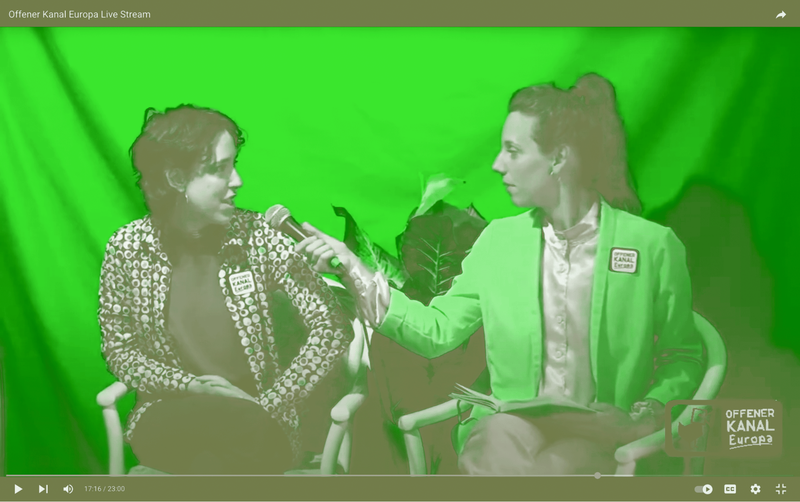
Offener Kanal Europa’s first ever live stream reenacting the model of PA TV (2020). Image Credit: Offener Kanal Europa
From Participation to Isolation: Privatizing Media and Space
While many PA TV stations in the U.S. have been defunded or marginalized since the early 2000s, the principles they foregrounded remain deeply relevant. These channels pushed not only expressive autonomy, but also situated knowledge, with a form of engagement grounded in place, real life relationships, and embodied action. In a time when activism is often reduced to likes, shares, or comments, such media practices remind us that urgent social issues cannot be addressed solely through virtual infrastructures. They demand collective presence, organized effort, and most importantly the reclaiming of space. After all, the atomization of online engagement mirrors a broader erosion of public access: as corporate communication platforms enclose digital discourse, our urban environments, the ground for protest, direct intervention, and commoning, are more and more privatized, monitored, and designed to inhibit spontaneous gathering. This hinders both our right to communicate and our right to the city itself.
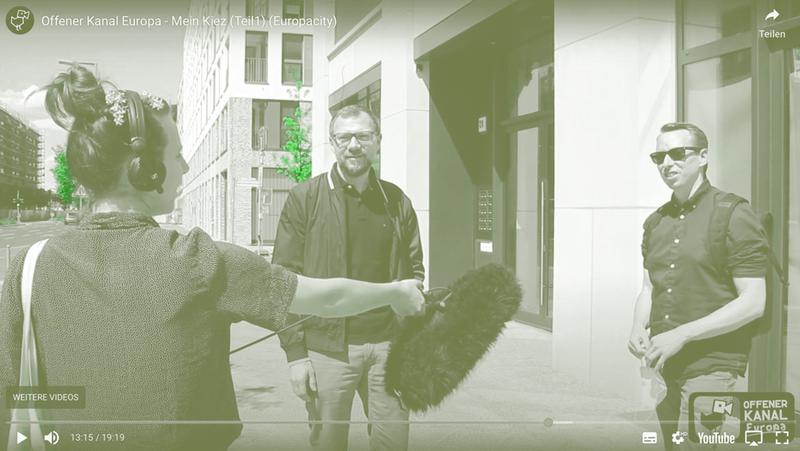
Public access TV street-interview with passersby of Europacity on Heidestraße, Berlin (2020). Image Credit: Offener Kanal Europa
Urban Financialization: Berlin’s Europacity
Over the past decade, Berlin has become one of Europe’s cities most affected by rising rents and housing prices.2 After the fall of the Wall, a cash-strapped local government sold off large portions of public land, allowing private and international investors to shape the city’s development. Public housing is now scarce, and even stable earners often rely on costly, short-term rentals that bypass tenant protections.3 Once a haven for creatives, Berlin’s growing economy has shifted toward service industries and online enterprises. Iconic sites like the East Side Gallery and the Tacheles art squat have given way to corporate buildings, including an Amazon tower looming over Warschauer Straße. Urban design in the capital now favors standardized, modular buildings marketed through sleek visuals that sell the city as an investment opportunity rather than a place to live.
Europacity4, a newly built district beside Berlin’s central station, exemplifies this transformation. Once a railway yard and part of the Wall until 1989, the area was privatized during Deutsche Bahn’s restructuring. The real estate company Vivico (later acquired by C.A. Immo) initiated its redevelopment in the early 2000s, demolishing most existing structures to make space for offices, luxury apartments, coworking spaces, and retail outlets. Corporations like KPMG, SAP, and TotalEnergies now sit alongside high-end residences. The result is a sterile, glass-and-concrete landscape monitored by surveillance and private security, where public infrastructure, such as schools, libraries, or institutions, is absent. This lack of low-barrier, communal spaces severely limits access to social life and chance encounters among neighbors.
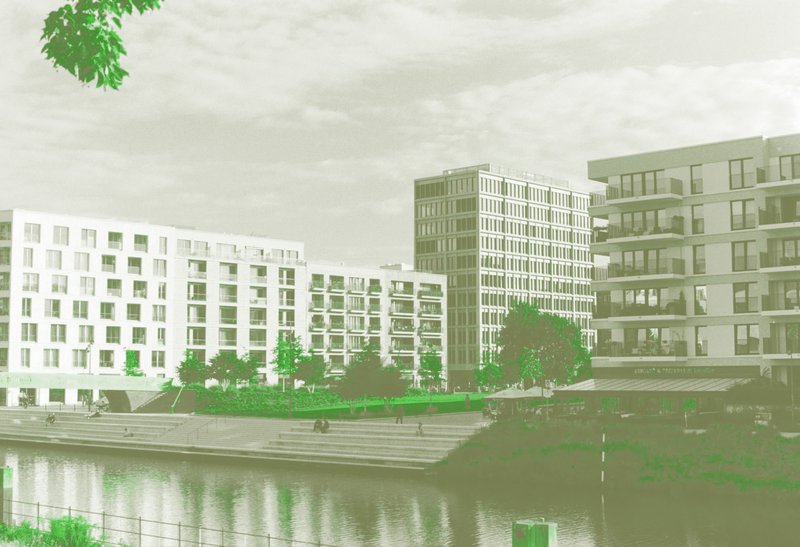
A view of Otto-Weidt Platz, main square of Europacity. Image Credit: Giacomo Marinsalta
Neoliberal privatization processes have not only reshaped economic activity but also social and spatial relations. Much like how corporate media monetize users’ attention and prioritize profit over public interest, public space is increasingly replaced by privately owned or pseudo-public areas, where access is conditional and non-commercial uses are discouraged or banned. In this context, streets, parks, and squares are reduced to legal obligations rather than foundations for communication and human connection. In Europacity, the main street Heidestraße is a passive promenade, while the main square, Otto-Weidt-Platz, offers little beyond unfinished landscaping and retail. The ‘city’ here feels more like a curated product than a lived environment, where civic voices and neighborhood identity are hard to recognize. Without shared, unregulated spaces, ties between long-term and new residents cannot take root. What grows instead is isolation.
Despite its central location, Europacity feels cut off, flanked by railway tracks, a canal, and, back in 2020, a third layer of isolation caused by the pandemic. The social disconnection was palpable, and residents, new or old, struggled to form a community.
What could an artistic response to this look like? The desire emerged to work closely with local inhabitants, while also inviting people from other parts of Berlin to visit a neighborhood many don’t even know exists. Though, how could a dialogue be established, not only among interested individuals, but also a critical one about the area and its public spaces?
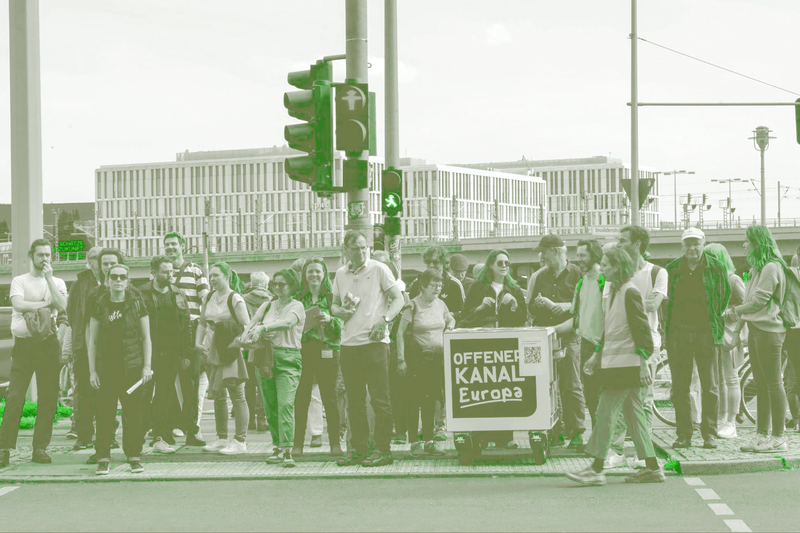
‘Europacity – who are you?’ Walking tour joined by Offener Kanal Europa (2024). Image Credit: K. Froschmann
Broadcasting the Right to the City
It was in this context, during the first summer of COVID-19, that Offener Kanal Europa5 was born. With the world on pause, the idea of a physical meeting point, bridging digital participation with local presence, took shape. When the chance came to rent a small, birdhouse-shaped Imbiss (snack stand) on Heidestraße, artist Nora Spiekermann, who had already worked in the area for several years, invited a group of creatives to transform it into a TV station. Two chairs, a fake plant and a green screen became an interview set. A cozy cabin was an invitation to reflect on isolation. Community dinners were cooked in the former Imbiss kitchen and served in the small garden and on the sidewalk. Talk shows, performance broadcasts, and interventions took place in public space. We came up with several TV formats that were designed to interact and talk to people whom we met in the streets. ‘Sport and Spiel’ for example, engaged with kids and adults, offering a variety of toys to play with and simultaneously chat with each other. Those formats were also documented on a phone camera, edited and uploaded later online. The aesthetics of the channel contrasts to Europacity’s corporate branding, being raw, makeshift and honest. The project blends analog and digital: livestreams on Instagram6 and YouTube7, as well as a growing online archive on the website documents stories that had no place within private real estate brochures, creating a memory repository for a neighborhood which did not yet have one (or anymore?).
Investors have erased nearly all formerly existing built structures in the area. What remains from the previous asset is a couple of old buildings. Former tenants of the area were very interesting to talk to, because they had experienced the immense changes brought by the erection of Europacity. Offener Kanal Europa’s activities create chances to connect these inhabitants with new residents. Being regularly present in Europacity made us meet people over and over again, so helped to build relationships, and learn about local stories and dynamics as well as hidden ownership structures.
In this way we also got in touch with Christian, the last tenant of an apartment building from the late 1890s heated with coal stoves. After the landlord didn’t clean the house and yard anymore, Christian turned into the superintendent. We would meet him often in the street or at the new local supermarket. One day, we were in need of electricity for a radio live stream, and so he invited us to use his backyard, which overlooks a newly built fancy hotel. He reported that he had received a letter, announcing that his house was about to be sold soon. Shortly after that Christian died and his house was finally sold. As the contact with the last resident of the house broke up, information about further developments were hard to get. A spontaneous interview8, once recorded with Christian has become a document of the development of the area and first of all, a testimony of self-initiative and care surrounded by international capital and its unsocial effects.9 Caring for your own building, the yard, the adjacent street is a form of appropriating the city, and going into contact with your surroundings, the neighbors. This is what is missing in the high-prized micro apartments next to Christian’s house, which are highly anonymous.
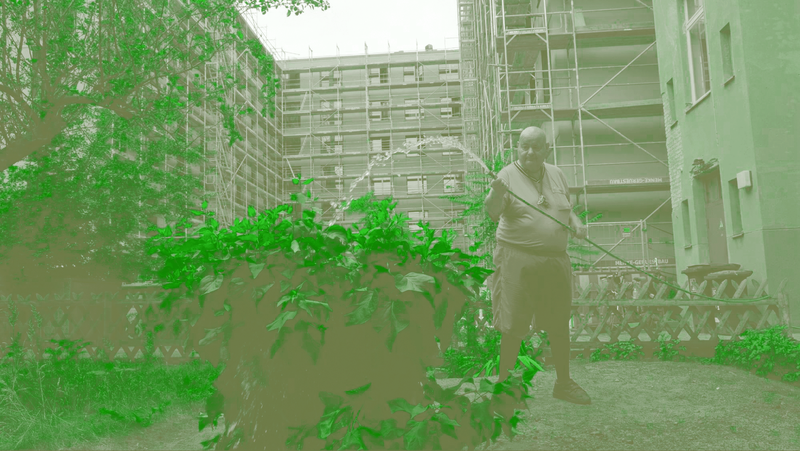
Christian waters the plants of his garden facing the newly built ‘Urban Loft’ Hotel in Europacity (2022). Image Credit: Nora Spiekermann
The initial idea of Offener Kanal Europa was to provide a platform based on physical presence in order to connect local residents, people from the neighboring districts, who did not have a reason to visit the site before, as well as activists and artists dealing with Europacity.
The local environment with its artificiality made it hard to reach and connect with people. After leaving the Imbiss-TV station due to lack of funds and capacity, this task turned out to be almost impossible: without a place as a meeting point, a long term artistic engagement in Europacity cannot work. Since 2020 we have continued with a number of interventions and public events, a big 2 day critical street festival and experimental city tours. This way, we managed to stay connected with the area and some of the local people. To this day, our social media accounts are used to report and communicate infrastructural developments and artistic actions in Europacity.
In 2024, C.A. Immo, the main investor of the area, staked out a video-watched area on Europaplatz opposite to the main railway station, called ‘Europacity Vibes’. Surrounded by raised beds, the site features tables, benches and a stage built out of wood. They wanted it to look homemade and cool and, above all, to simulate a social and artsy ‘vibe’. Throughout the summer, there was a program featuring food trucks, music events, a ‘weekly market’… Following their Instagram documentation, you could see that there was mostly a yawning emptiness and the described ‘neighborhood feeling’ was probably more of a joke. The ‘owner’ of Europacity seems to increase the value of its properties with this promotion and the appearance of a fake community leveraging on a well curated media outlet of the neighborhood that refers to Berlin as a creative hub and bottom up self made city. Social media is used here to create a non-existing picture of the city – one that might soon be from the past. In a public intervention in September 2024 in Europacity, we invited passersby to an interactive and fun self made game, built on a mobile trailer that would thematize the living conditions in the area, as well as their personal experiences in it. For the advertisement of the event, we wanted to answer artistically to ‘Europacity Vibes’, so we came up with new, ironic slogans, creating our own ‘vibe’.
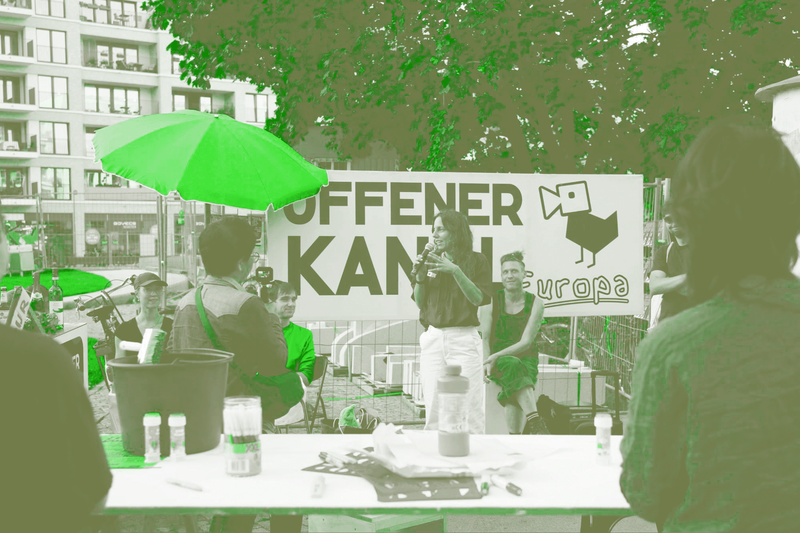
A snapshot of ‘Europacity Volltexten’, a public intervention on the main square Otto-Weidt-Platz (2023). Image Credit: Constanze Flamme
Reclaiming Presence
Can a TV channel reclaim public access? As Offener Kanal Europa shows, PA TV offers many tools that can mediate and connect different groups, activating a dialogue about urban developments that fail socially and democratically. Transforming the concept of PA TV to public space by the means of live interaction, on a media platform and in real life, was probably the most relevant to the whole project. This could involve reviving old media formats with a green screen, improvising a backyard interview, or challenging desert streets with interventions that are surprising and mobile. Site-specific actions are tactical steps to question local issues in public space. Their imperfection and spontaneity are maybe the only correct answer to a dry, polished cityscape. Today’s challenge is to resist privatization in all its dimensions and to invent new forms of interruption. Small collective gestures that question access to public space can act as glitches in the system, fracturing the seamless order of a rendered city shaped by financial interests.
-
(1) Hans Klein, ‘Public Access Television: A Radical Critique’, Telecommunications Policy Research Conference (TPRC), Washington, DC, 29 September 2006. ↩
-
(2) Cities for Rent, ‘How international investments are upending the housing market’, Tagesspiegel, 2 June 2022, https://interaktiv.tagesspiegel.de/lab/berlin-the-rental-market-lab-how-international-investments-are-upending-the-housing-market. ↩
-
(3) Tim White, ‘The strange loophole that transformed Berlin from tenant’s paradise to landlord’s playground’, The Guardian, 22 January 2025, https://www.theguardian.com/commentisfree/2025/jan/22/berlin-housing-crisis-germany-rents-flats. ↩
-
(4) https://www.caimmo.com/de/portfolio/projekt/europacity/ ↩
-
(9) Offener Kanal Europa, ‘Der Letzte Bewohner’, posted 17 June 2020 by Offener Kanal Europa, Youtube, 10 min., 52 sec., https://www.youtube.com/watch?v=1IPAtgk7tl8. ↩
Radio Communities
Radio as Commons Practice
Juan Fortun and Grégoire Rousseau
Introduction
In 1925, the poet and futurist Mayakovsky wrote the poem Radio Agitator ‘To countries where the sun is without shadow, Into a million listeners’ ears words crawl along the antenna!…A worker of America and a worker of Chukhloma will join their voices in a single chorus…Drum out with your million tongues, Radio-Agitator!’ and directly positions radio as the international means of communication to unite workers without any physical limitations, as the invisible electromagnetic waves can travel freely around the globe. Mayakovsky’s poem manifests the dialectical process in which the voice empowers the world as the world produces a new space for the voice.1 One hundred years later, in 2025, the means of communication have multiplied and moved (mostly) from analogue devices to digital services. The emergence of social media transformed how information travels, how people connect, learn, and share everyday life anecdotes but also political ideas, conflicts and situated struggles. The temporality of sharing, or reading a post, may not exceed a couple of seconds, the time to swipe up or down. That is the time we can afford within our late capitalist society, the time granted to us between advertisements. The social media user is both the producer and the product within the privately owned and managed space. Let’s adapt the situationist statement of 1975 ‘The spectators do not find what they desire; they desire what the find’ to our times and propose that most surely the spectator does not find what they desire; they desire what the algorithm offers to them while their private data is crushed, analyzed and extracted for future commercial and political purpose.2 A strategy of resistance against this form of media extractivism stands for the re-appropriation of our time, our tactic is to produce a commons space to take time together.
The text below is an edited transcription of the panel discussion Radio Communities: Radio as Commons Practice, held during the pre-fair programme of MISS READ3 x lumbung Radio4 in Wedding in Berlin and curated by Station of Commons in October 2024. In the conversation, we explore radio labor as a social process that sustains and build community, solidarity, and resistance. We delve into challenges of funding independent radio. We share strategies for sustaining operations through mutual support and resource sharing, highlighting alternative economic models that resist capitalist pressures. Our discussion reflects on how radio practices address social relations within collectives to organize limited resources – time, energy, space, and finances – and proposes approaching radio as a commons.
We examine tensions in using mainstream social media for promotion, as they often conflict with the ethos of independent radio. Some collectives choose to minimize or avoid these platforms, seeking alternative channels that align with their values and preserve community integrity, while others embrace them, recognizing that their commoning efforts are more important than the infrastructures where their messages and hopes travel.
We also explore the deeper significance of radio as a medium for environmental and spiritual healing in regions devastated by extractive capitalism, and radio’s role in archiving and healing. For instance, Anguezomo Nzé Mba Bikoro highlights how historical recordings, once used as tools of oppression by colonial perpetrators, become tools of liberation and healing over time. The background noises and ephemeral aspects of radio capture lived experiences and testimonies of marginalized voices, transforming into powerful narratives for future generations, emphasizing radio’s capacity to preserve collective memory and cultivate intergenerational solidarity.
The crisis of connection that a global pandemic initiated also brought along subversive ways of connecting that value the auditory and the virtual—this was the case for many of the collective radio and sonic projects since 2020, with which many of the participants identify themselves. Now, after years of weaving community through ethereal airwaves, we gather to collectively discuss what whispers of hope we might find among us and think together how to re-activate the agitator role of radio.
The following radio and sound artists participated in this edited transcripted discussion: Sumugan Sivanesan (fugitive Radio), Manuela García Aldana (SAVVYZAAR, part of SAVVY Contemporary Berlin), Pascale Obolo (Afrikadaa), Icnelly (Radio Nopal, Mexico), Markus (Cashmere Radio, Berlin), Juan Fortun, Grégoire Rousseau and Eddie Choo Wen Yi (Station of Commons), Anguezomo Mba Bikoro (Berlin), Alessandra Pomarico (Firefly Frequencies).
To listen to the entire panel discussion:
https://archive.org/details/radio-as-commons-practice
Shaping Inter-local spaces of resistance through radio
Sumugan Sivanesan (fugitive Radio) – 31:54
The internet has evolved from a text-based space to a highly visual one, particularly with the rise of corporate social media platforms like Instagram and TikTok. When I first started working with ‘post-internet’ radio, I met individuals involved in building autonomous FM radio infrastructures—such as antennas, transmitters, servers, and broadcasting boxes. Many of them expressed how much they valued radio’s ephemerality, in contrast to the permanent nature of online content archives. The appeal lies in the fact that when something is broadcasted, it exists only in that moment; if you hear it while it’s live, you experience it, but if you miss it, it’s gone. This ephemerality is particularly attractive in a time when people are preoccupied with documenting every aspect of their lives, archiving their meals, and when their behaviors are tracked, their data mined, and potentially used against them in the future.
Pascale Obolo (Afrikadaa) – 1:03:34
I’m interested in the medium of radio because I believe it offers one of the few spaces that provide freedom for resistance in today’s world. Even though I come from the field of publishing, I feel safer in this medium. I have the impression that working in radio and curating content is currently the best avenue for activism. Unlike writing, where I constantly worry about being censored or losing funding, radio allows me to express myself more freely without those concerns.
Manuela García Aldana (SAVVYZAAR) – 00:06:33
SAVVYZAAR serves as Savvy’s space for experimentation. Through it, we’ve discovered we can connect with different geographies and share various forms of knowledge and resources for struggles we all face—struggles we often think we’re facing in isolation. This aspect has become especially important for us in the aftermath of the pandemic. Now that we have established the radio, we’re beginning to understand all the possibilities this sonic space offers us.
Lynhan Balatbat-Helbock (SAVVYZAAR) – 00:08:41
We held our weekly meetings online and often discussed how painful it was to be disconnected from social gatherings and shared spaces—simply being together, sharing meals. Radio emerged as a convivial format that created the sense of belonging to something collective. When you tune in at a specific time, say 6 p.m. every week, you develop a recurring connection through your radio device. You feel like, ‘I’m part of this’.
A podcast, in contrast, can feel isolating—it sits on a website waiting for you to click on it, creating the feeling that you’re listening alone. Whereas radio is an imagined collective being because it was produced with people you work with. Perhaps that part of the team is listening simultaneously, and that creates a commonly shared experience. It became a beautiful format for connecting to an imagined commons.
Icnelly (Radio Nopal) – 01:26:13
I found Sumu’s perspective very interesting on FM radio, while our discussion is focusing primarily on internet radio. It’s a bit strange because we’re expressing something that seems somewhat outdated. What I understand is that while the internet has its limitations, it also offers internet waves. Despite challenges like censorship, we still have a way to navigate that space and voice our opinions. Audio, as you mentioned, is currently less regulated compared to other media forms. While there are regulations in some places, we can leverage this aspect to our advantage. One unique feature of audio is that it allows for modulation of voice, which isn’t as easily done with images or videos. Furthermore, creating audio content is something that many people can do, although some may not have the knowledge or confidence to participate. This brings to mind what you said about Wedding (Berlin). For instance, Radio Nopal is based in a specific neighborhood in Mexico City, yet we also host programs from diverse locations, including Sweden and other parts of Mexico. It’s interesting because we’re discussing radio as if it’s a traditional medium, but so much of it is already happening online.
Markus (Cashmere Radio) – 01:23:37
It’s interesting to note that Cashmere Radio is now based in Wedding, which has a local focus. However, many of its members don’t actually live in Wedding, making it a bit strange to have a physical headquarters. It might be more effective to have a decentralized approach throughout the city to better reach people. Another aspect I appreciate about radio is its history, as it serves as a prototype for what the internet later became, similar to early bulletin board systems. We can envision radio as a network of different stations that, like the internet, share information across various neighborhoods. Each station could re-broadcast relevant content or choose to discard it and create a new show. This could lead to the development of unique and complex networks that might not align with our modern world.
Learning from radio
Lynhan Balatbat-Helbock (SAVVYZAAR) – 00:04:52
SAVVYZΛΛR was born during the pandemic in 2020. When everything had to close, we found ourselves facing canceled contracts and programs we had envisioned. Our exhibition, planned alongside Merzmusik—a collaboration we regularly have—was also canceled, leaving 15 artists we had been working with for months without a platform to showcase their work. We asked ourselves: How can we think about radio as a social practice and as a means of reparation? It is not simply about postponing the show; it is about acknowledging and compensating artists who have become invisible during this panic and pandemic. We sought to maintain our connections with these artists through sonic commissions, striving to keep the contracts in place and ensure that those involved in our programming were still compensated. This is how SAVVYZΛΛR was born.
Icnelly (Radio Nopal) – 00:10:41
Radio Nopal has always been deeply connected to the community—not only our radio community, but to Mexico City itself. It is a curious dynamic: we are an online radio that people around Mexico and the world listen to, yet we remain intensely local. There is something intriguing about using this global internet platform primarily to discuss hyper-local events, jokes, and cultural references.
For us, community is meaningful, though it is a complex term. At Radio Nopal, we have 60 programs running – from weekly to monthly broadcasts – and we organize ourselves in a sociocratic way. Rather than using hierarchical pillars, we operate in circles: technology circles, community circles, fun circles. You join whichever circles interest you. Some people participate in just one circle or none at all, while others like myself are more involved—I am in five circles… actually nine! [laughs]
The beauty of this system is that you can determine your own level of participation. For example, you might say, ‘I do not know anything about websites, but I want to learn and be part of that conversation’—and that involvement helps you share knowledge. Or you might want to engage with the technology we use, since we have developed a system called Mensajito that allows us to broadcast without a computer. We love physical spaces but are not fond of computers! [laughs] Anyone interested in learning about this technology is welcome to do so.
For us, community takes different forms: in how we organize the radio itself, in how we connect with the local scene. We have even connected internationally, participating in the Venice Architecture Biennale in 2023. At Radio Nopal, the concept of community is constantly evolving.
Throughout our six years, we have engaged with different types of communities. Initially, we were primarily connected to the city’s art scene. Now, we have shifted more toward the music community, with many DJs and producers joining us—we even organize parties now. Our community evolves just as we do, adapting to new circumstances and interests.
Juan Fortun (Station of Commons) – 00:23:31
…This is lumbung radio [pointing at the space]. This space is very temporary, and we have enjoyed this temporal nature. Since the last documenta started, we have been broadcasting from here, although we were already experimenting with various broadcasting methods – both sound and video – before that. Initially, we noticed that many of our peers and friends across Europe lacked space to perform. So, we decided to provide them with a platform, even though we did not have a physical space of our own. Our approach to ‘space’ is not about finding a physical location; instead, we focus on nurturing friendships and maintaining strong bonds. This sense of community allows our commoning actions to flow more smoothly. In a face-to-face, in-real-life context, these relationships help facilitate collaboration in our creative endeavors. That’s our approach in relation to space.
How radio practice sustain community?
Lynhan Balatbat-Helbock (SAVVYZAAR) – 01:17:04
I think it is also very charming that you listen to not only forms of emancipation through democratization of technology, which I think is amazing because not everyone is skilled in publishing practices or writing, but many people have something to say or at least amazing music to share, so everyone can actually contribute to the sonic. I also appreciate formats that are more collaborative and less curated.
Juan Fortun (Station of Commons) – 01:11:57
I know that radio is actually very good at asking the right questions, such as: How do we do something together? Through radio, people exchange ideas about how to collaborate. Through that process, they begin to consider others’ perspectives and develop empathy—which takes significant effort. In our current context, it is just two clicks and you are online, but in other contexts, you need a full transmitter. You must be careful about what you say because authorities might confiscate your equipment—which happened to many radio stations in Mexico and Colombia during difficult times. The value lies in the entire process, not just in radio itself. I am not diminishing radio, but suggesting that the whole process it involves carries much more significance than the medium alone.
Lynhan Balatbat-Helbock (SAVVYZAAR) – 00:21:20 SAVVYZAAR is basically a side leg of an art and cultural space. It is not our main activity to have radio per se, because we also lack the funds to maintain it. We still try—we do not have a radio program for the sake of having the pressure to fill it with content, but we try, when we have the funds, to commission perhaps a sound piece, whether from a sound artist or something experimental. Often we use our programming that is in our space, like the audio of it, to re-stream things. But we do not have radio for the sake of having a radio station. It is just one of the many means around the art space. We also have massive discrepancies, like, ‘Who is putting this up today? What are we doing?’ We do not have one fixed person, there is no one paid for SAVVYZAAR—it is a labor of love. Ultimately, while we are always seeking project funding, we rarely find projects that are exclusively focused on radio.
On rendering the process of commoning
Lynhan Balatbat-Helbock (SAVVYZAAR) – 00:28:20
I think the format of a podcast for archiving information, conversations, interviews is beautiful. However, we also have our internal, almost ‘guerrilla’ method of recording meaningful conversations. Not everything, though is meant to be disseminated and shared with everyone because some information or precious things should be protected. It can be an ultimate act of generosity to share something publicly and invite everyone into the conversation. For example, we have recorded lectures in our archives, all of which are open source. Yet, we also maintain our own type of guerrilla sonic archive.
Lynhan Balatbat-Helbock (SAVVYZAAR) – 01:28:34
I cannot fathom the future because I am trying to survive now – I cannot understand or imagine the future of radio – but something I find beautiful in forms of connectivity through classical radio occurred in the 1970s. There was this composer and musician, José Maceda, who composed a piece called Ugnayan. When you think about the Philippines, it is a very scattered place. We say the Philippines, but it consists of more than 7,000 islands. It is very disconnected. He created this piece that played on New Year’s Eve over 20 radio stations, playing the same piece at the same time. Everyone on these different islands could hear the same piece.
Radio is a very beautiful democratic vessel for restitution. If we think about José Maceda—he recorded sounds and, 15 years later, returned to the villages. As you mentioned, the appropriation of sounds and holding something captive that you do not understand, and possibly also falsifying content—he went back and said: ‘In these songs, your forefathers are recorded, and I want to give this back to you because it actually belongs to you.’ Radio could be a vessel to restitute what belongs to people in terms of what was held captive from them—to disseminate it.
Anguezomo Mba Bikoro (Berlin) – 00:56:15
My experience in radio came through examining archival history. Looking at radio production from as early as the 1920s, we see in the discs made in South Africa and Namibia by colonial perpetrators how those positions of historical narrative have been functioning. The very interesting thing about radio – as Lynn mentioned about the background noises – these elements are what make the radio alive, bring its value, and provide the testimonial evidence we need. In the cylinder disc, you have the background sound of what is occurring: what the perpetrator is doing to the person being recorded, who is subjected to this recording. Often they were forced through beatings, drugs, or alcohol to perform for those cylinder discs.
Importantly, many of these cylinder discs were lost or set aside for many decades. We do not discuss time traveling in terms of radio production, because the point is not how many people you reach, but how the sound waves travel through time and what they will mean to the listener. We do not think about specific descendants. What those people were saying over 100 years ago—descendants like me will understand the meaning. Much of what is spoken is in different languages. They have false translations into German—completely, entirely false. The way victims or survivors described their torture was not through description but through poetry and metaphors. Those poetry and metaphors come from specific cultural settings that only descendants will understand.
These recordings, instead of being used as the predator’s tools of oppression and tools of banking, become tools of liberation and weapons for the descendants years later. Another generation emerged when I was a toddler, using radio as a form of protest and healing. In a very different context, in 1989, my first radio experience was on cassettes. These cassettes were used in the hospital with children to testify about the treatment occurring there. These treatments were rarely documented on paper by the doctors or nurses in the hospital. We were able to catch predators and perpetrators within the hospital. Instead of receiving treatment, extensive abuse was occurring.
As Lynn mentioned, not everything archived needs to be listened to or made public. However, something happens when you hear these recordings as you time travel into the future. For me, this raises important considerations: the meaning of what we record in the present might not make complete sense immediately. Yet it becomes prominent in building forms of liberation, building organization, revolt, and healing, because these are testimonies of what has happened. These background noises that in the present might seem annoying or difficult, or might appear to break professionalism—these are actually the magic behind it. The background, what we call the dissonances, the black noise, will be the key to understanding what history has told us, how we should write or rewrite it, and what positions exist.
This enables understanding that when somebody speaks in a radio context, they might be telling certain truths or might not be able to express themselves in the way they want to.
Listening to the future
Sumugan Sivanesan (fugitive Radio) – 00:31:24
I agree that radio’s lack of visibility contributes to its subversive quality, which is part of what makes it so attractive. This applies to what we’re expressing; most people have the ability to speak. Sometimes, simply holding a microphone and voicing thoughts can be quite cathartic or liberating. Additionally, the concept of fugitive radio highlights the likelihood that no one is listening—it’s not just about the radio broadcast; rather, it’s the act of creating it that helps me connect with communities exploring media, urban space, networks, and social infrastructures in unconventional ways. I find this to be immensely valuable. I remember a time before the internet, and in my experience of creating fugitive radio over the last few years, I’ve noticed that for many people today, the idea of just picking up a microphone and improvising freely is something they have never encountered before. Nowadays, when people create media – and everyone is making media – they often choose platforms like TikTok or Instagram, seeking views and likes. As a result, fewer individuals are inclined to create something spontaneous, which contrasts sharply with my background in early net culture, indie media, and experimental music and arts. I believe it’s significant that the future of radio isn’t necessarily moving forward in an accelerationist manner, but is instead looking back to a different way of engaging with media, allowing us to sidestep what is often presented as inevitable. There is a need to invest in a past potential future that might still be realized, pursuing the liberating promise of the internet before it transformed into a more authoritarian system. We must reinvigorate alternative histories and explore different trajectories.
Manuela García Aldana (SAVVYZAAR) – 01:33:19
I wanted to share some thoughts about the future of radio. In Abya Yala, for example, the future is often perceived as being rooted in the past. The Sankofa bird embodies this concept, looking back to learn and shape the future on the African continent. I believe this is a crucial approach. When we reflect on the history of radio, community emerges as a key aspect. Moments like this, where we gather to listen to one another, foster a sense of belonging. Even if someone listens to this later on, they still become a part of that community. So, as I think about the future of radio, I just wanted to express these reflections.
Alessandra Pomarico (Firefly Frequencies) – 01:39:52
I want to quickly discuss the importance of archives as a means of testimony, a way to transmit knowledge to future generations and evoke the past. This preservation of knowledge is crucial. However, we also need to consider the weight and cost of our data, and energy consumption. In light of climate change and resource scarcity, we need to think about how we can maintain our data practices responsibly. Online radios are fantastic tools that have led to the proliferation of many incredible autonomous and community radio spaces. However, they come with a weight, a cost, and an ecological impact due to the data storage. I realized this when one of the companies we subscribed to for keeping our radio alive began erasing our content. We had to find an alternative solution, and that experience truly showed the significant resources required to maintain the ongoing archives. Radio waves are invisible, and we don’t see the material reality behind them, including the energy required to keep the technology running and store our extensive archives. I have a question regarding what happens during storms or hurricanes when the internet goes down. It might be interesting to explore the interplay between radio and other forms of sharing voices, such as recording, transmitting, transcribing, and translating. These practices of listening and sharing voices may not rely as heavily on technologies that can fail easily, potentially leading to the loss of everything we’ve built.
Anguezomo Mba Bikoro (Berlin) – 01:43:39
I’ve been reflecting on the various projects I’ve undertaken over the years, particularly related to architecture. For instance, take the colonial architecture in Salvador da Bahia. In these buildings, you can hear the echoes of the testimonies from enslaved individuals through the traces left by ants navigating the structures. The vibrations created by these ants actually carry the stories of the past, as they were built by those very same enslaved people. My grandmother, despite being illiterate in the 1950s, possessed a profound understanding of the natural world, especially regarding plants. She believed that everything is interconnected and rooted in the soil. In Bahia, we explored how plants can emit frequencies that hold the memory of events buried within the earth. She would select specific plants from different regions of the forest, drawing from various villages and ethnicities, as many of these tribes no longer exist. These plants served as living testaments, producing unique sound frequencies that resonate with our bodies when we consume them. This approach to archiving is different from traditional methods. For me, it feels akin to a radio system from the 1950s, perhaps even before that. My grandmother didn’t create this knowledge; she learned it from her parents and grandparents. In my own experience, I found a connection between this ancient wisdom and modern technology through cassettes. The relationship I have with these sounds and plants is deeply personal, rooted in my family history. Because I learned it, it was very intimate, it’s in the family. This has led me to consider the concept of technology as a means of data preservation.
It’s very important to be mindful of what we say. Although I hadn’t considered it before, it’s certainly true. As I’ve mentioned, it doesn’t have to be documented; everything exists within us. If I absorb a specific plant frequency from a place that has experienced trauma, my body will react to that. This is especially relevant when working with herbalism and similar practices, as they can have particular effects on the body. This type of knowledge, along with the concepts of resistance and resilience, is something our current technological future doesn’t fully comprehend; it’s not entirely fluent in these ideas. I envision that to truly understand the future, we sometimes need to look back to the past. I believe the future of radio will be ecological. It will exist in the airwaves, in the remnants of the world, and within the soil and plants. In 500 years, we may not have the internet, computers, or other devices, but we will still have plants and ants. They will continue to teach us. Our bodies will evolve in how they function; we won’t just listen with our ears—we’ll listen with our skin, our cells, and everything around us. This concept is what I was trying to convey with my story from the hospital: radio is both ephemeral and infinite. I truly believe that the future will be much more connected to the soil.
Credits
Edited and Transcribed by Juan Fortun & Grégoire Rousseau
Panel discussion moderated by Grégoire Rousseau and recorded by Station of Commons and relayed by SAVVYZAAR and Reboot.fm (88.4 FM in Berlin).
-
(1) Robert Bird, ‘Envoicing History: On the Narrative Poem in Russian Modernism’, Slavic and East European Journal 51, no. 1 (Spring 2007): 53–73. Contains Mayakovsky’s ‘Radio Agitator’ poem in Russian and English translation on p. 65. ↩
-
(2) Guy Debord, ‘Refutation of All Judgments, Pro or Con, Thus Far Rendered on the Film “The Society of the Spectacle”’, 1975, UbuWeb Film, 4:12, https://www.ubu.com/film/debord_refutation.html. ↩
-
(3) MISS READ: The Berlin Art Book Fair & Festival, https://missread.com/. ↩
-
(4) lumbung Radio is an inter-local online community radio initiated for documenta fifteen. For a list of participants radios see https://lumbungradio.org/. ↩
Witnessing Gaza on TikTok LIVE
Sarah Al-Yahya
In November 2024, I joined a TikTok LIVE stream hosted by Adam,1 a young and sarcastic streamer from the Gaza strip who often broadcasts from his tent. I was watching the stream silently until, locking eyes with the camera, Adam stated in Arabic: ‘Some people are hiding in this LIVE! They are not even responding to my greetings or anything I say!’ My eyes traveled to the viewer count, which Adam was pointing at (Fig 1), knowing that the platform feature, TikTok LIVE, allows him to see who each of these viewers are. There were only 11 accounts watching, most of which were active in the comments. ‘He must be talking about me’, I thought to myself, in shame, and double-tapped the screen to ‘like’ the LIVE, a small digital gesture to show Adam that I was still listening to him.
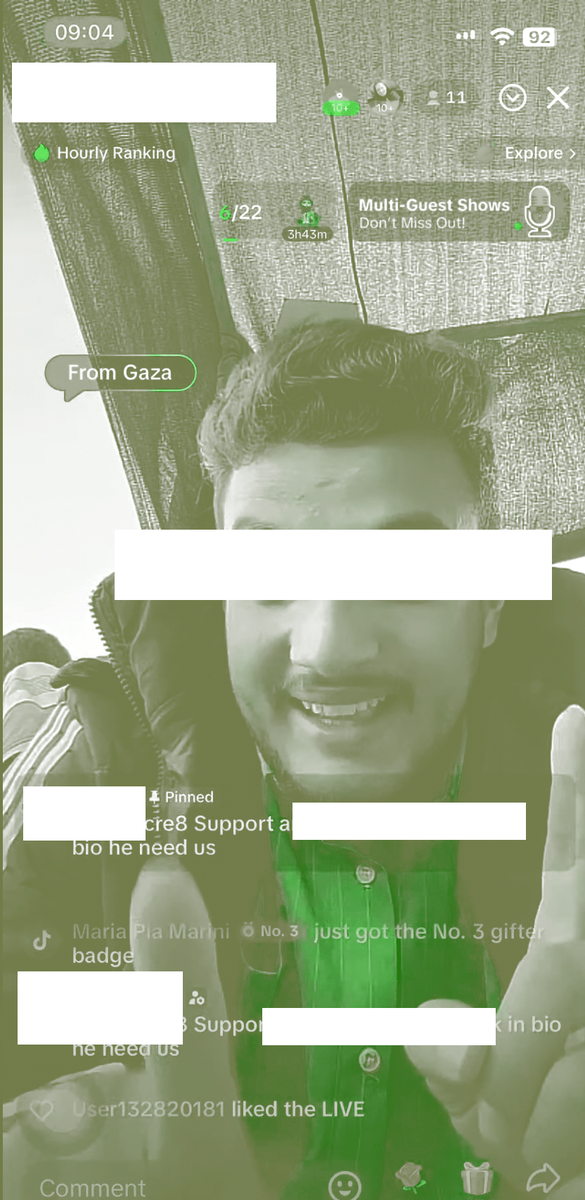
Fig 1: Still from Adam’s stream, where he points at the viewer count on the top right.2
In that moment, the phrase ‘livestreamed genocide’ which for months saturated my feed took on a new life. Livestreamed genocide became more than a descriptor of media saturation, but a dynamic that singularly addressed and implicated me in witnessing. I felt like what I had long owed to those broadcasting from Gaza could be partially satisfied if I stayed a bit longer, remaining visible to Adam.
With TikTok LIVE, it often happens like this. Streams with tens of viewers – sometimes hundreds, never thousands – insisted at my presence. What I witnessed on LIVE did not match the dominant image of livestreamed genocide elsewhere. It was not spectacular and bloody. Of course, it was still violent, but in a different register, one that is slow, mundane, and unstable.
What appears on TikTok LIVE is not only a different mode of livestreamed atrocity, but a testament to the profound mediation of this ongoing and escalating genocide, and the tactical fluency of those broadcasting and receiving it: Gazan streamers working within, and against, a platform built to erase them, and their viewers. These low-viewed, ephemeral streams are not just documentary records or urgent pleas, but tactical interventions.
‘Livestreamed Genocide’ as a Media Paradigm
A few weeks into the war on Gaza, users online began describing the ongoing crisis as a ‘livestreamed genocide’.3 In January 2024, Irish barrister Blinne Ní Ghrálaigh cemented the idea in public discourse as she presented South Africa’s case against Israel before the International Court of Justice (ICJ). She decried the inaction of the ‘international community’ despite the ‘overt […] rhetoric’ of Israeli officials and ‘despite the horror […] being livestreamed from Gaza to our mobile phones, computers, and television screens, the first genocide in history where its victims are broadcasting their own destruction in real time […]’4 Her words place the war on Gaza in a long history of modern crisis mediation, from Vietnam, the ‘first living room war’,5 to the 1991 Gulf war being the first ‘live’ war,6 Ní Ghrálaigh is invoking a similar sentiment that came up in the historical predecessors: How can we see it all and do nothing?
David Rieff, in his book Slaughterhouse, issues a similar indictment of Western governments and the United Nations for watching the genocide of Bosnian Muslims without taking action. He wonders, rhetorically, about the gap between knowledge and action: ‘In reality, no slaughter was more scrupulously and ably covered.’7 ‘Livestreamed genocide’, as a paradigm, carries the assumption that this genocide is made visible through mass exposure, and that witnessing ‘horror-in-real-time’ happens at a large scale. TikTok LIVE complicates this mode. Such streams do not often deliver horror as spectacle, nor do they deliver the clarity associated with ‘genocide in full view’, which has pushed Gazan streamers to develop a particular set of tactical practices. To understand how the terms of witnessing shift on LIVE and how these tactics take shape, we must first examine the infrastructure of TikTok LIVE itself.
LIVE on TikTok
Although TikTok LIVE is structurally embedded in the larger platform, it exists beyond the primary activity the platform is best known for, the ability to create, edit, and share short videos8 on an algorithmic feed. LIVE, is the platform’s broadcasting feature launched in August 2020.9 LIVE videos sometimes appear on users’ home pages as they scroll through short videos, but ultimately, there is a separate feed designated for them, accessed by clicking on the small ‘LIVE’ television-shaped icon in the top corner of the screen (Fig 2).

Fig 2: TikTok LIVE’s television-shaped icon.
The use of the television icon here is curious, implying a deliberate framing that separates the sequence of fragmented clips (TikTok ‘proper’) to an ongoing flow of broadcasts, temporally extended, or even temporally ambiguous. Still, however, the algorithmic ‘For You’ feed, described as the ‘For You Page’ or FYP by TikTok users, remains central to the platform’s live feature too. The centrality of this feature translates into the platform’s design, where the FYP is the first page users encounter upon logging in, as opposed to a feed that prioritizes creators whom users follow, which is what we see on platforms like Facebook and Instagram.10 Similarly, upon entering the LIVE feed, you mostly get a feed of algorithmically recommended streams, further decentering the follower-creator dynamic. This condition underlies much of the practices that Gazan streamers and their viewers take up in the mediation of livestreamed genocide on the platform, such active co-streaming across many accounts.
This pursuit for algorithmically-driven visibility is not just about narrative circulation. It is also tied to TikTok’s internal economy, for which LIVE is the cornerstone. This economy is built on the circulation of a virtual currency, TikTok Coins, that users purchase on the platform. Viewers can then use this currency to send TikTok creators virtual gifts, themed items that often appear animated on the screen (Fig 3).

Fig 3: TikTok LIVE’s gifting panel, where users can recharge their coin balance, and choose gifts to send streamers.
When a creator receives TikTok gifts, their value is translated into a different currency called Diamonds, which creators can cash out into real currency through PayPal. The percentage TikTok receives from this transaction chain is unclear, but it seems to be extremely significant, adding up to between ~50%-70% of the streamer’s earnings.11 In Gaza, these gifts punctuate scenes of rubble and soundscapes of onslaught from the Gaza strip, a visual dissonance that streamers and viewers alike grow accustomed to. In one stream, Kareem explains to his audience how they have nothing to eat or drink in the North of Gaza. Shortly after, a viewer sends him an orange juice gift (Fig 4). It is in these absurdities, which continue to intensify with time, that TikTok LIVE mediates livestreamed genocide.
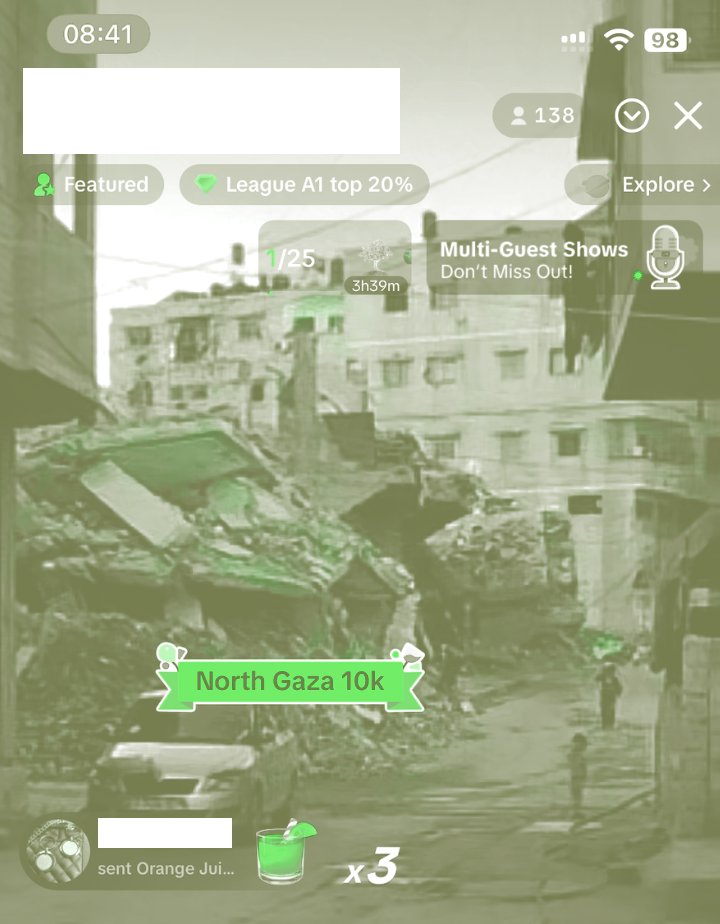
Fig 4: Kareem, broadcasting a scene from North Gaza, receives 3 ‘orange juice’ gifts.
Through TikTok LIVE in Gaza and other corners of LIVE as well, monetization often assumes the language of charity,12 with viewers sending gifts as a demonstration of humanitarian concern. This may seem intrinsic to content streamed live from a crisis zone, but TikTok actively promotes this framing. In a clip shared on LinkedIn, Adam Wang, head of TikTok LIVE, states: ‘I constantly hear stories of LIVE changed my life.’13 This sentiment is echoed in TikTok LIVE’s official partnerships with organizations like the Make-A-Wish Foundation,14 signaling that the platform is not only creating but exploiting this dynamic. In Gaza, these gifts are not mere symbolic support. As Um Naji states in a group stream, where she presents her situation to an audience of 25 viewers: ‘These days we go on TikTok LIVE just so we can have cash in hand and provide vegetables for our kids’.
It is crucial to note here that as time passes, with the enforced material conditions of genocide in Gaza continuously worsening, it becomes significantly harder for streamers to both convert their TikTok Diamonds to physical cash or find the food to spend it on.15 In a LIVE from September 2025, a streamer that goes by Daughter of Gaza is sharing with the stream host: ‘I’ve been promising the kids with some chocolate and sweets since I started joining your streams as a guest streamer, but I swear we really cannot find anything… Nowadays we crave anything, even if rotten’. Furthermore, she continues explaining that LIVE is not the same as it was in the beginning of the war on Gaza, indicating that viewers might be gifting less now.
This format where host streamers, often Palestinians in diaspora, invite a panel of Gazans to speak, became common on Gaza’s TikTok LIVE. The host gives participants the center stage, one by one, to describe their living conditions in a testimonial manner and receive virtual gifts from viewers. In one of the streams, a host, Kifah, addresses one of the Gazan women who is hesitant to share: ‘You are not begging! This is not how we Gazans do it! You are just presenting your situation for the people’. The articulation for dire need for Gazans is carefully managed on TikTok LIVE, framed beyond desperation as dignity and solidarity, an affective mode that streamers and their audiences co-produce in real time.
Group live panels and other gifting strategies in the cycle of monetization are not merely economic tactics. They also function, in part, as live performances carrying affective and political stakes. When deployed in TikTok LIVE streams from Gaza, these performances exhibit a form of liveness that holds one’s attention in a different way. The stakes extend beyond visibility; they lie in the ability of remaining in-range to the crisis in an intimate manner. This invites us to interrogate more deeply what ‘liveness’ means on LIVE.
LIVEness
The paradigm of ‘horror-in-real-time’ and the increasing degree of live mediation in modern crises could invite many viewers to assume that liveness, as a characteristic of content, guarantees legibility. If we assume that viewing something live offers a more immediate image of crisis or more truthful witnessing, then perhaps TikTok LIVE is as clear as it gets. It promises real-time access and co-presence, direct communication with live streamers, and unedited footage – unlike live news coverage, which is annotated with commentary, or pre-recorded and pre-edited social media content such as Instagram or standard TikTok posts.
Yet the liveness of TikTok LIVE does not necessarily guarantee visibility or legibility. Despite its real-time nature, it resists easy documentation and archiving. This is due in part to its ephemeral nature, existing only at the moment of broadcast, often leaving no trace. This fleetingness creates a precarious liveness, one that complicates assumptions about access and witnessing live.
As Philip Auslander argues, liveness is not an ontologically fixed condition, but a historically contingent concept, a variable effect of mediatization.16 What counts as ‘live’ shifts and mutates across various media and contexts. What was once defined by the spatio-temporal co-presence of theater has later expanded to include ‘live broadcasts’ and even televisual content ‘recorded live’, terms that Auslander describes as oxymoronic.17 Liveness, then, is produced through cultural and technological processes, not through the unfolding of a transparent representation of reality.18 It is a self-aware construct that borrows from and mimics specific mediatized forms to be recognized as live by audiences.19 As such, liveness is not a direct image of reality on the ground as it unfolds. It does not necessarily render what is difficult to interpret more legible, or the unseen more visible. Through this, we understand that despite TikTok LIVE’s more immediate real-time nature, it is no exception.
Faced with this precarious visibility, Gazan streamers on TikTok LIVE reach for performative practices that attempt to anchor attention. One of the most striking examples is the use of scripts – brief sentences, repeated rhythmically by streamers to request and sustain engagement. For example, one of the streamers I watched regularly, Abu Ahmed, can often be found on stream repeating a multilingual script, in Malay or Indonesian, English, and Arabic, in a hushed cadence.
Bantu Bantu [id: Help help], follow follow, share share, from Gaza, from Gaza Palestine… no water, no food, sick children, tap tap and share live Gaza ‘al Shamal [ar: North of Gaza]. Hasbiya Allah wani’m Al Wakeel [ar: Allah is sufficient for me, and He is the best disposer of affairs.]
He sits amid the rubble in the North of Gaza, streaming on TikTok LIVE for hours, repeating the same script over and over. The hum of drones accompanies his quiet speech, along with the distant boom of airstrikes and the high-pitched cracks of gunfire. Between the mundanity of the foreground and the destruction lurking in the background, his broadcasts testify to a ‘livestreamed genocide’ in a different register. The script, a staple of polished and narrativized televisual war coverage, is reshaped on TikTok LIVE. LIVE streamers globally rely on repetitive, robotic scripts to solicit gifts, in a manner often likened to video game non-playable characters, NPCs.20 Viewers grow curiously attuned to moments of rupture, when the streamer goes off script. In Gaza, these moments carry heightened stakes, such as urgent violence or escalation targeting a streamer only few are watching. The script thus becomes a minimal signal of presence prompting viewers to remain ‘in range’. They watch Abu Ahmed for hours, not for his scripted performance, but should he need to go off it.
Nick Couldry’s insights on liveness can help us understand this dynamic. He argues that liveness is a socially constructed category, and that the experience of liveness is less about what is transmitted than about the event of transmission itself. This does not mean there is no connection between liveness and real-world events, but rather that it is indirect. The live broadcast offers a potential link between shared realities, an ability to remain ‘in range’. Couldry cites an example from Joshua Meyrowitz who contrasts listening to a cassette with listening to the radio, arguing that the liveness experienced through the radio is that of remaining connected to the possibility that something unexpected might break in, that there will be ‘news’ about the world which interrupt the broadcast.21
Let’s return to Abu Ahmed. Most of his streams, as I mentioned, are dominated by a repetitive script and a still frame, often of himself, but sometimes of the surrounding environment (Fig 5).
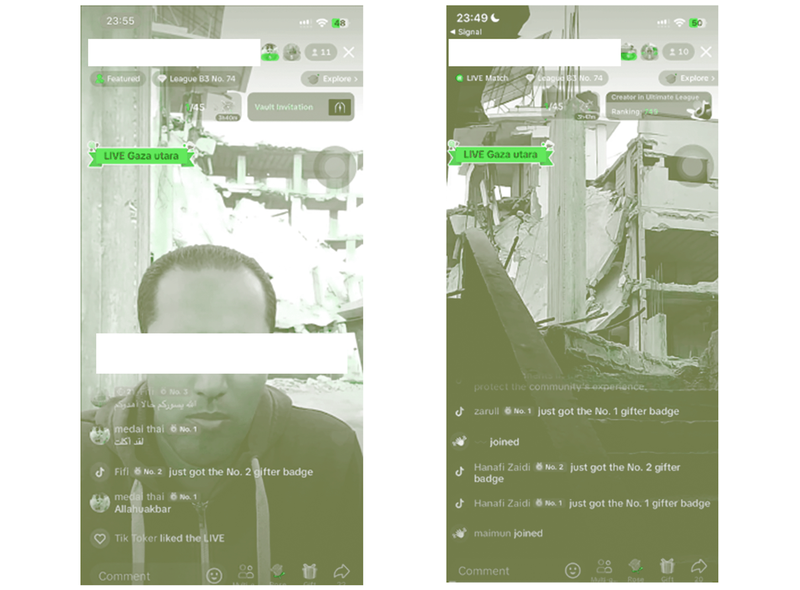
Fig 5: Stills from Abu Ahmed’s livestreams. (Left: Front-facing frame of Abu Ahmed, his commonly used one. Right: Outwardly framed still of Abu Ahmed’s surrounding environment).
In the everyday performance on his TikTok LIVE stream, Abu Ahmed is producing an image unfamiliar to audiences. It is a repetitive, almost static image that lasts for a long time, quite unlike the common landscapes seen in mediated content from Gaza, or even war zones in general. If you were to watch the war on Gaza live elsewhere, you would be faced with content of a different pacing and affect. His script here maintains Gazan presence without spectacle. The image is ephemeral by nature of TikTok LIVE, but once you are on the stream, the image of Abu Ahmed is stable, just him, facing the screen, framed by rubble. As the hours pass, audiences hear everything in the background and discuss frantically in the chat what the sounds may be – creating a visceral sense of connection, an anxious anticipation that holds them accountable and keeps them watching, as if they are waiting or fearing that at any moment the content of this mundane stream might be interrupted by the more ‘predictable’ tragedies of genocide in real-time. As we wait, we might recognize that this perceived mundanity, this deliberate scripted repetition, is also ‘livestreamed genocide’.
This mode of ‘in-range’ liveness complicates conventional media logic. Nick Couldry suggests that liveness frequently functions as a ritual that legitimizes what he calls the ‘myth of the mediated center’, that is ‘the belief, or assumption, that there is a center to the social world, and that […] the media speaks “for” that center’.22 This is the implicit power of traditional liveness, the fact that watching something live feels like being connected straight to that center, alongside others watching too.23 But TikTok LIVE operates outside the bounds of this mythical mediated center. It is often actively excluded from it. The image is fragile, its visibility precarious, often ignored by institutional media. Streams like Abu Ahmed’s are not legitimized by proximity to a media center, nor by connection to an official platform or a shared ritual of live viewing. Instead, their weight lies in this distance from the mythical center. His stream holds viewers not through spectacle, or institutional power, but because they deviate from both.
The ephemerality and precarity of TikTok LIVE are central to the affective force generated by the streamers. Content on the platform feature is not archived, and, so far, is rarely incorporated as part of the broader mediated narrative of this crisis. This fragility recalls Peggy Phelan’s foundational argument about the ontology of performance. The ephemerality of the live performance, argues Phelan, in contrast to Auslander, is what makes it real. 24 Phelan sees this absence from circulation, this inherent distance from the so-called ‘media centre’, as its most radical potential: ‘Performance’s only life is in the present’, she writes.25
On TikTok LIVE, the stream’s ephemerality – sometimes intensified by censorship and structural silencing – can be transformative for the viewer. For audiences, the horror of the content from Gaza, mediated through mundane scripts and nearly static images with low viewership, reinforces the persistence of the crisis, instead of dulling it. The disappearance of the live image does not necessitate the disappearance of horror. In fact, it provokes deeper concern, one that I have faced recently, when I failed to find the profile of a streamer I often checked on. In this way, ephemerality reinforces the moral imperative of remaining in range and watching LIVE.
Scripts, for Gazan streamers, offer a way to stabilize presence within the otherwise unstable visuality and temporality of LIVE. Once viewers are drawn in by these scripts, the streamers take to other tactics which more explicitly address their viewers, such as the usage of VPNs to reach particular geographic regions. An example of this emerged in a co-stream between Abu Ahmed and another streamer, Ameer, in December 2024. With only 5 viewers when I joined, I noticed that the conversation was less scripted than usual. Rather than sticking to a rehearsed routine, the streamers engaged in a more organic and personal conversation, occasionally giving instructions to their audience with a simple ‘tap and share!’.
At one point, Abu Ahmed discussed switching to a paid VPN to connect to Indonesia, explaining that he had more success streaming to audiences there, as they were more generous with donations. Ameer, on the other hand, struggled with a free VPN that did not achieve that desired outcome. This clarified a previous point of confusion for me about Abu Ahmed’s script which, as demonstrated earlier, infuses terms from Indonesian such as ‘Bantu’ (translating to ‘help’), and ‘Terima Kasih’ (translating to ‘Thank you’) signaling how he has adapted to welcome his new audience.
The conversation between Abu Ahmed and Ameer sheds light on the trial-and-error nature of their streaming practice, where even the mundane and repetitive elements of their broadcasts are shaped by a cycle of experimentation and active decision-making about self-representation. Live and publicly on the platform, they share tactics and methods to become better streamers and master the craft. In doing so, they make the practice more lucrative and their engagement more meaningful. Indeed, these tactics appear to be working. Abu Ahmed now draws a loyal viewer-base from Indonesia and Malaysia as a result of his script. Sometimes, they join as guest streamers and translate his Arabic words to expand viewership for him in their country.
The call to remain in-range, this in-range liveness, is shaped and sustained by the streamers’ devised tactics. Additionally, it is also reinforced by the algorithmic logic of the platform which, I have observed, further imposes a responsibility on the viewer. On LIVE, which is already marginalized within the app’s interface, the algorithm’s role expands beyond content discovery to audience positioning. Viewers, addressed by the script, might wonder, what does it mean that I received this image on my feed, when evidently so few others have?
Algorithmic Flow
TikTok and its live feature, LIVE, embeds the logic of algorithmic flow into the paradigm of vertical scrolling. Each unit of content feels intimately connected to the one before and says something about the agent, or user, scrolling through. Arvind Narayanan attributes the success of the platform to this vertical scroll, which he calls the ‘secret sauce’.26 He argues that TikTok’s secret is not really the algorithm, but all the ways it is embedded and presented. The centralization of the algorithmic feed as an apparently omniscient machine that knows the users ‘more than they know themselves’ produces powerful effects on LIVE as well.
Beyond shifting the viewing experience from a public sphere to an individual feed, the algorithmically governed selection of content you see creates an implied affective proximity. What appears on one’s screen is understood, whether consciously or not, as a reflection of the self. To scroll away from it is to reject the idea that the content speaks to you; to linger with it is to confirm that the content you are receiving says something about who you are. This implication, alongside streamer practices and small viewer counts, pushes these viewers to also be more active on the stream, devising their own tactics, and breaking out from their passive roles. This is the backdrop for my own experience stumbling upon LIVEs from Gaza. I approached this material with the knowledge that years of my data, harvested and extracted by TikTok, has created an image of me that, somehow, is delivered livestreams with fewer than 20 viewers of Gazans sitting amidst their destroyed homes. It feels like a responsibility. The intimacy of the content, often with just a handful of viewers, made it feel as though I ended up on these streams because I had to do something about it. I needed to stay, to witness, and maybe to record or write about it. Moments such as my interaction with Adam that I led this piece with cemented this responsibility.
This dynamic is not unique to me. I have observed how other viewers are motivated to take on roles in the livestream, such as moderating the comment section, or even joining the stream as silent co-streamers for reach or helping facilitate the conversation. In another stream, led by a Palestinian outside of Gaza – who hosts Gazan streamers to increase their visibility, among other things – we can observe a similar interaction. The host streamer, Hana, invites Fadil, a Gazan journalist and photographer to address the audience. He shares a heartfelt message with his camera on, thanking everyone who has supported the people of Gaza and Palestine, and suggesting ways people can help. He is interrupted by another guest streamer, an Iraqi. ‘My dear brother, my dear brother, I am interrupting. I know the Iraqi resistance is trying to support, but this is not enough…our hearts are wrung with pain for you.’ Fadil tries to continue, but the guest interrupts again: ‘Habibi, my eyes, I’m interrupting you again, but you are not indebted to us. We are indebted to you.’ Viewers in the chat are instructing this guest to stop interrupting Fadil, but he keeps breaking into the conversation, as if he has been waiting for this moment, to finally address a Gazan directly, so he can share all of the guilt, gratitude, and worry that he holds.
These dynamics become even more complex in streams that cross linguistic boundaries, like those of Abu Ahmed. In another stream on Abu Ahmed’s account, during the temporary first stage of the ceasefire deal in January 2025, the chain of communication becomes even more intricate. Abu Ahmed was joined by a guest named Hind, who asked him questions in Arabic, and relayed the answers to another French-speaking guest streamer. She asks: ‘They say the drone is buzzing 12 hours a day, is it true?’ Abu Ahmed promptly responds: ‘It leaves 8 hours a day, or maybe less.’ Hind responds: ‘Mmm..’ and immediately calls on the other guest, ‘Kim!’ and translates for her. Shortly, Kim responds: ‘Bzzzz, bzzz… désolé (fr: I’m sorry)… I am so sorry, I am so sorry, Abu Ahmed’. These entangled transnational exchanges reflect a form of witnessing in which viewers feel called to engage actively, moving beyond passive consumption.
While this arises from multiple elements (platform affordances, in-range liveness, and so on), I suggest that it is also the underlying structure of personalized algorithmic flow, the sense that one was meant to see something, that plays a central role in turning viewers into active participants with tactical sensibility. Additionally, TikTok’s creator tools – such as the ability to join a stream, moderate the comment section, and on-screen prompts – being embedded in the medium of viewing, as well as the diminished presence of traditional influencer dynamics give the burdened, implicated, and eager witness more room to engage. On TikTok LIVE, where streamers devise modes to remain present on the platform, the viewing experience shifts from ‘I am helplessly watching livestreamed genocide on my phone’, to ‘Livestreamed genocide found its way to me because maybe I can do something about it.’
Dream and Imagination as Tactics
While carving out a nook of agency on TikTok LIVE under algorithmic pressure is itself a tactical feat for the streamers and their viewers, their engagements move beyond the survival of the image toward radical imaginative practices. In these streams, what begins as documentation or witnessing, shifts into collaborative storytelling and narrative work.
During a TikTok LIVE session in January 2025, a Palestinian streamer based outside Gaza managed an intimate streaming space with eight guest co-streamers from Gaza, and 14 other viewers. Structured like a radio show, the session blended music, testimonies, conversation, and collective reflection. At one point, he played a nostalgic song lamenting the loss of the past, and then addressed his co-streamers from Gaza, imagining aloud: ‘The war will end, and the people will walk down the streets again.’ When a commenter addressed him, saying, ‘Prepare yourself to go to Gaza.’ He replied emotionally: ‘God willing! Who told you I didn’t want to go to Gaza anyway?’ before continuing, ‘The rubble will be cleaned up, and there will be vendor stalls again on Omar Al Mukhtar Street.’
Such moments of imaginative participation present a brief respite in livestreamed genocide, one that is not captured or indicated by metrics or visibility. As Sulafa Zidani argues, drawing on Jenkins et al., civic imagination, ‘the capacity to imagine alternatives to current cultural, social, political, or economic conditions’27 is a vital tactic of Palestinian resistance online. ‘Indeed, the very infrastructure and tools of Israel’s military occupation are meant to contain, limit, and hold captive Palestinian mobility, creating an imagination of the future that is uncertain and ominous – a “checkpoint future.”’28
In various streams I tuned into, streamers were engaging in such a practice. This imagination takes various scales and possibilities. For example, in a group stream hosted by a Palestinian who used to work as a bricklayer, one of the women on the stream described the situation of her own home, wondering whether it could be rebuilt. The host, with ease, immediately described a possible structural solution. She responds: ‘God willing, when this war is over’, to which he replies: ‘When the crossing opens, my cousin told me to be ready. He wants to go and purchase wood, and a trailer, so we can work in bricklaying as before. So, for example, if someone has a room he cannot rebuild, we can rebuild it for him for free… In Gaza, you have wise people! If they weren’t all killed… There are talented people who will help you rebuild.’
In another stream, Hamzah, a younger streamer with a friendly and animated personality, is chatting with his viewers, many of whom seem to be US-based, in broken English. He describes his dreams of visiting New York, saying: ‘I’m never travel from Gaza, by the way I hope… my hope to travel to New York City. Crazy Brother67 I will coming to you, but I can’t because the border is close, every time close, and it’s forbidden for us to travel. You got me Crazy Brother, right? or not?’ Later, he says: ‘My dream city’ then questions his English and says ‘My city dream? Is New York’ A viewer comments saying ‘I’m from New York yalla come habibi [ar: come on, come my beloved!]’ to which Hamzah covers his mouth shyly and says ‘I hope I hope, but I live in Gaza and we are arrounded [surrounded].’
While these dreams might seem simple to the regular viewer, engaging in such imaginative interactions amongst each other and with their viewers seemed to excite and ground the streamers I watched, preparing them for the respite they hope for from this real-time horror.
Such instances of collaborative dreaming and planning that find space on TikTok’s LIVE feature, solidify that livestreamed genocide looks different on the platform. Through these networks of streamers and viewers, sometimes families and friends, imagination is a radical tactic and a refusal of narrative and algorithmic flattening. Beyond documentation and helpless witnessing, streamers on LIVE forge a path of possibility.
Yet still, as I reflect on TikTok LIVE in Gaza, situated within TikTok proper, where horror-in-real-time is mediated and censored, I am reminded again of the key question: How can we see it all and do nothing? This question, or dilemma, that has echoed throughout countless instances of mediatized crises historically, still resonates. Whether TikTok LIVE can truly address this outrage perhaps remains uncertain. However, what this case asserts is that Gazans on TikTok LIVE and their viewers, despite it all, continue to cultivate potential in the most constrained digital spaces and under the most devastating circumstances. This potential often lives in the simplest exchanges. As Hamzah once expressed, very sincerely,
‘Really, really I’m so happy you guys, because you watch me. You care about me. You remember me, and when you remember me, you make me happy guys.’
His words highlight the power of being seen more wholly, as more than a decontextualized subject of ‘livestreamed genocide’ but someone to be known, engaged with, and remembered fondly.
-
(1) All streamer names have been pseudonymized. ↩
-
(2) All identifying features of streamers, such as usernames and faces, have been blurred or covered. ↩
-
(3) A search filtered by date on Twitter reveals the expression was already in circulation within the first few weeks of the war on Gaza. For example, see: Eda Seyhan (@eda_seyhan), ‘This is Liverpool Street Station. 76% of the British public support a ceasefire. Lots of commuters sat down and joined the protest. These aren’t “hate marches”—they’re a commonsense reaction to watching a livestreamed genocide. #CeasefireNOW’, Twitter, 31 October 2023, https://x.com/eda_seyhan/status/1719484532187861335; Other examples from the first few months: Starman (@91_starman67619), ‘The situation in Gaza is unbearable. I can’t believe we are watching a livestreamed genocide from the comfort of our homes in the 21st century. I can’t take it anymore watching this unfold’, Twitter, 3 November 2023, https://x.com/91_starman67619/status/1720476390867309055; BELLA CALEDONIA (@bellacaledonia), ‘This isn’t a war, or if it is it’s one that’s so asymmetrical it doesn’t fit the description. This is the first livestreamed genocide’, Twitter, 21 December 2023, https://x.com/bellacaledonia/status/1737909989744734366. ↩
-
(4) World Has Failed Gaza in ‘Livestreamed Genocide’, South Africa’s Delegation Says at ICJ, 2024, https://www.youtube.com/watch?v=y0t4aFLYry4. ↩
-
(5) Andrew Hoskins, Televising War: From Vietnam to Iraq, London: Continuum, 2005, 13. ↩
-
(6) Hoskins, Televising War, 50. ↩
-
(7) David Rieff, Slaughterhouse: Bosnia and the Failure of the West, New York: Touchstone, 1996, 459. ↩
-
(8) D. Bondy Valdovinos Kaye, Jing Zeng, and Patrik Wikström, TikTok: Creativity and Culture in Short Video, Digital Media and Society Series, Cambridge, UK; Medford, MA, USA: Polity, 2022, 4-5. ↩
-
(9) ‘Introduction 1: About TikTok LIVE’, 1 October 2024, https://www.tiktok.com/live/creators/en-UK/article/tiktok-live-intro-ugc-eduaction_en-GB?name=undefined. ↩
-
(10) Stefanie Duguay and Hannah Gold-Apel, ‘Stumbling Blocks and Alternative Paths: Reconsidering the Walkthrough Method for Analyzing Apps’, Social Media + Society 9, no. 1 (January 2023): 20563051231158822, https://doi.org/10.1177/20563051231158822, 6. ↩
-
(11) Hannah Gelbart, Mamdouh Akbiek, and Ziad Al-Qattan, ‘TikTok Profits from Livestreams of Families Begging’, 12 October 2022, https://www.bbc.com/news/world-63213567; Kaye, Zeng, and Wikström, TikTok, 151. ↩
-
(12) Gelbart, Akbiek, and Al-Qattan, ‘TikTok Profits from Livestreams of Families Begging’. ↩
-
(13) Kenny Billy, ‘Hear from Adam Wang, Head of TikTok LIVE’, LinkedIn, 9 December 2024, https://www.linkedin.com/posts/billykenny_hear-from-adam-wang-head-of-tiktok-live-activity-7272011507100528642-bA59?utm_source=share&utm_medium=member_desktop&rcm=ACoAAC63WXwBg7U5g29xrG8cIHI-Y2pmZzOnh8k. ↩
-
(14) Newsroom TikTok, ‘Supporting Make-A-Wish with TikTok LIVE Feat. Jason Derulo and Alexander Stewart’, Newsroom | TikTok, 18 November 2024, https://newsroom.tiktok.com/en-us/supporting-make-a-wish-with-tiktok-live-feat-jason-derulo-and-alexander-stewart. ↩
-
(15) ‘UN Says Gaza Famine Expanding, 10 More Die from Hunger amid Israeli Siege’, Al Jazeera, accessed 28 August 2025, https://www.aljazeera.com/news/2025/8/27/un-warns-gaza-famine-expanding-as-aid-groups-decry-israeli-siege. ↩
-
(16) Philip Auslander, Liveness: Performance in a Mediatized Culture, 3rd edition, London; New York: Routledge, Taylor & Francis Group, 2023, 40. ↩
-
(17) Auslander, Liveness, 60. ↩
-
(18) Auslander, Liveness, 39. ↩
-
(19) Auslander, Liveness, 15. ↩
-
(20) Samantha Cole, ‘Viral TikTok NPC Streamer Pinkydoll Doesn’t Care What You Think’, VICE, 17 July 2023, https://www.vice.com/en/article/viral-tiktok-npc-streamer-pinkydoll-doesnt-care-what-you-think/. ↩
-
(21) Nick Couldry, (ed.), Media Rituals: A Critical Approach, London New York: Routledge, 2003, 96. ↩
-
(22) Couldry, Media Rituals, 2. ↩
-
(23) Couldry, Media Rituals, 99. ↩
-
(24) Peggy Phelan, Unmarked: The Politics of Performance London; New York: Routledge, 1993, 146. ↩
-
(25) Phelan, Unmarked, 146. ↩
-
(26) Arvind Narayanan, ‘TikTok’s Secret Sauce’, Knight First Amendment Institute, accessed 1 April 2025, http://knightcolumbia.org/blog/tiktoks-secret-sauce. ↩
-
(27) Henry Jenkins et al., (eds.), Popular Culture and the Civic Imagination: Case Studies of Creative Social Change, New York: New York University Press, 2020, 5 quoted in Sulafa Zidani, ‘Tweet Like It’s Free: Civic Imagination in the 2021 Palestinian Unity Intifada’, Journal of Palestine Studies 53, no. 3, 2 July 2024, 56, https://doi.org/10.1080/0377919X.2024.2419028. ↩
-
(28) Zidani, ‘Tweet Like It’s Free’, 56. ↩
Rewiring against the Giants
Rewiring against the Giants
Disrupting the Doomscroll
Tactics for the Collective Reclamation of Attention from within the Content Machine
Jack O’Grady
We know we’re trapped by our phones, for sure, but aren’t we at least trapped on the scroll together?1
What covert rescue operations could our posts and content run to retrieve each other’s vital attention from the algorithm?
What can you say to the million strangers who see you every day tO get them to look away and back toward their real lives?
‘Nothing.’
This was the first response I received while leading a workshop on the potential applications of ‘Disruption Content’—social media content posted with the express purpose of motivating anyone who finds it to get the hell out of there. As folks around the room began to nod in agreement with the quick negation of my entire thesis, I realized that I might have been asking a stupid question.
‘To get it [Disruption Content] in front of anyone the algorithm has to pick it up’, someone else added in. ‘It wouldn’t boost you if you’re trying to get people offline. And even the people who see it can just scroll past it to something new.’
Once the workshop was over, as everyone shuffled out and I stayed behind to sort through note cards and doodles, I couldn’t shake that initial rejection of the very possibility of this kind of action having significant impact. The easy assertion that there is nothing we can do for each other out there on the Scroll, nothing we can say to disrupt the machine and rescue each other from its neon interior. The lights are simply too dazzling, the world beyond it too grim.2
I had intended for the workshop3 to be focused on co-creation, brainstorming a protocol for creating Disruption Content. We spent most of our time instead arguing over whether this work was a massive waste of time. No one in the room could conceive of a message potent enough to prevent someone from just scrolling on to the next or keep them from coming back. Would it be more effective to just start throwing random people’s phones into the trash? Is that praxis?
By the end, all we agreed on was that putting art out there to try and get each other back some free attention4 was a noble cause most saw as too easy to scroll right past. Despite my commitment to said cause, after all the attendees had left, I was on Instagram Reels in seconds, feeding myself back into the machine for the price of: a million renditions of the same deeply evil man’s stupid face, Reddit posts regurgitated in AI voiceover being interpolated over an AI-generated mobile gameplay clip, nonconsensual gore, etc.
Living/Organizing in a State of Cyclical Paralysis
The question I had most looked forward to asking my workshop participants, which received no real response, was: ‘what does doomscrolling do to a community?’ Yet I also had to ask myself what I was doing? Giving all this thought to disrupting scrolling behavior whilst spending at least half an hour every night propped up in bed virtually raising my cortisol levels.
There’s a lot going on in my phone. There’s a lot going on in the world. When I look down at this little screen, it feels like everything happening anywhere is happening right here, and only if I scroll past it. The interweave of algorithmic nonsense with sheer reality beamed directly at our amygdala rapidly exhausts any remaining mental capacity and pushes the scroller into an overloaded state.5 Demanded to process an onslaught of content either impossible to rationalize or too distant to resolve, the mind empties.6 It’s not silence so much as unresponsiveness, the lurch of an old car when you slam on the gas pedal to get up a hill. That overload can be paralyzing; unmitigated it’s one of, if not the primary mechanism to push you from empty mind overload to a state of utter cognitive fatigue: ‘paralysis of the analytical capacity’.7
Even when the phone is out of hand, fatigue doesn’t dissipate so easily.8 What does diminish is that capacity for free, critical thought in the face of dense information.9 You start again with less room than before, less time to process before the new boundary10 is breached and you cannot bear all this thinking any longer. It’s all paradoxically brainless and maddening, but that’s the environment in which we must communicate now. When I asked that first question – ‘how does doomscrolling affect a community?’ – folks thought mostly of the misinformation you encounter on the Scroll. This is one dimension, but I was interested in the act itself, the overall reduction of one’s capacity to process busier and busier mental environments.11
At a time when the need for legitimate on-the-ground organizing is escalating day-by-day, what does it do to a community for so many of its people to be trapped online in thought-degrading panic cycles?
The overloading environment that might induce the overload-anxiety-fatigue progression is extremely social. The Scroll is not all on-its-face insidious as the deluge of AI-slop nonsense and hateful punditry, most everything else encountered online now has something urgent to ask of us. The average person can be rapidly depleted of the energy to respond to all these requests for connection.12 Fed into the familiar feedback loop, this can lead to a ‘social networking fatigue’13 that precludes interest in social behavior. Like cognitive fatigue, networking fatigue reduces one’s social capacity, and with it, your ability to tell a real request for connection from another exhausting sell among a million other exhausting sells.
When discussing communities, I’m thinking specifically about communities interested in organizing amongst themselves. This organizing criterion could, and often does focus in on activist communities, but it also includes neighborhoods, affinity groups, or support circles; all are needed to maintain healthy and just societies. While social technologies have enabled some astounding movements to thrive and endure,14 the reality so far has been that these artifacts are deployed in, and carry with them, a world strictly hostile to any re-imagination or re-interpretation of their core, technocratic systems.15 Life online also remains easily separated from life in-the-world,16 limiting collective imaginations over what modern emancipation and organization can look like. Organizing social networks, especially culturally subversive ones, would be difficult enough in this environment without the fatiguing of our baseline capacity for social behavior.17 When individuals are subject to the Scroll, subject to the degrading overload-anxiety-fatigue cycle, communities of effective and active organizing degrade right along with them.
Considering Disruption
This is the environment in which I first began encountering content that screamed at me about how much of an idiot I was for being on my phone. Every time I encountered a piece of content like this I was, for at least a moment, forced to look up, out of my screen but not into the ‘real world,’ but into the gap between.18
Disruption Content pursues an interventionist approach to organizing in a mass attention deficit environment.19 The thesis of this approach is that, if the modern individual is most likely embedded in a hostile feedback loop that degrades both their capacity for analysis20 and social connection,21 then the modern community’s survival is dependent on its ability to cut directly through that loop. Disruptive approaches to connecting with potential community members online demand a collapse of the binary between our physical and virtual social worlds22 by refusing to respect the ‘fourth wall’ separating the scroller from the world. The effect, if successful, is to deprive the symbol of its ability to speak with the symbolized by any means necessary, collapsing the performance and driving the viewer out of this neon cave and, hopefully, into a complementary system of authentic dialogue and world-building.
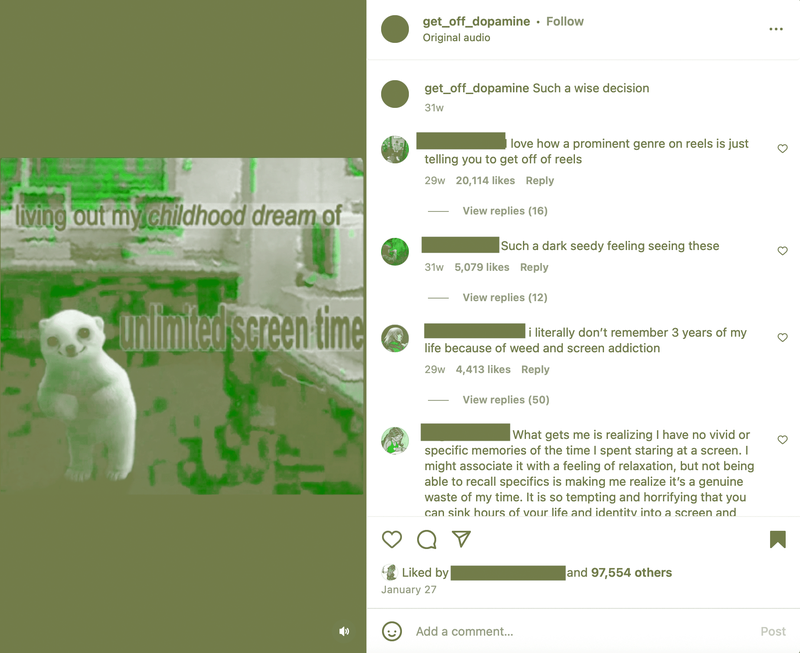
Beginning with this definition, I was quickly aware of every way this method could, and often did, fail. For how much I had encountered it, I still went on my phone every night before bed and in most moments of free time. And, doing as capitalism does, any successful disruptive approach often contributes a template for future nonsense content to more effectively cannibalize the aesthetics of resistance.23 So that’s the message in the medium, right? When a workshop participant contributed a media studies point-of-view and evoked McLuhan, this is what they were getting at. The message is: ‘you’ll be back’. And we usually are.
This line of thinking poses ‘content activism’ as a fully captured or compromised method. All approaches to action, though, are compromised,24 and this one quite a bit, but that doesn’t immediately deprive it of value. What it does is pose the activist a more challenging negotiation when engaging with it as a tactic. And the activist must negotiate it, at some point, as everyone who could be reached by a message will likely be receiving it in some way mediated through or impacted by the Scroll; it’s a force one must contend with, either through direct disruption or passive acceptance of the limitations it places on the operative space for communication. But rather than allowing the binary between virtual and physical action25 to remain unchallenged, this is an insistence on the possibility for approaches to exist that effectively disrupt the Scroll.
Following this insistence, it follows that certain approaches to Disruption Content will be better fit for purpose, either more or less compromised. Identifying those approaches and evaluating their effectiveness can help us put together a protocol to add to our repertoire when negotiating resistance on social media. I had initially envisioned the Disruption Content taxonomy as diverse and specific, but it is content in the end, change is its only constant. I’m instead dividing the genre for analysis much more generally, typifying examples by intention and mood over form. From this view, we can look at Disruption Content as either:
A Passive Reminder. Gentle in its approach to the viewer, but insistent in its goals. Reminders are passive in that they don’t do much in and of themselves to stand out but are focused on impacting the viewer through repeated encounters.
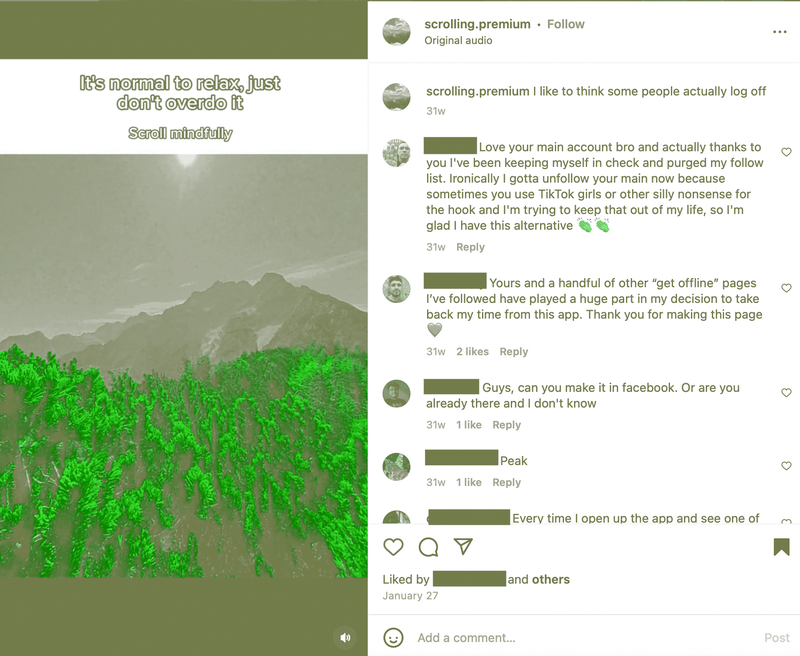
A Deliberate Intrusion. Tries to compete directly in the attention arms race by finding new ways to scream at the viewer. Intrusive content posits the Scroll as a kind of stupor that the viewer must be shocked out of through discomforting and often personally insulting attacks.
A Direct Appeal. Unlike other approaches, making an Appeal usually requires a face, someone speaking through the fourth wall to the scroller as a person. This is the most bare-bones approach to disruption, at least on its face, by focusing on the ability of one person to appeal to another. Direct appeals often took the form of someone speaking to the camera, either encouraging scrollers to adopt new behavior, commiserating on the challenge of kicking screen addiction, or proposing some new, usually media-based, solution to this problem.
Each of these approaches to Disruption Content inevitably must survive out there on the Scroll. I can’t follow every viewer of a post to ascertain how successful an approach was for motivating them to do much more than comment or like. However, the fragments of intention they’ve left behind do produce an affective environment which tells us something of the world this kind of content might promote. The perspectives rendered invisible by my focus on comments are, of course, those who don’t comment at all, those who scrolled right past, and those who heeded the call promptly and never came back. Here’s hoping they all did the latter.
Responses to Disruption Content
How Scrollers Feel
Online and in-conversation, the general attitude toward anti-screentime messaging is positive. However, a widespread feeling that we should spend less time on our phones, whether communicated through revolutionary-adjacent imagery or not, doesn’t pose a sustainable foundation for organizing.26 Without a clear intention to act, a part of me wants to view every fire emoji or ‘so true’ as just another thumb that scrolled past after a brief respite—a stand-in of sorts for those who, as folks at the workshop predicted, agreed with the message but couldn’t help checking out what came next.
The most common ‘negative’ response was disbelief and exasperation, a kind of annoyance that someone would even try this; I think, again, of the vacant stares and blank negation when I posed this genre as a possibility. However, the space left for conversation on the idea, even if the specific stimulus fell flat, did give the poster plenty of room to continue operating in if they were willing to remain involved.
While the negative responses offer a chance to negotiate, the proliferation of memes as a stand-in for social connection presents a more difficult obstruction. It might come as no surprise that ironic comments were never associated with any real intention or motivation. Other scrollers tended to flock to ironic comments, however, generating a kind of magnetism that might have colored their capacity to seriously engage with the idea.
How Scrollers Act
If this is a movement – and each disruptive post a ‘landing page’ for it – it’s a movement that draws on common feelings of discomfort with screentime to unify potential members but seems to pass on little obligation to actually act.27 Maybe this is McLuhan again, and we’re still losing this war with the medium. However sincerely a post might offer a space for users to find motivation, it will inevitably be sorted off their feeds, and most leave it up to the algorithm to bring it back around again. Discussion does not guarantee action nor solidarity, but it’s a foundation for moving in that direction that ‘almost instantly dissipate(s)’28 when it loses a focal point.
The individual focus of comments expressing motivation tracks with the often-personal tone taken by disruptive posts, which confront or encourage or engage the ‘person watching this’. Self-discipline was a common discussion point: the idea that there was ‘more you could be’ and that your screentime was ‘holding you back’. The ephemeral communities of commenters reminding each other to stay on the grind are limited examples of anything effective29—endless self-improvement in a world settled on decay.
How Scrollers are Paralyzed
The last complication was brought to my attention during the workshop discussion, when participants realized through their conversations that almost all of them related feelings of intense shame with self-awareness of their social media usage. The shame described by participants welled up rapidly in confrontations with their behavior but often dissipated with similar haste once the stimulus was gone.
Sources of shame are deeply individual, but we can think about the affective states that might trigger it. The fact is that the online environment is a tremendously overloaded information space30 and disruptive content demands additional cognitive labor from its audience to reflect on their own shortcomings. Even a gentler message still exposes a scroller to a baseline accusation that they’re spending too much time here—have done something ‘wrong’. Processing this while experiencing the Scroll’s inherent overload stresses the limit of a user’s information capacity and is likely to induce the anxiety that bridges the gap between overload and fatigue and frustration at their inability to act.31
Shame, along with most difficult emotions, is a natural progression of frustration,32 and no more productive. The outcome of frustration might be a temporary break from mindless social media usage, but it’s correlated over a longer term with adopting avoidance behaviors when encountering similar content.33 Workshop participants echoed this when they noted that the kind of disruptive content I was describing sounded like the sort of post they’d be in a hurry to scroll past because of how it made them feel. Attaching that emotional aversion to a message meant to be disruptive might sound effective – in a theater of the absurd or cruel type of way – however, when we view disruption content as one tactic in a repertoire meant to free up mental capacity for action, it becomes a serious barrier to successful work.
What Can be Done Now
The outlook seems to be that motivating social media discontinuance is ineffective, and even counter-productive, when conducted through mass communication channels. The ever-escalating urgency needed to catch a scroller’s attention34 inherently leans disruptive content toward tactics that stress the limits of a viewer’s coping ability. Whether you scroll past it or give the post a minute of your time, there’s a good chance you’ll leave it feeling worse about yourself and your ability to change your circumstances. In a media environment saturated with exhibitions of shock factor, irony, sheer noise, and real horrible things happening in the world, a disruption aimed at the viewer can be much more alienating than motivating.
However, I still hold that Disruption Content has more to offer as a tactic than its initial deployments have shown. In order to do so, however, I believe the genre would benefit from embracing a few key axioms:
This work is valuable even when it fails. Most viewers who do get offline will likely find their way back on again. This can be described as a failure, but there is still something gained. A small break to foster focus away from the screen is a valuable lived experience for someone who might now be more receptive to alternative approaches to technology in the future.35 If forcing folks offline is a gamble that usually backfires, accepting the tactic as spreading an idea more than it is affecting change can be enough.
Embracing this axiom requires a certain level of acceptance with our lives as fully realized both on and offline. This might appear to go against the ethos of Disruption Content, but it speaks more to how my own initial conception of the genre was flawed, hyper-focused on the act of going offline over the possible changes in behavior and gradual erosion of habits these kinds of posts might foster. If the purpose of every disruption is to get someone to put their phone down, falling into the self-defeating arms race of attention-grabbing stunts rapidly becomes inevitable. Turning away from that narrow definition of successful work, finding value in disruptions which might not change anyone’s minds right now, opens up the genre to explore new ways of approaching scrollers which don’t rely so much on the tugging of ultimately unproductive emotional responses like shame, anxiety, and guilt.
We’re better offline, but we can’t abandon it. A line advocating strict rejection of the virtual only reinforces a binary between it and the real, limiting the capacity for organizing to span both. Folks already working in the world understand the constraints digital platforms place on them and negotiate them as part of their daily tactics.36 Activists against the Scroll must provide space in their messaging for the continuance of these new communities.
To be an advocate only against the Scroll, with nothing more to stand for than more people looking up from their screens, is inevitably to be an advocate for almost nothing real. The message that ‘we should spend less time on our phones’ is a neutral interjection which most have been shown to receive with a vague positivity; it must be augmented with purpose and direction toward a specific cooperative vision to become meaningful. The reason to produce Disruption Content needs to be more than just cumulatively lower screentime; it must aspire toward the rejection of the Scroll as both a physical act and a mindset of dull anxiety and paralysis. That latter purpose allows Disruption Content to live in better harmony with the virtual world, seeing it as a place it doesn’t seek necessarily to abolish, but reclaim from the vampiric forces which have made of it a feeding ground. Without this clarity of vision and acceptance of a world split between the virtual and the physical, Disruption Content makes itself vulnerable to that same process of capture. By spouting an easily accepted message, it becomes just as easily co-opted to serve the cults of hustle culture and toxic productivity, among others.
We ought to expand our chosen theatres for contention to include the community, the real, and the small. Speaking of hustle culture and toxic productivity, the isolated attitude of commenters on disruptive posts reflected how most content was framing its message—a personal battle between you and your phone. Most disruption posters uploaded frequently, but didn’t publicly engage much with commenters to offer more than the same message, again and again. Many commenters engaged with posts as personal diaries or motivational touchpoints they could return to when needing a reminder to get off their phone and go do push-ups or something. The result was countless comment sections filled with energized individuals generally not communicating with each other, or not recognizing each other as already forming a kind of ephemeral community. Most energy produced by a post seemed to travel inward, re-purposed by each commenter – or their employer – to improve productivity without fundamentally changing their relationship to the machine.
Avoiding this outcome requires an extension of the work involved in disruption to include the maintenance of public response, the intentional work of meeting people where they are as they feel moved to respond to a post and helping them understand where this energy could go. We should re-imagine disruptive posts as communal spaces recognizing a shared purpose and finding in that purpose a means for collaboration. Emphasizing reciprocal behavior, group accountability, and identification with a common obligation can foster connections that extend beyond the few seconds your thumb gives a post to live.
To wrap up, let’s consider how these axioms around productive disruption online can transform into specific content tactics deployed on the Scroll.
Empowering scrollers. Overload is the baseline mental state that provides disruptive content and scrollers with such little room to operate. However, a scroller’s experience of overload is innately related to their personal capacity to cope with the information presented.37 Enhancing that capacity to intake, process, and integrate information can protect scrollers from overload38 while discouraging avoidant behavior.39
Content that disrupts the Scroll to give viewers a quieter place to recharge or discuss personal tactics for healthy mental habits online could at least improve the likelihood that more overtly transgressive messaging won’t trigger an immediate progression into anxiety and fatigue.
While not expressly pursuing a disruptive agenda, there are accounts which create content like this already, creating little pockets of calm intended to give scrollers a break from the noise. I have a post saved which I like to visit before bed, when I’m trying to detach myself from a Scroll and go to sleep, containing just a blank screen and a calming tone. These posts receive high engagement, and many commenters also mention saving them for later, making the format well-suited to deployment as a more overtly disruptive tactic.
Keeping the costume on. The bait-and-switch – where a disruptive post presents as standard nonsense before abruptly turning on the viewer – was a popular method for intruding into the Scroll. However, lulling scrollers into a sense of familiarity and then bombastically shattering it only exacerbates the misfit between them and their mental environmental.40 In this sense, presenting disruptive information in an identifiable and more or less ‘algorithm-approved’ format enhances that information’s likelihood of surviving the scrolling environment and being fully processed by a viewer. The Direct Appeal works particularly well here, as the algorithm loves human faces and hard sells. Looking at comments, as well, Direct Appeals seem to be getting the message over much easier by playing closer to the rules of the game.
Intervening between overload and anxiety. Despite best efforts, it’s still likely that many scrollers encountering disruptive posts are already experiencing some level of overload. While we can’t always avoid stressing that mental limit, overload doesn’t have to snowball into cognitive fatigue, frustration, and avoidance. That transition is highly dependent on the introduction of anxiety as a mediator.41 Staying aware of this, posters should consider how both their content and how they engage with commenters can intervene in the development of anxious feelings. Avoiding the kind of shame-inducing tactics discussed already and remaining engaged with commenters expressing those feelings once a post is out there can help keep folks from spinning into defeatism.
To avoid inducing feelings of shame, posts which take a more collective stance over isolating the viewer can promote more productive engagement with the idea. Workshop participants discussed a sense of shared struggle as a counterweight to shame, noting that others identifying with the same ‘failings’ made them feel less personally at fault for experiencing this screen addiction. Avoiding accusatory and overly urgent messaging can also work to slow the onset of anxiety over having to abandon your phone—a lifeline to the world for many.
Directing attention to structures. If you can get someone’s attention, there’s more to do with it than point out that we spend too much time on our phones. Disruption Content can be more effective by drawing attention to the structural, normative forces enforcing this negative media experience. One workshop participant shared an anecdote of immediately dropping their phone after seeing a post of a laughing Mark Zuckerberg encouraging them to continue scrolling so he could scrape off just a little more data. Changing the message from ‘you are failing yourself’ to ‘you are being used’ associates it with a higher order of struggle. The goal, in the end, is to direct the energy captured by the Scroll to meaningful organization against these very structures, so using our shared suffering under them as a catalyst for action dovetails with the entire scheme.
Organizing with other posters. One workshop participant brought up the idea of a social media strike, a mass content denial to break the dopamine loop and force viewers to do something else with their time. Whether or not that could ever be feasible, I was excited by the prospect of setting an example. Disruption can be a post screaming at you to get off your phone, it could also be your favorite meme page shutting down because there’s more important things to be posting about. It could be more public-facing organizers42 embracing offline communication as a substantive part of their cultivated media orbit. It could be smaller virtual communities disrupting their own routines by committing to more offline action and message distribution.
Disruption can be throwing open a window to let the whole void in43 and seeing who doesn’t drown in it. But I’m not sure now who that ever really helped, because disruption could also be a door opening, a welcoming gesture from a stranger in a hostile place, a spot to rest where you least expect and most need it. It’ll always be easy to ignore, might feel a little stupid to even consider, but it’ll matter to those whom it reaches. There’ll be a little more of the good distraction than there was before, a little more free attention back to get curious about what we could be doing instead, who we could become together. In a world running out of better futures, that might make at least the slightest difference.
-
(1) Charles Heckscher and John McCarthy, ‘Transient Solidarities: Commitment and Collective Action in Post-Industrial Societies’, British Journal of Industrial Relations 52, no. 4 (2014): 627–57, https://doi.org/10.1111/bjir.12084. ↩
-
(2) Kevin Tucker, ‘The Suffocating Void’, The Anarchist Library, n.d, https://theanarchistlibrary.org/library/kevin-tucker-the-suffocating-void. ↩
-
(3) I experienced this crisis of faith while leading ‘Touching Grass: How Do We Protect Our Attention Spans and Energy from the Doomscroll’, and I’m grateful to my graduate school’s student council for organizing the conference where I conducted it. ↩
-
(4) Alessandra Aloisi, ‘Art and the Power of Distraction: Bergson, Benjamin, and Simone Weil’, in The Politics of Curiosity, Routledge, 2024. ↩
-
(5) Bibiana Giudice da Silva Cezar and Antônio Carlos Gastaud Maçada, ‘Cognitive Overload, Anxiety, Cognitive Fatigue, Avoidance Behavior and Data Literacy in Big Data Environments’, Information Processing & Management 60, no. 6 (2023), https://doi.org/10.1016/j.ipm.2023.103482. ↩
-
(6) Xiongfei Cao and Jianshan Sun, ‘Exploring the Effect of Overload on the Discontinuous Intention of Social Media Users: An S-O-R Perspective’, Computers in Human Behavior 81, no. Complete (2018): 10–18, https://doi.org/10.1016/j.chb.2017.11.035. ↩
-
(7) Cezar and Maçada, ‘Cognitive Overload, Anxiety, Cognitive Fatigue, Avoidance Behavior and Data Literacy in Big Data Environments’. ↩
-
(8) Amandeep Dhir, Yossiri Yossatorn, Puneet Kaur, and Sufen Chen, ‘Online Social Media Fatigue and Psychological Wellbeing—A Study of Compulsive Use, Fear of Missing out, Fatigue, Anxiety and Depression’, International Journal of Information Management 40, no. Complete (2018): 141–52, https://doi.org/10.1016/j.ijinfomgt.2018.01.012. ↩
-
(9) Cezar and Maçada, ‘Cognitive Overload, Anxiety, Cognitive Fatigue, Avoidance Behavior and Data Literacy in Big Data Environments’. ↩
-
(10) Dhir, Yossatorn, Kaur and Chen, ‘Online Social Media Fatigue and Psychological Wellbeing’. ↩
-
(11) Vando Borghi, ‘Curiosity Among the Ruins of Homo Faber: Infrastructural Capitalism and the Politics of Care’, in The Politics of Curiosity, Routledge, 2024. ↩
-
(12) Cao and Sun, ‘Exploring the Effect of Overload on the Discontinuous Intention of Social Media Users: An S-O-R Perspective’. ↩
-
(13) Ae Ri Lee, Soo-Min Son, and Kyung Kyu Kim, ‘Information and Communication Technology Overload and Social Networking Service Fatigue: A Stress Perspective’, Computers in Human Behavior 55, no. Part A (2016): 51–61. https://doi.org/10.1016/j.chb.2015.08.011. ↩
-
(14) Sky Croeser, ‘Rethinking Networked Solidarity’, in Social Media Materialities and Protest, 1st ed., 28–41, Routledge, 2019, https://doi.org/10.4324/9781315107066-3. ↩
-
(15) Croeser, ‘Rethinking Networked Solidarity’. ↩
-
(16) Emiliano Treré, ‘Nomads of Cyber-Urban Space: Media Hybridity as Resistance’, in Social Media Materialities and Protest. Routledge, 2019. ↩
-
(17) Lee et al., ‘Information and Communication Technology Overload and Social Networking Service Fatigue: A Stress Perspective’. ↩
-
(18) Tucker, ‘The Suffocating Void’. ↩
-
(19) Attention deficit may not be the right terminology to use here, though it is the most commonly deployed. Our ‘attention deficit’ is much more so a ‘distraction deficit.’ We are well-attuned to our screens and poorly clued into the world around us. What is lacking is more so the ‘free attention’ than it is attention in and of itself. ↩
-
(20) Cezar and Maçada, ‘Cognitive Overload, Anxiety, Cognitive Fatigue, Avoidance Behavior and Data Literacy in Big Data Environments’. ↩
-
(21) Lee et al., ‘Information and Communication Technology Overload and Social Networking Service Fatigue: A Stress Perspective’. ↩
-
(22) Treré, ‘Nomads of Cyber-Urban Space: Media Hybridity as Resistance’. ↩
-
(23) Scholium, ‘The Hollowing of Anarchy: Exhibition Value’, The Anarchist Library, n.d., https://theanarchistlibrary.org/library/scholium-the-hollowing-of-anarchy-exhibition-value. ↩
-
(24) Emmi Bevensee, Jahed Momand, and Frank Miroslav, ‘No Ethical Activism Under Capitalism’, The Anarchist Library, n.d., https://theanarchistlibrary.org/library/emmi-bevensee-jahed-momand-and-frank-miroslav-no-ethical-activism-under-capitalism. ↩
-
(25) Treré, ‘Nomads of Cyber-Urban Space: Media Hybridity as Resistance’. ↩
-
(26) Heckscher and McCarthy, ‘Transient Solidarities: Commitment and Collective Action in Post-Industrial Societies’. ↩
-
(27) Heckscher and McCarthy, ‘Transient Solidarities: Commitment and Collective Action in Post-Industrial Societies’. ↩
-
(28) Croeser, ‘Rethinking Networked Solidarity’, 38. ↩
-
(29) Croeser, ‘Rethinking Networked Solidarity’. ↩
-
(30) Cezar and Maçada, ‘Cognitive Overload, Anxiety, Cognitive Fatigue, Avoidance Behavior and Data Literacy in Big Data Environments’. ↩
-
(31) Cezar and Maçada, ‘Cognitive Overload, Anxiety, Cognitive Fatigue, Avoidance Behavior and Data Literacy in Big Data Environments’. ↩
-
(32) Bao Dai, Ahsan Ali, and Hongwei Wang, ‘Exploring Information Avoidance Intention of Social Media Users: A Cognition–Affect–Conation Perspective’, Internet Research 30, no. 5 (2020): 1455–78, https://doi.org/10.1108/INTR-06-2019-0225. ↩
-
(33) Dai, Ali, and Wang, ‘Exploring Information Avoidance Intention of Social Media Users: A Cognition–Affect–Conation Perspective’. ↩
-
(34) Markus Schroer, ‘Sociology of Attention: Fundamental Reflections on a Theoretical Program’, in The Oxford Handbook of Cognitive Sociology, edited by Wayne H. Brekhus and Gabe Ignatow, 0, Oxford University Press, 2019, https://doi.org/10.1093/oxfordhb/9780190273385.013.23. ↩
-
(35) Bevensee, Momand, and Miroslav, ‘No Ethical Activism Under Capitalism’. ↩
-
(36) Treré, ‘Nomads of Cyber-Urban Space: Media Hybridity as Resistance’. ↩
-
(37) Cezar and Maçada, ‘Cognitive Overload, Anxiety, Cognitive Fatigue, Avoidance Behavior and Data Literacy in Big Data Environments’. ↩
-
(38) Cezar and Maçada, ‘Cognitive Overload, Anxiety, Cognitive Fatigue, Avoidance Behavior and Data Literacy in Big Data Environments’. ↩
-
(39) Cao and Sun, ‘Exploring the Effect of Overload on the Discontinuous Intention of Social Media Users: An S-O-R Perspective’. ↩
-
(40) Lee et al., ‘Information and Communication Technology Overload and Social Networking Service Fatigue: A Stress Perspective’. ↩
-
(41) Cezar and Maçada, ‘Cognitive Overload, Anxiety, Cognitive Fatigue, Avoidance Behavior and Data Literacy in Big Data Environments’. ↩
-
(42) Zeynep Tufekci, ““Not This One”: Social Movements, the Attention Economy, and Microcelebrity Networked Activism’, American Behavioral Scientist 57, no. 7 (July 2013): 848–70, https://doi.org/10.1177/0002764213479369. ↩
-
(43) Tucker, ‘The Suffocating Void’. ↩
Data Liberation
The revolt against the social media oligopoly
Claudio Agosti
Technopolitics was happening before my eyes, and the ‘I told you so’ wasn’t helping anyone. Even though a small group of techno-paranoids discouraged activists from using Facebook and Instagram, their promise of an instant audience and the feeling of increased reach easily captivated even politically savvy friends, relatives, and everyone who felt they had something to say. Now imagine their faces when their political events were taken down. Or when expressing solidarity with a cause was flagged as hate speech. Imagine falling into such a trap willingly and then realizing you can’t leave, because of the so-called critical mass. Technopolitics is happening, and we’re not just passive spectators. We produce data, and that data fuels what here is referred to as surveillance-based social media platforms: large, centralized social media services built on profiling, targeted advertising and attention extraction. Since this data comes from us, in theory, we could control it, but that’s not happening. Is society doomed into Zuckerland? Can we reverse this? This article tells a story based on my first-hand experience between 2019 and 2023 to attempt this. It mixes theory and practice to promote an innovative tactic of subversion. We’ll start by analyzing the reasons for this worldwide Stockholm syndrome, in which even if you hate a platform, you can’t leave it.
Are people really enslaved in so-called dopamine addiction? Are our friends hostages of platforms, forcing them to maintain an account to not feel isolated? Or are valuable sources, such as media and public institutions, forced to be there because of the promise of visibility? All of the above.
We’ll discuss one of the most problematic powers of surveillance-based media platforms. Then address my attempts to ‘break free’ by using technological means, and deal with the hard question: how much can a technical solution actually solve the problem of a society that doesn’t question the politics embedded into digital platforms?
The ultimate prize of reading this piece is to inspire you to apply a grassroot form of resistance, a mixture between technology and politics, full of challenges and opportunities. In this piece we’ll dissect it all.
Problem identification
Having amassed billions of users through convenient services, these platforms are difficult to leave because of the network effect: everyone and everything is on the dominant network, so departing means losing contact, audience and influence. As user+consumers we are trapped inside surveillance-based social media platforms; the social pressure to remain comes at the cost of autonomy. You stay, but your feed fills with AI-generated sludge, carefully tuned to exploit the weak spots inferred from your past behavior.
As Tristan Harris1 and others have popularized, the attention economy runs on continuous experiments: algorithms test millions of variations to see what keeps you scrolling a little longer, turning your nervous system into the target of an optimization problem. That is the core of our social dilemma: we need the content and connections that live there, but accessing them is wrapped in psychological traps. Staying outside means losing valuable information or contact with loved ones; staying inside means being constantly subject to techniques designed to extract time, data and attention.
‘If people don’t want to stay on Facebook nobody is forcing them.’
This is what a Facebook spokesperson-lobbyist once told me at a human rights conference—one of those events the company periodically visits to feign concern for minorities and other token causes. It was RightsCon 2017. Independent social media already existed, so I replied (paraphrasing; our younger selves always sound sharper in hindsight):
That’s not really true, is it? Sure, nobody forces us explicitly, but Facebook designed the entire environment so leaving feels like cutting yourself off from everyone you know. You built a system where all our friends, groups, events, and memories are trapped, and then you shut down every API that once allowed developers to build bridges out. There’s no real portability. You can’t take your network with you, and that’s the real lock-in. People want alternatives; they just can’t afford to lose their social connections. Meanwhile, the free software community and the open protocols research grows, the Fediverse actually allows that kind of interoperability, where users and platforms can talk to each other freely. But Facebook made sure that freedom was impossible, not because it’s technically hard, but because it’s bad for their business model.
As a historical aside, one of Facebook’s winning moves at the beginning, when it was competing with Myspace for critical mass, was a technical hack to lower switching costs. If you want to know more, an article from Cory Doctorow2 explains it well.
Let’s pretend that a bit of hacking can solve everything
In this article, I would like to suggest a radical approach: to copy the content from these platforms and republish it in free networks such as the Fediverse. This would enable people to find content more easily and potentially reduce switching costs.
I’ll refer often to the term ‘scraping’ which has recently been co-opted by AI companies to justify their massive data theft. But this is not what web scraping generally means. Yet, the definition of Web Scraping3 is more neutral (paraphrased from Techopedia):
Scraping (or web scraping / data scraping) is the technique by which a computer program automatically extracts data from content originally intended for human reading (e.g. HTML pages, PDFs, websites) and converts it into structured, machine-readable formats (such as JSON, CSV, or database tables) for processing, storage, analysis, or reuse.
Scraping is the technique allowing us to collect data. Instead of harvesting for a profit-seeking purpose, we’ll do it for the public benefit. Think of a cultural institution that has been publishing its programme on a Facebook page for years, with no proper archive anywhere else. Or that incredibly useful resource whose articles are wrapped in cookie walls, tracking scripts, and attention-grabbing ads. Or a grassroots collective that coordinates protests or mutual aid only through an Instagram profile that could vanish with one moderation mistake. These are the kinds of situations Data Liberation is concerned with: public-interest content that exists, but is locked inside the enclosures of Meta/Google/ByteDance/etc.., aka surveillance-based social media platforms.
Since social media data is the reason why people remain in the surveillance-based platforms, if this data goes into a more ethically maintained network, maybe this can spare profiling and advertisement to that friend of yours?
Data Liberation is the idea of copying content from Centralized Social Media and republishing it on an open protocol network.
Data Liberation is a concept to overcome the lack of critical mass and weak network effects. The idea is to free some content, from being only an asset of the surveillance-based media platform to becoming available on free social media networks too. An adversarial bridge. It’s a bet: many things could go wrong, but below, we’ll explore all the technical, ethical and legal complexities we must consider.
How to scrape without losing information
The most basic way to copy something is to take a screenshot. But a screenshot is almost useless for meaningful navigation: you cannot search, filter or build any interface on top of it. To make liberated content really usable, we need structure, and that means metadata: labels and context that describe, organize and connect pieces of data.
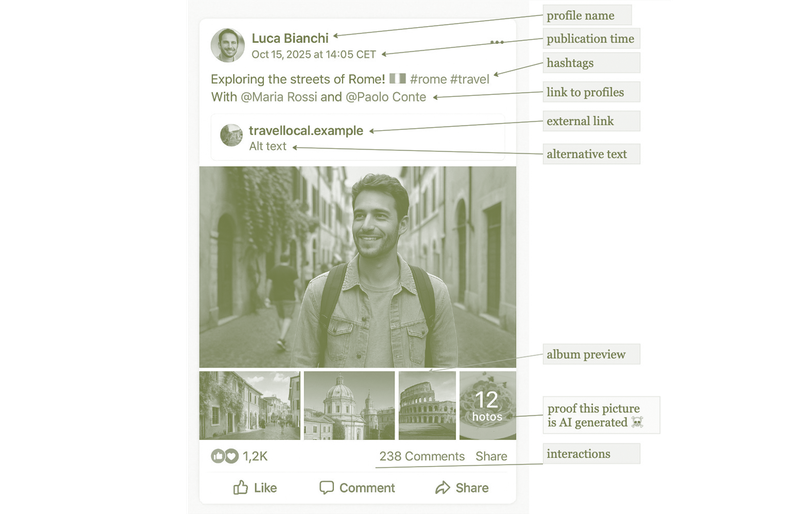
Fig 1: Example of a social media post annotated to show how many layers of metadata surround a single piece of content: profile name, publication time, hashtags, profile links, external link, alternative text, album preview, (an AI-generation typo!), and interaction counters.
- On social networks, almost everything you experience is driven by said metadata: names and usernames you can click, timestamps, links, hashtags and mentions, counts of likes, comments and shares. In the Facebook post shown in the figure, each balloon simply points to one of these markers. If we only capture the raw text and image, and do not also extract this surrounding information, we lose most of what makes the post navigable.
For people used to privacy debates, metadata is usually what enables surveillance and behavioral targeting. An article by David Golumbia4 helped me see how deep this goes: what we think of as ‘personal data’ is in fact a stack of layers. There is the data you explicitly give, the data the platform observes about your behavior, and then the extra categories it infers by analyzing both—interests, risk scores, predicted attributes. In that sense, a lot of what matters most about you online is metadata created around your actions.
We can apply the same lens to social media content. A post is the base layer; around it, platforms attach automatic metadata (who posted, when), creator-supplied tags and links, social signals such as replies and reshares, and, above all, inferred metadata: rankings, relevance scores and predictions about who should see it. This invisible layer is what lets them decide what surfaces in feeds and searches.
If Data Liberation had access to all these layers, we could build indexing, filtering and discovery tools that respect people’s agency instead of the platform’s business model. Yet today the most powerful parts (the inferred metadata) remain locked away as proprietary assets. Inferred metadata is treated as the company’s property, even though they are built on top of our behavior and histories. So far, when people exercise their data-access rights, surveillance-based social media platforms never return this inferred layer to the user. This is so, even though such inferred metadata must be considered personal data subject to legal protection under the GDPR. But at the moment we do not even know the full extent of this inferred data, let alone how to reclaim it. How can we change that? Glad you asked, follow me down the rabbit hole.
Strategic litigation
To ensure the enforcement of our rights, we or civil society actors can initiate legal proceedings to establish a legal precedent. This approach is known as strategic litigation because the case itself may not be particularly significant, yet the legal principle it sets carries major significance for civil society. Between 2019-2022, I led such a legal action seeking access to inferred metadata (by proving that users were being profiled through a protected category of personal data, which would oblige the company to disclose such information).5 But this approach was unsuccessful. It took years and, even though that fight still needs to be won by civil society, I had enough time to reconsider our needs more carefully and put that approach into discussion.
If it was true that we need rich metadata to offer a high-quality experience with liberated content, I found myself torn between a question of principle and a question of strategy. In principle, people should be able to obtain all their data back, including inferred profiles and opaque classifications. Strategically, though, even if we did gain access to that corporate metadata, building on top of it would mean importing their categories, their biases and their worldview into our own tools. It made me realize that metadata is not just a technical detail: it is where power sits, and whoever generates it decides what can be seen, found and valued.
We need our own metadata: a smart scraping mechanism that fetches, clones and enriches the content. This would combine automation, existing classification and manual intervention. Luckily I had the safest fallback from any legal failure: a battle grade technology.
Homework done, or, why regulations won’t save us
In 2016, I started a project called Tracking Exposed.6 Its goal was to prove that social media algorithms were harmful and explore ways to challenge them. At the beginning I worked with academia, published peer-reviewed research, and taught students how to recognize algorithmic bias. It worked out, the project has since evolved into two specialized spin-offs: AI Forensics7 and Reversing.Works.8
From a niche research area, we found a way to use evidence of algorithmic-driven harms to prove GDPR violations and put legal pressure on exploitative social media platforms. The debate on the Digital Services Act (DSA) was informed by the difficulties we encountered with scraping and reverse engineering algorithms.
But let’s be realistic, are regulation and strategic litigation alone really going to resolve this issue? Hardly. It makes corporate social media spend more money, forces them to comply with laws that were designed too many years too late, and meanwhile new exploitation dynamics are deployed over us.
Plus, the influence of the trillion-dollar industrial complex that is surveillance capitalism cannot be unseated by fines. Users will continue to be trapped until we take real action to break up monopolies. Is this going to be a gift from above? I don’t think so, or at least it shouldn’t be our only hope. If we want a future beyond corporate control, we will have to save ourselves.
Over the years, I have built a set of scrapers for Facebook, YouTube, TikTok and other platforms in Tracking Exposed, which are designed to study how their algorithms behave in practice. When the director of the documentary Nothing to Hide9 reached out to me with a new project on alternative networks such as the Fediverse, I realized that it was the right time and place to experiment with a more proactive solution: copying public-interest content out of surveillance-based media platforms into autonomous spaces. That’s when the concept of Data Liberation began to be tested.
The Disappear Documentary, Berlin Clubs, and Librevents
Around 2020, two forces converged: a documentary project called Disappear was underway (short version on YouTube ‘Under the radar: covering your online tracks’),10 aiming to explain the ecosystem around digital autonomy and spotlighting the Fediverse (more details below). At the same time, Berlin’s underground club scene was running into a growing problem: event censorship and shadow banning on Facebook. For communities that thrive in the margins, it was a threat to their existence.11
By ‘events’, we mean announcements with a date, location, and title. For example: ‘Cheshire-cat-parade starting from 15:00 in Wonderland Platz’. The organizer’s goal is to be as visible as possible, especially to your own people. And to do that, you need to follow them where they already are: on Facebook. A deadlock. Nobody migrates where there’s no content and not the right audience/followers. The core of the problem for event organizers has always been ‘If your party starts disappearing from Facebook, do you still exist?’
We established Librevents to liberate the event announcement of the Berlin clubscene from Facebook by publishing them on the Fediverse.
Fediverse, and the crucial role of ActivityPub
Let me do a short detour here to explain what the Fediverse is. Its complexity is one of the challenges of empowering Data Liberation. The Fediverse12 is a network of interconnected platforms rather than one single website built on ActivityPub. ActivityPub13 is an open, decentralized protocol that allows different platforms to exchange social data and talk to each other without asking permission from a central gatekeeper. One platform is Mastodon,14 probably the best-known example: a Twitter-like microblogging platform that runs on ActivityPub. Mobilizon15 is a federated events and groups platform, designed as an ethical alternative to Facebook Events, so that communities can organize and share events without relying on a centralized platform. Gancio16 is a community events calendar used by local groups and social centers to publish what happens in their neighborhoods.
These services use ActivityPub under the hood to let their different instances exchange posts, events, and updates. These are only a few examples: many other software projects use ActivityPub to rebuild social media in less exploitative ways, or to invent entirely new forms of online social interaction.
All these services are made of many independent servers, called instances. Together, these instances form the distributed and decentralized Fediverse: no single server owns, sees, or controls the whole network. This nature of the Fediverse gives us the control and agency needed, but makes it harder to communicate to a wider audience. As explained below, if anyone tries to convince you that we can make do without decentralization and distribution, that there is a BetterFacebook, aka a single product which is just better, you’re getting fooled.
This poster was one of our ways to summon hackers and activist to our adversarial interoperability hackathon; the website is now archived at librevents.vecna.eu, and you can find a few talks meant to capture the key reasoning behind that moment.17
But the tension remained: while many clubs wanted out of Facebook’s exploitative system, they still depended on its critical mass, and the users were there. The reach was too hard to walk away from.
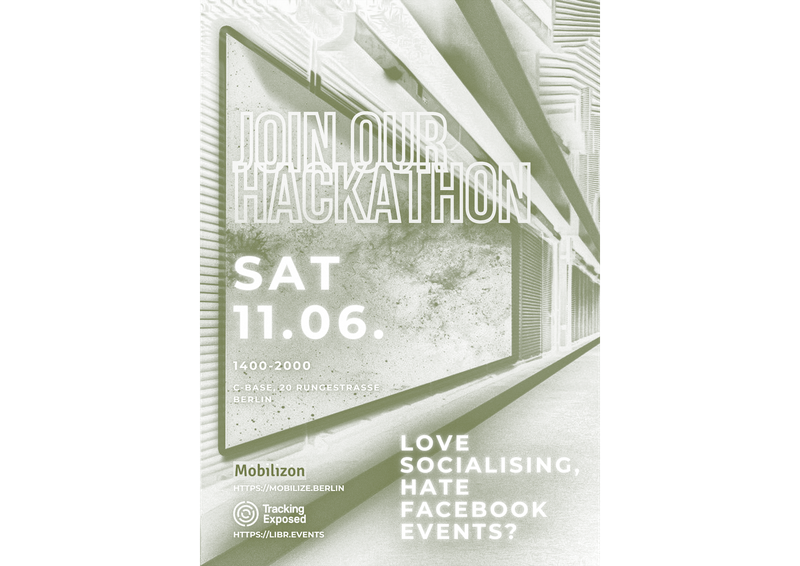
Fig 2: Poster for the first Librevents hackathon in Berlin, organised by Mobilizon Berlin and Tracking Exposed to prototype federated alternatives to Facebook Events.
Let’s get back to Berlin: the first design of Librevents was set out to liberate Facebook event data and inject it directly into Mobilizon, a federated event platform. We spun up a dedicated platform (mobilize.berlin)18 and started pulling in listings from Berlin clubs, protests and community events. Our goal: show people they didn’t have to live in Facebook’s chokehold to know what was happening in their own city.
We developed a guerrilla toolkit to make it work. One part was an automated browser that could log into Facebook, navigate events, and extract the data. The other was a browser extension volunteers could use to scrape events manually as they browsed. It was messy, but it worked. We mirrored Facebook’s public event ecosystem into the Fediverse, transforming an otherwise empty space into a live calendar of real, relevant happenings.
The response was encouraging. There were waves of new users every time Musk or Zuckerberg did something sketchy. Organizers saw original and mirrored events on Mobilizon and started using it.
If a dog can be as big as an elephant, it would look like an elephant.
Platforms in the Fediverse are designed with collective values at their core, for people, not profit. However, in a world dominated by platforms with vast user bases, they struggle under the weight of network effects and only attract small, self-selecting communities; a tiny minority who care about the technology. This is the first value-conflict: is that OK? Perhaps yes!
The small communities in the Fediverse are happy this way; they aren’t looking to scale up at any cost. Maybe that’s wise; everything Facebook-sized becomes as corrupt as Facebook.
Or is this time different? Is interoperability enough to stop the usual corruption that arrives when a platform becomes central? Probably not. As soon as a network concentrates attention, it attracts influencers, advertisers and data hoarders; whoever runs key pieces of infrastructure gains power, and attacks follow. Let’s call them the attention parasites. They are negative effects roaming into a network once it starts to gain social relevance.
The Fediverse has one real line of defense: diversity of software, instances and governance. Also, a protocol can still be attacked or co-opted, but an ecosystem of independent instances and multiple different logics is harder to capture, making the efforts of attention parasites less profitable and less likely to succeed. This is why I do not see Bluesky as a convincing alternative. Despite its decentralized branding, it reproduces Twitter-like social mechanics and still depends on central indexes. Backed by venture capital and operated by one company, it centralizes power and responsibility instead of distributing them. It’s not just a matter of semantics: I can see a diverse ecosystem growing there, but the question remains: when the aforementioned attention parasite shows up, will the solution be a multitude of answers taken by the community, or a carefully decided trade-off by the tech leadership? The second option is a sign of centralization, and that is the vulnerability.
Let’s welcome Adversarial Interoperability
In The Internet Con: How to Seize the Means of Computation,19 Cory Doctorow discusses ‘competitive compatibility’, or ‘com-com’. It’s the idea that users and developers should be free to make new things that interoperate with old ones, even if incumbents dislike it, because that’s how the open internet originally worked. He connects this to a larger political argument: that the tech giants’ dominance was built on com-com (e.g., early web browsers, email clients, and social tools), but once entrenched, they lobbied to criminalize the very practices that allowed them to rise.
And that’s why now we use the term ‘adversarial interoperability’, when someone makes a new tool or service that plugs into an existing one without permission. Librevents is a practical experiment of this concept, has proved that adversarial interoperability could bridge the centralized and the decentralized: like when your friend saves the paywalled article as a PDF and shares it over a group chat. The friend is doing a service to the group, but it’s a manual process of selection and sharing. For successful Data Liberation, we have to reduce the amount of clicks necessary to do it. That with just enough code, creativity, and a refusal to play by the rules, we can operationalize this.
That was just the experiment with a hypothesis, but it also opened the floodgates to a tangled mess of ethical dilemmas, technical nightmares, and community-building hopes we can’t just duct-tape over, even if the mission is as noble as dropkicking Elon Zuckergoogle’s face for the greater good.
First Lessons
The meeting at the hackathon mentioned earlier provided us with some practical feedback:
- We need to make sure that clubs don’t feel that their invitation is being blindly copied. It’s the equivalent of a brand replication attack. (Trust issue?)
- If someone asks a question, we need to ensure that someone else answers it, or at least informs people where they can find effective information. (Community support, transparency issue?)
- We need to ensure that the link to the club is available correctly, so that even if we collect it from Facebook, people accessing it via Mobilizon can reach it directly. (Technical issue?) Based on this feedback, you’ll see a list of things that didn’t work out below. I’m listing them like an explorer who has returned from a difficult, harsh expedition, so that if new expeditioners decide to take the same trip, they will be better informed.
The medium (or, the interface?) is the message
If the user interface designer includes a question such as ‘Is this event wheelchair accessible?’ next to the ‘Location’ field every time a new event is created, this accessibility detail will be attached to your invitation. If you make this question mandatory, 100% of events will have this metadata.
Facebook does not ask about wheelchair access, and also does not care about many other accessibility or edge cases. It is optimized for the least friction; for ‘default thinking’. The setting for ‘normies’, and nobody should start a Data Liberation without mapping the missing metadata, otherwise, you’ll get close to…
‘Garbage in, garbage out’20
Centralized social media platforms are overloaded with clickbait, native advertising and disinformation, among other things. Data Liberators should avoid copying such material unthinkingly. Uncritical automation risks degrading the quality of the federated network. If we replicate their noise, are we any different?
Returning to the wheelchair example above, there are three options:
You can just copy the event without caring about it. Nope. As I said, you shouldn’t repost garbage just because it’s easy. Check the source thoroughly before trusting their content with an automatic republication.- Manually curate the liberated data. This involves less automation and more individual selection. Check the place yourself and expand the description.
- LLM Deepsearch. At the cost of some time, a modern, non-optimized computer might be able to run local models well enough to execute simple data enrichment functions. With the spread of LLM, both as a local or cheap service, it might be tempting, but this introduces bias and unpredictable behavior, so it should always be integrated with a human-in-the-loop. You should also expect heterogeneous behaviors. Not all events have the same details. Some organizers write this information in the attached picture, or in the description or even external link. This unpredictability is the first challenge. Where possible, this is solved with technology, but adding manual review steps and the ability to edit the event details was deemed the safest option. We knew that an extra step would incur a cost in terms of usability. Fewer events will be liberated, but this guarantees quality and a hand-picked decision.
Technical and Operational Challenges
Any Big Tech platform performs frequent UI updates and especially invests in anti-scraping tactics. It’s a cat and mouse game you should be ready to handle. But in addition to those, the feedback received taught us:
- Consent dilemma: some organizers were happy to find their events on Mobilizon, but others were confused or uneasy (‘Who put my event here? Is this official?’). This required cross-platform outreach and a dose of community management.
- And the conversation fragmentation. Facebook and Mobilizon both allow event comments, but they aren’t synced. Our solution: Clearly mark imported events and link back to the original. It wasn’t elegant, but it reduced the risk of inaccuracy.
We made sure the Mobilizon posts credited the original Facebook page or user who created the event, to the extent possible. This was important because we didn’t want to steal or misrepresent anything. A standardized way to attribute cross-posted content (like a federated equivalent of a retweet that clearly points back) would be very useful for such projects, and a protocol I am planning to look into is SOAP: A Social Authentication Protocol21 which might solve the issue of linking and authenticating content across social networks.
What makes data worthy of liberation?
It’s subjective; it depends on the barriers and/or surveillance costs imposed. For some people, a cookie banner that forces you to accept advertisements is a form of extortion. For others, it’s a business interest, not a public one. The following four points suggest some general rules:
- Public interest value: Content with civic, cultural, or informational significance (e.g., events, alerts, publicly funded material), not trivial or purely private updates.
- Trapped in exploitative systems: Data locked inside platforms that rely on surveillance, profiling, or coercive consent models.
- Respect for creators: Liberation must include attribution, the possibility for the original creator to reclaim control, and exclusion of content where republishing could cause harm.
- Extra: If you are the creator, you don’t need to liberate your own data. In that case you should ensure data portability to allow for multi-platform publishing (the ‘Related existing experiences’ section below talks about this).
If This Works, Who Stays in Control?
Data Liberation is a temporary bridge. The endgame is simple: a critical mass of people and creators migrate to the Fediverse, so we don’t have to liberate their content anymore. But to reach that point, copy isn’t enough, we need to support creators in reclaiming their agency.
That means helping them migrate both old and new accounts. Any liberated content should, by design, end up under the control of its original author. To do this right, every user, page or channel we mirror should have a one-to-one mapping in the Fediverse, anchored in a decentralized index22 that does not yet exist. There also needs to be a clear, accessible process to hand over control of these mirrored accounts and their archives when the creator is ready. And then there is the awkward question of sustainability: who funds this work? Running scrapers and federated infrastructure at scale costs time, servers, maintenance and legal resilience; there are only so many unpaid hours we can squeeze out of volunteers. If Data Liberation is to move beyond fragile experiments, it will need support from institutions and foundations willing to weaken social media monopolies rather than partner with them, and to treat this as infrastructure rather than a one-off campaign. For now, some of the technical challenges and the long-term funding model remain unsolved.
Dream big
We’re not stopping at events. The next move is to liberate everything that keeps people shackled to social media platforms: videos, pictures, articles. And here’s our advantage: the Fediverse isn’t just one platform, it’s an ecosystem. What if the next viral comedian never needs YouTube?
ActivityPub gives us that power! Photos flow through PixelFed23, videos through PeerTube24, longform through WriteFreely25, and many others: one protocol, many front doors.
We don’t need to flood the system. Imagine one campaign at a time. It could be to liberate peer-reviewed science from closed portals (I would call this ‘the Aaron’, ofc)26 or it could focus on public interest announcements. Or the latest meme collection. The content type isn’t important; it’s about the communities. Reach them. Show them that freedom from a profiling algorithm is possible. Curate together. Build something real.
Not everyone would be willing to fully leave the surveillance-based social media platforms. And when creators are not migrating or mirroring their channels, Data Liberation steps in. In the medium term, this is a bridge; in the long term, we need to ensure new content will be produced natively on free networks.
Federation Alone Won’t Save Us
Is it really a victory if the same systemic abuses are repeated on a different protocol? If the majority of people are still manipulated by powerful techno-billionaires, does it matter which app they use?
Switching platforms isn’t a solution if users don’t understand the politics of each Fediverse instance, the dynamics of exploitation, or how their attention is being harvested, because being federated does not automatically guarantee the good faith of the instance administrator.
This isn’t just a technical issue; it is political and educational. No protocol alone can fix the fact that, even if the switching cost to leave surveillance-based social media platforms were zero, most people would still experience it as merely changing service providers. For whole generations these platforms are where they become ‘informed’ and keep in touch, so the harm feels intangible, spread across interfaces and defaults. Our human stories aren’t equipped to recognize these struggles. It’s not just a private choice about which app, it’s a political choice that impacts society as whole.
Let’s play a nightmare scenario. Influencers or corporations begin running their own instances in the Fediverse, harvesting user data and attention under the guise of decentralization. Instead of one massive platform, we’d face many smaller centers of control, still profiting from surveillance and manipulation. If a business-oriented instance attracts enough users, keeps them connected to the broader Fediverse, and quietly feeds their activity into a Real-Time Bidding27 market, then nothing fundamental has changed. We’ve simply decentralized the exploitation. And let’s not forget: an open-by-default network makes large-scale profiling easier for adversaries who wish to study and target individual behavior. This creates an expectation of high reliability – an expectation born out of top-notch infrastructure engineering – now applied to a system built on voluntary efforts.
The landscape has already begun to shift. After 2022, the Fediverse saw a significant surge in users, and new client/server implementations began to flourish. But this growth carries a looming threat: can a federated network be conquered—and if so, how?
As the aforementioned Cory Doctorow book points out:
The existence of for-profit servers in the Fediverse does not ruin the Fediverse (though I wouldn’t personally use one of them). The fact that multiple neo-Nazi groups run their own Mastodon servers does not ruin the Fediverse (though I certainly won’t use their servers). Not even the fact that Donald Trump’s Truth Social is a Mastodon server does anything to ruin the Fediverse (not using that one, either).28
You should critically examine to what extent any supposed replacement for a social network would replicate the same social and technical dynamics. If the aim is engagement and virality rather than healthy discussion within a selected (or even open) community, then the protocol doesn’t matter: you already know how it goes.
Related existing experiences
Such complex dynamics offer different solutions, each with its own limits and perks. To know more, take a look at openportability.org29 which helps migration from Twitter to other equivalent networks. POSSE30 to Syndicate Elsewhere. To follow the regulatory struggle, look at the Data Transfer Initiative.31 How to sync your YouTube Channel to PeerTube,32 and the multi-purpose multi-channel multi-network Bidgy Fed.33
One of the most notable tools in this space is Nitter,34 which is a free alternative front-end for Twitter/X. It allows anyone to view public tweets without logging in, tracking, or ads. In 2024, Twitter/X blocked anonymous guest access35 and many public Nitter instances stopped working,36 citing unauthorized scraping and API violations. While Nitter achieves meaningful privacy and access goals, it doesn’t liberate data in the sense that this article means. It only mirrors it. The result is a read-only website. It doesn’t free the content toward autonomous, federated spaces. Still, it’s a worthy example of an adversarial effort to reduce surveillance, with it people can read tweets without exposing themselves to X’s trackers. Nitter restores access to public information without an X account, bypassing X’s dark-pattern ‘log in to view more’ walls. Nitter is also a good example because it is designed to empower self-hosting, since anyone can deploy their own front-end.
When Liberation Ends: Reflections on Sustainability and Continuity
The active phase of Librevents concluded at the beginning of 2023: this article gathers its lessons, and the libr.events domain now survives only as an archive.37 Librevents was never meant to be a permanent service, but a proof of concept that a small, independent initiative can chip away at network effects by pulling content out of walled gardens.
Data Liberation excites but also worries me. We mustn’t give the impression that we are scammers cloning profiles. It is vital to respect the rights and efforts of creators who share knowledge as a commons: checking facts, providing sources, inviting critique. Their work is often exploited and underpaid, yet their knowledge ecosystems must be preserved, and any mirrored archive should ultimately return under their control. By contrast, streams of content optimized for hype, advertising and blunt propaganda do not deserve the same protection; Data Liberation projects should avoid reproducing that layer of the attention economy. Data liberators should not see themselves as massive scrapers and re-posters, but as archivists capable of deciding, curating, indexing, and filtering content. If possible, they should enrich the content with new metadata.
Data Liberation is a means, not an end. The long-term goal is a digital environment in which users are no longer confined to walled gardens, where interoperability is standard and monopolistic lock-in fades into the past. But every adversarial project is asymmetrical: on one side, thousands of well-paid, coordinated engineers and lobbyists reinforcing lock-in; on the other, a handful of hackers trying to subvert technology and create an opening.
Librevents relied on short bursts of volunteer energy and never grew into a stable contributor base, perhaps because it arrived too early. As the conflict over the digital sphere hardens, the next iterations of Data Liberation will need both better tools and stronger collective backing. At best, they can help a more aware society reclaim some power over its communication infrastructure.
From Brussels Effect to Washington Effect
Looking forward, the sustainability of Data Liberation cannot rest solely on activists. It requires distributed collaboration projects sharing code, federated infrastructure providing redundancy, and communities of practice that learn from each other’s partial failures.
If I still believed that robust, rights-based regulation from Brussels and Washington was politically within reach, I would probably present it here as the obvious solution. But we can no longer afford that illusion. The European Commission that once promised to rein in platform power is now busy hollowing out its own rulebook: a weak AI Act under constant pressure from corporate lobbyists to delay and simplify its obligations,38 a Chat Control mandate that normalizes indiscriminate mass scanning and the end of anonymous communication,39 Google’s new developer registration decree showing how a de facto gatekeeper can still unilaterally rewrite the terms of app distribution and threaten projects like F-Droid (wasn’t the Digital Market Act designed to prevent such a dominant position?).40 Or even worse, the recent Digital Omnibus that openly rolls back core EU digital protections in the name of deregulation and competitiveness,41 and, most absurdly, a sovereignty debate in which opening more Big Tech data centers in Europe is sold as strategic autonomy while entrenching extractive control over knowledge, energy, and resources.42 Rather than a ‘Brussels effect’, what we are now witnessing looks more like a new Washington effect: under the banner of ‘innovation’ and ‘competitiveness’, the current Commission aligns itself with a US-centered security and industrial agenda, steadily watering down the very regulatory backbone that once made EU standards exportable. The Brussels effect was never a natural law; it depended on political courage and a willingness to confront corporate power, and both are in short supply. If there is any realistic source of hope, it may lie less in today’s regulators than in younger generations, who already act as global trend-setters: if it became cool not to live inside centralized platforms, their refusal could do more to shift the landscape than yet another round of timid European white papers.
This is why we cannot wait for benevolent regulators to deliver interoperability from above. The struggle is political: at the European level, to push whatever regulation does emerge to strengthen rather than sacrifice digital rights, and at the local level, to ensure that federated instances are governed by and accountable to the people who inhabit them and the communities they enable.
If Librevents has shown anything, it is that the battle over data is not only about code or law, but about imagination. To imagine a world where networks do not hold us hostage, where creators are not trapped in extractive systems, where interoperability is not adversarial but ordinary. Data Liberation is one tool in that struggle: a small hammer against a very high wall. But every strike leaves a mark.
-
(1) The Social Dilemma (dir. Jeff Orlowski, 2020), documentary film, Netflix, available at: http://www.netflix.com/title/81254224. ↩
-
(2) Cory Doctorow, ‘Adversarial Interoperability: Reviving an Elegant Weapon From a More Civilized Age to Slay Today’s Monopolies’, Deeplinks blog (Electronic Frontier Foundation), 7 June 2019, https://www.eff.org/deeplinks/2019/06/adversarial-interoperability-reviving-elegant-weapon-more-civilized-age-slay. ↩
-
(3) ‘What is Web Scraping? – Definition from Techopedia’, Techopedia, https://www.techopedia.com/definition/5212/web-scraping. ↩
-
(4) David Golumbia, ‘We Don’t Know What “Personal Data” Means’, Uncomputing (blog), 20 June 2018, https://web.archive.org/web/20181130023848/http://www.uncomputing.org/?p=1983. ↩
-
(5) Digital Freedom Fund Case Study, https://digitalfreedomfund.org/non-consensual-tracking-on-pornhub – Non-Consensual Tracking on Pornhub. ↩
-
(6) Tracking Exposed, https://tracking.exposed – inception project exposing platform tracking, spawning this and related experiments. ↩
-
(7) AI Forensics, https://aiforensics.org – nonprofit investigating influential and opaque algorithms. ↩
-
(8) Reversing Works, https://reversing.works – reverse engineering holding gig platforms accountable. ↩
-
(9) Nothing to Hide (dir. Marc Meillassoux and Mihaela Gladovic, 2017), documentary film, 86 min, Deep Docs Films, available at: https://deepdocs.eu/nth/. ↩
-
(10) France 24, ‘Under the Radar: Covering Your Online Tracks’, Reporters, television report, 15 April 2022, video, https://www.youtube.com/watch?v=YKQQM1KNXMU. ↩
-
(11) Joseph, ‘Speech about Community, Free Software, Decentralization, and mobilize.berlin’, The Digital Self (blog), 20 June 2021, https://blogs.fsfe.org/joseph/2021/06/20/speech-about-community-free-software-decentralization-and-mobilize-berlin/. ↩
-
(12) Wikipedia contributors, ‘Fediverse’, 27 November 2025, https://en.wikipedia.org/?oldid=1324475159, accessed 28 November 2025. ↩
-
(13) ActivityPub.rocks, https://activitypub.rocks – tutorials and test suite for interoperable ActivityPub implementations. ↩
-
(14) Mastodon, https://joinmastodon.org – main onboarding portal to Mastodon, flagship ActivityPub microblogging network. ↩
-
(15) Mobilizon, https://mobilizon.org – federated events and groups platform, ethical alternative to Facebook Events. ↩
-
(16) Gancio, https://gancio.org – federated community events calendar software using ActivityPub. ↩
-
(17) Librevents/Mobilize.Berlin, ‘Librevents “Liberating” Data From Big Tech’, Hacking in Parallel (///HiP-Berlin///) conference, Berlin, 28 December 2022, video, https://diode.zone/w/wy8nDtAQy7HRRtjdeJrLP7. ↩
-
(18) Mobilize Berlin, https://mobilize.berlin – Berlin events platform on Mobilizon, supporting Facebook migration for event organizing. ↩
-
(19) Cory Doctorow, The Internet Con: How to Seize the Means of Computation, London and New York: Verso, 2023. ↩
-
(20) ‘The concept that flawed, biased or poor quality (“garbage”) information or input produces a result or output of similar (“garbage”) quality’ from Wikipedia contributors, ‘Garbage in, Garbage out’, https://en.wikipedia.org/?oldid=1324425866, accessed 20 December 2025. ↩
-
(21) Felix Linker and David Basin, ‘SOAP: A Social Authentication Protocol’, arXiv preprint arXiv:2402.03199 [cs.CR], 5 February 2024, https://arxiv.org/abs/2402.03199. ↩
-
(22) Imagine there are two data liberators: one mirroring the New York Times YouTube channel and the other fact-checking all news about big pharma. One day, a video interview about insulin gets published on the NYT channel. Are they going to duplicate their liberation effort? That would be problematic in terms of resource optimization, and especially if the original author wants to take control of their content when migrating to the Fediverse. That’s why an index is necessary to allow the liberators to check if a resource (an URL) has already been liberated. Since we can’t trust a centralized index—hence the need for a decentralized one. (This simple footnote does not cover the issue of the reliability and trustworthiness of such an index). ↩
-
(23) Pixelfed, https://pixelfed.org – decentralized Instagram-style photo sharing; ActivityPub federation. ↩
-
(24) PeerTube, https://joinpeertube.org – federated, peer-to-peer video hosting; YouTube alternative. ↩
-
(25) WriteFreely, https://writefreely.org – minimalist federated blogging platform, ActivityPub-compatible writing. ↩
-
(26) The Internet’s Own Boy: The Story of Aaron Swartz (dir. Brian Knappenberger, 2014), documentary film, 105 min, available at: https://www.youtube.com/watch?v=M85UvH0TRPc. ↩
-
(27) Irish Council for Civil Liberties, 17 August 2020, ‘Evidences and explanation on how RTB works’, https://www.iccl.ie/digital-data/real-time-bidding-evidence/. ↩
-
(28) Doctorow, The Internet Con: How to Seize the Means of Computation. ↩
-
(29) OpenPortability, https://openportability.org – moves followers from X to Mastodon/Bluesky, exercising cross-network data portability. ↩
-
(30) IndieWeb, ‘POSSE’, https://indieweb.org/POSSE – publish on your own site, syndicate copies elsewhere for user-controlled portability. ↩
-
(31) Data Transfer Initiative, https://dtinit.org – nonprofit developing standards and tools for direct, interoperable service-to-service data transfers. ↩
-
(32) Frank Ring, ‘How to Sync Your YouTube Videos to PeerTube’, Fraxoweb blog, 12 August 2024, https://fraxoweb.com/how-to-sync-your-youtube-videos-to-peertube/ – tutorial for importing YouTube channels into PeerTube, enabling video content portability out of YouTube’s silo. ↩
-
(33) Bridgy Fed, https://fed.brid.gy – bridge connecting websites, the fediverse, and Bluesky, syncing profiles and interactions across protocols. ↩
-
(34) zedeus, ‘Nitter’, GitHub repository, https://github.com/zedeus/nitter. ↩
-
(35) Jon Brodkin, ‘Twitter Front-end Nitter Dies as Musk Wins War Against Third-party Services’, Ars Technica, 15 February 2024, https://arstechnica.com/tech-policy/2024/02/twitter-front-end-nitter-dies-as-musk-wins-war-against-third-party-services/. ↩
-
(36) Throwaway59378, ‘Why Is Nitter Being Discontinued Now, but Wasn’t Before?’, GitHub issue #1175, zedeus/nitter, 16 February 2024, https://github.com/zedeus/nitter/issues/1175. ↩
-
(37) Mirror of the Librevents website, discontinued: https://librevents.vecna.eu. ↩
-
(38) Cynthia Kroet, ‘Europe’s Top CEOs Call for Commission to Slow Down on AI Act’, Euronews, 3 July 2025, https://euronews.com/next/2025/07/03/europes-top-ceos-call-for-commission-to-slow-down-on-ai-act. ↩
-
(39) Patrick Breyer, ‘Reality Check: EU Council Chat Control Vote Is Not a Retreat, But a Green Light for Indiscriminate Mass Surveillance and the End of Right to Communicate Anonymously’, https://www.patrick-breyer.de/en/reality-check-eu-council-chat-control-vote-is-not-a-retreat-but-a-green-light-for-indiscriminate-mass-surveillance-and-the-end-of-right-to-communicate-anonymously/. ↩
-
(40) marcprux, ‘F-Droid and Google’s Developer Registration Decree’, F-Droid blog, 29 September 2025, article on Google’s new worldwide developer registration requirement, https://f-droid.org/en/2025/09/29/google-developer-registration-decree.html. ↩
-
(41) European Digital Rights (EDRi), ‘Press Release: Commission’s Digital Omnibus Is a Major Rollback of EU Digital Protections’, 19 November 2025, https://edri.org/our-work/commissions-digital-omnibus-is-a-major-rollback-of-eu-digital-protections/. ↩
-
(42) Frederike Kaltheuner, ‘Europe’s Sovereignty Debate Has a Blind Spot: The AI Bubble’, LinkedIn post, 25 November 2025, https://www.linkedin.com/posts/frederike-kaltheuner_europes-sovereignty-debate-has-a-blind-spot-activity-7398993891506561024-h5dK. ↩
In the belly of the meme
Tactical dissemination in the Arab and diasporic digital sphere
Noura Tafeche and Basem Kharma
Increasingly, meme scholarship has expanded beyond the familiar terrains of Pepe/MAGA/Wojak-centered analyses, tracing memetic production across heterogeneous linguistic, aesthetic, and political environments. What this broader cartography still tends to miss, however, is the tactical dimension of meme-making—how visual fragments become instruments of maneuvering within constrained or surveilled publics.
In this article, we treat memes not as interchangeable units of digital culture but as mutant visual operations: unstable, adaptive, and deeply entangled with the shifting conditions of the Arab world, its diasporas and its fierce stance.
Studying the Arab online sphere is crucial, as research on memes belonging to this region of origin remains quite limited. Memes within this context carry loaded meanings shaped by obviously specific historical, cultural, and political contexts, including legacies of satire rooted in pioneering figures like Naji al-Ali, whose work critiqued authority through a highly symbolic and irreplaceable character, Handala (Fig 1).1
Handala is a ten-year-old Palestinian refugee – the same age al-Ali was when he was forced into exile – who symbolizes steadfast defiance and the refusal to grow up or turn his back until he can return to his homeland, Palestine. Born in the 1970s, this iconic and deeply beloved figure has become a ubiquitous emblem of the Palestinian struggle and wider Arab resistance, appearing across an infinite variety of media.

Fig 1: Our beloved Handala <3
Owing to its extensive propagation and dense semiotic charge, Handala may be considered a full-fledged precursor to digital virality in the Arab world.
Academic studies often rush to identify the foundational cultural markers of a movement, in this case it is not difficult to trace back Handala’s visual legacy and energetic dissemination belonging to a long tradition of political satire. Far from diminishing over time, its enduring symbolic relevance continues to shape and reflect political and cultural expression.
In this sense, contemporary memes inherit not only Handala’s political edge but also his tactical function: the ability to bypass official narratives through accessible, rapidly circulating visual forms.
Nowadays, in many Arab countries, public spaces for open discussion are shrinking due to authoritarian repression and strict control over speech. Within this context, memes function as a subverting tool to circumvent censorship, make political dissent louder and produce alternative worldviews. They do not simply represent a ‘space for dialogue’ but act as pocket instruments within contested digital spaces, serving as both mediums of communication and subjects of research that reveal imbalances between surveillance and resistance.
In this regard, 2011 stands as a pivotal period. The Arab revolutions that erupted that year brought with them an ideal of societal change and reorganization in a more democratic and horizontal manner. Meaning, collective decision-making, grassroots participation, and the rejection of centralized, authoritarian systems through the masses’ self‑organizing power to overturn entrenched orders.
Public squares from the very Sidi Bouzid, the Tunisian town where Mohamed Bouazizi’s self-immolation in December 2010 ignited the first wave of the Arab uprisings, to Tunis and from Maydān al-Taḥrīr in Cairo to the streets of Damascus, Aleppo, Sana’a, Benghazi and beyond, became spaces of mass mobilization. In these squares people called for political freedom, social justice, the eradication of poverty and the dismantling of hierarchical power structures and corrupted governments. During this period, crowded in-person debates were abundant, and the exchange of opinions was immediate and no longer needed to be mediated or hidden behind the interpretative layers of satire. However, with the general repression of revolutions and the return of regimes in 2014, public gathering for expression became dangerous—if not impossible. The need to recreate the spaces once occupied by the squares became essential in order to keep the ideals that had filled them alive. In response, memes and other experimental forms of visual hypertext, slightly predating today’s memetic formats, emerged in the early 2010s. Functioning as a tactical digital tool, reviving lost spaces of expression and sustaining revolutionary ideals in new, adaptive formats, encapsulating hopes and their subsequent disillusionment following the 2011 revolutions and articulating the rapid decline in the popularity of political leaders. This dynamic has long been visible in images circulating on Facebook and in the handwritten signs carried by demonstrators calling for the resignation of then–president Hosni Mubarak in Egypt (Fig 1, 2, 3).2
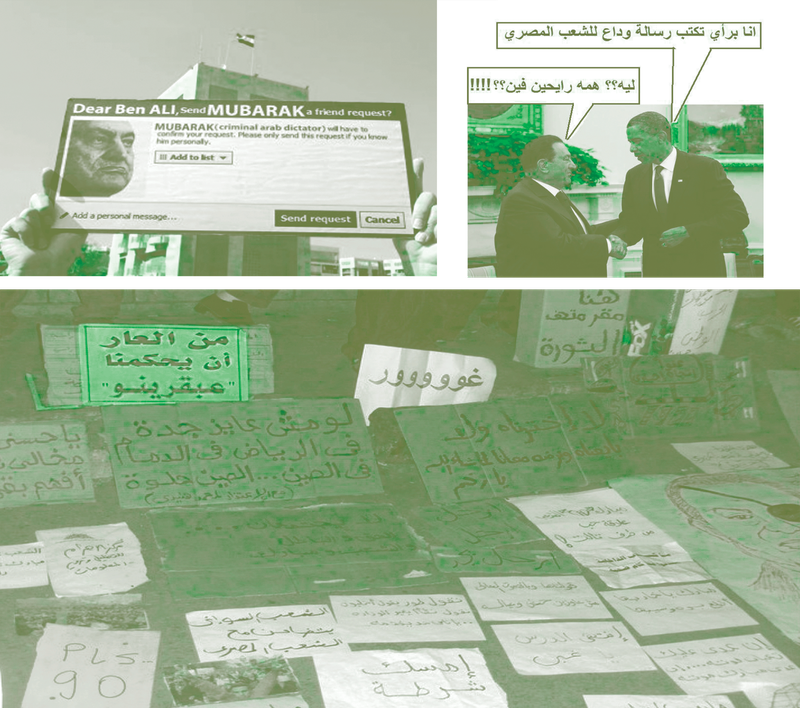
Fig 2 (Top Left): Source: Photographer not credited.
Fig 3 (Top Right): Source: Author not credited. Translation from Arabic: Obama advises Mubarak to write a farewell letter to his nation (before stepping down during the 2011 Egyptian revolution). and Mubarak asks: ‘Why? Where are they going?’
Fig 4 (Bottom): Source: Photographer not credited. Translation from Arabic: A pile of cardboard signs, one of which referring to Mubarak leaving: ‘If you don’t want to go to Jeddah, there is Riyadh and Dammam or even China, China is beautiful.’
The consequences and tensions born from those uprisings continue to traumatize political and cultural life across the region. Memes offered then, and at present times, an irreverent, humorous, undiluted – sometimes therapeutic, sometimes unsettling yet frank – lens to observe these ongoing processes, showing how self-organized digital spaces remain a beacon of tactical contestation.3
Let’s be clear: not every single meme is tactical. Memes become tactical to the extent that memers strategically craft and disseminate content to influence. They engage intentionally niche or broader public opinions, spur dialogue – sometimes even disputes – and navigate repressive environments where open expression is restricted, not only by governments but also by the platforms themselves. Within this ecosystem, private groups flourished on Facebook, providing semi‑closed spaces for experimentation, exchange, and the cultivation of shared references.
Already in 2017, the now‑archived, original content only, private Facebook group Post Colonial Memes for Oriental Minded Teens,4 still active private group Abnormal Arab Shitposting,5 and still active page Arab memes for depressed teenagers6 stood among a constellation of bilingual, possibly diasporic-led, online spaces with participation in both English and Arabic, that together sketch what could be seen as a minimal archaeology of Arab and diasporic anti/post‑colonial meme culture.


Fig 5, 6, 7, 8: Memes from Post Colonial Memes for Oriental Minded Teens. Respectively 22 April 2019, 6 January 2019, 1 June 2018 and 28 August 2019.
In their own irreverent way, these Facebook groups functioned as gateways into Arab and Muslim histories and – at times – as bridges to a community from which one might otherwise feel fragmented or apart. This is not the place to determine whether the meme is a form of pure or purist activism, but it’s also worthy to analyze how memes operate within fast-moving digital ecosystems, favor adaptation and encapsulate highly-dense semiosis designed to trigger rapid response, which are key tactics in digital resistance.
Taken together, these earlier formations—Handala’s visual legacy, the post-2011 tactical use of images, and the semi-closed meme ecologies of the late 2010s, outline the genealogy from which today’s Arab meme-makers emerge. Yet this historical arc tells only part of the story.
From the source: the memers POV
In contrast to our previous work7 which provided our external interpretive framing for Arabophones and Arab culture/politics/life-related memes, we chose to take advantage of something that online culture sometimes allows: the ability to reach out directly to the creators themselves. Through a series of interviews with two meme pages we are fans of—ones we, Noura and Basem, frequently share and discuss in our private conversations, we aim to understand how their work is tactically framed within the Arab meme ecosystem. Especially in relation to current events and lived realities across the Arab diasporas. Our goal is to inspire and highlight the agency involved in meme-making as a form of tactical media, with flying colors.
The interviews were conducted via anonymous email exchanges. We neither asked for nor received identifying information beyond what the memers were comfortable sharing. This approach allowed for open, thoughtful responses while respecting their anonymity—a political and personal necessity in their trade.
We now invite you to hear from the creators themselves: Melanchonyasylum8 and Arabiamemetica.9 Melancholyasylum has been active on Instagram since mid-2022, but the creator used to post Syrian political memes on a closed Facebook group a few months before opening an Instagram page. The creator has been living in Germany for about 8 years.
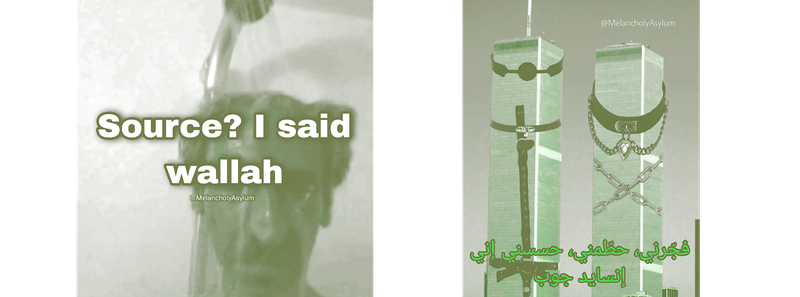
Fig 9: @melancholyasylum, Instagram. In Arabic ‘wallah’ means ‘I swear by God’. In modern casual speech – especially among youth – it’s often just used for emphasis to affirm sincerity.10
Fig 10: @melancholyasylum, Instagram. Translation from Arabic: ‘Blow me up, wreck me, make me feel like it’s an inside job’.11
Arabiamemetica is a meme page created in October 2024. Unlike other memers, the administrators of Arabiamemetica use Italian alongside Arabic to create their memes. The themes vary widely and focus both on ideas emerging from the Arab world, particularly resistance against Zionism, and on local events happening within the social/militant context in Italy.
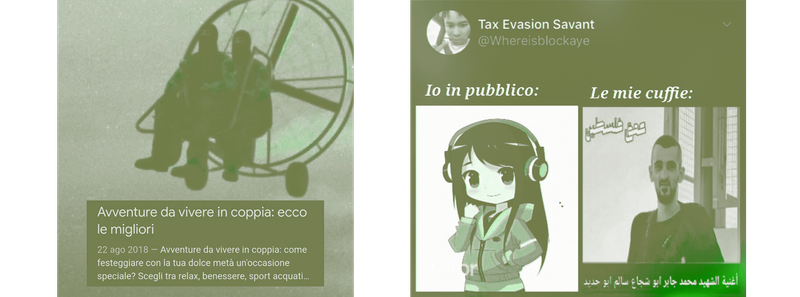
Fig 11: @arabiamemetica, Instagram. Translation from Italian: ‘Couples’ adventures: here are the best ones’. 12
Fig 12: @arabiamemetica, Instagram. Translation from Italian: ‘Me in Public – My headphones’. The headphones image depicts the song dedicated to Martyr Muhammad Jaber ‘Abu Shuja’a’ (1998-2024), commander of the Tulkarem Battalion.13
Tracing their trajectory and development is useful for understanding how these pages emerge and evolve over time.
Melancholyasylum has been active for several years, Arabiamemetica, by contrast, was recently launched (in October 2024), they both use bilingual play, the first between English and Arabic allowing its memes to circulate widely, while Arabiamemetica’s choice is to work mostly in Italian, occasionally dipping into Arabic, anchoring its work in the Italian cultural space, a setting where the debate has been lacking and sorely needed.
Despite these differences in trajectory, language, and scale, Melancholyasylum and Arabiamemetica share a common tactical horizon. Both use memes to carve out semi-closed communities of recognition—spaces where Arab and Arab-diasporic audiences can see their own contradictions, doubts, and hopes mirrored back at them, converting platforms like Instagram into semi-public arenas where anger, grief, and satire can coexist. Their memes operate as pressure valves and as tools for memory work: they digest the aftermath of 2011, the violence of ‘Western values’, and the ongoing genocide in Palestine. They use humor and DIY dense visual formats to process trauma and push back against dominant narratives. What unites them is not a shared aesthetic but a shared insistence that meme-making can be a form of situated, vernacular theory and a means of collective survival in hostile environments.
@melancholyasylum
What do you think the function of memes is in the absence of spaces for discussion in the Arab world, both in the diaspora and in Arab countries?
I think memes are a language Arabs use to get a point across. And for me personally it’s a megaphone because I never felt like my voice would be heard if I was serious, but if I could somehow get people’s attention with humor, I could perhaps get them to listen to me. Memes have also been a means of escapism. If I make a meme about something terrible happening to us, maybe it’ll help you digest the situation (despite a lot of my memes being generally cynical). On top of that I wasn’t impressed by Arab memes at all and felt like we needed better representation.
Expanding the perspective to include other pages similar to yours, such as @panarabistmeme14 – or those more focused on archiving a zeitgeist, like @onewiththeinternet15 – do you observe an aesthetic, linguistic, or political evolution in how the Arab community is representing itself through memes or other DIY online languages?
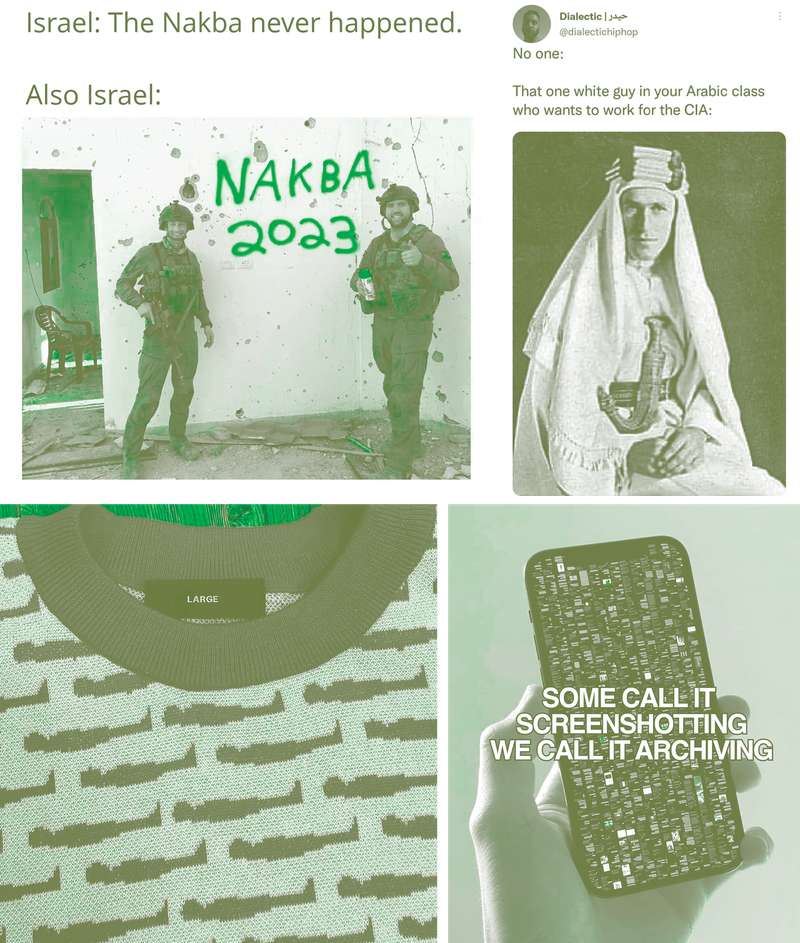
Fig 13, 14 (Top): @panarabistmemes, Instagram.
Fig 15, 16 (Bottom): @onewiththeinternet, Instagram.
Yes, of course. A lot of the new Arab pages popping up on my radar are strange and obscure, unlike the meme pages we used to see 9-10 years ago. Take the account levantinediva.16 For instance, that’s making amazing political and social Arab memes from a feminine perspective right now. I have huge respect for those creators and believe they fill a very important need. Sometimes I don’t understand the memes, or they don’t make me laugh but I’m intrigued that somebody would make a meme about a certain subject or in a certain way that I would’ve never thought of doing. But in many cases unfortunately these pages don’t last long. Either they get terminated and don’t make a second account or they lose their passion. I think there’s a certain love for attention that you should have in order to have a long-lasting meme page.
Your page and some of the memes you create express pain over the situation in Syria through a sarcastic lens that spared no one. In this way, it seemed to echo the revolutionary ideals of 2011, at a time when Syria had become a battleground for various foreign actors and appeared unable to determine its own destiny. What do you think was the function of memes in such a present context?
I get so many messages asking me who I’m with. Am I on this side or the other and even though this question might make sense in the real world, in the meme world it doesn’t. If I find humor in something, I make memes about it no matter what. Sometimes I make a meme but because of the timing, I wouldn’t post it until some time had passed. For instance, there was some hate online towards Druze because of what Al Hajri of Sweida was saying17 and at the same time I thought of a meme about Druze (Fig 17).18

Fig 17: @melancholyasylum, Instagram.
I made the meme and waited till the dust settled a bit and then posted it. I didn’t want to implicate Druze as a whole in what one of them was saying and the meme wasn’t even about politics, but still, I didn’t want them to get undeserved hate so I waited a bit. I don’t do this all the time. I’m not even always aware of it. I only got one comment on that post calling me sectarian for ‘talking about other sects,’ but aside from that, nothing else.
When it comes to measuring the impact, I don’t read the comments much anymore, there are just too many. I usually never hide or delete comments under my posts even if they’re shitting on me. Instagram automatically hides some comments, but I always unhide them.
I feel like people should know what others are saying. Recently, I had to disable comments on one of my posts illustrating the trolley problem:19 the person with their hand on the lever was marked with the Syrian flag, while the people on the tracks are marked by the Iranian and Iraqi flags. The comments got very heated and the racism between Syrians and Iraqis was unbelievable, I was tired of deleting comments so I just disabled the section. Sometimes you never know the reaction a meme will get. The meme with the vodka bottle20 started getting so much attention from around the world all of a sudden and for some reason, people started praising Bashar, so I had to post and pin two comments explaining I was going to delete comments talking shit on minorities and another one explaining to the foreigners that this meme was meant as satire and we don’t miss Bisho.21
With the fall of Bashar al-Assad’s regime (December 2024), there has been a noticeable shift in the tone and direction of memes. While satire traditionally targets those in power, your satire continues to be directed at Assad. However, with the rise of Al Sharaa, your memes have increasingly focused on the new government. What space can satire occupy in this emerging situation that is taking shape in Syria?
Believe it or not I barely got any hate from posting about Bashar before his fall. I only got it a few times when I said that Bisho isn’t part of the axis of resistance. It’s just a made-up lie. I was accused of being a terrorist and all that stuff. When it comes to the new government, I get a lot of hate online when I criticize it. I think I once said something along the lines of ‘we used to be afraid of the government when we criticize it, now we’re afraid of the people when we criticize the government.’ I understand it though, because so many people see hope in this new government and to criticize it might mean that a 13 years long revolution was for nothing. I’m not going to stop making memes about whoever steps into the spotlight, with a reason to be made into one. I still make memes about Bashar because I think we’re not done with him yet. People still blame Syrians for defeating him and say that we were good before the revolution. It’s a disservice to our image if I don’t defend the revolution.
Yeah, that makes sense, that the revolution is one of your core principles in meme making. Let’s talk about the importance of using languages other than English in social media environments. You often switch between Arabic and English: how does this choice relate to your position in the diaspora, and what impact does it have on the kind of content you create? Do you find that certain formats or topics work better in one language over the other—for instance, was the choice to use Arabic in your quiz meme (Fig 18) 22 tied to meaning, tone, or perhaps even to navigating censorship?

Fig 18: @melancholyasylum, Instagram. Translation from Arabic: ‘Bomb Tel …’
When we discuss that particular meme I used Arabic because the phrase ‘اقصف تل ابيب’ is originally popularized in Arabic so it wouldn’t be funny if I said ‘bomb Tel Aviv’. When it comes to censoring Instagram it doesn’t matter what language you post in, the censors will find you. I use English in my memes because most of the media I consume is in English. I can express myself in English better than Arabic to be honest. Some memes of course are funnier in one language or the other and I like to make my memes accordingly. Also, the clash of Arabic and English in memes is by itself sometimes humorous. You feel like those two languages are not supposed to be together so when you combine them it leads to something new. Like my ‘Ali El Deek is an industry plant’ meme (Fig 19).23
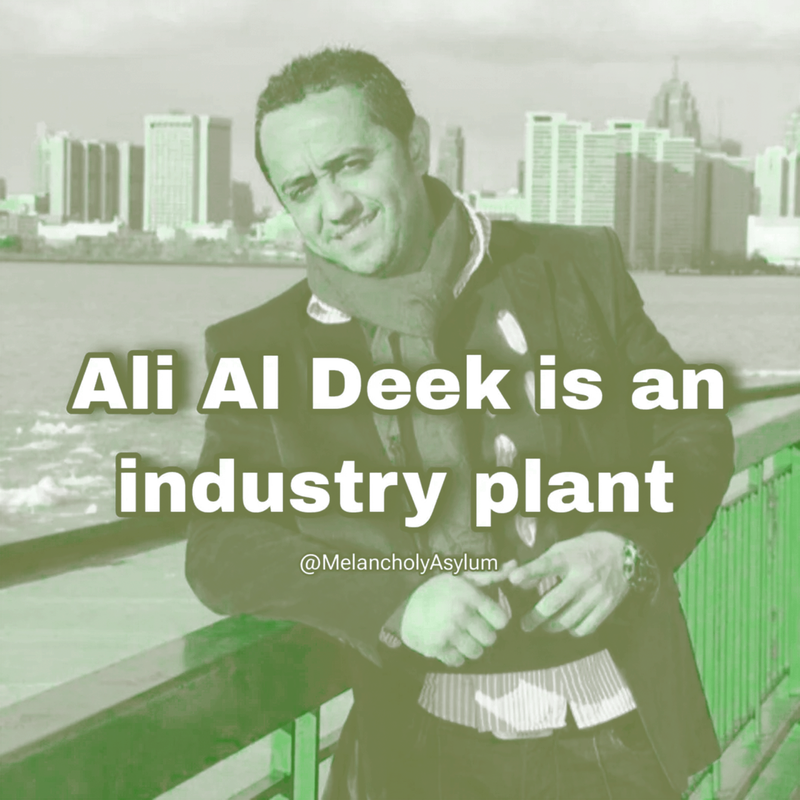
Fig 19: @melancholyasylum, Instagram. The humor arises from applying the slang term ‘industry plant’, typically used for North American and anglophone pop stars, to the unlikely context of a Syrian folk singer.
Beyond language, there is also an aesthetic dimension. Much of the English-speaking, Western-centered internet feels visually exhausted—recycling the same figures again and again, from Trump and Musk to European-philosopher quotes and even Luigi Mangione’s iconoclasm. K-pop and Japanese otaku/pop culture have become a significant aesthetic center in their own right, yet the world is far more complex than a simple two-pole model. Do you think digital culture can evolve toward a more pluricentric ecosystem, one less dominated by these Western references? Or is such speculative plurality still mostly aspirational?
Here’s why I think the Arab space online is a lot better than the Western space. We make our own memes just like they do, we have our own references just like they do, but we are AWARE of their memes and their culture and we can mix our memes with theirs, criticize them, make fun of them etc… We have more to say than they do because we’re aware of everything they talk about but they’re not aware of what we say. We can make fun of them and they will never understand it. We can reference an event that happened in the Arab world using a Western meme which is something that they can’t do. If the Internet is mostly dominated by Western culture, that doesn’t bother me—as long as we Arabs, or people living in the Arab world, have our own little online space filled with inside jokes they don’t get.
We agree! In 2013, the design duo Metahaven wrote in their pamphlet on memes called Can jokes bring down governments?: ‘The joke is an open-source weapon of the public. The meme has escaped the confines of internet forums, and is becoming a tool useful to targeted political struggles.’ Do you think their statement is still valid in 2025?
Yes, I agree completely. There’s a reason why memes are censored. They have a strong effect on how people perceive certain situations or events and it could change people’s minds one way or the other. When I first started posting memes online it was because of my frustration with the fact that I have something to say but nobody would listen. Posting them and getting a huge following has certainly changed my life and I get a lot of messages telling me ‘خلقي فشيلتي وهللا بحكيك’24 so on a small scale I’m reaching people’s hearts. I’m sure this would gradually have a ripple effect and slowly more people will see my memes and have their opinions changed or feel like their opinions are heard which would lead them to feel like they’re not alone in their struggle and they’d try to reach more people that feel the same way. And if the meme is political it would definitely have the power to shake governments.
Do you find that your meme-making spills over into your everyday political actions? Or do you see your activism as separate from the page?
I go to protests sometimes, I argue with people when they talk falsely about Syria or Palestine and I wear stuff that shows solidarity, so people on the streets either feel encouraged to do the same or so people would know that there’s opposition to their POV. Especially since I live in Germany, I like to wear my Free Palestine t-shirt to lectures where the dean of my university is the professor.
Your work is starting to be displayed and discussed on established platforms (like Do Not Research25) and in key articles on culture magazines (such as Icon26) related to digital culture, and through them, a historical and political theme is being expanded via your medium. Are you attached to the underground nature of your work, or do you appreciate the fact that your meme circulates through transmediality—meaning, not only confined to social platforms but also discussed in the art world?
I love the fact that memes are getting what they deserve. They’re art, they’re genuine art. Some are good art, some are bad, just like any form of art. And their quality isn’t about how well made they are. Most of the time it’s about how funny they are, but the well-made ones also have a special place in my heart. I’m happy that my memes are being recognized in the Arab sphere no matter which platform. I feel like I gave a voice to the people that matter to me the most. Even though my username is in magazines now, I still feel like we’re in a niche community where a lot of people know each other and the outsiders don’t know about us. We’re the niche pocket in the Arab pocket of media. The fact that my memes are being discussed also makes me self-conscious about them. I never thought I’d be written about in my life but I know that it’s something good because it’s tangible proof of my achievement in this sphere. I know I inspired a lot of meme pages, I’ve made a lot of people happy, I’ve had a big effect on Syrians in this niche pocket of the internet, but this feels like something I can just hold in my hand and look at. For a motivationless person like me, something new like this could motivate me.
Do you foresee that memers and the broader memer community will assume a socially significant role in the future within the context of Arab and Arabophone self-representation?
Yea they could, I don’t see why they couldn’t or won’t. Making memes is just another creative outlet for artists and we’ve seen many artists take important roles in government or society before.
Choose your favorite meme that you’ve created. Would you like to tell us about the choice behind it? What sparked the idea?
I’ll just tell you about one of the memes that I love so much. It’s the Courage the Cowardly Dog intro parody ‘بشار الرئيس الجبان’27 (Fig 20).28
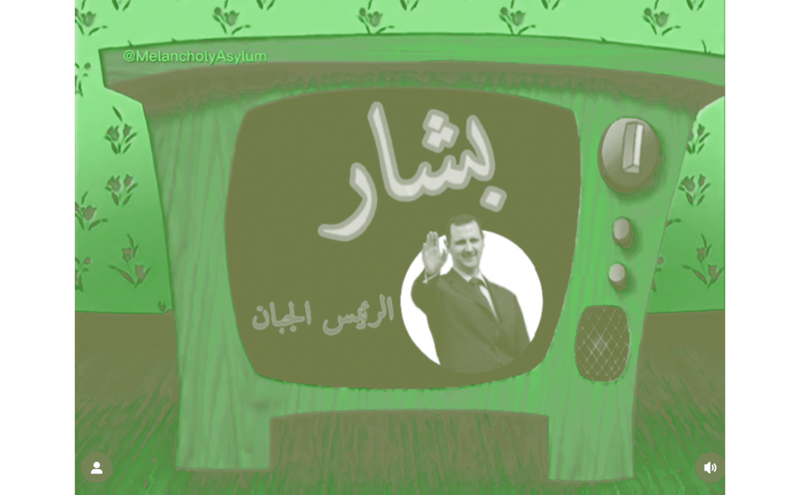
Fig 20: @melancholyasylum, Instagram. The parody plays on the idea that Bashar is a cowardly president (with a pun, since ‘Asad’ means ‘lion’ in Arabic), just like Courage is the cowardly dog.
I can’t believe I made that meme in 2022 and on my phone. I put a lot of effort into it. Maybe I’d also shout out the ‘Pimp My Country’ meme29 because it took so much out of me. Planning how to make it took months and to actually make it look the way I wanted it to look was so tiring. It’s disappointing those two memes didn’t get the attention they deserved.
People don’t realize how hard it is to find material that you can edit over when you want to make memes. I couldn’t find a pic of Bisho with his mouth open which is why I had to use my own mouth and edit it over a pic of him for the last frame of the meme. I think it didn’t get lots of attention because it was relatively early on. Before I reached more than 1k followers perhaps I’m not sure. People prefer the memes that you can understand and get the gist of in one or two frames. That’s my experience at least.
Do you create memes for yourself, or do you consider your audience when making them? What kind of audience are you most attached to?
Yes, I create a lot of memes for myself. I make memes that I never post. I made a meme where I say something along the lines of ‘if you’re struggling to get over an ex, make them a meme but never send it’. A play on writing somebody a letter but never sending it. I also make memes for my friends with years of inside jokes with the same effort I put into making memes that I post publicly, it’s very fun to see people reacting to something they never thought somebody would ever make. When it comes to what type of audience I prefer, I don’t think I have that anymore. I do consider what type of audience would like to see what meme so I make memes that every type of person would like but I don’t have favorites anymore and I try to make memes that I personally like otherwise I lose the reason I made this page in the first place. I must admit sometimes a meme would go viral but a few of my followers that I value don’t end up liking it and it makes me hate the meme. I scroll through my memes when I’m bored cuz I think they’re fun, but if the meme wasn’t liked by some of my favorite followers I scroll past it instinctively.
The memer, while maintaining anonymity, becomes part of a broader network, whether Arab, Arabophone, Arab-descendant, or otherwise. Do you perceive this sense of community? In this regard, feel free to mention any pages that inspire you or your general sources of inspiration.
Feeling like you’re part of a community comes and goes. There was a time when I felt like everyone in Arabgram knew each other, collaborating and connecting. But these days, I don’t really feel that anymore. Every now and then, a page pops up trying to create a sense of belonging or push for collaboration on some project—but I’m just over it. Nowadays, I care more about making sure my perspective is presented accurately, without having to compromise on someone else’s ideas, even if they’re well-intentioned. Maybe there’s a small niche community growing in Syriangram—I’ve heard there are a lot of new meme pages, but honestly, I wouldn’t know much about it. I wish them all the best.
I’ll take this occasion just to say that every time I see a new Arab meme page pop up I feel so proud and happy and I wanna shout them out because some of them bring something to the table that I could never bring or have the early courage to create something even though people might not like it. Here are some shoutouts: (all Instagram pages)
@levantinediva @danny_private._.hehe @reo0.exe @shitposting.dairy @syriandomari @wkm_2.0 @lookatthissy @lilithpal85311 @averagesyrian @sharabelward @5arra.posts @religion_mems
@arabiamemetica
Translated from Italian by Noura Tafeche
What inspired the creation of the @arabiamemetica page?
We30 grew up in Italy—a country that loves to see itself as the cradle of civilization, art, and hospitality. But when it comes to representing the Arab presence here, things tend to go suspiciously quiet. And when it does speak up, it’s often through the usual orientalist clichés. There were almost no spaces speaking from the diaspora, to the diaspora—with all the messiness, nuance, and contradictions that entails. So we thought: if no one else is doing it, maybe we should.
@arabiamemetica was born in that space: somewhere between Arabic spoken at home and Italian learned in school. We’re talking to each other—not in a closed-off way, but in an intimate one. There are certain feelings, insights, and moments of identity friction that only those who’ve lived them will immediately get. And if outsiders catch on, it’s because we’ve let them.
Put simply: we wanted to say things – and say them in ways – we can’t always manage elsewhere. It’s a form of release. A way to be unfiltered. The anonymity helps with that.
Your page is unique compared to similar pages because it’s written in Italian. What motivated that language choice?
We write in Italian not as a strategic or aesthetic decision, but because it’s often the language we use to think and discuss. We’re reclaiming the very language used to throw certain concepts at us—a counter-response, articulated using the exact dictionary we were made to learn. It’s the language through which we were taught what ‘integration’ means, and now it’s the one we use to question what ‘belonging’ really entails.
We’ve internalized Italian so deeply that we can now use it – paradoxically – to deconstruct the narratives it helped build about us. At the same time, we’re expressing ideas that speak to our people, but in Italian—because we like the idea of confusing the audience (Fig 21 and 22).31
Fig 21: @arabiamemetica, Instagram. Translation from Italian: ‘When I see the cops at the station (I’m Arab)’
Fig 22: @arabiamemetica, Instagram. Translation from Italian: ‘At home, mom and dad have to speak Italian, otherwise you won’t learn the language’
The choice to use Italian also narrows your potential audience. When you create a meme, do you have an audience in mind?
Our primary audience – the one we think of before posting anything – is simple: people like us. Children of the Arab diaspora, born and raised in Italy, carrying layered, contradictory, and at times burdensome identities—yet full of sharp insight. We speak to those who, like us, have learned to navigate a system that often views us only as marginal, problematic, or exceptional. Those who have developed a keen instinct for spotting violence—even when it’s delivered in calm tones and polished language.
Our response isn’t to shout louder or seek legitimacy in the usual spaces. We’ve chosen another path: irony. A form of soft power—an unconventional weapon we use among ourselves, and now transcribe into Italian, with all its biting edge.
We don’t take ourselves too seriously, but we do take our surroundings seriously. And while we often wonder who will actually see a meme—whether it will stay within our peer group or fall into the hands of someone who’ll completely miss the point—we don’t worry too much. Some posts are designed to be decoded only by those with the right frame of reference. Others speak for themselves, though they may leave outsiders a bit confused.
In short, our main audience is those who already share certain codes. But if someone from outside stumbles upon them and decides to stay and listen, that’s fine—so long as they understand we’re not speaking to them. At most, we’re allowing them to listen in.
Some memes address broader issues like white feminism or October 7th, while others are rooted in more specifically Italian contexts. Can you expand more on this duality?
Living in Italy means, whether we like it or not, being part of this society. We contribute to its culture, inhabit its codes, and participate in its contradictions. But our lives don’t begin and end here: they’re deeply intertwined with the histories, memories, and languages of the places we come from. That dual belonging – always complex – also shapes the way we communicate.
That’s why our memes are never a straight line. They shift in tone, context, and register. They operate on multiple levels at once and reflect the multifaceted nature of who we are. Some are ironic – sometimes cutting – responses to topics we’ve been dealing with for years in exasperatingly repetitive ways (like certain crass interpretations of feminism (Fig 23).32 Others emerge from things closer to home: everyday dynamics, shared experiences, micro-humiliations, and the quirky life of the public square (Fig 24).33

Fig 23: @arabiamemetica, Instagram. Translation from Italian: ‘White feminism; me’
Fig 24: @arabiamemetica, Instagram. Translation from Italian: ‘When I see on social media ‘#ultimogiornodigaza’ campaign’. #ultimogiornodigaza translated to The Last Day of Gaza was an Italian initiative circulated on social media that called for people to display a white sheet, representing a burial shroud, in their windows on May 9th, 2025 as a sign of solidarity with Gaza. The criticism refers to the fact that this initiative was purely symbolic and performative.
We move fluidly between these two tracks, without pretending to offer answers. Sometimes we’re speaking to the system; other times, it’s just us talking to each other. We laugh, and we make others laugh—but that laughter, if you pay attention, says far more than it seems to.
Many meme pages emerged in 2011, giving voice to satire against spaces that seemed to be open to but later turned out to be against counter-revolutionary waves, especially in Egypt and Syria. Your page started in 2024, under very different conditions and from different personal experiences. How do you relate to the events of 2011 and to those of October 7 in 2023?
The revolutions of 2011 and the subsequent counter-revolutions deeply shaped, even from afar, our paths of personal and collective growth. Many meme pages we follow and draw inspiration from were created by people who directly experienced the events of 2011; others were born from the voices of those raised in the diaspora after the counter-revolutionary waves extinguished – or tried to extinguish – the revolutionary spark.
These memes, raw and rough, but often filled with deep historical awareness, become tools for self-irony and emotional survival. A way to process trauma and avoid sinking into self-pity or the paralysis of despair. They are, in essence, a form of resistance to the mental and spiritual decay that the unresolved aftermath of the 2010s could easily impose.
October 7 marked a turning point for the diaspora in Italy. We became active participants in a moment that sparked the building of new, alive, and radical connections, identities, and political reflections. Our page also emerges from an urgent and shared need: to communicate, through irony, thoughts and positions that often have no space in the personal, professional, or academic contexts we inhabit. It’s a real pressure release valve, in an Italian environment where certain discourses are still demonized.
In doing this, we draw inspiration from those who have made the most of the 2011 experience, turning it into living memory and fertile ground for healthy self-irony. We inherit that legacy to build our own space – critical and liberating – post-October 7 revolution.
How important is virality to you?
We have mixed opinions on going viral. Some of us believe that becoming viral means creating content people can identify with—stepping out of self-referentiality. Others think that virality isn’t essential to the page, but can be a bonus. Being niche means being appreciated by a few, because not everyone can grasp or access out-of-the-box clarity.
Does the activity on your page have a political impact in everyday life, or does it end with the meme?
Creating a meme often sparks debate among us and provokes interesting analyses from others on the hidden or explicit meanings behind a deliberately ugly meme. We’d love for some memes to have a stronger political impact – like exposing nasty dynamics – but that requires time.
Have you noticed an aesthetic and political shift in how the Arab community is represented through memes in recent months and years?
Yes, and one point stands out: many of the recent memes from the Arab community share traits that might initially seem like flaws but actually say a lot. They’re ugly memes, in the most liberating sense: graphically messy, visually aggressive, worlds apart from the polished, sterilized aesthetics of mainstream platforms. Chaotic—because they reject linearity, and feed on accumulation, exaggeration, and disorder.
They’re brain-rot memes: intentionally absurd, worn out and exhausting, resigned to the world’s complexity, answering it with strategic nonsense—visually and linguistically. And of course, they’re ridiculous, but not naively so: they’re absurd with intent, a form of resistance, a coded language that only those with certain references can truly understand.
This aesthetic of ugliness and surrealism isn’t accidental—it’s a clear statement of intent. Discomfort becomes a way to respond to exclusion without asking for permission. Ultimately, it’s an aesthetic that doesn’t seek acceptance: it doesn’t care—it just wants to speak.
Choose the favorite meme you’ve made. How did the idea come about? Also feel free to share the meme pages or sources that inspire you.
Our favorite meme is the one featuring a father and son having a conversation about name choices. The son is named The Lion of Nablus,34 in honor of Palestinian martyr Ibrahim Nabulsi. The meme format is very old and recognizable, the graphic style is crude and messy, but the content is quite niche—that contrast represents the essence of Arabiamemetica (Fig 25).
Pages that have consistently served as our sources of inspiration and creative influence: (all Instagram pages) @levantinediva, @arabboomer.returns, @radical.arab, @lilithpal85311, @gigaphonememes, @_laughbdarija, @benbarkashitposting
Fig 25: @arabiamemetica, Instagram. Translation from Italian: ‘Dad, why is my sister named “Rose”’? ‘Because your mom loves roses.’ ‘Thank you, dad.’ ‘No problem, Lion of Nablus.’
Conclusions
Through the interviews, what emerges is a vivid picture of how memes operate not only as humorous content but as active spaces for creative development and reimagining of Arab collective memory. In the absence of open forums for political discussion and public debate, memes have become powerful instruments for constructing new imaginaries/spaces where people/users can engage with politics, identity, and history on their own terms.
One of the most striking aspects is the way memes reshape trauma and historical experience through satire. This isn’t merely satire for its own sake, it’s a tactical one, to process collective wounds, resist dominant narratives, and reframe the present. It offers a language in which critique can be both sharp and survivable, humorous and serious at once. The symbolic world generated through this meme-making becomes a vital means of questioning the past and imagining the future.
The tactical logic of Arab memes lies precisely in this adaptability to different audiences. They compress the complexity of lived realities, spanning from disappointment, anger, absurdity, and hope, into formats loaded with meaning, often reflecting nascent or old disillusionment with pan-Arabist ideals, for example, or the persistence of these ideals in their full force. This article is not simply a celebration of meme culture, but a recognition of its importance as a site of cultural production and political expression, as the ones we analyzed are not just reflections of society, they are participants in shaping it. They ask questions, they provoke responses, sometimes activating inner short circuits, they open up dialogues where none seemed possible.
That’s why it is common to read users comments saying, ‘through this meme I vented my frustration’. Many of us have thought, at least once, ‘I didn’t know how to explain my disappointment or anger until I saw this meme’: these reactions reveal how memes function as emotional shortcuts, tools for expressing what might otherwise remain unspoken. In many cases, they dare to say what the mainstream media denies or avoid addressing, what conservative or fearful segments of society wouldn’t even allow themselves to think. In this sense, memes become a space where the unsayable finally finds form. At the same time it’s important not to romanticize the role of memes as unifying forces. Often, in the comment sections, users confront and even diss each other and engage in debate much like in the online forums of the 1990s and early 2000s. In this sense, the meme acts as a catalyst, gathering often highly caustic and conflicting opinions given the grand schemes and intense political issues that are already exposed to high fragmentation, just as the Arab and Arabophone communities themselves often remain divided and unevenly connected, sometimes clashing with panarabist sentiments, and at other times, reopening colonial-era wounds.
To see memes only as entertainment is to miss their deeper function: they are repositories of collective memory and creative lifelines, often serving as strategically-crafted history lessons in miniature, blended with fragments of everyday experiences, reconnected with TV shows, pop songs, and other elements of one’s cultural repertoire that act as relational threads linking diasporic backgrounds. For those who craft these digital artifacts, the task is not about volume or virality, but about precision, resonance, and timing. In a world saturated with visual white noise, these memes do more than respond to political and cultural realities—they are embedded within them. Their role is less about offering grand solutions and more about carving out small, unconventional, vital spaces where many can center themselves in the discussion, exercise self-representation, and assert their own voice.
-
(1) For more insights on Handala we recommend reading ‘Handala Will Age Again Soon’ by Jamil Sbitan at https://www.jadaliyya.com/Details/26128 and the LAP Network’s Handala Zine found at: https://librarianswithpalestine.org/wp-content/uploads/2019/04/HandalaZine.pdf. The name Handala comes from the Arabic word for the colocynth (حنظل, ḥanẓal), a perennial plant native to the Levant which bears bitter fruit, grows back when cut, and has deep roots. ↩
-
(2) Fig 1, 2 and 3. Screenshots from page 73-74 of ‘The Arab Spring: A New Era of Humor Consumption and Production’ by Wafa Abu Hatab, International Journal of English Linguistics; Vol. 6, No. 3; 2016, ISSN 1923-869X E-ISSN 1923-8703, published by Canadian Center of Science and Education. ↩
-
(3) Wafa Abu Hatab, ‘The Arab Spring: A New Era of Humor Consumption and Production’, International Journal of English Linguistics 6, no. 3 (2016): 70–87, https://www.researchgate.net/publication/303554271_The_Arab_Spring_A_New_Era_of_Humor_Consumption_and_Production. ↩
-
(4) Fig 5, 6, 7 and 8. Post Colonial Memes for Oriental Minded Teens, https://www.facebook.com/groups/132689757407773/, Private group. Created in 2017, 28.1K members as of August 2025. ↩
-
(5) Abnormal Arab Shitposting,https://www.facebook.com/groups/575269219314380/, Created in 2016, 2.8K members as of August 2025 born out of Abnormal Arab Memes page https://www.facebook.com/AbnormalArabMemes/. ↩
-
(6) Arab memes for depressed teenagers, https://www.facebook.com/ArabNibbasTale, Created in 2019, 78K followers as of August 2025. ↩
-
(7) Noura Tafeche and Basem Kharma, ‘Ecosistema di un meme Arabo’ (original Italian version), Arabpop n.6, Tamu Edizioni, p.118, 2024.; Noura Tafeche and Basem Kharma, ‘Ecosystem of an Arab Meme’ (translated to English), Do Not Research, 2025, https://donotresearch.substack.com/p/ecosystem-of-an-arab-meme. ↩
-
(10) Fig 9. melancholyasylum, Happy almost new year dear followers❤, 30th December 2023, Slide 3, Instagram, https://www.instagram.com/p/C1eoaa7Izn3/. ↩
-
(11) Fig 10. Melancholyasylum, ينعاد عليكم جميعاً ,3> , 11 September 2022, Instagram, https://www.instagram.com/p/CiXS_aGMCVO/. ↩
-
(12) Fig 11. Arabiamemetica, Cose da fare con la dolce metà (Arab version) , 28 October 2025, Instagram, https://www.instagram.com/p/DBrzmLqsx2Y/. ↩
-
(13) Fig 12. #siamoragazze *, 5 November 2024, Instagram https://www.instagram.com/p/DB_PKSOszBY/. ↩
-
(14) Fig 13. panarabistmemes, Nakba, 20 May 2024, Instagram, https://www.instagram.com/p/C7M4rlXs7V2/. Fig 14. panarabistmemes, Arabic class, 6 June 2022, Instagram https://www.instagram.com/p/Ced2YYAM7KZ/. ↩
-
(15) https://instagram.com/onewiththeinternet. Fig 15. onewitheinternet, Saddam, 30th July 2025, Slide 1, Instagram, https://www.instagram.com/p/DMtpxgSI788/. Fig 16. onewitheinternet, Some Call, 14 January 2025, Slide 1, Instagram https://www.instagram.com/p/DE0VLe8T8NI. ↩
-
(17) The incident involved a clash in July 2025 between Druze militias led by Al Hajari and Bedouin families in the Swaidah area of southern Syria. Government forces intervened following these hostilities. The fights were marked by significant sectarian violence, with government forces accused of carrying out massacres against the Druze because of their religion. To learn more about this issue, we recommend reading the Al Jazeera article ‘Why did Israel bomb Syria? A look at the Druze and the violence in Suwayda’ found here: https://www.aljazeera.com/news/2025/7/16/why-did-israel-bomb-syria-a-look-at-the-druze-and-the-violence-in-suwayda. ↩
-
(18) Fig 17. Melancholyasylum, *♥ كوكتيل ميمز للحبايب * May 18 2025, Slide 7, Instagram, https://www.instagram.com/p/DJy12nXMCrc/. ↩
-
(19) Melancholyasylum, Iraq is like an obsessed ex that won’t let you move on #Syria #Fyp, 12 April 2025, Instagram https://www.instagram.com/reel/DIWC1eyM-lm/. ↩
-
(20) Melancholyasylum, Why would Imamu say this? #Syria #Fyp, 5 May 2025, Instagram, https://www.instagram.com/reel/DJRI25OMtoh/ Meme translation: Arabic sentence says ‘curse his soul’ referring to Hafez al Assad, Bashar’s father. The sung part says: ‘Imam Ali and the lion Bashar’. ↩
-
(21) Nickname for ex-president of Syria, Bashar Al Assad. ↩
-
(22) Fig 18. Melancholyasylum, Don’t solve it or else I’m in trouble, 7 January 2024, Instagram https://www.instagram.com/p/C1zX_JcIqTW/ ↩
-
(23) Fig 19. Melancholyasylum, Ali Al Deek is an industry plant, 26 April 2025, Slide 9, Instagram https://www.instagram.com/p/DI6I-_fMfYj/. ↩
-
(24) In Syrian Arabic it can be translated as ‘I vented my frustration, I’m speaking seriously’ to mean that the meme let out the user’s frustration. ↩
-
(25) Tafeche and Kharma, ‘Ecosystem of an Arab Meme’, Do Not Research, 2025, https://donotresearch.substack.com/p/ecosystem-of-an-arab-meme. ↩
-
(26) Hadi Afif, ‘The Core of it All: Internet aesthetics as tools of resistance, from driftcore to corecore and other algorithmic undergrounds’, ICON, 2025, https://icon.ink/articles/the-core-of-it-all/. ↩
-
(27) Translation: Bashar the cowardly president. ↩
-
(28) Fig 20. Melancholyasylum, بيشو، الرئيس الجبان 27 September 2022, Instagram, https://www.instagram.com/reel/CjAeQPMgcZm/. ↩
-
(29) Melancholyasylum, Pimp my ride, 22 March 2025, Instagram, https://www.instagram.com/reel/DHgBWnqsbna/. ↩
-
(30)The creator(s) prefer to remain anonymous in terms of being a multiple identity or a singular. ↩
-
(31) Fig 21. Arabiamemetica, 1312, 28 October 2024, Instagram https://www.instagram.com/p/DBr0lbiMa9W/.; Fig 22. Arabiamemetica, Professor, 3 December 2024, Instagram https://www.instagram.com/p/DDH5lsAMsRG/. ↩
-
(32) Fig 23. Arabamemetica, White Feminism; Me, 4 November 2024, Instagram https://www.instagram.com/p/DB9ZgecsVIr/. ↩
-
(33) Fig 24. #ultimogiornodistaminchia https://www.instagram.com/explore/tags/ultimogiornodistaminchia/; 27 September 2025, Instagram https://www.instagram.com/p/DJc37ZJsDFL/?img_index=1. ↩
-
(34) Fig 25. Arabiamemetica, Orgoglio di mamma e papà, 6 November 2024, Instagram, https://www.instagram.com/p/DCBjtXtMAzO/. ↩
Defiant creative investigations and technofascism
Eke Rebergen
‘How can we continue to attack this panoptic hellscape and get away with it?’ This question was posed in a rather provocative text titled ‘Cars as Cameras’ from 2023.1 The authors aim for bold resistance against large-scale police surveillance made possible by unprecedented data collection. They promote fighting back against existing proliferation of harmful high-tech machines and to try to halt the ecologically destructive technological infrastructures of big tech companies. These interlocking systems and devastating effects for them constitute a panoptic hellscape that they resolutely oppose. They don’t rely on reflexive methods or ethical frameworks, nor believe in developing so called responsible technology or more cautious implementation strategies. Following their line of reasoning: artist and designers today are stuck in a slumber of ever more undecisive critical approaches and abstract conservative strategies, while there is plenty need for thorough and defiant counter investigations and decisive oppositional action. It is time to break through the current creative apathy.
The authors of ‘Cars as Cameras’ propagate direct action. They advocate forms of sabotage and destruction. Their specific target: Tesla. They give examples of previous attempts of smashing car windows, suggest many other points of intervention ranging from the network of charging stations to vehicle lots, and explain how to minimize the chance of getting caught. When fighting against something that constantly monitors and oppresses, caution is advised to avoid unwanted consequences, lawsuits, or unpleasant repercussions. Strike wisely, the authors proclaim.

Fig 1: Front of Cars as Cameras booklet made by No Trace Project, text by Rose City Counter-Info.
Designers and artists are in a good position to strike wisely. They can develop and iterate all kinds of experimental forms of resistance and work towards clever creative disruptions. Some indeed are already demolishing Tesla cars as a public art event2 or dropping enormous Olmec head sculpture on top of these cars as an artistic statement.3 Others decided to make ‘I bought this before I knew Elon was crazy’ stickers, suggested creative projects for debadging4 or disguising the car.5 Also, culture jamming projects were carried out like the Swasticar campaign making hatred for Elon Musk visible on the street6 or the contradictory cybertruck7 featuring the Palestinian flag and keffiyeh design. Still, there is a risk of getting caught up in mere pranksterism and niche critical creative work. Few creatives seem willing to explore the boundaries of what art and design can achieve beyond the more well-known rhetorical designs and aesthetic art performances. Let us proceed with determination in developing further creative research for attacking the panoptic hellscape. For this we will delve into voltage glitching, rescuing snails, and understanding tiki bars in Texas.
Disturbing and disclosing Tesla
We remain focused on Teslas as the primary target for exploring further creative possibilities. Based on investigations from the No Trace Project (an activist collective that also turned the ‘Cars as Cameras’ text into an easily printable zine), Tesla cars are to be understood as part of the vast state’s surveillance network and the omnipresent security systems. All nine Tesla cameras are actively recording while the car is moving, but also when the car is parked and turned off in what is called the ‘sentry mode’. The publication offers insights into the Samsung cameras used and the AI programs that process the data. The videos can be recovered afterwards and in some cases the footage might be kept indefinitely. In the ‘Cars and Cameras’ text concrete examples are mentioned of how such data is used by the police. The authors refuse being constantly recorded and oppose the possibility of being identified all the time. They offer some interesting insights into the technologies used and point to promising directions for further investigation.
Their main concern is to stay unrecognizable, for example through wearing loose-fitting clothing and sunglasses, and by staying out of the field of view of these cameras. And to use spray paint to cover the cameras when needed. Although such practical suggestions are informative to dodge the omnipresent technologies of control, it seems necessary to get beyond mere keeping out of sight and a little window smashing or spray paint now and then. Both staying under the radar and engaging in forms of vandalism do not provide much further insight into the ongoing innovations and inner workings of these systems, nor the possibilities for scaling up resistance. There must be more diverse, thoughtful and investigative ways and embodied experimentation to counter these complex systems. It would be helpful if we can single out further specific malicious code or functioning, share insights with others and collaborate, and more thoroughly counter harmful technological infrastructures that surround us.
In their presentation for the Chaos Computer Club of December 2023 in Hamburg, one of the main European hacking conferences, Niclas Kühnapfel, Christian Werling and Hans Niklas Jacob explained how to get ‘back in the Driver’s Seat’ of Tesla.8 These presenters had been researching the Autopilot Hardware of the Tesla and they presented a successful so called ‘fault injection attack’ and extraction of encrypted keys to make it possible to connect to Tesla’s autopilot API. The method used for fault injection was ‘voltage glitching’. That is a creative and elusive trick to get access to software by manipulating hardware. Don’t worry: it does not matter if you haven’t got a clue what this means. The setup in the picture will give you at least some idea of the kind of technological skills needed, and the type of work done. They showed how to defiantly dig into these complex technological systems and disclose what these powerful black boxes do, uncovering what rules it is programmed to perform, and what its makers wish to hide from us in inaccessible domains of these machines. They showed it is possible to develop new ways to indeed attack Tesla’s most locked away technological systems and understand its hidden inner workings. Although it certainly is not easy, they considered it fun and self-empowering. They got a big round of applause from the crowd.
A couple of months later a diverse group of activists tried to halt Tesla’s expansion of its Gigafactory in Grünheide’s forest near Berlin. It was organized by groups such as the Grünheide Citizens’ Initiative, the ‘Turn Tesla off’ alliance, and other groups like Fridays for Future. From March 2024 onwards people already occupied the adjacent forest, creating tree top houses and working together with the residents of the area. It culminated in large scale action days encouraged and strengthened by Disrupt, an alliance including ‘Ende Gelände’ which is known for earlier occupations and large-scale protests. Together they protested ‘car capitalism in a green guise’ including the supply chains, felling of trees and destruction of forests, immense water usage, and more general the proliferation of individual transport in the face of the evolving climate catastrophe.9 Leading up to these protests, some engaged in further militant action like the ‘Switch off Tesla! volcano group’ that disrupted the functioning of the Tesla factory by setting a power station on fire, claiming that ‘the longer the Gigafactory remains closed, the better for the planet’.10 In their statement they claimed they even rescued snails from electricity pylons before setting these pylons on fire a few minutes later.11 I suppose mentioning these snails was important to them because rescuing them symbolized something bigger. They were not out to destroy but to save lives. And while not everyone will feel like setting power stations on fire or risk getting arrested, there is something sympathetic in their way of reasoning: ‘We don’t make people mine lithium in horrible conditions. We don’t destroy the earth. We don’t trade grain on the stock market. We don’t want to kill other people or shrug off their deaths to maximize profits.’ They wanted to take out some of the infrastructure, find out what this would set in motion, protect what should not suffer from these vast tech expansi
ons, and be sure to fight for life for all. They showed it can indeed be done and by staying anonymous they got away with it.
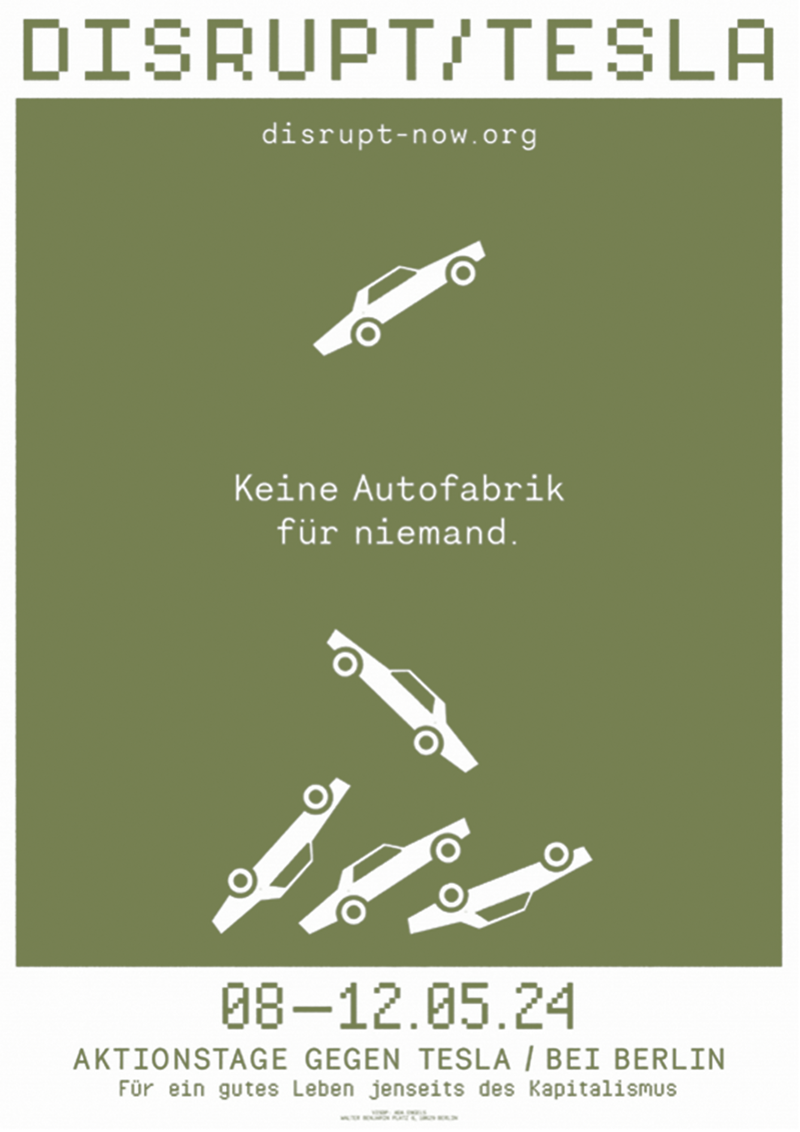
As a final example, again a couple of months later, the ex-Tesla employee Lukasz Krupski was in court for revealing critical safety issues of Tesla’s cars. He had disclosed Tesla vehicles ‘unexpectedly accelerating or braking when their autopilot function is switched on’ by bringing ‘thousands of safety complaints from Tesla customers to German business paper Handelsblatt and US regulators, after trying to raise the alarm about company procedures internally.’12 A recurring consequence is for example that Tesla taxis collide with outdoor seating areas. As he explained in an interview with BBC this is a matter of general concern: ‘It affects all of us because we are essentially experiments in public roads. So even if you don’t have a Tesla, your children still walk in the footpath’.13 Krupski got away with it in court. The judge affirmed he had acted as a whistleblower and ruled that Tesla ‘unlawfully retaliated’ against him. But the point is obviously not to win such court cases. It is the whistleblowing and disclosing. It is about making sure other people know what is happening even though it unfolds out of sight and to adjust the general impression of smooth functioning of these complex technological systems we encounter every day.
What all these examples have in common is that they develop oppositional stances that point out programmed harm and try to disclose the unacceptable consequences of tech functionalities. As such it highlights but also attacks aspects of the hellscape we are living in. They show there are creative ways to disrupt the technology in these cars and counter their uncharted development and functioning. They emphasize it is possible to find supportive platforms and reach like-minded communities the moment you reveal things that the Musks of this world don’t like revealed. And the list can be extended towards other branches of his tech imperium. Like the Carrizo Comecrudo Tribe of Texas that are currently fighting SpaceX to protect Boca Chica Beach land with DIY documentaries and heartfelt personal stories.14 Or the Black feminists that explicated the white supremacist ideology that underpins platform affordances after Twitter was taken over by Musk.15 Or the Neuralink employee who released information to Wired about the death of a monkey that was euthanized after a brain implant broke off.16 As these examples show, it is possible to go beyond scratching the surface and ventilating a minimal sort of critical awareness. It extends the current search for ways to get beyond symbolic actions, tweet wars and digital activism, and get away from the self-referential and often obsessively used online platforms to work towards more in-depth investigations, alternative infrastructures and community action.17
The question ‘how can we continue to attack this panoptic hellscape and get away with it?’ points towards this kind of upping the creative stakes. We should desperately (re)learn ourselves to further probe, speak out, reveal, disclose, obstruct, destroy, organize, collectivize, conspire. Today, this is the challenge for meaningful creative experimentation in the face of technological injustice, extraction, and surveillance. Let’s channel our creative and investigative powers and defiantly experiment with attacking and countering the panoptic hellscape. And make sure we point out the most pressing and worrisome aspects of it.
Understanding technofascism’s specifics
Unfortunately, it is not just about some technical details that are instrumental for some well-defined social problems. Technology today plays a multifaceted role in all kinds of societal issues and gets often infused with dangerous ideologies or unjust future scenarios. We need to be aware of the dark historical lineages and hardly noticeable oppressive social dynamics that might be at play. This is where it gets particularly interesting. Here the need for additional creative research becomes even more apparent.
Fig 4: Cover of book Cooling the Tropics.
Recent academic research has developed interdisciplinary approaches to address the entanglements of technological functioning, undesirable social tendencies and broader oppressive systems. Specific technological details and disclosing can make us aware of how nasty histories and problematic ideologies can continue to shape, and be reaffirmed by, these high-tech everyday products. The devil is often in the details. Like the tiki bar near the SpaceX launchpads in Texas. It is just a small detail of the resort village in Brownsville, shown in a journalist’s photo of the SpaceX campus. There is nothing particularly special about it at first sight. But this simple fact of having this tiki bar at SpaceX becomes significant when connected to the histories of imported commodification and still pervasive colonial imaginaries. As Hobart’s recent mind-blowing research highlights,18 Hawai’ian shirts and cocktails are not accidentally connected to spaceflight or Musk’s ideologies. Through documenting and investigating technologies of refrigeration and cooling Hobart points out the ongoing conditioning power of imaginaries of transportation, masculinity, scientific research, and environmental politics. Questioning the reason of existence of this tiki bar can lead toward a thorough rethinking of the histories of oppression. It reminds us of the much older writings by the Dutch collective Bilwet, that already linked together and exposed the technological conditioning in the dreams of space travels, car culture, tourism and healthcare.19 And like Hobart shows, through reawakening the local mo’olelo (storied histories) and disclosing the colonial archives, we can rethink the interrelated stories of chilled drinks, childhood nostalgia, and dreams of outer space. Only then we can reevaluate the specifics. The simple technology of refrigeration, so common for all of us, must be understood as linked up with extractive, restrictive, and often outright repressive social structures and settler colonialism that are somehow also tied to SpaceX and especially this tiki bar in Texas. It opens a rich world of alternative perspectives and readaptations. We ultimately need this type of interdisciplinary research and thinking to get to the more fundamental understanding and overturning of the hellscape we currently face.

Fig 5: (Screenshot from video of projections on Tesla factory by Led by Donkeys and Political Beauty)[https://www.instagram.com/reel/DFKlMtUoiBE]
Ultimately, as was done in the projections on the Tesla factory in Germany realized by Led By Donkeys and Political Beauty,20 this means we must point out fascist resurgences. The projections were shown days after Musk’s Nazi salute. It documented Musk’s relations with right wing politicians in Europe. But the uncovering of repressive social imaginaries and the inherent fascist tendencies shouldn’t stop there. Fascism surely is not just some Nazi salute or alignment with right wing politicians. It is a (potential) broad social base that challenges bourgeois institutional and cultural power, re-entrenching the already devastating economic and social hierarchies.21 Whether the current tendency should be understood as a (latent) form of late fascism, according to Toscano rooted in a history of racial capitalism, systemic violence and crisis22 or post-fascism of heterogeneous and transitional movements,23 what concerns us here is the interdependence with new technological innovations. In current technofascist developments, there is not just a new authoritarianism driven by technocrats24 or post-internet far right thriving on the message boards and platforms with its strategic concealments, shitposting and pranksterism,25 or MAGA fascist-propaganda slop26 and other the cringe and cruel bullshit aesthetics of right-wing ideology.27 Technofascism might well be the general intensifier and exacerbator of the panoptic hellscape in its current multifaceted forms.
You certainly cannot just post your way out of fascism.28 To counter the indirect and invisible mechanisms of racism and discrimination, consisting of microaggressions and everyday harm, we must battle the interconnectedness of covert communication and social media effects. This can be an immediate, poetic, and humorous creative practice as the online exhibition by Error 417 shows.29 But we need to dig deeper and uncover what lurks behind this all. As Eschmann reminds us, once such racism and ideology of domination was symbolically covered by emblematic pointed white hoods, but now it is often covered by a metaphorical hood of subtlety.30 His inclination to make sure the ‘hood comes off’ we extend here towards Tesla cars and beyond. Understanding what is beneath the hood of the car, or more broadly the shiny surfaces and designed interfaces becomes extra relevant when understood in relation to Musk’s clear right-wing radicalization, visible in his embracing of far-right movements and conspiracy theories.31 McQuillan’s assessment of the fascist inclinations of artificial intelligence32 can only be made based on extensive knowledge of the actual technologies and different social contexts it operates in. As Saraiva showed in ‘Fascist Pigs’ for earlier periods in time, analyzing techno-scientific particularities can be key to understanding fascist mass mobilizations, infrastructural power of a fascist state, and the design of a rooted-in-the-soil national community.33 A kind of antifascist infrastructural analysis is not only important for understand how fascism works but also for knowing how it can be creatively fought and undermined.34 To engage in such interdisciplinary research to uncover inherent undesirable social tendencies and broader oppressive systems, it is necessary to deepen our understanding and make more technologically informed assessments of the pervasive ‘microfascist machineries’ as described by Bratich, with its anaesthetizing and abstracting social effects.35
Tech-savy creative research and (re)learning
There is already some attention for the importance of antifascist action and thought in artistic exploration (or any creative interventionism or investigation) beyond the reactive culture wars. 36 We can expand on the call to ‘turn to the space and time of the studio’ into a ‘unique contribution of art education to antifascist struggles’ that Lewis and Hyland propose as antifascist politics of studioing37 and take the kind of practice they suggest towards creative disruption of and reimaginations of technological systems. Let’s incorporate the disclosing of the workings of technology in collective oppositional learning within feminist counterpublics, channeled through spaces of protest and as part of a common antifascist struggle.38 Such creative work can be informed by gender, trans and queer struggles, inherent to fighting back against fascism, and with Kovich this should be a call for more diverse roles and activities, taken up within and beyond the already existing reading groups, social clubs, collective kitchens, daycare and sports.39 New technological innovations of the panoptic hellscape permeates all of this, so attacking and getting away should be an unwavering concern in all related social spaces, research groups and creative media projects.
Only by pursuing this, we might eventually find ways to slowly recalibrate the current ideological inclinations, change oppressive dynamics, and reorient towards alternative possibilities and histories. As we become even more assured of the fascist lure of cryptocurrencies40 we might be better equipped to reevaluate the alternative histories as found in BlackNet, hashcash, RPOW, or any libertarian coinage and certificates.41 Rejecting SpaceX’s mission of conquest and expansion, clearly echoing fascist sci-fi narratives,42 will open opportunities for space without rockets43 or revisiting the ‘reverse imagineering’ of the Association of Autonomous Astronauts.44 And a radical rejection of the current ‘smart’ cars could make way for initiatives like planka.nu, a Danish social movement that explicitly supports fare dodging and advocates free public transport through a solidarity fund to pay for any fines—ultimately hoping to free us, according to their book, from all ecologically unsustainable cars, the inherent economic and social segregation, egoistic behavior, massive road network planned by technocrats, numerous traffic regulations, traffic congestions, and car traffic accidents.45
Design teachers, art critics, creative professionals, academics, activists, students: this is the point where you come in. It means there is a need for organizing hacking sessions, whistleblowing workshops, collective sabotage practices. We need to overcome feelings of anxiety and technological incompetence and instead learn and investigate the specifics. We must be bold in connecting this to technofascism and open space for radical alternatives. The advantage we have is that we can mobilize a rich history of art and design and its expertise of material sensitivity, thinking by doing approaches, technological experimentation, and critical (un)making.46 To creatively respond to current complex and pressing social challenges of devastating technological developments, it is necessary to make tech-savy investigative uncovering and related defiant research a shared field of practice. This can be done within the artist studios and design schools but there are also social centers, activist spaces, and academic study groups to engage. We need to connect the inner workings of the technological systems that surround us, that we all experience, to broad histories of surveillance, ecological destruction, all-encompassing infrastructures and tech power. We must understand how specific technologies are used to control, oppress, kill, mutilate, extract, repress. We need to develop counter narratives, rooted in technological disclosing and disruptive investigations. And as we start to undermine the panoptic hellscape, we may become ever more convinced of the necessity of such experimentation and know better how to get away with ever more clever interventions and disclosing.
We can take first cues from the anarchist troublemakers, the vandals, and the creatures of the night that the ‘Cars as Cameras’ text explicitly addresses, but extend the collaboration and invite anyone that feels tech anxiety, anyone looking for existing forms of experimentation and radical reimagining, and all kinds of other socially engaged collectives out there. It is more necessary than ever to stimulate further bold collective strategizing for effectively attacking the panoptic hellscape that increasingly seems to be closing in on us. We hope the above can encourage to strike wisely, collectively and creatively.
-
(1) Rose City Counter-Info, ‘Cars as Cameras’, Noblogs, 7 October 2023, https://rosecitycounterinfo.noblogs.org/2023/10/cars-as-cameras-a-short-overview-of-tesla-surveillance-features-and-lessons-for-attack/. ↩
-
(2) Kate McCusker, ‘Sledgehammer-wielding Musk critics smash up Tesla in London art project’, The Guardian, 10 April 2025, https://www.theguardian.com/technology/2025/apr/10/sledgehammer-wielding-musk-critics-smash-up-tesla-in-london-art-project. ↩
-
(3) Maya Pontone, ‘Artist Crushes Tesla With Colossal Olmec Head Sculpture’, Hyperallergic, 21 March 2024, https://hyperallergic.com/878913/artist-chavis-marmol-crushes-tesla-with-colossal-olmec-head-sculpture/. ↩
-
(4) Whooshn, ‘Quick and Easy: Remove Your Tesla Logos Without a Scratch!’, YouTube, 4 February 2025, https://youtu.be/a-VNLqm1odk. ↩
-
(5) Miles Klee, ‘Tesla owners are desperately trying to disguise their cars’, Rolling Stone, 12 March 2025, https://www.rollingstone.com/culture/culture-features/tesla-elon-musk-embarassed-disguise-car-1235294522/. ↩
-
(6) Noor Al-Sibai, ‘Ads for Elon Musk’s “Swasticar” Go Viral as Tesla Crumbles’, Futurism, 27 February 2025, https://futurism.com/tesla-stocks-elon-musk-swasticar. ↩
-
(7) Scoop Empire, ‘A bold transformation of the Cybertruck featuring the Palestinian flag and keffiyeh design, blending innovation with a powerful message of unity and support’, Instagram, 13 January 2025, https://www.instagram.com/reel/DEwvxo8i3Id/. ↩
-
(8) Niclas Kühnafpfel, Christian Werling, and Hans Niklas Jacob, ‘Back in the Driver’s Seat’, 37C3, 27 December 2023, https://media.ccc.de/v/37c3-12144-back_in_the_driver_s_seat_recovering_critical_data_from_tesla_autopilot_using_voltage_glitching. ↩
-
(9) Disrupt, ‘Block Tesla – Disrupt Elon. Stop the expansion of the Tesla Gigafactory in Grünheide’, 2024, https://oldwp.disrupt-now.org/en/disrupt-tesla/. ↩
-
(10) Act for Freedom Now!, ‘Berlin, Germany: news from Tesla and a second communique from the Volcano Group’, 10 April 2024, https://actforfree.noblogs.org/2024/04/10/berlingermany-news-from-tesla-and-a-second-communique-from-the-volcano-group/. ↩
-
(11) Vulkangruppe Tesla Abschalten!, ‘Nachschlag zum Brandanschlag auf Tesla’, Indymedia, 9 March 2024, https://de.indymedia.org/node/345275. ↩
-
(12) Blueprint for Free Speech, ‘Lukasz Krupski wins retaliation case against Tesla’, 11 December 2024, https://www.blueprintforfreespeech.net/en/news/lukasz-krupski-wins-retaliation-case-against-tesla. ↩
-
(13) Zoe Kleinman, ‘Ex-Tesla employee casts doubt on car safety’, BBC News, 5 December 2023, https://www.bbc.co.uk/news/technology-67591311. ↩
-
(14) Frank Hopper, ‘In Shadow of SpaceX, Tribe Fighting to Protect Sacred Sites from Elon Musk’, Deceleration News, 3 January 2023, https://deceleration.news/spacex-elon-musk-carrizo-comecrudo/. ↩
-
(15) temi lasade-anderson and Francesca Sobande, ‘Ideology as/of Platform Affordance and Black Feminist Conceptualizations of “Canceling”: Reading Twitter’, Television & New Media, 26(1), 2025, pp.119-131. ↩
-
(16) Dhruv Mehrotra and Dell Cameron, ‘The Gruesome Story of How Neuralink’s Monkeys Actually Died’, Wired, 20 September 2023, https://www.wired.com/story/elon-musk-pcrm-neuralink-monkey-deaths/. ↩
-
(17) Katherine Alejandra Cross, Log Off: Why Posting and Politics (Almost) Never Mix, LittlePuss Press, 2024. ↩
-
(18) Hi′ilei Julia Kawehipuaakahaopulani Hobart, Cooling the Tropics: Ice, Indigeneity, and Hawaiian Refreshment, Duke University Press, 2022. ↩
-
(19) Bilwet, Het Beeldenrijk: over stralingsangst en ruimteverlangen [Empire of Images: Radiation Fear and Space Desire], Raket en Lont, 1985. ↩
-
(20) Led By Donkeys, ‘Heil Tesla’, YouTube, 23 January 2025, https://youtu.be/NjWl_RNDMSA. ↩
-
(21) Devin Z. Shaw, Genealogies of Antifascism: Militancy, Critique and the Three Way Fight, Kersplebedeb Publishing, 2024. ↩
-
(22) Alberto Toscano, Late Fascism: Race, Capitalism and the Politics of Crisis, Verso, 2023. ↩
-
(23) Enzo Traverso, The new faces of fascism: Populism and the far right, Verso, 2019. ↩
-
(24) Kyle Chayka, ‘Techno-Fascism Comes to America, The historic parallels that help explain Elon Musk’s rampage on the federal government’, The New Yorker, 26 February 2025, https://www.newyorker.com/culture/infinite-scroll/techno-fascism-comes-to-america-elon-musk. ↩
-
(25) 12 Rules for WHAT, Post-Internet Far Right, Dog Section Press, 2022. ↩
-
(26) Charlie Warzel, ‘The MAGA Aesthetic Is AI Slop, Far-right influencers are flooding social media with a new kind of junk’, The Atlantic, 21 August 2024, https://www.theatlantic.com/technology/archive/2024/08/trump-posts-ai-image/679540/. ↩
-
(27) Gareth Watkins, ‘AI: The New Aesthetics of Fascism’, The New Socialist, 9 February 2025, https://newsocialist.org.uk/transmissions/ai-the-new-aesthetics-of-fascism/. ↩
-
(28) Janus Rose, ‘You Can’t Post Your Way Out of Fascism’, 404 Media, 5 February 2025, https://www.404media.co/you-cant-post-your-way-out-of-fascism/. ↩
-
(29) Error 417, ‘13 Scores Against Tech Fascism’, 2026, https://error417.expectation.fail/13scoresagainsttechfascism/. ↩
-
(30) Rob Eschmann, When the Hood comes off: racism and resistance in the digital age, University of California Press, 2023. ↩
-
(31) Jacob Silverman, Gilded Rage. Elon Musk and the Radicalization of Silicon Valley, Bloomsbury, 2025. ↩
-
(32) Dan McQuillan, Resisting AI: An Anti-fascist Approach to Artificial Intelligence, Policy Press, 2022. ↩
-
(33) Tiago Saraiva, Fascist Pigs: Technoscientific Organisms and the History of Fascism, The MIT Press, 2016. ↩
-
(34) Gwen Barnard and Naomi Alizah Cohen, Notes Towards an Antifascist Infrastructural Analysis, 17 October 2022, https://titipi.org/wiki/index.php/Notes_Towards_an_Antifascist_Infrastructural_Analysis. ↩
-
(35) Jack Z. Bratich, On Microfascism: Gender, War, and Death, Common Notions, 2022. ↩
-
(36) Tom Holert, ‘Transfixing the Fascist Episteme’, in Deserting form the Culture Wars, ed. Maria Hlavajova, Sven Lütticken, BAK, 2020. ↩
-
(37) Tyson Lewis and Peter Hyland, ‘The Anti-Fascist Politics of Studioing’, Revista Portuguesa De Pedagogia, 56, 2022. ↩
-
(38) Ewa Majewska, Feminist Antifascism: Counterpublics of the Common, Verso, 2021. ↩
-
(39) Tammy Kovich, Antifacism Against Machismo, Kersplebedeb Publishing, 2023. ↩
-
(40) Peter Howson, Let Them Eat Crypt: The Blockchain Scam That’s Ruining the World, Pluto Press, 2023. ↩
-
(41) Finn Brunton, Digital Cash: The Unknown History of the Anarchists, Utopians, and Technologists Who Created Cryptocurrency, Princeton University Press, 2019. ↩
-
(42) Sherronda J. Brown, ‘Sci-fi, fantasy, and fascism’, Scalawag Magazine, 4 February 2025, https://scalawagmagazine.org/2025/02/sci-fi-fantasy-and-fascism/. ↩
-
(43) Magali Daniaux and Cédric Pigot, Space Without Rockets, UV Editions, 2022. ↩
-
(44) Brian Holmes, Unleashing the Collective Phantoms, Autonomedia, 2008. ↩
-
(45) Planka.nu, The Traffic Power Structure, PM Press, 2016. ↩
-
(46) Janneke Wesseling and Florian Cramer, Making Matters, Valiz, 2022. ↩
Frequencies for Better Futures
Frequencies for Better Futures
Convivial Tools for Worlds to Come
The Island School of Social Autonomy
Denise Sumi
The Island School of Social Autonomy (ISSA) is located on three hectares of land above the small coastal town of Komiža, on the island of Vis in the Adriatic Sea (Fig 1).
Fig 1: The Island School of Social Autonomy is located on three hectares of land above the small coastal town of Komiža, on the island of Vis in the Adriatic Sea, CC 4.0 by ISSA School / BONK productions.
In an era shaped by the destructive forces of (neo-)colonialism, capitalist extraction, unsettlement and climate crisis, ISSA cultivates experimentation for reconstructing and sustaining life forms and social bonds outside the logics of neoliberal governance and extinction. The school is located within the Mediterranean Sea, a position that Tiziana Terranova identifies as subaltern and a ‘laboratory for the development and testing of new technologies for the government of mobility, the securing of borders, and the military policing.’1 ISSA is a place and mindset that experiments with traditional and new technologies, that explores ‘autonomy as a political strategy and as a model for organizing social life’,2 countering the prevailing logics and institutions that Terranova speaks of. Focusing on self-sustained and life-integrated learning instead of discipline and disruption, here, a growing group of artists, philosophers, media scholars, journalists, and activists are building new kinds of social, material, and media infrastructures that unfold differently than the logics of late capitalism.
In autumn 2024, I attended the first major public event organized by them. I took a ferry from Split across the Adriatic Sea, next to me, an elderly man with sun-tanned and wrinkled skin was reading a biography of Tito. After embarking, I found myself on a public bus with many others, travelling along hilly roads to the other side of the island, arriving on, one would say, an idyllic vacation destination. I then walked 15 minutes along narrow, cobbled streets to a former Yugoslav socialist hotel on the seafront that, with stunning attention to design details, resembled an era unfamiliar to me. The next day, a bus picked up a group of people – art students, artists, academics, retirees, families, and activists – and drove us uphill to the actual school site. On my first day of the working action, I carried wooden planks along an earthy path for about 800 meters with strangers for several trips. We worked to prepare the future terracing, which soon would host guests, gatherings and talks under the open sky. I not only encountered some of the 200–250 people who were part of To Live Together, but also several dark grey-green salamanders that quickly hid under warm rocks when they sensed my presence. I remember the buzzing of insects and the fly-by of butterflies, as well as the distinctive scent of wild rosemary and salvia in the Dalmatian coastal area. We worked for about six hours—some building stone walls, others hunting for a 4G or 5G signal with DIY antennas, while still others cooked, rested, chatted, or provided (child) care. At lunch we were served a Naan-Aligned dish, and gradually, some of the strangers began to become familiar faces. After lunch, media hacktivist Marcel Mars introduced ISSA’s online pirate library and strategies for media resistance. More on that later.
What draws me to ISSA and what I aim to map out with my contribution, is not merely what they do, but how they do it. This is not an institution that produces knowledge as commodity, but one that understands knowledge as ecology: messy, interconnected, resistant and disobedient to extraction. This is not an institution that produces another event to be attended, but the making-present of threads, the conspiracies between ideas and bodies. Their approach is refreshingly material. Where others theorize about networks, ISSA enacts them by building together—and not as part of another Biennale or University program. Their experiments are not lab-like, temporary curiosities but affective infrastructures—ways of being together in common that generate new possibilities for learning, creating, existing.3 They understand that pedagogy is not neutral transmission but active world-making and that teaching mustn’t be disciplinary, but can be a form of love and leisure.4 Their tactical and strategic tools proliferate not as finished products but as protocols—ways of doing that can be adapted, hacked, reimagined by others. What strikes me most is how they hold together the theoretical and the practical without flattening either. ISSA follows the idea that there’s no divide between theorists and practitioner but ‘that the production of theory is also practice.’5 The site itself carries memory—layers of history that they neither dismiss nor romanticize but work with. ISSA suggests that learning might be less about acquiring and more about attuning. In a time when education increasingly resembles extraction, they insist on slow restoring and cultivation. All this feels urgent.
To Organize! Mediated Resistance
The land in the hills of Komiža belongs to private owners who have made it available to the association for a symbolic rental price for 99 years. For the core group, transparency is crucial for direct democracy and living well together. However, transparency in complex social structures that scale up might be obscured, which is why organizing, trust, and care must become equally important. Since its founding, over twenty-five ‘conspirators’ have supported ISSA’s vision with funds, advocacy, or labor. The current core group of organizers includes Marina Andrijašević, Srećko Horvat, Predrag Kolaković, Marko Pogačar, Saša Savanović, Gordan Savičić, Selena Savić, Domagoj Smoljo, and Carmen Weisskopf from !Mediengruppe Bitnik.6 Many have biographical links to Croatia and former Yugoslavia, bringing lived experiences of different forms of collective organization. I first heard about ISSA and its public program at Berlin’s Panke.Gallery event esc return ↩: scripts for degrowth, buen vivir and living otherwise,7 and when I registered for the public program, I was invited to join a Signal group that now connects almost 200 people.8 It is, even now, a very active group, sharing news of student protests in Belgrade, resources on DiEM25, information on projects with similar concerns, solarpunk book tips, recipes, and more. While ISSA’s basis rests on the organization of its core group members and the material infrastructure, it extends into a communal-collective enunciation, a shared presence, intent, and its manifestation. Rather than discarding the notion of community as outdated, I argue for its continued relevance where it intersects with broader collective struggles. Within ISSA, multiple communities intersect. There is the Berlin-based community; a network connected through Croatia, the Balkans, and the Mediterranean Sea; an extended international community; the local community of Komiža; and the more-than-human communities of land and sea. As with any diverse grouping, identities diverge, livelihoods and political emphases differ. Yet the challenge remains: how to live, build, and organize together in difference, not by erasing these, but by learning to dwell within multiple worlds.
Fig 2: ‘A Tour Through Revolutionary Island’ with Srećko Horvat , CC 4.0 by ISSA School / BONK productions. To Live Together: Social Autonomy.
In asking how ‘to live together’9 and discussing which forms of society make a good life possible, ISSA is firmly rooted in a rich philosophical, political, and activist tradition that is left-leaning in thinking and action, critical of authority, state structures, and centralized power. The Island School stands in close vicinity to common struggles, from the communist Yugoslav partisans who fought a fascist regime on the island in the 1940s (Fig 2), the (proto-)anarchists, the Italian autonomous movement of the late 60s and early 70s, the anti-globalization movement of the 90s and early millennium, and Critical Net Cultures or Tactical Media. Like these previous movements, ISSA positions itself critically towards liberal democracy. Instead of liberal democracy, it advocates for direct and participatory democracy, openness, heterogeneity, hospitality, mutual aid, and social instead of individual autonomy. Social autonomy builds on the basic understanding that the social fabric is always interconnected and interdependent, never based on separation or self-sufficiency for some.
Fig 3: Learning with Pirate Care, ‘For a Global Mutiny Against an Empire of Negligence’, CC 4.0 by ISSA School / BONK productions.
The ISSA website is full of stories, writings, and conversations that inspire the project: a text by anthropologist David Graeber on Libertalia, a possible 17th-century community on the island of Madagascar founded by French pirates; a tribute to internet activist Aaron Swartz, an early advocate of digital piracy and the digital commons; a text by Henry David Thoreau, who moved to a cabin near Walden Pond in North America in the mid-19th century to live deliberately;10 and a text on the concept of mutual aid by the anarchist Peter Kropotkin, who argued in 1902 that for many animals cooperation was as important as competition.11 What is interesting here is that for thinkers like Kropotkin and Thoreau, the question of autonomy and life is not only directed at the human community. It explicitly includes non-human agents as part of the social. In contrast to most of the above-mentioned movements, this principle of interconnectedness amongst all species is reflected in the Island School of Social Autonomy’s approach for example in the way they build but also in their close exchange with artists and friends such as James Bridle or Višnja Kisić and Goran Tomka from Forest University.
While the collection of references helps to understand ISSA’s guiding principles, the voices of women who serve as inspiration could be expanded. As part of the public program To Live Together*, Silvia Federici gave an online lecture. She reminded us that no male-dominated movement, from the anarchists to the communists, has ever adequately addressed questions of reproduction and the conflict between capital and life. Whatever action we take, says Federici, must contain within it the seed of a different kind of society, one that extends towards feminists, translocal, ecological, and infrastructural concerns. ‘In today’s new forms of capitalist development, the digital economy, you cannot have an economy without practically destroying, consuming the earth, without an immense amount of extractivist activity to produce the lithium, the coltan, and the many other minerals that are necessary.’12 Thus, Federici calls for a deactivation of mechanisms as a tactic, for collectivizing reproduction in a way that is not built on the exploitation of people and nature. For ISSA, this is not a nostalgic return to an imagined premodern common or localism, or the complete rejection of all digital technology, but a way of rethinking the socio-technical and social reproduction itself. Tools and infrastructures of everyday life – information technologies, food, health, learning, care – become the site where social autonomy is practiced and defended.
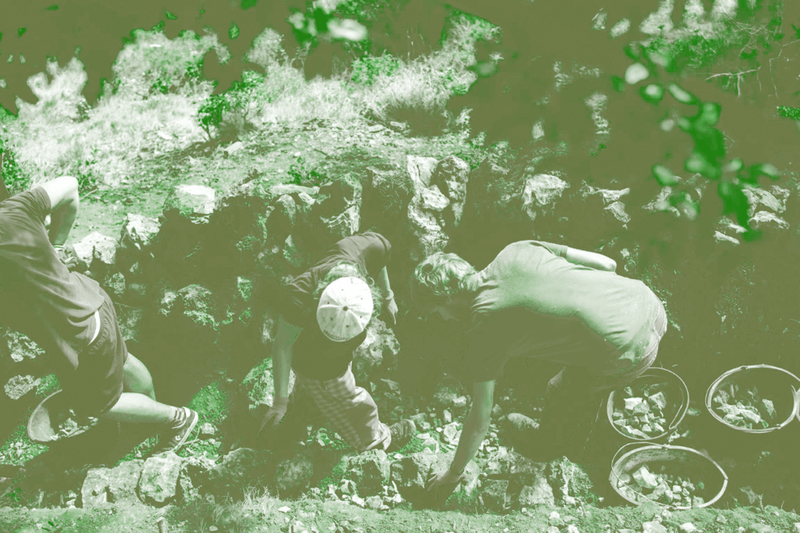
Fig 4: Collective working action ‘We Are Building the School, the School Is Building Us’ and ‘Dry Stone Walling’ with Igor Mataić, udruga Pomalo, CC 4.0 by ISSA School / BONK productions.
To Learn and Build Together: Convivial Tools
ISSA’s understanding of the tools and infrastructures that form society follows to a great extent Ivan Illich’s concept of conviviality. Illich was a critic of industrial and technocratic society with its dogma of acceleration and productivity and its tools that serve overgrowth, monopoly, over-programming, and polarization. He argued that tools are not limited to machines and hardware, but include systems that produce information, education, health, knowledge, and collective decision-making. He intended it to refer to autonomous and creative interaction between people and between people and their environment. The German dictionary translates ‘conviviality’ as ‘unbeschwerte Heiterkeit’ and ‘Geselligkeit’, meaning ‘carefree cheerfulness’ and ‘joviality’. However, in a world of genocide, terracide, and overwhelming grief, I don’t believe in ‘carefree cheerfulness’ and ‘joviality’ as endurable forces. I prefer to translate conviviality as ‘with the living’ or ‘living with’, as a communal force between all living species and matter. An active and discursive act of living with. A convivial society is one without technocrats. A convivial society is one without power holders. A convivial society might include traditional forms of governance. Each convivial society has its unique arrangements. According to Illich, the focus must be on tools that enable ‘self-initiated learning’, that are ‘least controlled by others’, that are participatory and accessible, and that cultivate an autonomy that respects planetary boundaries.13 ISSA is, so to speak, a real-time experiment with convivial tooling. Its planned infrastructure projects include the construction of geodesic domes, Thoreau’s Cabin, an amphitheater, electric cars and boats, an uphill zip line, a pirate radio station, a Mediterranean forest garden, a seed bank, and a local server, embodying this commitment. In the last two years, several basic infrastructure projects have been realized: the reconstruction of the 100-year-old stone house and the construction of several terraced stone walls under the guidance of local expert Igoš Matić. Wherever possible, traditional building methods and local materials such as stone and earth were used (Fig 4). The dry stone walling method is non-invasive and has been used in Dalmatia for centuries. Electricity has been provided by solar panels.
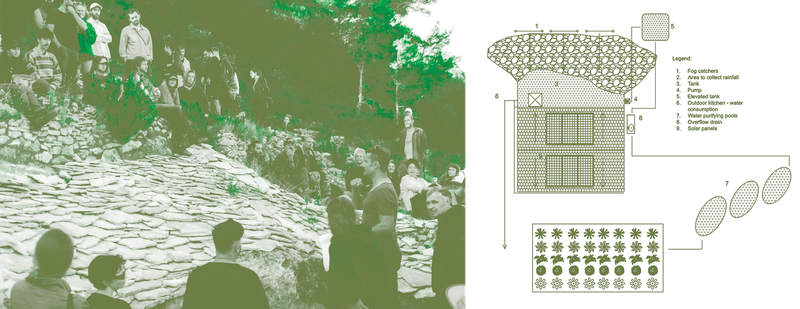
Fig 5: Getting insight from Matko Šišak into the infrastructure project ‘Circular Water System as Convivial Tools’ by ZMAG, CC 4.0 by ISSA School / BONK productions.
Fig 6: Construction diagram for the project ‘Circular Water System as Convivial Tools’ by ZMAG, CC 4.0 by ISSA School / BONK productions.
Currently under construction are a large terrace, an outdoor kitchen, compost toilets, antennas, a local server, and a forest garden, all collectively planned and built. ZMAG (Zelena mreža aktivističkih grupa, Green net activist group) was commissioned to build a circular water system consisting of a traditional cisterna, cloud collectors, water tanks, and bio-filtration systems (Fig 5, 6).14 ISSA’s website is self-hosted by !Mediengruppe Bitnik, enabling local autonomy over information and digital sovereignty outside corporate cloud systems. The local server to be built on-site and powered by solar energy might become a node within the Solar Protocol, a larger network of solar-powered servers where each server only transmits data based on an environmental logic, dependent on season, the time of day, and weather conditions.15 The stone house serves as both repositories, housing ISSA’s physical and digital libraries. Both collections feature texts about the Mediterranean region, about radical theory, or practical ‘how-to’ pamphlets, while the digital library, based on a local file server, mirrors shadow libraries like UbuWeb with its 4TB, and sometimes another mirror travels to exhibitions and other sites (Fig 7). Here, knowledge and infrastructure are conceptualized as commons—resources held collectively rather than privately owned. This sharing of knowledge through libraries, workshops, lectures, and community work actions creates a living pedagogy of collaborative learning, embracing the DIWO (do-it-with-others) ethos and skill-sharing that foreground collective reconstruction strategies. The title of the working actions in October 2024 was We Are Building the School, the School Is Building Us—a phrase that captures the materialist Marxist understanding that as we actively transform the material conditions around us, it simultaneously transforms our social fabric. During my stay on the island of Vis, I attended the workshop Your Own Private Pirate Radio Station (Fig 8, 9). Later, in 2025, in a continuous workshop as part of Wiener Festwochen, I managed to finish my first self-soldered radio transistor. It works! It may sound trivial, but this generative act of skill-sharing, of not only seeding an idea but giving me the tools to access/read books aloud or share records from my music collection with my immediate neighbors through transmission technologies—whether in the event of a breakdown or simply as a joyful tactic—changes something in my understanding of the political body towards a more caring and social habitat.
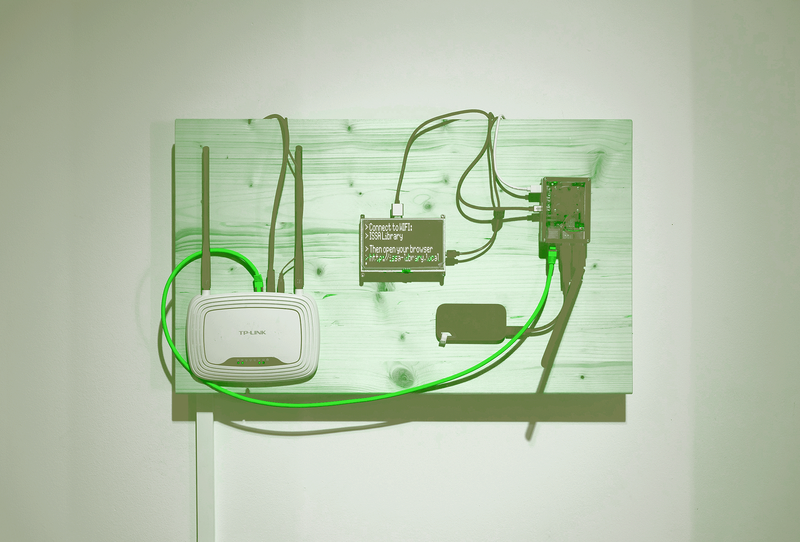
Fig 7: ISSA – Island School for Social Autonomy, ISSA Library, 2024, Tools for Change, 2024, HEK, photo: Franz Wamhof
Regenerative Autonomous Zones
Many people involved within ISSA bring decades of critical engagement with information politics, media systems, computational processes, and governance in our networked world. Rather than retreating from technology, they recognize that today’s crises demand action beyond digital spaces and individualistic network culture. This isn’t prepping or anti-tech escapism, but a deliberate reimagining of how knowledge, social autonomy, and critical media infrastructure can be cultivated outside capitalist paradigms before being reintroduced to wider networks. The 1990s Tactical Media movement and Hakim Bey’s ‘Temporary Autonomous Zones’ promised political subversion through DIY, hedonistic, community-based approaches, and spontaneous moments of insurgency against information hegemony.16 Where Tactical Media prioritized guerrilla interventions into existing systems and media subversion through websites, videos, and hacking, ISSA focuses more on building material autonomy through learning and infrastructure development. ISSA seems to shift from temporary insurrections to lasting infrastructures, from representational politics to embodied, relational practices that are regenerative, sustainable, and place-based without being place-bound. Unlike earlier movements concerned with collective deliberation across the whole social factory, or their hope in the global potential of the multitude,17 ISSA focuses on the community, the place-based, the small-scale and the materializing, while remaining open and regenerative. Their hope lies not in singular solutions but in archipelagos of autonomous zones that persist rather than dissolve, engage rather than disrupt, and relate with place and material rather than isolate. ‘From the “free software” to the “solidarity economy” movement’, Federici and George Caffentzis point out that ‘“time banks”, urban gardens, seed banks, Community Supported Agriculture, food coops, local currencies, “creative commons”, shadow libraries, open syllabi, bartering practices – all represent a crucial means of survival.’18 With this in mind, it becomes obvious that ISSA is not meant to be replicated one-to-one elsewhere –different sites and communities need different tools and topics – but that its pedagogical approach might be a model to share.
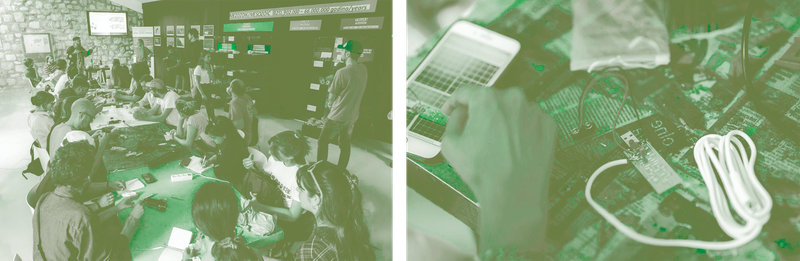
Fig 8: Participants of the workshop ‘Your Own Private Pirate Radio Station’ by !Mediengruppe Bitnik, CC 4.0 by ISSA School / BONK productions.
Fig 9: Building ‘Your Own Private Pirate Radio Station’ with !Mediengruppe Bitnik, CC 4.0 by ISSA School / BONK productions.
The integrating of self-initiated learning, skill-sharing, and thinking and doing, the application of open protocols rather than solutions, and the focus on the social rather than the individual—these modes can serve as a model for radical local autonomies or testing grounds for direct democracy in other contexts. From the land uphill, from the local community of Komiža to the Paris Commune, to the Pro-Palestinian protests, to the student protests in Serbia, ISSA finds alliances and learns from and with them. To freely paraphrase Franco ‘Bifo’ Berardi, a founding friend of the project, we cannot control the whole force of global (media) dynamics, but we can steer smaller processes and continue to create many worlds of sociability. I wish for the future not to belong to fortresses at the center nor to gated bunkers, but to many networked islands at the margins—slowly and reflectively constructing convivial tools for worlds yet to come.
-
(1) Tiziana Terranova and Iain Chambers, ‘Technology, Postcoloniality, and the Mediterranean’, e-flux Journal, no. 123 (December 2021): 12-21, https://www.e-flux.com/journal/123/436918/technology-postcoloniality-and-the-mediterranean/. ↩
-
(2) Island School of Social Autonomy, ‘About’, https://issa-school.org/about. ↩
-
(3) In her 2019 editorial for the transmediale journal, Daphne Dragona introduces the term ‘affective infrastructures’, defining them as ‘alternative architectures of association and resistance’ with reference to scholar Lauren Berlant. Daphne Dragona, ‘Affective Infrastructures Editorial’, transmediale, October 31, 2019, https://transmediale.de/en/journal/affective-infrastructures-0. ↩
-
(4) In Deschooling Society, Ivan Illich refers to Thomas Aquinas who understood teaching as an act of love. He also draws upon the Greek term ‘schole’ that meant leisure. Ivan Illich, Deschooling Society, 1970, reprint Chicago: University of Chicago Press, 2023, 101. ↩
-
(5) Gayatri Chakravorty Spivak, ‘Can the Subaltern Speak?’ in Marxism and the Interpretation of Culture, eds. Cary Nelson and Lawrence Grossberg (Urbana: University of Illinois Press, 1988), 275. ↩
-
(6) This is by no means an exhaustive list, and these names have been joined by others with varying activities and degrees of intensity. ↩
-
(7) The symposium took place on June 1–2, 2024, and was part of the project find.select.transform – Resiliente Netzwerke in einer verletzten Welt at Panke.Gallery, Berlin, https://www.panke.gallery/event/esc-return-scripts-for-degrowth-buen-vivir-and-living-otherwise/. ↩
-
(8) Lately, all members of the Signal group have been invited to an online meeting to get more information about how to get involved. At this point, five working groups exist, covering the topics: Funding; Care & Organization; Infrastructure & Land; Digital Infrastructure; and Learning & Education. ↩
-
(9) To live together was the title of the first public program, taking place from October 4–9, 2024. Island School of Social Autonomy, ‘To live together’, https://issa-school.org/to-live-together/. ↩
-
(10) Henry David Thoreau, Walden; or, Life in the Woods (Boston: Ticknor and Fields, 1854). ↩
-
(11) Island School of Social Autonomy, ‘Inspiration’, https://issa-school.org/inspiration/. ↩
-
(12) Island School of Social Autonomy, ‘Conversation with Silvia Federici’, https://issa-school.org/reflections/conversation-with-silvia-federici/. ↩
-
(13) Ivan Illich, Tools for Conviviality (New York: Harper & Row, 1973), 11. ↩
-
(14) STARTS4waterII residency in collaboration with Drugo More, https://drugo-more.hr/en/starts4waterii-challenge6-issa/. ↩
-
(15) Solar Protocol by Tega Brain, Benedetta Piantella, and Alex Nathan, https://www.solarprotocol.net/. ↩
-
(16) Hakim Bey, T.A.Z.: The Temporary Autonomous Zone, Ontological Anarchy, Poetic Terrorism, New York: Autonomedia, 1991. ↩
-
(17) Michael Hardt and Antonio Negri, Empire, Cambridge: Harvard University Press, 2000, 22–41. ↩
-
(18) George Caffentzis and Silvia Federici, ‘Commons Against and Beyond Capitalism’, Upping the Anti, 2020, 95. ↩
INFORMATION SMUGGLING
Augustina Lavickaitė
My late grandfather used to say that each generation has its own tragedy. For him, it was the mass deportation of Lithuanians to Siberia and the struggle of living under the oppressive regime of the USSR. For my parents, it was fighting for independence and building a life out of the ugly remains of communist rule. The list goes on, generation after generation, of trauma and oppression, and this struggle seems to have become a matter of pride, an important part of Lithuanian national identity.
My generation grew up without a tragedy of our own. We heard the stories of our relatives and we felt a sense of danger as if waiting for something bad to happen. There has always been a feeling that we need to be ready to do something when the time comes, but it’s not clear what we are supposed to do or how to know when the time has come. russia’s war on Ukraine and Lithuania’s location in between two pieces of russian territory made the trauma for my generation an even more urgent possibility. I found myself looking for narratives in the past, identifying connections and similarities, and, in that way, searching for a sense of control over the present and the uncertain future—as if saying, this has happened before, it might even happen again, but here is what people did and what worked.
In my search for a narrative, I came across a repeating gesture of carrying, smuggling, bootlegging information back into the Lithuanian community in order to sustain it. Not as a ritual or a cultural tradition, but as a practice of media production; an act of publishing and making something public, which puts specific emphasis on the materialities and processes of information transportation and distribution, rather than the content and its consumption.1 Between 1866 and 1904, book smugglers carried Lithuanian books from print houses in modern day Kaliningrad and Poland to farmers and churches around lands occupied by the russian empire. Only 40 years later, between 1944 and 1953, the partisan movement resisted the Soviet Union in part by printing leaflets, newspapers, and books on their fight for independence, the Lithuanian language and farmer’s rights. To understand the urge to publish as a way to resist and what it means to today, I frame these case studies through information warfare and media ecologies.
Information warfare and publishing
Information warfare relocates conflict from the frontline to the entire country and its population. In this format of conflict, information is not only the tool for warfare but also the setting of the war – it is within the information that the warfare is taking place. Information consumers are the territory of warfare and their attention is to be fought over, whether it is for political gain or corporate monopoly.
As a response to information warfare, information smuggling is an act of publishing, of making something public. It is delivering a specific narrative to a group of people who would otherwise not have access to it. It is validating the smuggled information by stating that it is important enough to risk lives for. On the other hand, information smuggling is also about making a public. By smuggling information, a public is created, and it exists and develops around the circulating content—here distribution becomes a crucial part of the work. Smuggling information ensures that a community survives, but it also equips the same community for resilient growth and expansion. Therefore, it ‘can no longer be seen merely as a criminal act, as the state authorities would claim, but becomes part of social protest against different oppressions.’2 In the context of an oppressive regime, the role of these individuals becomes two-sided – the state views them as criminals, while most locals praise them as heroes. The divide is clearly visible, for example, in the difference between USSR versus partisan archives. This situation is, of course, not limited to information smuggling, it covers any type of smuggling, which threatens the state’s authority over its people and the mobility of its goods.
Recently, a kind of information smuggling has formed in the digital environment—The Internet’s Dark Forest is a metaphor for survival tactics of alternative communities and truths. The concept comes from Liu Cixin’s The Remembrance of the Earth’s Past, and connects directly to the partisan activities in Lithuania and beyond. The affordances of the internet’s metaphorical dark forest and the information smugglers’ literal forest define the type of communication that can take place—both naturally gravitate towards safer, more private modes and tools of communication. A key difference is the possibility to exist within and outside of the Internet’s Dark Forest—something that was nearly impossible in the physical context of information smuggling.
Material context
The minute you understand architecture to be the relation between the event and the physicality, between static material and a dynamic ephemeral event, you understand that this relation can move both ways. You can start from an event and ask what kind of architecture it needs or you can look at the building and say what kind of event might have happened here or what kind of event that sort of enclosure, that sort of material syntax, will enable.
Head of Forensic Architecture, Eyal Weizman3
Contemporary media discussions, especially recent ones surrounding fake news and disinformation, often focus on issues of content and its consumption. However, studies suggest that the most unique characteristics of fake news are media infrastructures, and social and technological circumstances enabling its spread.4 This suggests that focusing on the structures allowing content to be produced and shared could lead to more successful attempts at identifying and controlling fake news. Information smuggling reflects the same insight—the forest terrain, it’s affordances, and the underground network of partisans were the defining elements of the resistance. In this way, the forest operated not only as a backdrop to resistance but as part of its media infrastructure—shaping production, circulation, and concealment in much the same way that urban squats or pirate radio stations have served other movements. Understanding the forest as an active element in the media ecosystem places it within a longer tradition of improvised, embedded infrastructures that tactical media practitioners inhabit and adapt to hostile conditions.
The word smuggling implies borders (between countries, between a forest and a city, etc.) and two different environments (regimes, legal frameworks, taxes, ideologies) on either side. The practice of smuggling takes place in the context of borders which historically, geographically, and geopolitically allow or even require smuggling – whether of information, people, or goods – to occur. Borderlands, such as Lithuania between the West and the East, create precarious conditions to which smuggling becomes an answer and a form of resistance. The social and cultural context of smuggling also informs the content being smuggled and the shape it takes. For example, religious books and farming manuals were the first things to be smuggled to a deeply religious, Lithuanian-speaking audience of farmers. On a more radical level—the russian regime profited from collective farms and a degenerate alcoholic society, so smuggling books was a symbol of education and culture. Meanwhile, the landscape and the actual materiality of the geography actively participate in the distribution and logistics of smuggling – forests allow hiding, rivers provide a natural border, mountains give an advantage to those skilled to cross them, etc. John W. Donaldson uses the term ‘arcifinious’ territory to describe states with natural defense capabilities—forests, rivers, mountains, but also deserts and seas. These affordances can exist naturally or be built artificially with defensive or offensive strategies in mind (Stefan Helmreich’s concept of ‘infranature’).5 In the case of Lithuania, the forests within and surrounding the country offered an ambiguous space where resistance and smuggling could thrive.
Information smuggling in Lithuania
The practice of information smuggling is deeply rooted in an environment of oppression and cultural erasure. It is this undebatable reality which gives rise to all further discussions of resistance, its reliance on media and networks, its successes and failures. The specific case of oppression here is the repeated attempts at the russification of Lithuania.
Restricting freedom of speech, disconnecting the society from the West, limiting communication and outside sources, censuring culture and education—apart from the obvious physical violence and destruction of the country, these forms of oppression describe information warfare in Lithuania as well as hybrid battles over meaning and culture of the 20th and 21st century.
Book smugglers (1866-1904)
In an attempt to russify Lithuania and isolate it from its history, Lithuanian language, publications, and any cultural activities were banned for a period of 40 years. With a population of barely 1 million people and no physical power to stage a military uprising, Lithuanians needed to find alternative methods and networks of preserving their language, culture, and national identity. Printing and reading Christian books in Cyrillic was equivalent to renouncing faith altogether, so the first material to be smuggled into Lithuania were prayer books, published mostly in German-controlled East Prussia and distributed in religious communities. Soon, however, the spectrum of printed matter expanded to include non-religious books as well as periodicals, newspapers (Apszvalga, Varpas, Ukininkas, Vienybe Lietuvniku), and other patriotic and political content. These prints were usually smaller than modern newspapers, similar to the pages of a book. They contained news, fiction, poems, and songs, and also included tips on smuggling books and crossing borders without being caught. Although small underground resistance groups were quick to form between students and members of the clergy, the smugglers acted alone, crossing the German-russian border at the risk of being shot, deported to Siberia, or jailed. Books used to be hidden in sacks of cheese, eggs, or bread; others strapped tool belts and hid newspapers under thick clothes. An estimated 5 million copies of printed materials were smuggled during press prohibition.6 After the failure of the russo-Japanese war and the growing awareness of how ineffective the ban was, it was finally lifted in 1904.
Partisan press (1944-1953)
Forty years after the lifting of the publishing ban, Lithuania was once again fighting for its independence from russia. In 1944, when mass mobilization, arrests, and shootings of disobedient citizens began, thousands of armed Lithuanians retreated to the forests to avoid being forced to join the russian army and, instead, form guerrilla groups. Family members often had to join to avoid being targeted as a source of information. The ranks included teachers, high school students, priests, and officers, but mostly peasants, which was shocking to the russians, who did not expect working people to resist the working people’s government. Lithuanian partisans would strike unexpected blows and hide in forest bunkers for longer periods of time. These bunkers would be installed in homesteads, forests, swamps, riverbanks, and sometimes even in wells. Partisan groups usually consisted of 5-15 people and each group had several well-equipped and camouflaged bunkers to move around in. To exchange information on their positions and other important issues, partisans communicated through ‘legally’ living peasants and farmers and, rarely, through direct meetings. Partisan press first took the form of leaflets published underground, describing the political situation of the time and containing appeals to the population with various warnings and recommendations. Later on, larger groups of partisans published their own books and newspapers with news from Lithuania and the world, explanations of the government’s policy, and information about their struggles. In total, the partisans published about 80 periodical publications, some of which had a circulation of 5-6 thousand copies.7 russia’s revival of communist propaganda made sharing partisan ideology extremely important to keep peasants from joining kolkhoz (collective communist farms) and to maintain the fighting spirit associated with the expectation that the West would declare war against russia. Partisan groups gradually faded as the oppressor found ways to infiltrate partisan ranks and torture captured participants into giving away important information. In less than 10 years, over 20,000 partisans were killed and about 2,000 fighters and 16,000 supporters were arrested and deported.
Media Ecology
Ecological thought, once unleashed, permeates everything. It is as much movement as science, with all the motive, restless energy that word connotes. Every discipline discovers its own ecology in time, as it shifts inexorably from the walled gardens of specialized research towards a greater engagement with the wider world.
James Bridle8
Ecology has been introduced in the context of media as a way to study the effects of communication on how humans think and behave. Media ecology asks what kind of environment results in the existence of that specific media and what kind of elements (human, nature, technology) are needed for it to form.
The complex message system of the two information smuggling cases suggests the following interpretation—information smuggling as media production and the forest as a media infrastructure all come together to form a literal ecosystem (of objects and beings) as well as a tactical media ecosystem (of routes of information, the terrain, and the smugglers). Ecology offers a way of thinking through the case studies and analyzing the repeating dynamic that takes place within the forest.
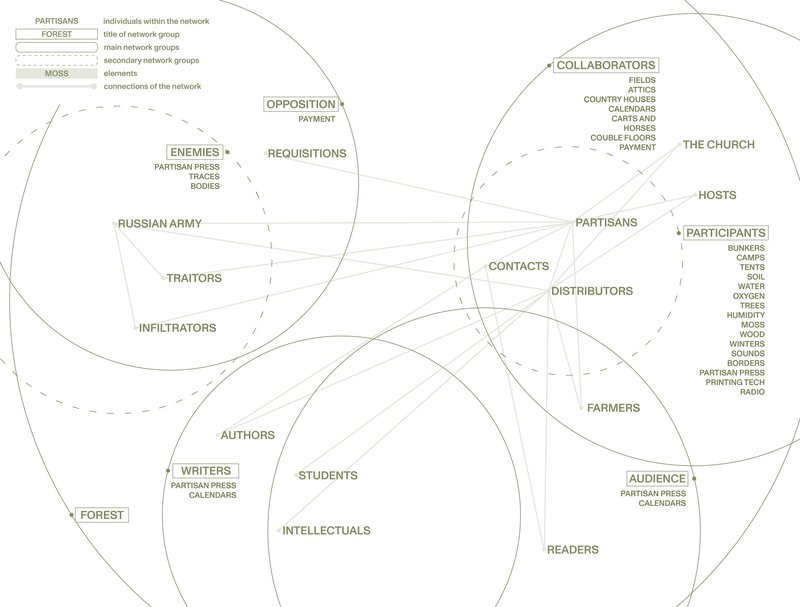
The Forest
As I tried to understand information smuggling, I engaged with state-owned archive material (images, sketches, maps), memoirs, and historical and archaeological sources. The two case studies overlapped in physical territory, many of the existing bunkers and tactics being reused in later struggles. It seems as if these instances of information smuggling are not isolated cases, but an ongoing relationship between the Lithuanian people and the territory they inhabit. And so, as I looked for a red thread, I eventually stopped distinguishing between book smuggling and partisan press—after all, they represented the same narrative. I did, however, group my findings into four categories: network, infrastructure, terrain, and media.
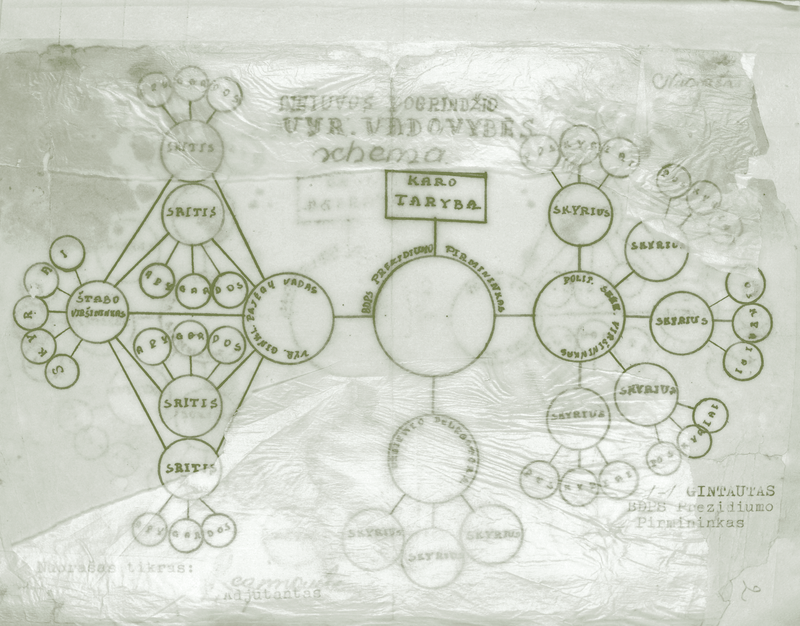
Network: the individuals and groups that participated in information smuggling.
Information smuggling relied on a wide network of individuals who each played a specific role within the media ecology of the forest. Many information smugglers were young men from rural areas with no military background, forced to leave behind everyday life after the russian occupation. Others contributed by writing, distributing, or hosting the underground press. While some teachers and students sent in texts from outside the forest, most of the content was written from within. Information smugglers were responsible for collecting and distributing material, which helped build stronger ties with local populations. Farmers, printing house workers, students, intellectuals, and even priests formed the surrounding support system by providing materials, shelter, and circulation routes. In attempts to reach russian soldiers, information was smuggled through newspapers, scattered in town squares. Despite the state’s efforts to disrupt this communication through traitors, infiltrators, and censorship, the forest network adapted.
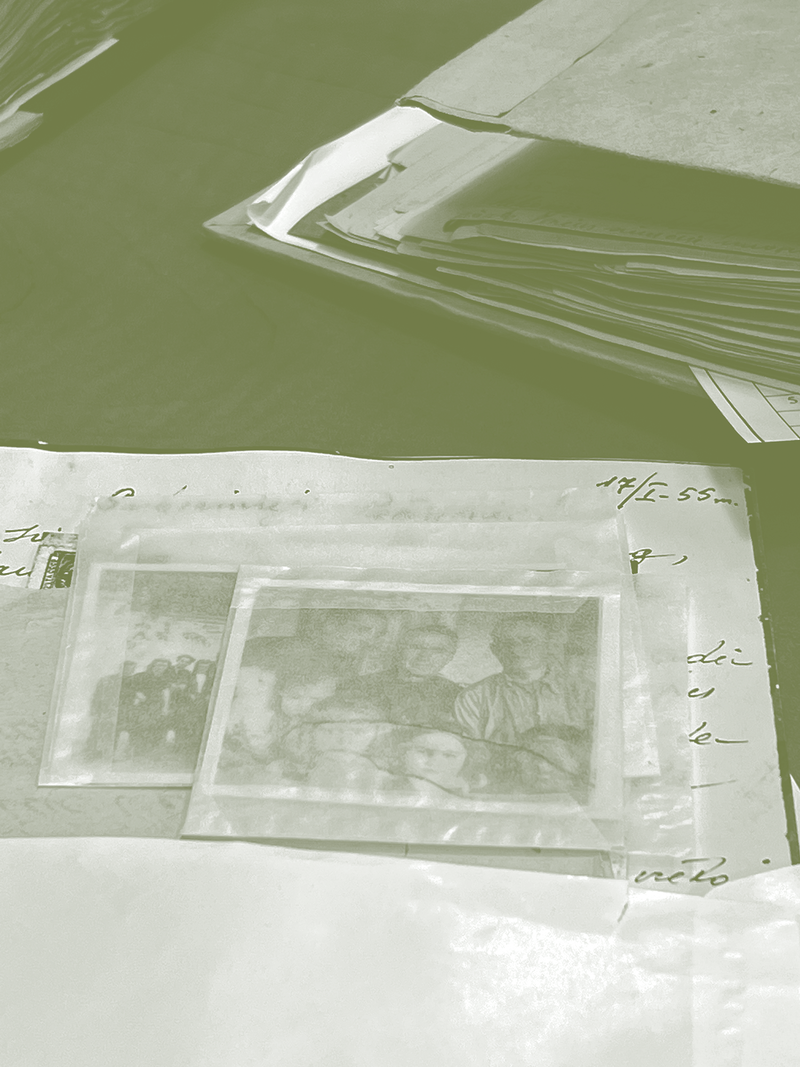
Infrastructure: the physical structure that connects and organizes a network.
Thousands of bunkers across Lithuania make up the infrastructure of information smuggling, hidden beneath barns, stoves, wells, gravel, and inside homes. The way they looked, where they were, and what strategic function they served evolved alongside the resistance. And if no bunker was available, temporary shelters were dug into fields and disguised with soil and wooden planks, allowing partisans to be ‘buried’ during the day. Country houses and their architectural voids, such as cellars, attics, gaps between beams, were also repurposed as storage and distribution sites for print materials.
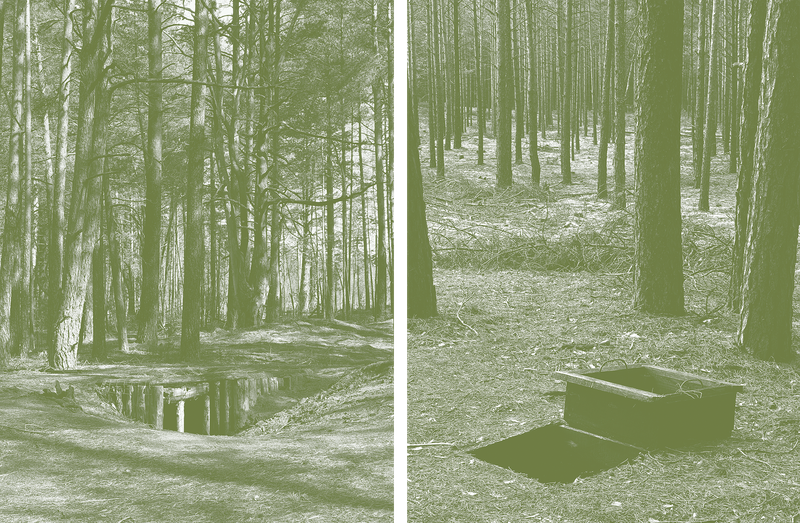
Terrain: the land and its elements.
Hiding places needed to be strictly camouflaged and controlled: no cutting of grass, no breaking of branches in the surroundings, no following of the same paths, no moving into new bunkers too quickly. The location and the structure of bunkers were determined to a large extent by the soil type. The light, sandy soil of the southern region was the easiest to dig up and quickest to be distributed in the surrounding areas. Building bunkers near large bodies of water, such as rivers, made it easier to dispose of soil and sand. On the other hand, high groundwater was to be avoided due to constant flooding of bunkers. The vegetation surrounding the bunker was another important detail. A certain type of moss is marked as a disadvantage to camouflaging a bunker installed in the forest. During the day, this moss dries up and footprints remain visible for a long time; if the same route is taken several times, a clear path remains. Living conditions in the bunkers were very poor—water seeped through the walls and ceiling, and there was a lack of oxygen. The first few days in a new hideout were often the most difficult—it was cold and humid, and the space had to be warmed gradually with body heat and breath. After spending a winter in the bunkers, the partisans who would come out were very pale, with swollen faces. Agents would be able to notice such physical signs, identify partisans and know that a bunker must be nearby.

Media: tools and formats for storing and transferring information.
More than fifty newspapers were published in Lithuania during the partisan resistance (1944–1953), with periodicals appearing across all regions. Print runs and formats depended on the available tools, which were limited and often improvised. When no other tools were available, newspapers were typed by hand in small quantities. Most were printed using handmade rotators, which enabled larger circulation despite poor ink and paper quality. Hectographs were also common. In 1950, a few partisan groups gained access to letterpress machines, which improved the quality and speed of printing. In parallel, partisans used radio receivers hidden in bunkers to listen to international broadcasts and pass on news to the local population. The confiscation of radios by occupying forces made this form of information transfer rare and highly valued. The use of media in information smuggling cases also appeared in more indirect and violent ways. For example, even the corpses of partisans became a means of communication—the russians left bodies in public spaces to provoke a reaction from relatives and, in this way, identify resistance networks or extract further information.
Identifying and outlining this media ecosystem requires bringing together little pieces of history – moss, soil, attics in barns, newspapers typed by hand, bodies of the deceased used as bait – from memoirs, archives, archeology reports, and artistic interpretations of the period. Finding and analyzing this material is a detective’s work, a process of discovery, partly because of the nature of the underground resistance and partly because of the brutal force it was countered with. This results in an abstract and entirely non-linear narrative taking place on the same land throughout decades. Land, which we inherit alongside conflicts from previous generations.
Tactical media has always been about adapting to and embedding within existing infrastructures, from urban squats to pirate radios. Recognizing these infrastructures reveals how and why resistance takes the shapes it does. The forest, as a tactical media infrastructure, has a deep historical precedent in information smuggling, and continues to shape resistance today, in Ukraine, by unintentionally archiving conflicts (ex. drone fiber-optic cables on tree canopies), allowing concealment (ex. drone shelters and launch sites), and disrupting surveillance (ex. obscuring movement from above and masking thermal traces). Placing the forest in this context allows us to see it not as a passive backdrop, but as an active element in the circulation and preservation of information under occupation. In the future, its role could remain the same: a space where media can be produced, moved, and hidden when other infrastructures are compromised, and where the evidence of these acts endures long after the conflict has shifted.
-
(1) Lisa Parks and Nicole Starosielski, Signal Traffic: Critical Studies of Media Infrastructures, Urbana: University of Illinois Press, 2015. ↩
-
(2) Mahmoud Keshavarz and Hosrawi Sahram, Seeing like a Smuggler: Borders from Below, London: Pluto Press, 2022. ↩
-
(3) Marc-Christoph Wagner and Eyal Weizman, dirs., Forensic Architecture, YouTube video, 18:49, Louisiana Channel, 19 May 2022, https://www.youtube.com/watch?v=M5c9KrHHVMc. ↩
-
(4) Jonathan Gray, ‘“Fake News” as Infrastructural Uncanny’, New Media & Society 22, no. 2 (2020): 317–341. ↩
-
(5) Stefan Helmreich, ‘Nature/Culture/Seawater’, American Anthropologist 113, no. 1 (2011): 132–144. ↩
-
(6) Antanas Tyla, Garsviu Knygnesiu Draugija, Vilnius: Mintis, 1991. ↩
-
(7) Ricardas Cekutis, ‘Partizanu Spauda 1944–1953 m.’, Genocide and Resistance Research Centre of Lithuania, 11 January 2005, http://genocid.lt/Leidyba/16/cekutis.htm. ↩
-
(8) James Bridle, Ways of Being: Beyond Human Intelligence, London: Allen Lane, 2022. ↩
Interconnecting Imaginaries
Networks in a Pluriversal World
Juan Fortun
Every technology of connection carries a worldview within it. This becomes visible only when we encounter technologies that operate from fundamentally different premises—when copper means something beyond conductivity, when networks exist as social relationships rather than infrastructure, when connection happens through dimensions we’ve forgotten how to perceive.
In May 2024, I met with artist George Mahashe in Dakar during the African Art Book Fair. I was developing my project Sonic Books, exploring orality and books as technologies of healing. George was presenting—defunct context, his most recent book, a work he described as part of a foretelling, or ‘Miloro’,1 a vision that guides one’s life.
As we sat together, I ran my fingers along the copper spine of his book, feeling the metal’s coolness, its weight, while George spoke about how these materials threaded through generations of his family’s practice. It was in this moment that I felt the weight of something I couldn’t yet name—heavier than the book, older than either of us.
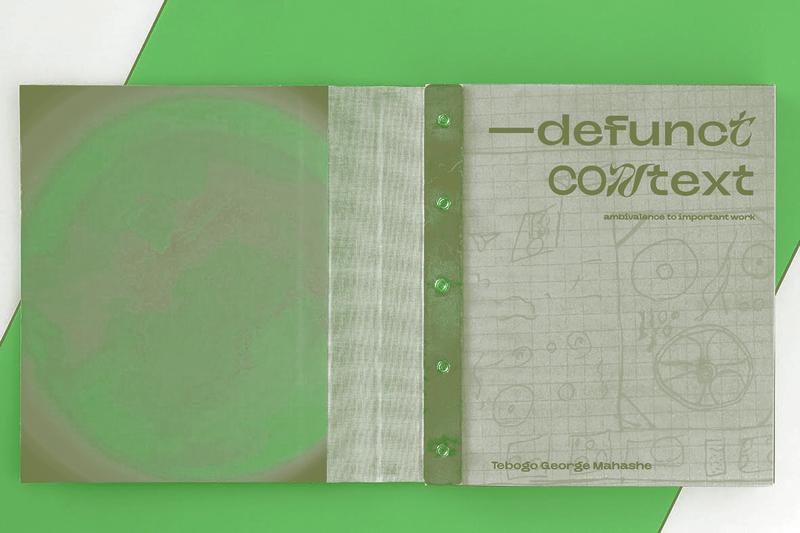
Fig 1: Image credit to George Mahashe.
We were in Dakar, where Orange—France’s telecommunications giant—controls the infrastructure that determines how millions connect, a colonial legacy dressed in the language of development. Yet across West Africa, movements are emerging to sever both military and technological dependencies from France, demanding sovereignty over their own systems of connection and defense. The question becomes: how do you rebuild from the inside when the very architecture of communication was designed for extraction? How do you imagine networks that aren’t simply replacing one master with another?
Here, copper has been speaking its own language long before colonial powers taught it to carry their signals. The question George’s copper-bound book posed wasn’t whether alternatives exist, but how many forms of connection we’ve been trained not to see.
This partial transcript2 captures that moment from our conversation:
Juan Fortun 15:34
How is the book a technology in this context? And as we know, no technology is neutral. The idea that technology is neutral—that’s something only people in Silicon Valley want to believe.
George Mahashe 16:12
First, it’s a technology that calls out. That’s really important. But the important thing about these foretelling is that they speak about the radio, they speak about the telegram, they speak about the internet. In that sense, together with the book, we are also told to expect technologies that would allow sound and other mid to travel over large distances. In particular, the telegram which is of course the foundation of the internet. It’s also a series of copper cables, until it evolved into fiber optics.
The interesting thing about this particular book is that it’s held together by two pieces of copper, two pieces of copper that are bound together by brass screws. This particular configuration references another technology that I don’t know if I’m even supposed to be speaking about, but I do speak about it any way. One of the first gifts I received when I took the trouble to get to know my family history was the idea of Makhalaka bracelets associated with people Bokhalaka in Southern Africa. So, in my introduction, I introduced myself as MoKhalaka, a people that came from the Zimbabwe region, but they also have roots in the Congo, in Ethiopia, and some even stretch it to say that we’ve had relations with the area that is now part of the Levant.
A particularly interesting story I came across when I started doing the research was related to a dream about these particular copper and brass technologies. I shared this with a mentor who has been helping me navigate my dreams; as well as my recovery, and my acknowledgment of what it means to actually be connected to my own history. I said, ‘I had this dream’ and she responded, ‘Those things are very old. I cannot help you.’ So, I had to go to my father, but he didn’t really pay much attention. Until I met this young and old man at the same time—who gave me an archival report written in 1905. It was the account of the different groupings of people and families in the Transvaal region (currently Limpopo and mpumalanga region of South Africa). In the report, there is a passage where they speak of Balemba, who introduced themselves as the Black Jews, but also as people who have been spoken about through research as Vhashavi (traders).
Let me not tell the whole story because it’s quite a complicated one, but Balemba are said to be a line of priests that are associated with the religious orders of the Jewish tradition. In their description, the report speak about how they were good bracelet makers. The Makhalaka being one of the bracelet technologies they created. The reason I’m telling you this story in relation to the foretelling of the telegram is that, for most people, copper bracelets are also seen as transmission technologies. I haven’t yet understood enough to know whether they transmit or whether they augment your body to receive or access information.
Juan Fortun 21:39
I’m understanding this through the concept of peer-to-peer connections. You’re building a system where I can be both receiver and transmitter—something completely new. This technology forms multi-directional links and bonds, not just back and forth between two points, but extending to many people simultaneously. That’s the essence of a decentralized network.
George Mahashe 22:23
To speak to your question, ultimately I think it would be misleading to separate Silicon Valley from the technologies that my family traditions come from. Copper, or Mufhiri as we refer to it, is a universal and very old technology that Silicon Valley has just packaged differently. I talk about the book as being held together by this particular technology to emphasize the fact that the internet, from my family’s point of view, is something that was foreseen but also something that had been practiced for many generations.
George’s words stayed with me as I continued visiting community networks. If copper bracelets were transmission technologies for many people in Africa, what other forms of connection have I been trained not to recognize? When the UN speaks of connecting the unconnected, they assume disconnection where different forms of connection may already exist. They presume that this particular mode – digital, immediate, commercially mediated – represents the universal ideal rather than one possibility among many. But the deeper question isn’t just what forms connection takes, but who controls the means of connection, who benefits from it, and how it shapes our ways of being together.
Comunalidad
These insights deepened when I began visiting community networks in Oaxaca, Mexico. There, I encountered a notion that transformed my understanding of connecting technologies: Comunalidad. Articulated by Mixe philosopher Floriberto Díaz and Zapotec philosopher Jaime Martínez Luna, Comunalidad is centered on shared territory, collective work, communal authority, and celebration.
What’s crucial to understand is that Comunalidad isn’t just a cultural practice—it’s a structure of resistance that emerged to help indigenous communities navigate and survive colonization. When Díaz and Martínez Luna theorized this concept in the 1970s, they were reclaiming the power to define their own socio-political systems. For generations, it had been anthropologists who studied and theorized indigenous life from the outside. This was indigenous voice creating political theory about indigenous reality—naming and explaining the very structures that had made life possible under colonial rule.
It’s not merely a theoretical concept but a lived practice—a way of being in relationship with others and with place. You cannot understand Comunalidad from text alone—it must be lived, breathed, suffered through. As Martínez Luna writes:
Comunalidad expresses universal principles and truths regarding indigenous society, which should be understood from the outset not as something opposed to but as different from Western society. To understand each of its elements, certain notions must be kept in mind: the communal, the collective, complementarity, and integrality. Without considering the communal and integral sense of each part that we aim to comprehend and explain, our knowledge will always be limited. Given the above, we can understand the elements that define comunalidad: The Earth, as Mother and as territory, Consensus in Assembly for decision-making, Free service, as an exercise of authority. Collective work, as an act of recreation. Rituals and ceremonies, as an expression of the communal gift.3
Throughout Oaxaca, I witnessed this approach manifesting in diverse technologies. Radio Totopo in Juchitán broadcasts in Zapotec language while fighting multinational wind energy corporations transforming ancestral lands. Telecomunicaciones Indígenas Comunitarias4 operates cellular networks across over 70 indigenous communities, governed through traditional assembly systems.
What strikes me isn’t the technical sophistication but the governance innovation—a kind Silicon Valley cannot comprehend. These communities navigate questions that commercial providers won’t even acknowledge: How do you balance individual need against collective survival? Who speaks for those who cannot yet speak—the land, the unborn, the ancestors? How does consensus hold when it takes months to achieve and seconds to break? What values guide a network when profit isn’t the answer? These aren’t quaint traditions but hard-won practices of survival, sophisticated technologies of relation that understand every connection as a thread in communal fabric—delicate, vital, impossible to untangle without unraveling the whole.
As I see it, successful networks are 10% infrastructure and 90% social organization. That 90% consists of everything invisible but essential: collective governance determining how resources are allocated, knowledge-sharing ensuring skills remain distributed throughout the community, shared labor maintaining equipment through storms and breakdowns, and cultural protocols guiding acceptable usage and content.
Every empire misreads the governance structures of those it seeks to control. The Spanish saw devil worship where there was democracy; modern Mexico sees wasted time where governance is most alive. When city dwellers lament how indigenous communities ‘waste’ resources on fiestas, they reveal the poverty of urban imagination—the inability to recognize governance when it doesn’t wear a suit or speak in spreadsheets. When I found myself pulled into these celebrations, what I witnessed was nothing less than democracy made flesh: months of preparation that become a technology of knowing, a patient cartography of collective capacity.
These fiestas operate as living inventories of communal possibility. Through the exhausting work of celebration – the debt and reciprocity, the careful negotiations of who dances where or who cooks what – communities perform an accounting more thorough than any census. They discover who holds which knowledges, who bridges which conflicts, who can be trusted with collective resources when the stakes are real. The fiesta becomes a technology of knowing, an embodied census of capability and connection. In the crushing proximity of shared celebration, dancing until dawn beside people you might privately despise, you learn the terrible and necessary art of living together—not in abstract harmony but in the sweaty, difficult work of maintaining social fabric despite its constant tears.
What outsiders dismiss as tradition is actually sophisticated social technology: these celebrations are the infrastructure through which communities metabolize difference, process conflict, and generate the trust necessary for collective governance. When these same communities build telecommunication networks, they’re not importing foreign technology into traditional practice. They’re extending an ancient understanding—that connection is work, that networks are relationships, that governance happens in the space between exhaustion and ecstasy, where individual will dissolves into collective possibility. The fiesta and the cellular tower operate on the same principle: both are technologies for holding community together across distance and difference.
From Inter-connecting to Inter-relating as pluriversal practice
Many worlds of connection already exist—often hybridizing, overlapping, and evolving within the same communities. This reality shifts our questions from ‘traditional versus modern’ to more nuanced inquiries. I found myself asking how different connection technologies strengthen or weaken community agency, how diverse practices can coexist within pluralistic ecosystems, and what governance structures enable communities to determine which technologies best serve their needs. These questions move us beyond simplistic adoption narratives toward understanding connection as contextual and culturally embedded.
What would it mean to embrace ways of interconnecting that recognize relations not just to each other but to the lands that birth our technologies? It would mean acknowledging that technologies of connection aren’t neutral tools but expressions of particular worldviews. Copper isn’t just a conductive material but part of living landscapes with their own histories and relationships. When copper is embedded in bracelets or cables, we’re not just using an inert resource but entering into relationship with specific places and their histories. The future isn’t a single network but many—tailored to specific contexts, values, and ways of being. Copper bracelets, community radio, cellular networks, and satellite internet aren’t opposing forces but different threads in a global tapestry of connection where many worlds can flourish simultaneously.
Yet this multiplicity raises an inevitable question: What happens when these different ways of connecting prove incompatible? When the extractive logic of one network threatens the relational fabric of another? When satellite internet requires rare earth mining that destroys the very territories where copper bracelets carry ancestral knowledge?
The people who embed their lives in communal ways have long navigated this question through what activist and philosopher Ailton Krenak calls la danza de las alianzas afectivas (the dance of affective alliances).5 This practice abandons the demand for universal compatibility, instead embracing relationships built on affection between non-equal worlds. But what guides this dance of difference? In the communities I’ve witnessed, the answer remains consistent: the Earth itself becomes the non-negotiable baseline. The territory as living entity – not resource – provides the ethical compass for all relations. A network that poisons groundwater to manufacture its components has already failed, regardless of how many people it connects.
This isn’t romantic environmentalism but survival pragmatics. Communities that lose their land lose everything, including the possibility of connection itself. The pluriverse of networks can only exist if each respects this fundamental limit.
The inadequacy of our current approaches becomes clear when we consider how media activism has evolved. In Social Movements and Their Technologies,6 Stefania Milan traces three decades of organizing around communication technologies—from institutional debates through civil society organizing to the internet renaissance. Yet even these progressive movements never questioned the extractive foundations of the networks themselves—the mines, the energy, the waste. Perhaps this is why tech oligarchs now control the connections: the fight was over who controls the network without asking what the network does to the Earth.
The communities I’ve witnessed suggest a different phase is emerging—one that doesn’t just redistribute access to existing technologies but questions their very foundations. This new period acknowledges that our networks exist within ecosystems, depend on finite resources, and embed particular relationships to land and place. Unlike previous decades focused on representation and participation, this insurgence asks: Which communities lose their ground so we can have our cloud?
While I write these words, communities are already at work—building networks that don’t destroy the ground they stand on. From George’s copper-bound books carrying ancestral transmission technologies to Oaxacan communities governing cellular networks through their protocols, people are already building the pluriverse of connection. The challenge isn’t to connect the unconnected but to recognize and support the diverse forms of connection already flourishing.
Standing at this threshold – climate crisis meeting technological transformation – the question isn’t whether we’ll have networks, but which worldviews will shape them. What the communities from Oaxaca to Dakar have taught me is this: technosocial justice without climate justice is just rearranging extraction. Social justice without technological sovereignty is hollow. And – most pointedly for Silicon Valley – spirituality without social critique is just capitalism seeking absolution. The same companies that mine rare earths in the Congo host meditation retreats in California. The CEOs who surveil billions practice digital detoxes. They import yoga and ayahuasca while exporting extraction and exploitation, as if personal enlightenment could somehow offset systemic devastation.
But the communities I’ve witnessed understand what Silicon Valley’s spiritual tourism cannot: that genuine connection – to Earth, to each other, to the sacred – requires accountability to the territories and peoples that make our technologies possible. These struggles converge in one truth: the networks we build either honor these relationships or sever them, either nurture the conditions for collective life or extract until nothing remains.
The copper in George’s book and the copper in our cables come from the same Earth, but they participate in radically different relationships. One treats metal as memory, the other as commodity. One understands connection as reciprocity, the other as resource flow. Both are real, both function, but only one asks permission from the land it touches. The answer to which worldview shapes these networks may determine not just how connection happens, but whether the ground beneath our feet remains alive enough to sustain any connection at all.
-
(1)To read more about this foretelling read George Mahashe, ‘Mashogojo Mašokošoko Boshokhoshokho’, Handle With Care, Gabi Ngcobo, eds., Javett Art Centre at the University of Pretoria, (Javett-UP): Pretoria, 229-240, ISBN 978-1-991255-00-6. Found at this link: https://lebitla-la-ngaka.yolasite.com/ws/media-library/40110fea5acc4e1793cc94c5ce8b2266/mashogojo-iteration-1a-.pdf. ↩
-
(2) Following George Mahashe’s practice in his doctoral work, we do not italicize khelobedu terms in this text. As he argues, italicizing vernacular languages reinforces their othering, a position informed by Katleho Kano Shoro’s poem ‘Sesotho saka will not be written in italics’ and Chimamanda Ngozi Adichie’s willingness to risk losing a foreign audience rather than subordinate non-Western languages to typographic conventions of difference (cited in Namwali Serpell’s article ‘Glossing Africa’). We adopt this convention here as a deliberate editorial choice. ↩
-
(3) Floriberto Díaz, Escrito, Comunalidad, energía viva del pensamiento mixe Ayuujktsënää yën - ayuujkwënmää ny - ayuujk mëk äjtën, Edited by Sofía Robles Hernández, Mexico City: Dirección General de Publicaciones y Fomento Editorial, UNAM, 2014. ↩
-
(4) Telecomunicaciones Indígenas Comunitarias operates autonomous cellular networks in indigenous territories where commercial providers refuse to offer service due to lack of profitability. ↩
-
(5) Ailton Krenak, Futuro ancestral, edited by Rita Carelli, translated by Teresa Arijón, Madrid: Taurus, 2024. ↩
-
(6) Stefania Milan, Social Movements and Their Technologies: Wiring Social Change, Palgrave Macmillan UK, 2013, https://doi.org/10.1057/9781137313546. ↩
Forking For Future?
The Case of the Extinction Rebellion - Just Stop Oil Split
Alberto Manconi and Daniele Gambetta
Schizoplacement
The two of us – like everyone – are already many. We met over the years by trying, more or less smoothly, to stick together, among ourselves and with others, to make class, to organize. In the process, we tried to assemble our respective obsessions, interests, addictions, skills… in groups, sure, but also as a pair—as friends, comrades in a collective, and white male students of computer science and social science, outwardly cis and hetero. When we first met, more than ten years ago, Alberto was pursuing a degree in Political Science, while Daniele was studying Mathematics. Our encounter took place in a specific context that also resonates throughout this article: a student-run space in front of the Science Department at the University of Pisa. There, together with others in a newly formed collective, we sought to bring critical thinking and political theory into dialogue with the large community of scientists in the academic town.
Those were the years of the first Facebook, but also of the long wave of hackerspaces and DIY self-productions. We found a peculiar and ‘new’ point of convergence in the digital world, in the political and strategic uses of technological innovation tools. We ended up decrypting the winds of organizational novelty blowing from the Arab world in the early 2010s, but when we struggled to parse that language, we interfaced with its Spanish translation in May 2011: the squares and ‘nascent’ social networks were being occupied.1 This interplay between the political and the digital, between street-based and network-based organizational forms, was the ‘unusual encounter’2 that nourished our collaboration. But as increasingly happens, we wrote about it while everything was mutating. It’s like mapping a terrain amid floods, fires, and earthquakes. Or collecting and processing data from a proprietary, militarized platform.
Meanwhile, we’ve also witnessed and participated in, suffered and even fueled, countless political clashes and splits. We both also split apart, polarizing between one side of us caught in the schizoid stream of ‘always-new’ social movements and ecological struggles, and the other fascinated by the contradictory, even hedonistic, contamination with digital, tech, and cultural innovation spaces. Our dichotomy reflected an open debate in the countercultural spaces connected to social movements, with those on one side more connected to the practices of grassroots politics and activism, and on the other, those seeking even clumsy and contradictory hybridizations with new environments and seemingly distant paths - makers, fab-lab, STEM entreprecariats… The first pings the second: ‘Instead of overthinking your stuff, do something militant—give us a hand!’; the other replies: ‘Instead of wasting time, write, play and learn to code!’
Naturally, we both were right and wrong. But the synergy we hoped for never happened—pretending we’ve worked on it until now, we can admit it.
Debugging these ubiquitous polarizations, we ask what protocols and affects compile them, what topologies they render. In short, we want to address the divisions fracturing political subjectivities today from the standpoint of mental and social ecology.3 We’re scanning the ambivalent emergence of new trajectories of subjectification, now that the cost of instantiating new ‘subjects’—or better, assemblages of enunciation—has dropped to zero. Not ‘on paper’, but on-line.
On the one hand, networked movements4 demonstrate infinite capacity for proliferation and singularization—of the new. On the other, when physical squares and streets empty out, profiles become identity, digital oligarchs tweak algorithms, and neo-liberal fascists learn and invest, subjectivities shrivel into followers primed for generalized war. The exit code is desertion.5 But the query remains: ‘How to do it together?’—without forgetting this isn’t about permanent unity in a suffocating class, but parsing how the multitude self-organizes into class6 and thus how the organizational eco-system articulates itself.7
We’re in the kernel of bad schismogenesis8 and polarizations: rather than replacing identities with the multiple, identities multithread and individualize. So how to fork, how to split, from this point?
We look at the split that gave rise to Just Stop Oil (JSO), which in 2022 forked from the organizing model first developed by Extinction Rebellion (XR). This fork matters because it shows how two climate movements in the UK used media in creative and effective ways, and how a fork can be a smart response when the original organizing framework no longer fits the changing context—even if that framework was carefully designed and codified.
For today’s organizers and campaigners, this is a chance to think differently about splits. Instead of seeing them only as moments of division or weakness, forks can become opportunities for the wider movement ecosystem. In this case, the fork between XR and JSO offers lessons for the climate movement as a whole.
But first, we look at the debate within open-source (OS) communities, where the idea of a ‘fork’ originally comes from. Understanding how OS communities have discussed and practiced forks helps us see why the concept can be useful for social movements today.
Forking in Open-source Communities
The hacker and OS world has been an environment for experimenting with and codifying collaborative practices. The reasons are simple: the hacker community was one of the first to build vast collaborative networks among strangers scattered across the globe. Consequently, the attempt to construct shared protocols—to borrow a telecommunications analogy—was inevitable.
This doesn’t mean that defining shared rules alone guarantees smooth sailing. However, paving the way in this direction made it possible to identify certain concepts that later proved useful for increasingly widespread processes, roles, and phenomena. Here, we’ll focus on one concept: the fork, which denotes splits in OS projects.
In the OS environment, the term fork refers to the process where, starting from an original project, a group of developers decides to create a different version, initiating an independent development line—and thus splitting the programmers, typically dividing them between those who remain tied to the original and those who join the new version. The concept of a fork has a dual interpretation: it’s both a technical bifurcation (due to the software’s features) and a social one (due to the community’s division).
The decision to fork a project is socially ambivalent. On one hand, it’s resisted and seen as a crisis for the OS community, especially given the wasted energy and resources resulting from broken cooperation ties. On the other hand, it’s the very essence of OS practice, which, at scale, enables the multiplication and differentiation of projects, effectively proliferating planned cooperation relationships.
Moreover, forked projects, remaining within the community and thus faithful to OS ethics, are distributed under free licenses with attribution to the original project (per OS and Creative Commons licenses). This ensures that even when a fork sparks conflict or friction within the community, it remains part of the same organizational eco-system.
The codification of these processes also allows us to detail the nuances of such divisions: how and how much the secondary project maintains symbiotic relations with the primary one. Observing post-fork project evolution reveals varied outcomes: most commonly, the secondary fork dies from lack of energy or commitment; in rarer cases, it surpasses the original in activity and adoption; or it may remerge with the primary via a merge of properties, driving overall innovation and progress. To quote journalist and hacker Jono Bacon in The Art of Community:
It seems to be working. In the kernel community, we’ve had lots of forks, but they tend to be technical in nature. Not all of them work, and I’m not claiming that people are happy when their fork doesn’t necessarily end up being used, and there is obviously always jockeying for position, etc., but on the whole I think it’s still a pretty “healthy competition” rather than the kinds of ugly forks that some projects have had.9
The term fork initially referred generically to a division in a project’s development, but over time, it became a codified technical term. Crucially, this codification reveals its dual nature: a split that enables new collaborations.
In software development, the term appears as early as 1980, when Eric Allman mentioned ‘forks off’ to describe divergent software versions. By the 1980s, forums like Usenet used fork to denote the creation of discussion subgroups. In the 1990s, with the rise of open-source development groups, a software fork began to imply a social fork, closer to the idea of a split, fracturing community cohesion.
While fork was initially generic and non-technical, this changed in the 2000s with the advent of Git, a version-control system (a tool to organize and streamline collaborative software development among distributed contributors). Before Git, global teams working on the same code had to manually coordinate parallel modifications, risking conflicts when simultaneous edits contradicted each other—a recipe for chaos.
Git structures and tracks code changes, managing approvals to prevent conflicts. Over time, online platforms like GitHub have emerged, built atop Git’s logic. At Git’s core is the repository—an empty project ‘space’ for code and content. Collaborative work relies on commands like:
- Clone: Create a local copy of the project to modify.
- Pull/Push: Download the project’s current state or upload your own versions.
- Merge: Combine proposed changes.
Critically, Git formalizes forking: creating a new repository from an original to develop independent modifications, which can later be proposed back to the upstream (original project).
What makes forking remarkable in open source is twofold:
- It’s a well-codified process for collaborative work.
- By formalizing division, it aligns splits with a broader macro-goal—the open-source project’s collective advancement—turning even the ‘worst-case’ scenario (schism) into a functional outcome, however potentially contested in the moment.
In To Fork or Not to Fork, hacker-activist Mako Hill analyses historical open-source forks, exploring how to maximize their benefits. A key case study is Ubuntu, a Linux distribution forked from Debian to create a more user-friendly alternative, sacrificing customization for accessibility.10
Hill highlights the unique relationship Ubuntu maintains with its parent project, questioning whether Debian is a fork or pseudo-fork, periodically incorporating modifications from the original into its fork—a dynamic of constant mutual dependence and updating.
It’s worth noting how codifying as fork a process like project division requires its abstraction and generalization, and so it’s possible to apply it in other ecosystems. Shortly after OS, though with entirely different values and spirit, the cryptocurrency world adopted the fork concept to describe the splitting of a single crypto (e.g., Bitcoin Gold and Bitcoin Cash from Bitcoin) into two distinct blockchains.
The analysis of risks and benefits of a fork has a lot to do with tools and methods of decision theory and game theory, and this could be considered as an example of study inside the bigger context of computational social science, where using mathematical tools and simplifications, models are built to search for – possible – optimal equilibrium points within complex social systems.
Thus, while the primary effect of codifying the fork process is its abstraction, the secondary effect is analogical transfer: applying these inherited structures to other ecosystems and communities. Therefore, we can propose introducing the fork concept in ecological movements’ design.
Forking in Climate Justice Movements: XR and JSO
We now turn our attention to a sphere that might seem far removed from open-source software development but shares similar organizational challenges and innovations: the climate movement. Specifically, we’ll trace the XR’s development in the UK, framing the JSO as its fork. We initially understand XR, and later the broader XR-JSO ecosystem, as a new typology of organizational ecosystem—a social operating system.
XR functioned according to a rigorously codified model outlined in its Handbook.11 Its actions followed a social software called the ‘Civil Resistance Model’ (CRM), developed by its most well-known co-founder, Roger Hallam. While Hallam drew inspiration from historical examples of civil disobedience prominent in the Anglosphere – Gandhi, Martin Luther King Jr., and the suffragettes – our activist and research experience reveals another crucial element: the tactical use of media, both social and traditional, bolstered by allies within media outlets, like George Monbiot, one of the Guardian’s leading writers in the UK who got himself arrested working with XR in 2019.
XR’s impact and its ability to merge direct action with self-mediated visibility resonates with the technopolitical strategies of Spain’s 15M movement.12 This approach aligns with the open-source ethic of transparency, treating media as an essential tool and a strategic target. Alongside transparency, XR amplified a defining feature of climate movements: participants’ moral motivation to act, measured at 95% in XR’s early London actions.13 Given XR’s intergenerational composition and its recruitment of people with no prior direct-action experience, this moral drive highlights its social operating system as a mobilizing force, framing Nonviolent Direct Action (NVDA) as a personal commitment that risks self-sacrifice through arrest.
The fusion of transparency ethics and sacrificial morality becomes even more explicit in JSO, where activists declare on camera their moral obligation to carry out disruptive actions—even as they’re being arrested. One might remember the images of JSO activists Phoebe Plummer and Anna Holland who threw tomato soup at a (glass-covered) Van Gogh sunflower painting in London’s National Gallery, glued their hands to the wall, and loudly declared that there is no art on a dead planet.
XR emerged in late 2018 with just a few dozen activists and grew into a global movement following its mass civil disobedience campaigns in April 2019. Following the CRM, it brought central London to a standstill with creative, festive blockades, resulting in over 1,000 arrests within days. This drew intense media coverage, particularly in the UK but also globally, positioning XR as the radical wing of the climate movement just as Greta Thunberg’s school strikes spread to over 100 countries.
Local XR groups proliferated rapidly. To form a chapter, activists only needed to endorse XR’s three core demands (‘Tell the Truth’, ‘Act Now’, and ‘Beyond Politics’) and ten principles, disseminated through ‘Intro to XR’ events and NVDA trainings—rather than through horizontal assemblies. Coordination happened via Mattermost, though the founding group retained leadership. This structure enabled decentralized creativity within a tightly codified framework for mass NVDA. It is interesting to note how Mattermost, an open-source platform for secure collaboration in software development born in 2015, has over the years been increasingly adopted by NGOs (such as the Wikimedia community) as well as informal activist groups and political organizations to handle and manage their communication.
We can thus interpret XR as a social operating system, with the CRM as its software for executing NVDA. This ‘software’ worked during XR’s expansion, but three systemic flaws soon emerged, corresponding to adaptations made in JSO’s fork. While CRM tenets 2–5 (target capitals, break laws, remain nonviolent, repeat actions) stayed the same in A22, points 1 (mass participation) and 6 (festive/artistic protest) were significantly altered.
These flaws arise from the tension between codification and mediatization: XR’s media exposure allowed external forces to disrupt its internally coded functions. Using software metaphors, we categorize them as: 1) Bug; 2) Glitch; and 3) Error compatibility.
1. Bug
XR mobilized tens of thousands of activists, within a determined social composition: hyper-educated white middle class, predominantly urban. This represents a bug because the social operating system is functioning exactly as designed. However, this functionality becomes a system vulnerability, revealing that the design process failed to adequately account, from the outset, for how the prescribed strategy would open itself to both grassroots criticism and media exploitation—particularly during periods of rapid proliferation.
The predictable outcome emerged: an operating system designed by a small group with specific backgrounds (the known co-founders are all white professionals in research or creative fields), explicitly based on a software of individual sacrifice and willingness to be arrested, inevitably created strict social boundaries. Moreover, the fact that XR launched in a complex global city like London made these compositional limitations glaringly evident.
A particularly notorious incident laid bare this bug. Though perfectly consistent with the social software’s programming, it revealed a critical flaw that media systems then exploited. On October 17, 2019, during the ‘International Rebellion’ campaign (a two-week NVDA concentration in London and other capitals abroad), two activists boarded a Tube train at Canning Town station to disrupt service. Frustrated working-class commuters, needing to reach jobs or care responsibilities, physically confronted them. In a viral video, one activist kicked a black commuter attempting to remove them from the train.

This incident became XR’s most media-recognized moment, cementing its white middle-class image just as the movement sought maximum CRM software proliferation. Instead of planned expansion, it prompted organizational setbacks. Media exposition showed antecedent divisions: it emerged that 72% of members had already opposed actions to the Tube in an internal poll on Mattermost,14 and XR’s website clarified that the action was organized by ‘a very small group’ not involved in XR’s national decision-making bodies.15 XR Scotland criticized the movement’s lack of a class-conscious and decolonial perspective before the event.16
This wasn’t the only event exposing XR’s unaddressed bug—its specific social composition. Materials revealed problematic patterns: romanticizing imprisonment, heroizing NVDA activists, and displaying extreme benevolence toward police officers, all while ignoring how risks are differentially distributed based on class, gender, and especially race. These issues were exacerbated by involving activists with no prior experience and encouraging self-organization in both actions and material production. XR’s coded assumptions about sacrifice and arrest created exclusionary parameters that media amplification then hardened into public perception.
The Tube protest became the media’s opportunity to stamp an ‘anti-social’ and ‘racist’ label onto XR’s collective identity, which until then had been endogenously and strategically coded by its co-founders.
When JSO later adapted CRM, they maintained its core elements: the mobilized social composition didn’t fundamentally change. However, JSO introduced a simple but clear awareness of privilege that early XR had failed to convey. Based on exchanges and interviews with JSO activists, their stance can be summarized as:
‘NVDA isn’t for everyone, but we use it precisely because we recognize our privilege. That’s why we feel morally compelled to face the legal and physical consequences of disruptive actions. The severity of the crisis demands that those with the social standing to take risks must step up and do so’. This will help JSO to collaborate with workers on strike.17
The fork on ‘composition bug’ interpretation became explicit in XR-UK’s December 31, 2023, ‘We Quit’18 announcement, where it abandoned public disruption as a primary tactic, aiming to broaden participation. JSO immediately countered, declaring ‘we won’t stop’.19 This codified the terms of their split less than a year after JSO’s formation, which had begun through joint actions with XR.
Yet, from what we’ve observed, this clarification (or codification) of the division via XR’s statement hasn’t significantly heightened tensions or distance between activists in the two movements. Instead, it has formalized their differing strategic approaches while allowing continued collaboration.
2. Glitch
The glitches stem from temporary computational overloads. In XR’s case, this refers to the strain caused by the difficult interplay between apocalyptic narratives and horizontalism, but it also applies to the challenge of reconciling that same apocalyptic tone with (self)care and celebration.
Horizontalism is broadly embedded in XR’s adoption of networked-movement logics. This included tools like Mattermost for coordination and the third demand ‘Beyond Politics’—which emphasized the movement’s radically democratic nature. There, XR calls for citizens’ assemblies, with members selected by sortition (reflecting societal demographics) and binding votes on climate emergency policies. However, XR’s horizontalism was inherently contradictory compared to networked movements like Occupy, which were far more radically decentralized. As seen in XR’s official response to the ‘Tube affair’, the movement had ‘national decision-making bodies’—revealing a leadership structure above local groups. Even local groups had coordinators and, if large enough, other formalized roles. In short, while XR’s operations were highly codified, its rapid growth into a mass organization also created ambiguity. This ambiguity often led to disorientation:
- Those accustomed to traditional organizational structures (e.g., religious or union settings) perceived XR as chaotic.
- Those from grassroots or countercultural activism saw it as overly rigid and hierarchical.
To avoid projecting our own biases regarding the glitch’s media event – particularly the episode culminating in Hallam’s expulsion from XR – we directly quote from Wikipedia’s entry on XR and JSO’s co-founder:
In an interview with Die Zeit on 20 November 2019, Hallam said that genocides are “like a regular event” in history and he also called the Holocaust “just another fuckery in human history”. He made this comment in the context of a broader discussion about genocides which have been committed throughout human history, in which Hallam compared the Nazi Holocaust to the atrocities in the Congo Free State in the late 19th century; as he stated, the “fact of the matter is, millions of people have been killed in vicious circumstances on a regular basis throughout history” and he also stated that the Belgians “went to the Congo in the late 19th century and decimated it.” Hallam’s controversial comparison drew support from African activists, the Stop the Maangamizi: We Charge Genocide/Ecocide! Campaign, who were critical of the tone of his language but lauded him for his honesty and his willingness to highlight the crimes which colonial powers committed in Africa. However, his comments about the Holocaust, perceived by some as anti-Semitic, resulted in his expulsion from Extinction Rebellion in 2020.
The interview, published in the German magazine just one month after the Tube incident, appears in the context of media attacks against XR, where Hallam’s eccentric figure played a particularly attention-grabbing role. This role continued until late 2022, when, as co-founder and organizer of JSO, Hallam again found himself at the center of a scandal in the right-wing media. A ‘The Sun’ journalist, pretending to be interested in participating in an action, infiltrated an online JSO organizational meeting that was planning a major action, which was then actually carried out—blocking the M25 London Orbital Motorway. Before the action took place, the journalist reported the story in The Sun and to the police, who then preemptively entered Hallam’s home and seized his computer equipment. His main offence had been telling participants in this meeting that they would take part in the ‘biggest disruption in modern UK history’.20
Years later, in the same week when JSO saw its demand approved by the (new) government led by the Labour Party, Hallam was sentenced to 5 years in prison, with four other activists receiving 4-year sentences for conspiracy to commit public nuisance.21
Hallam’s language is markedly apocalyptic. This tone corresponds to the urgency of organizing increasingly ‘disruptive’ actions, as evidenced by his incriminating statement. Such an approach appears to disregard other crucial elements of XR’s overall operating system, such as decision-making horizontality, regenerative care-based culture, and festive artistic expression. Or, more precisely, these elements are conceived by Hallam – and by many activists later involved in JSO – as clearly subordinate to the moral urgency of acting to stop climate and societal collapse.
The modification implemented by JSO involves subordinating any horizontality, as well as any care practices and aesthetic/attire choices characterizing activists, to NVDA understood in a distinctly disruptive sense. Point 6 of the CRM originally stated: ‘If we can’t dance at it, it isn’t a real revolution. The artistic communities need to be on board: it’s a festival. We are going to show the media that we’re not sitting around waiting to die any longer. We’re gonna have a party. Obviously.’22 But this was completely overturned: JSO’s actions would instead bring disruption into the quintessential spaces of artistic communities—museums.
The effectiveness of museum actions has been endlessly debated. Yet despite JSO beginning by blocking fossil fuel infrastructure, it was the museum actions that ultimately allowed it to recapture global media attention, after the 2019 London Bridge blockades and Tube incident. This shocking move took apocalyptic narratives to their extreme conclusion, while following in the footsteps of the Suffragettes and ‘respecting’ protective glass: they draw attention to time running out due to the climate crisis, on this side of the glass.23
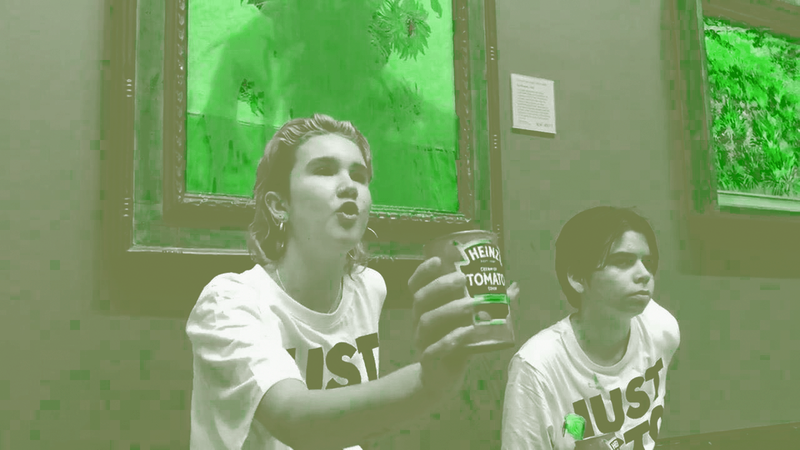
3. Compatibility error
The conception of temporality and its narrative framework represents a defining feature for climate justice movements, particularly those emerging in Europe and spreading globally during 2018-19. The necessity to embed urgency so fundamentally within the organizational system substantially differentiates XR from any other operating system, social or otherwise.
To complete our technological analogy, we propose framing the last XR issue in the shifting external context as a ‘compatibility error’ arising from these changes.
XR’s mobilizing capacity was initially enabled by two ‘temporal’ and external factors:
- The IPCC’s stark declaration that ‘only 12 years remain to meet Paris Agreement targets’ (marking the first time a concrete temporal limit had been established).
- The media spotlight on Greta Thunberg’s early speeches.
XR was designed to harness this wave of mobilization. However, the sudden emergence of the pandemic crisis radically altered the landscape, abruptly terminating the climate movements’ mass participation capacity. Hence, our analogy to a compatibility error—when software becomes incompatible with its broader operating system and environment.
This pandemic shift in the human, political, and media ecosystem directly undermined a core CRM requirement (point 1.) articulated by Hallam: ‘First, you need the numbers. Not millions, but not a few dozen people either. You need several thousand: ideally, 50,000’.24
Tens of thousands was the scale of XR in 2019. Therefore, XR in the UK never completely faded, even when, from 2020 onward, it could no longer mobilize tens of thousands for NVDA, but continued to engage thousands nationwide through legal and public actions, artistic activities, and community regeneration. By contrast, JSO—and the entire Western A22 network it references and belongs to—operates as a single-issue campaign where self-sacrifice is key. While it recruits activists from XR, its aim isn’t to build an equally broad alternative: it focuses on one specific yet substantial demand—halting new oil extraction. Through this narrow focus, it manages to radicalize the dramatic urge for action against the climate and social collapse, and to forge new alliances. But once its demand was recently met, it chose to dissolve.25
The emotional and bodily expression during disruptive actions made the climate crisis tangible—a crisis otherwise confined to a hypothetical future in media discourse and collective imagination.
What’s interesting about the XR-JSO fork is that many activists continued collaborating with both ‘wings’ of the movement. Even Hallam and prominent figures of XR, co-authored shared assessment documents.26 In our view, this marks a new possibility for rethinking organizational forms in such movements, where the branches of a fork remain parts of the same ecosystem, still recognizing themselves as such despite actual divisions.
This is why we believe framing XR as an operating system—using a modifiable, adaptable social action software like the CRM—ultimately captures a shift within the system itself: XR, through the JSO fork and the ‘We Quit’ statement, does something significant that can’t be understood through traditional leftist ‘political splits’ where division creates identitarian conflicts. Instead, XR de facto positions itself as ‘one part’ of a broader whole – a new social operating system? – while JSO represent another partial approach within a larger organizational and operational framework, inspired by radical flank theory.
Whether this was a fork or pseudo-fork, conscious or subconscious, planned or not, seems largely irrelevant. What matters is that these moves politically, mediatically, and organizationally define an ecosystem. Not the ‘complete’ one which Nunes’ organizational philosophy alludes to, but still—a functioning, adaptive one that reveals new possibilities of thinking through relationships and splits between organizations.
Conclusions
During the 2010s, scattered experiments in organizational innovation occasionally redefined the relationship between internal processes and external communication. These attempts—sometimes successful, sometimes clumsy—sought to blend digital tools with process design to create organizations that could potentially break free from traditional forms. These efforts reflected a broader tension: the desire to leverage digital platforms for rapid scaling and decentralized coordination, while still grappling with the need for sustainable structures beyond mere viral moments. This was evident in networked movements and later reflected in digital parties,27 but, in our view, this drive continued more substantially – and away from the spotlight – within transfeminist, antiracist and ecological movements, which defined grassroots politics in our times.
In short, a growing tendency toward codifying the social processes emerges through which movements develop and reproduce themselves, rising from the ruins of traditional organizations.
With this text, we aimed to introduce a concept – that of the socio-political fork – which we believe can help deepen and innovate how divisions within social movements are understood, particularly concerning the challenges they encounter in their development. This includes exploring both the parallels and differences with collaborative models in software development.
We argue that the trajectory of XR, and later the fork represented by JSO in the UK, provides a meaningful foundation for grounding the notion of the socio-political fork in contemporary movements. Indeed, the fork analogy has already been used to analyze social organizations, but primarily in studying structures operating within competitive ecosystems—whether political or market-oriented.
We therefore define – provisionally, of course! – the socio-political fork as a division that occurs based on a rather precise codification of a social movement. It clearly signals, from the outset, the potential to expand both the capacity for action and external collaboration within the original or main organizational ecosystem—what we have here called the ‘operating system’.
Indeed, identitarian divisions have historically proven prevalent and devastating for workers’ movements and the left. The Italian term ‘scissione’ – like religious schism – marks the onset of fratricidal, identity-driven conflict. By contrast, the open-source concept of forking reveals the potential for alternative yet complementary paths of development. We are certainly not the first to highlight the urgency of non-identitarian organizational bifurcations transcending horizontal dreams and vertical nightmares: more than others, Bogdanov and Guattari developed theoretical approaches deeply rooted in the pivotal political events of Russia 1917 and Paris 1968. Their concepts of tektology and disingression, or ecosophy and transversality, embody lifetimes of committed theoretical and practical research toward alternative ways of organizing – and even of ‘fighting out’ constructively – while drawing nourishment from the political and technological innovations of their eras.
The modest question we wish to raise through this text is whether our times, now that the house is burning and we’re out of time, might finally be ripe for fighting it out… if not less, then at least better!
-
(1) Daniele Gambetta (ed.), Datacrazia, Ladispoli: D-Editore, 2018. ↩
-
(2) Maria Galindo, Femminismo Bastardo, Milano: Mimesis Edizioni, 2022. ↩
-
(3) Felix Guattari, Les trois ecologies, Paris: Galilee, 1989. ↩
-
(4) Manuel Castells, Networks of Outrage and Hope: Social Movements in the Internet Age, Cambridge: Polity Press, 2012. ↩
-
(5) Franco “Bifo” Berardi, Disertate, Milano: Timeo Edizioni, 2023. ↩
-
(6) Michael Hardt and Antonio Negri, ‘Empire, Twenty Years On’, New Left Review 120 (Nov-Dec 2019). ↩
-
(7) Rodrigo Nunes, Neither Vertical Nor Horizontal: A Theory of Political Organization, London: Pluto Press, 2021. ↩
-
(8) Gregory Bateson, Steps to an Ecology of Mind, Chicago: University of Chicago Press, 1972. ↩
-
(9) Jono Bacon, The Art of Community: Building the New Age of Participation, Sebastopol, CA: O’Reilly Media, 2009. ↩
-
(10) Benjamin Mako Hill, ‘To Fork or Not to Fork: Lessons From Ubuntu and Debian’, 7 August 2005, https://mako.cc/writing/to_fork_or_not_to_fork.html. ↩
-
(11) Extinction Rebellion (ed.), This Is Not a Drill: An Extinction Rebellion Handbook, London: Penguin Books, 2019. ↩
-
(12) Javier Toret (ed.), Tecnopolitica y 15M: La potencia de las multitudes conectadas, Barcelona: Editorial UOC, 2015. ↩
-
(13) Clare Saunders, Brian Doherty, and Graeme Hayes, ‘A New Climate Movement? Extinction Rebellion’s Activists in Profile: A Report’, CUSP Working Paper Series, no. 25, 15 July 2020, https://cusp.ac.uk/themes/p/xr-study/. ↩
-
(14) Matthew Taylor, ‘“It has been polarising”: tube protest divides Extinction Rebellion’, The Guardian, 17 October 2019, https://www.theguardian.com/environment/2019/oct/17/london-tube-protest-divides-extinction-rebellion. ↩
-
(15) Extinction Rebellion UK, ‘Today’s tube action: how it happened’, 17 October 2019, https://extinctionrebellion.uk/2019/10/17/todays-tube-action-how-it-happened/. ↩
-
(16) Extinction Rebellion Scotland, ‘In the last week, two widely-shared images […]’, Facebook update, 19 October 2019, 15:31, https://www.facebook.com/XRScotland/posts/pfbid0AtxBHskydJAFmf8orwycYzVcCeUGTUXbzJE8aVbiiGE6titTfPTJ5RVynZYnFnbwl. ↩
-
(17) Alberto Manconi, ‘Tempo scaduto? L’esperienza di Just Stop Oil’, Zapruder 64, Profondo Nero, 2024. ↩
-
(18) Extinction Rebellion UK, ‘We Quit’, 31 December 2022, https://extinctionrebellion.uk/2022/12/31/we-quit/. ↩
-
(19) Sophie Squire, ‘Just Stop Oil activist - “We aren’t going to stop”’, Socialist Worker, 15 January 2023, https://socialistworker.co.uk/news/just-stop-oil-activist-we-arent-going-to-stop/. ↩
-
(20) Damien Gayle, ‘M25 protest recruiter called for “biggest disruption in modern UK history”, court hears’, The Guardian, 25 June 2024, https://www.theguardian.com/uk-news/article/2024/jun/25/m25-protest-recruiter-called-for-biggest-disruption-in-modern-uk-history-court-hears. ↩
-
(21) Haroon Siddique, ‘Just Stop Oil jail terms raise questions over harsh treatment of protesters’, The Guardian, 19 July 2024, https://www.theguardian.com/law/article/2024/jul/19/just-stop-oil-jail-terms-questions-over-harsh-treatment-of-protesters. ↩
-
(22) Extinction Rebellion (ed.), This Is Not a Drill, London: Penguin Books, 2019. ↩
-
(23) Alberto Manconi, ‘Al di la del quadro: rappresentazione e proteste nel Regno Unito’, Dinamopress, 17 October 2022, https://www.dinamopress.it/news/al-di-la-del-quadro-rappresentazione-e-proteste-nel-regno-unito/. ↩
-
(24) Extinction Rebellion (ed.), This Is Not a Drill, London: Penguin Books, 2019. ↩
-
(25) News Agencies, ‘UK activist group Just Stop Oil holds its last climate protest’, Al Jazeera, 26 April 2025, https://www.aljazeera.com/news/2025/4/26/uk-activist-group-just-stop-oil-holds-its-last-climate-protest. ↩
-
(26) Clare Farrell, Gail Bradbrook, and Roger Hallam, ‘Telling the truth so we can learn from mistakes - reflections five years on’, Extinction Rebellion Global, 19 October 2023, https://rebellion.global/blog/2023/10/19/reflections-5-years-on/. ↩
-
(27) Paolo Gerbaudo, The Digital Party: Political Organisation and Online Democracy, London: Pluto Press, 2019. ↩
Tactical Media Repository
Tactical Media Repository
Avantwhatever.com
A domain for experimentation, collaboration, and creativity
Ben Byrne
The ubiquity of megacorporations online, the dominance of walled garden platforms and protocols, and the ever growing and resource hungry infrastructures on which these depend form the ‘internet complex’.1 The platform capitalism of this complex restricts the possibilities for creative life on and offline.2 Politics and their aesthetic expression are reduced to symbolic economies that themselves contribute to the escalating degradation of our intertwined mental, social, and environmental ecologies.3 There is urgent need for tactical maneuvers that contribute to the development of alternative creative ecologies such as those Avantwhatever.com embodies, treating online spaces as embedded in and dependent on the physical world, a commons for all.
Avantwhatever is a forum for digital sound, art and design. The organization started as an experimental music label, publishing releases freely online and physical editions in 100% post-consumer recycled packaging, which were launched with live performances. It has since hosted concert series, soundwalks and other place-based events, and three festivals. The last of the festivals, Avantwhatever 2020, was held entirely online during the COVID pandemic, with Avantwhatever.com designed as a domain for experimentation, collaboration, and creativity. The domain now further hosts the Avantwhatever Commissions series, which supports the creation of works that engage listeners with more-than-human realities.
Designed by me and Paul Mylecharane, who also developed the site, Avantwhatever.com uses the technologies and standardized protocols of the web to publish freely and openly, and is hosted using 100% renewable energy. This includes hosting interactive and procedural work as sub-domains, providing a forum for computational sonic creativity that is not supported by most commercial platforms. Seasons of commissions also include audiovisual works hosted using the software PeerTube, so that they can be shared across the decentralized networks of the fediverse, using software such as Mastodon.
The commissions are published freely online, with artists and others encouraged to stage further presentations of the works. This challenges dominant logics of artificial scarcity in which creative work is often sequestered in galleries and other spaces exclusively and only later released more widely, if at all. Instead, works are shared as widely as possible, building interest and engagement that fosters audiences and thus presentation opportunities for artists.
Capitalist extraction has relied upon ongoing enclosures of the public, of everything from land to the internet. Ecological urgencies now necessitate a return to holding in common, to claiming less in order to share in more. Avantwhatever.com helps cultivate a sonic domain, a commons that is free and open to all—listen in and contribute.
-
(1) Jonathan Crary, Scorched Earth: Beyond the Digital Age in a Post-Capitalist World, London: Verso, 2022, 11. ↩
-
(2) Nick Srnicek, Platform Capitalism, Theory Redux, Cambridge: Polity, 2017, 10. ↩
-
(3) Félix Guattari, The Three Ecologies, Translated by Ian Pindar and Paul Sutton, London, UK: The Athlone Press, 2000, 28. ↩
Cartography of Darkness
https://dark.society.systems
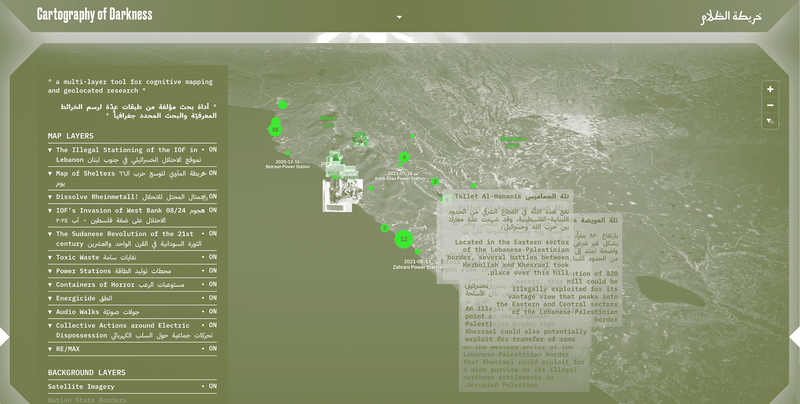
Cartography of Darkness is a transclusive research platform dedicated to exploring universalisms and the unity of knowledge in our highly obfuscated, crisis-ridden age. Beginning with our situated knowledge in Lebanon, the platform’s inaugural chapter ‘FOR A TRANS-ELECTRIC SOLIDARITY’ seeks to publicly probe and critically map the obscure genealogies of Lebanon’s techno-political and ecological histories of dispossession, ecocide and agnotology while studying the unity of knowledge. The cognitive mapping platform is comprised of a sonified accretive map made of several layers of interactive strata and spatialized data, a public media repository that makes accessible for the first time research material found in personal archives created by scientists, artists and investigative journalists and the scraped web, new text and audio research is published regularly as part of a seasonal periodical/research chapter that remains open for a period of nine months.
Every periodical/research chapter seeks to expose the regimes of invisibility that contaminate and head Lebanon’s hegemonic modes of production, while fostering new ways to collaboratively see into, study and transform our environment. The contributions revolve around trans-electric and trans-regional solidarity, burgeoning social models based on mutual aid, public access and social justice as opposed to kleptocracy; and ecologies of care as opposed to the local and global economy of toxic discard and denial. By doing so, ‘Cartography of Darkness’ seeks to collectively search for ways to expose, link and see through the regimes of invisibility, the explosive environments and cultures of corruption that denigrate life from the people in Lebanon, while deeply influencing the links between the production of knowledge, the production of space and the articulation of politics.
The entirety of the architecture and code of Cartography of Darkness is made publicly readable and available for re-use through a GNU V3 open-source license. All the material in the repository that the team has directly digitized and archived are available for use and re-use through a Creative Commons license. The three spaces that make up Cartography of Darkness; the Periodical, Repository and Map are interlinked in a transclusive approach to one another. ‘Transclusion’ was conceived and coined by philosopher, sociologist and computer architect Theodor Nelson in the 1960s. It describes media that are brought in from various sources to be ‘knowably in more than one place’. Nelson also coined the relevant terms ‘hypermedia’, ‘hypertext’, ‘xanalogical storage’ and ‘intertwingularity’ that we would argue are not based on the digital advent of computational media, but on trans-millennial theories of emanation found in the quiddity of the circulation of thoughts and media.
Cartography of Darkness is made possible through a joint grant from the Arab Council for Social Sciences and the Arab Fund for Art and Culture. A major part of the digitization and archiving in the repository is made possible through the Digital Earth Fellowship and a grant by the MIT Libraries and the MIT Programme in Science, Technology Society. If you would like to contribute, you are very welcomed to get in touch at society@posteo.si.
Complicity Map
academiccomplicity.nl
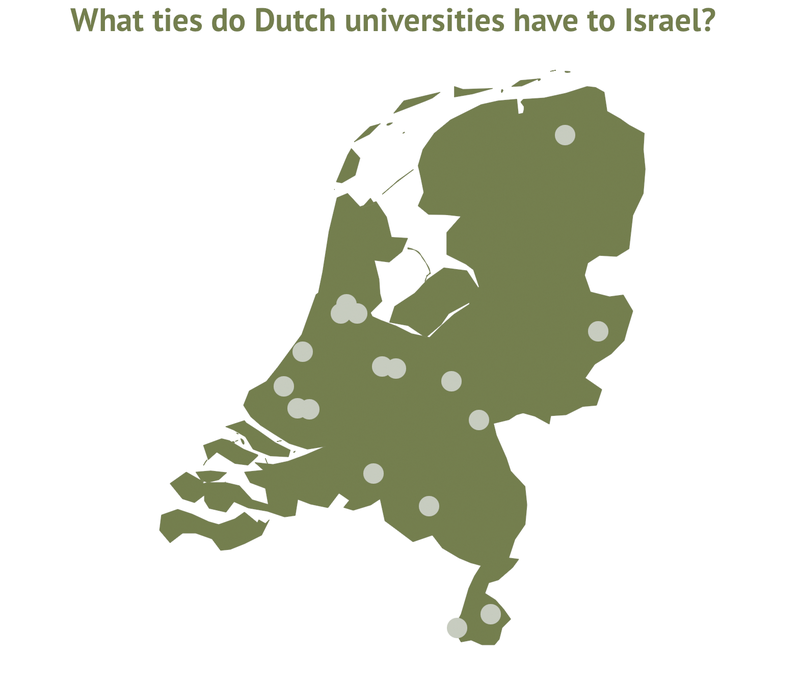
From late 2023 until now, in response to the ongoing genocide in Palestine perpetrated by the state of Israel, students and staff of Dutch universities increased pressure on their institutions to cut ties with Israeli companies and universities complicit in this crime against humanity. Students and staff have been calling for the academic boycott of Israel for many years prior, because Israeli academic institutions have been complicit in the commission of apartheid, colonization, and occupation against the Palestinian people for many decades. This website serves as an information source in support of their activities, and for anyone else interested in this issue.
Based on a variety of sources, including the CORDIS-website with EU funded research projects, university websites, results from Freedom of Information requests and the work of Dr. Maya Wind, this website maps institutional ties that are current as of March 2026. It builds on research by Stop Wapenhandel, the Rights Forum, Students for Palestine and students and staff at various Dutch universities, and is a work in progress.
Complicity Map is a tool for students, activists and researchers to discover the complicit links between European universities, private companies and government institutions with their Israeli counterparts. The participation of Israel in the EU’s R&D frameworks is an integral part of the multifaceted European-Israeli collaboration that has directly contributed to sustaining settler-colonialism, occupation and apartheid in Palestine for decades, ultimately culminating in the genocide of its indigenous people.
Elegies of Oil Spills
aleesteele.mmm.page/elegies-for-oil-spills
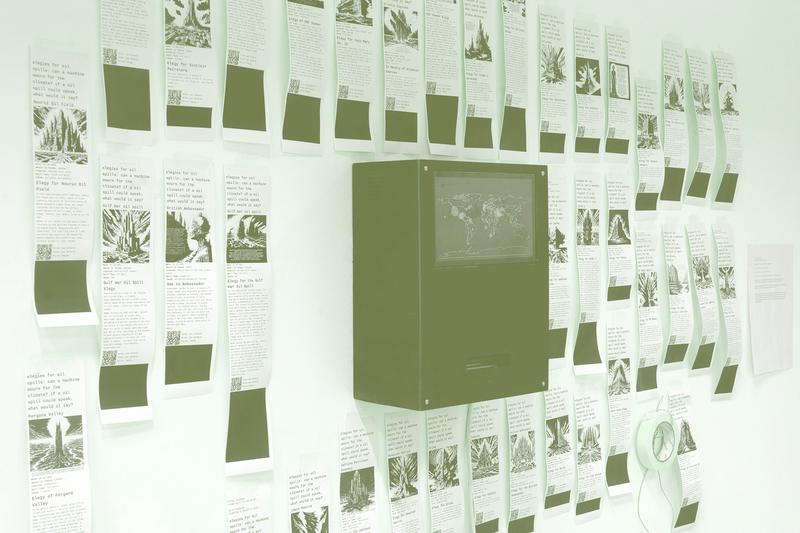
Our project asks a central question: how do we counter the embodied ethos of extraction? How might we assemble existing techniques to help us perceive and resist the physical and emotional effects of extractive systems?
Extraction’s contradictions surround us: in the commodities that structure our lives, in the unwaged labor that sustains volunteer communities, and in the natural resources demanded by computational work, especially data-hungry AI. These tensions shape both our world and our inner lives, yet they are rarely understood as embodied experiences, even when scholars and journalists map them intellectually.
In response, we created Elegies for Oil Spills, an artwork that asks:
- Can a machine mourn for the climate?
- If an oil spill could speak, what would it say?
- What might machine mimicry reveal about narratives of oil, spillage, and ecological destruction?
Using open datasets of major oil spills, the system generates speculative artefacts printed as thermal-paper receipts. The receipt becomes a generative canvas, its production process echoing oil refinement.
A viewer begins by selecting an oil spill on a map. The system then searches for articles related to the spill’s metadata, probing available resources to ‘extract’. These articles are scraped and passed through a refinement pipeline: first to the ChatGPT API to produce an elegy, then again to generate a minimalist brutalist image derived from the poem. The final output is issued as a unique, single-use generative artwork.
All components are contained within a black box housing a touchscreen, Raspberry Pi, and Epson receipt printer. The installation can sit on a plinth or be wall-mounted. While designed for full functionality with Wi-Fi, it also includes an offline mode with local data.
Internet Core
networkcultures.org/internetcore/
Internet Core Manifesto
- 1 Against Banality in Digital Art
Post-Internet art has been absorbed by the art market, converting itself into a product within platform capitalism. Internet Core seeks to dismantle this structure, rejecting the dependence on commercial platforms that limit digital experimentation. We reject visual uniformity, the repetition of marketing formulas, art domesticated by platforms. We demand error, dissonance, ruin. We want images that do not adapt completely, that destroy and reconstruct.
- 2 Rupture with the Clearnet
On the Clearnet, artists remain trapped in algorithms designed to maximize consumption and superficial visibility. Internet Core advocates for a digital exodus towards decentralized communities in the Deep Web and Dark Forests, where creativity is not subjected exclusively to market logic.
- 3 -core as a Subversion Strategy
The ‘-core’ suffix has evolved from musical or subcultural styles like hardcore and emo to become a label of ethereal tendencies. Internet Core resignifies it as a method of resistance, a way to navigate the saturation of aesthetics and to hack algorithmic narratives.
- 4 Revival of Subcultures
Subcultures are not dead; they have expanded in the digital sphere. In a context of climate collapse, post-pandemic crisis, the extreme political shift to the right and contradictions of capitalism, Internet Core becomes a space for collective action. Archiving images, constructing -cores, and developing shared visual identities are forms of political and artistic resistance.
- 5 Performativity and Resistance Strategies
Contemporary art still fails to grasp the magnitude of the digital space. Internet Core proposes a new aesthetic and critical performativity that assumes digitality as a battlefield. Visual culture becomes a weapon to dismantle power structures, hack the establishment, and construct new forms of radical imagination.
Learning Palestine
learningpalestine.net
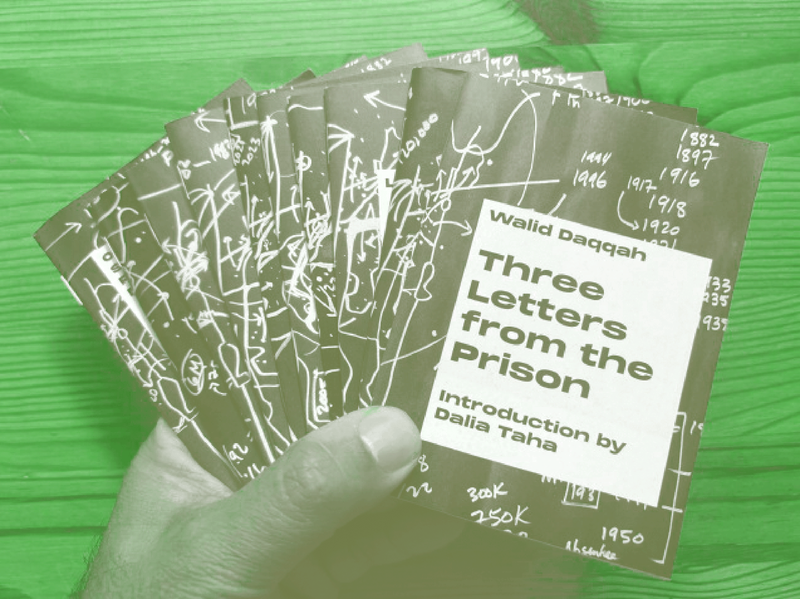
Learning Palestine is a group of artists, academics, intellectuals and community members, who aim to disseminate knowledge on the history of the ongoing struggle for justice, liberation, and freedom of Palestine and the Palestinian People. The group practices new and old ways of disseminating this knowledge, that function out with the constraints of social media and corporate controlled networks. The initiative currently unfolds through four interconnected modes of learning:
The Learning Palestine sessions aim at learning and teaching (could also be ‘sharing knowledge’ or ‘disseminating knowledge’) about the ongoing oppression and resistance in Palestine through historical and personal storytelling. They are in-person, intimate sessions through which the story of Palestine is told through time and place, using the militant pedagogical techniques of drawing and writing, without showing images or pre-made visuals.
The 12 hour radio programs include lectures, interviews, book presentations, talks, storytelling, music, songs, poetry and chants, alongside other audio material collected from different online platforms.
We collaborate with Radio Alhara and other online platforms.
The Pamphlets is a collection of online essays that are essential readings for a comprehensive understanding of the Palestinian struggle. Authored by diverse writers from various backgrounds, these essays span different periods and cover a range of topics. Learning Palestine is (re)publishing these texts to disseminate knowledge on the history and present-day struggles for justice and liberation for Palestine and the Palestinian people. The collective republishes these essays without seeking prior permission from authors or publishers, asserting the urgency of their circulation amid the ongoing genocidal war on Palestine. These publications are offered as tools for historical and political literacy in the service of liberation, grounded in the belief that knowledge must be activated to create a more just world. What is knowledge for if not to change the world to a just place for all?
The manifesto of Learning Palestine is titled ‘What is the Future of Art?: A Manifesto Against the State of the World’, and was presented at the Palestinian Pavilion of the Venice Biennale. The manifesto is a call for urgent action in response to the ongoing genocide in Gaza, confronting the stark realities shielded by nation-state rhetoric and imperial power. Accompanied by poetry, the manifesto stands for dismantling nation-states, reclaiming land, and restoring art and poetry as essential tools of resistance.
Lumbung Press
documenta-fifteen.de/en/lumbung-press/
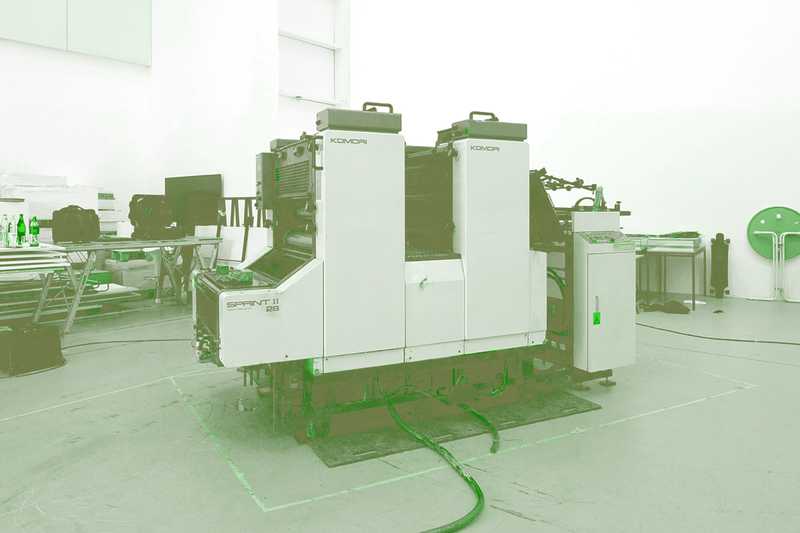
documenta fifteen: lumbung Press, 2022, Photo: Nicolas Wefers
Lumbung Press is a common project developed by lumbung members, lumbung artists, and the Artistic Team of documenta fifteen. It emerged as a response to the question of how the lumbung can make publications and share them in an independent and sustainable manner. The collectively run lumbung Press (installed at documenta Halle during documenta fifteen) shows how to print books and other materials and offers self-publishing resources during and beyond the 100 days of the exhibition. Printing technicians instruct the participants in the usage of the machines.
Lumbung Press believes in publishing as a means to build a collective body and is founded on transmission without intermediaries, translation or proofreading outside the logic of each project. Lumbung Press revolves around the community that emerges with shared effort (everyone helps in some part of the process) and working towards dismantling clients and services, replacing it with compression and adaptation to the local needs of artists and lumbung collectives. This means avoiding focusing on specific results at the expense of materials or production systems. Production can be opened, adapted or modified to find the unexpected, but coherent and precise in each circumstance. It is not about arriving at a product, as much as it is about what you can do with what you have.
Lumbung Press works to dislocate offset printing from commercial objectives and contexts into creative and more social methods and approaches without losing production and the possibility of a mass audience. It studies and experiments around the conception, layout, multiplication, printing, distribution, and value construction of a publication.
There are two strategies of publishing: A fast immediate one that produces daily varying flyers and posters, and a slower process that harvests books and publications from the artistic contributions to documenta fifteen.
The printed material of the Lumbung Press is distributed via three channels: In Kassel through lumbung Kios, by the book trade on a national and international basis, and via lumbung members and lumbung artists in their own ecosystems.
Obiezione Respinta
obiezionerespinta.info/en/
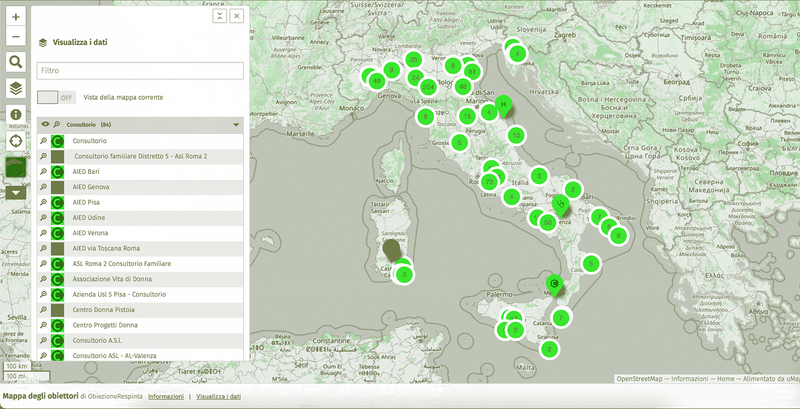
Obiezione Respinta is a transfeminist, counter-institutional infrastructure situated at the intersection of reproductive justice, data activism, and feminist media practice. Emerging from within the Non Una Di Meno network, the project responds to the pervasive mechanism of obiezione di coscienza (conscientious objection) that continues to obstruct abortion access and reproductive care across Italy. Conceived as both a digital platform and a collective tactic, Obiezione Respinta reclaims cartography as a feminist tool of resistance—transforming the logic of mapping from an instrument of control into a medium of solidarity, visibility, and epistemic disobedience.
Built from anonymous testimonies, the project’s interactive map traces the lived geographies of access and denial in hospitals, counseling centers, and pharmacies. More than a dataset, this cartography functions as a performative archive: a dynamic interface where affect, experience, and situated knowledge converge. By turning individual testimonies into collective intelligence, Obiezione Respinta generates a counter-cartography of reproductive injustice that makes visible the hidden architectures of refusal and neglect embedded in the national healthcare system.
Operating as a horizontal and self-managed network, through hybrid assemblies across regions, the project enacts a feminist politics of infrastructure. It transforms the act of mapping into a form of commoning—an ongoing process of collective autoformazione (self-education) that redefines data as a site of care and shared responsibility. This distributed model resists institutional capture, fostering new modes of collaboration and solidarity across feminist, queer, and activist communities.
Obiezione Respinta simultaneously performs a juridical and epistemic critique. Re-reading Article 9 of Law 194, which grants the ‘right to objection’, the project exposes how patriarchal jurisprudence constructs conscience as a privilege exercised over the bodies of others. Against this asymmetry, it posits reproductive freedom as a collective right: to free, safe, and guaranteed abortion, to bodily autonomy, and to non-binary, decolonial healthcare that transcends gender and ethnic hierarchies.
Through its open-access mapping platform, the collective develops a feminist infrastructural aesthetics—a tactical media practice where interface design, testimony, and activism merge into a shared site of political composition. The map becomes both an investigative and generative device: a living topology of resistance that documents and disrupts the biopolitical management of reproduction.
By reframing data as a field of feminist struggle, Obiezione Respinta intervenes in the colonial and patriarchal logics of visibility that structure contemporary governance. It transforms witnessing into world-making, reclaiming the right to narrate, to know, and to decide.
Obiezione respinta. Sul nostro corpo, sulla nostra sessualità decidiamo noi.
(Obiezione respinta. Over our bodies, our sexuality—we decide.)
Permacomputing
permacomputing.net
Permacomputing is both a concept and a community of practice oriented around issues of resilience and regenerativity in computer and network technology inspired by permaculture.
In a time where computing epitomizes industrial waste and exploitation, permacomputing encourages a more sustainable approach, maximizing hardware lifespans, minimizing energy use and focusing on the use of already available computational resources. Permacomputing asks the question whether it is possible to rethink computing in the same way as permaculture rethinks agriculture. Permaculture is the science and practice of creating semi-permanent ecosystems of nature. The resilience of any such ecosystem is equal to its diversity and interconnectedness. Permaculture design is a system of assembling conceptual, material and strategic components in a pattern which functions to benefit life in all its forms. It seeks to provide a sustainable and secure place for living things on this earth.
At first it may seem paradoxical to connect permaculture and computation. Indeed, an extractive technology that depends on a wasteful use of finite resources can hardly be permanent. Therefore, by making this connection, what we are truly asking is whether or not there can be a place for computer and network technology in a world where humans contribute to the well-being of the biosphere rather than destroy it? And if yes, how?
Permacomputing wants to imagine such a place and take steps towards it. It is therefore both utopian and practical. We want to find out how we can practice good relations with the Earth by learning from ecological systems to leverage and re-center existing technologies and practices. A radical reduction of wastefulness is a fundamental aspect of it: maximize the hardware lifespans, minimize the energy use. And this is not just about a set of technical problems to be fixed—the attitudes also need a radical turn. Understandability is aesthetics, virtual does not mean immaterial, and doing things with less is not a return to the past. We want to investigate what a permacomputing way of life could be, and what sort of transformative computational culture and aesthetics it could bring forward.
The principles of permacomputing are:
- Hope for the Best, Prepare for the Worst
- Care for All Hardware — Especially the Chips
- Observe First
- Not Doing
- Expose the Seams
- Consider Carefully the Interaction Between Simplicity, Complexity and Scale
- Keep It Flexible
- Build on Solid Ground
- (Almost) Everything has a place
- Integrate Biological and Renewable Resources
Radio Alhara
radioalhara.net

Radio alHara emerged in the early months of the pandemic as a translocal experiment in collective broadcasting. Founded by Elias Anastas, Yousef Anastas, Yazan Khalili, Mothanna Hussein and Saeed Abu Jaber between Bethlehem, Ramallah and Amman, the project began as an act of resistance to isolation and disconnection. Its name – Al Hara, meaning ‘the neighborhood’ in Arabic – evokes a sense of proximity and shared space, even under conditions where movement and gathering were suspended.
From the outset, Radio alHara positioned itself not simply as a radio station but as a social and political infrastructure. Built on open participation and collective authorship, it allows anyone to contribute sound, text or conversation; listeners become producers, and the neighborhood becomes global. Its programming, moving fluidly between soul, house, classical Arabic and experimental sound, refuses algorithmic logic or institutional framing. The form of its organization – horizontal, open-ended, decentralized – is itself the political gesture.
Over time, Radio alHara evolved into a platform for solidarity and resistance. During the 2021 Sheikh Jarrah evictions, for instance, the collective launched the Sonic Liberation Front, transforming the airwaves into a transnational field of protest and care. Through such acts, the station demonstrates that radio can be both medium and movement: a mode of connection that collapses borders while amplifying the experience of life under them.
As a tactical practice, Radio alHara reclaims radio as a commons, an infrastructure of listening that resists enclosure, nurtures collective agency, and reimagines what it means to inhabit space together. It is at once a neighborhood, an archive, and a living frequency of solidarity.
re-search.site
Renée Ridgway and Anders Visti
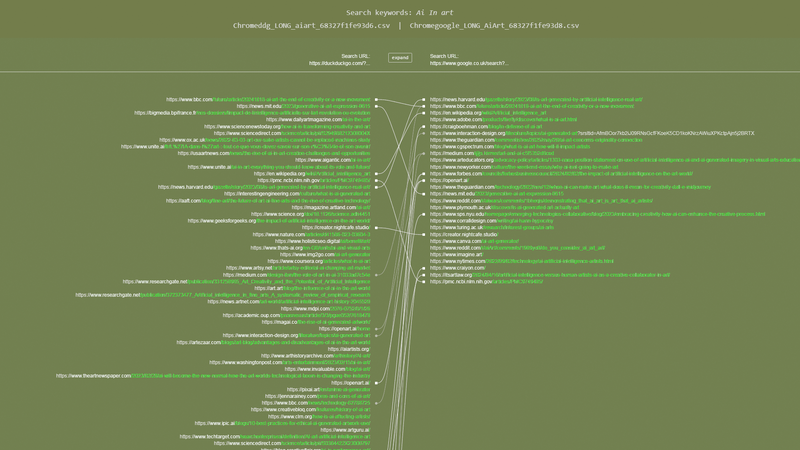
Operating as an increasing invisible information infrastructure,1 Google still has a hegemony on search, with a worldwide market share of around 90%. People still ‘ubiquitously google’ yet the actors and dynamics of search are changing with the uptake of generative artificial intelligence aka chatbots, which often provide one answer or an overview to all queries, instead of ten ranked hyperlinks.2 Investigating the ethics and politics of these search technologies becomes crucial in an era of surveillance capitalism, along with exploring their workings. Transient as well as opaque, what are some of the criteria determining search results, how can they be visualized, compared and better understood?
In a workshop setting, a bespoke platform (https://re-search.site) enables users to visualize, compare and interpret their search results based on different keywords and browser/search engine/operating system settings.3 The participants can (re)search their own interests by carrying out keyword searches within the platform itself, which is able to parse the results into comparative data visualizations. As a critical deep-dive into technology, the front-end interface design positions search results obtained with diverse browsers/engines side-by-side, reflecting their similarities and differences, visually. Matches and ranking show Google’s own agenda of hierarchizing its own products, whilst alternatives provide diversity in the search results. It also takes on the contemporary condition of GenAI by surfacing responses from the most used chatbots (Gemini, OpenAI, Llama) in the platform’s interface through the ‘art of prompting’. By querying with phrases and specific questions, the platform demonstrates how users’ results change with every iteration, thereby facilitating a comparative analysis of the answers.
The re-search.site is a media artwork and a functional web interface that also engenders the social relevance of search as a knowledge infrastructure. As practices of representation, the platform seeks to intervene and give shape to the world by making invisible infrastructures more tangible and comprehensible to the public. In both search methods, the platform collects participants’ search results on a server, making permanent online search habituations as it constructs a commons of collective memory. By enabling new forms of intervention that accentuate connections between activism and media art, it produces a conducive space for critical reflection as it attempts to anticipate uncertain futures. Contributing a post-digital perspective, the platform encourages collaboration and cross-disciplinary interactions, embodying tactical visions of the techno-social in regard to the future of search.
-
(1) Jutta Haider and Olof Sundin, Invisible Search and Online Search Engines: The ubiquity of search in everyday life, Routledge, 2019, https://doi.org/10.4324/9780429448546. ↩
-
(2) Renée Ridgway, ‘Deleterious consequences: How Google’s original sociotechnical affordances ultimately shaped “trusted users” in surveillance capitalism’, Big Data & Society, 10(1) (May, 2023), https://doi.org/10.1177/20539517231171058. ↩
-
(3) The project received financial support from the SHAPE centre, Aarhus University, Denmark, https://shape.au.dk/en/. ↩
Stream Art Network
networkcultures.org/void/2024/11/14/launch-of-the-stream-art-network-san/
The idea of the StreamArtNetwork (SAN) emerged together with UKRAiNATV’s weekly live webcasts from the StreamArtStudio in Krakow (PL), in response to the full-scale Russian invasion of Ukraine, just after February 24, 2022. Media artists, activists, journalists, AV producers, DJs, and IT freaks from the region and beyond reached out to others to pick up the stream, join, and show solidarity. Soon after, responses came in, and collaborations started, first and foremost to support artists in Kyiv, Lviv, Kharkiv, and other places throughout Ukraine.
UKRAiNATV began traveling, showing up, hosting workshops and lectures using pop-up studios in New York, Trondheim, Rome, Barcelona, Berlin, Lviv, and Kyiv – searching for partners around the world. In early 2023, THE VOID (T.V.) channel of the Amsterdam-based Institute of Network Cultures joined, followed by the Intermedia Budapest crew in early 2024. In the fall of 2024, a network was established consisting of the following founding members, each running a green-screen studio: UKRAiNATV in Krakow, THE VOID in Amsterdam, Re:Frame.TV in Kyiv, Konfluxus Collective in Budapest, CDI in Coventry, and the 3022 in Vilnius.
The aims of the StreamArtNetwork are diverse, radical, and utopian at the same time. The network streams together, mixing and layering, meeting in-between platforms, localities and realities. We stream against war, neo-imperial invasions, genocide and limited mobility. Against big-tech centralization and neo-liberal social media monopolies with their 30-second ‘influencers’. We invite all like-minded to join, in favor of an endless exploration of time-spaces that we are creating together in our collective, heterogeneous hyper-realities – in global, hybrid, innovative, decentralized, low-budget, and sustainable ways, in a permanent process of learning and teaching by streaming for change, together.
Please join the network, press
SAN invites both institutional partners and smart, creative, transdisciplinary collectives – small experimental labs, and big rich cultural entities stack in cultivating the traditions of twentieth-century white cubes and old-school theatre halls. Demystify and reclaim the video tech. Hack your nearby green room or buy that green piece of textile et voilà, you’re on-air. The virtual is material and vice-versa. The stream art network is testing new models and initiating discussions on systemic changes regarding the production and distribution of contemporary and digital culture, and the redistribution of funds for its development. We will set up a green-box studio and collaborative media lab in every cultural, educational, public, and social institution and reclaim the internet, our archives, digital and critical culture, and direct, equal, multi-directional communication across political, geographical and technological boundaries.
Founding members:
-
UKRAiNATV, Krakow https://ukrainatv.streamart.studio
-
CDI, Coventry https://warwick.ac.uk/fac/cross_fac/cdi
-
Re:Frame.TV, Kyiv https://www.instagram.com/re_frame.tv
-
3022, Vilnius https://3022.place
-
Konfluxus, Budapest https://www.instagram.com/konfluxus.collective
-
THE VOID/INC, Amsterdam https://networkcultures.org/void
Slutty Urbanism
sluttyurbanism.art
THE SLUTTY_VERSE
The black leather couch that was rescued from a garbage bin in Amsterdam around 2018 was the cradle where Slutty Urbanism started to conspire. The manifesto was first published on Medium.com. We went through an emotional journey along with changes within the collective and new slutty comrades. In these seven years, pandemics, wars, authoritarianism and techno-fascism became even more unhindered. The slutty urbanists have started to imagine a new set of possible universes which are against this techno-dystopia.
So, welcome to the Slutty_Verse, where we howl to disturb the algorithmic power. In a prolonged wailing noise, we cry hysterically to wish authoritarian politicians a constant premenstrual dysphoric disorder. We gaze at the world through the lens of glitches until we become glitches. Our witchcrafts are meant to destroy the toxic positivity of city-branding and AI solutionism. Of course, we couldn’t care less about the dumb rapid development of AI tools, which are harmful to our environment and dangerous for our cognitivities. Through our potions, we want to prevent over-touristification and massive extractivism of data of the quantum self. In this numerical fragmentation of bits, we want to reclaim technologies for collective and solidarity purposes. We refuse the rise of fascist villains and their embarrassing ‘broligarchy’. Yet, we understand that all of this comes together to build this muscular, phallic form of power that pretends to overextend itself through physical violence and technological domination.
In the Slutty_Verse, we are not naive about digital technologies, we are not against them or social media per se. What we do is formulate spells, drink and serve concoctions of sarcasm to navigate, resist, and regain the urban and technological spaces we have no choice but to live in. While some options for refusal or evasion are no longer available, different pathways have emerged. Facing the current political desolation, we propose a mix of old and new praxis—such as walks, creative writing, workshops, and performances. We exorcise subconscious surveillance with radical friendship and care. To keep alive and constantly renegotiate our political subjects—we embody sluts and witches to scare the bros and their pathetic egos. We utterly critique the late (platform) capitalism. We drift within speculative thinking, refreshing our critical feminist positionality as a mediated form of hostility and aversion against the neoliberal and sanitized academia.
Being sluts, we are not fond of pristine objects and smart technologies. We oust the meaning of smart that is implied by the concept of ‘smart wife/city/home’, where people and places are guinea pigs to suck their data like in a lab. We don’t use navigation apps; we buy stuff from real humans, paying in cash. Thus, we invite you to the Slutty_Verse, in which together we can recoup diversity, alterity, and queerness…
The World after Amazon
afteramazon.world
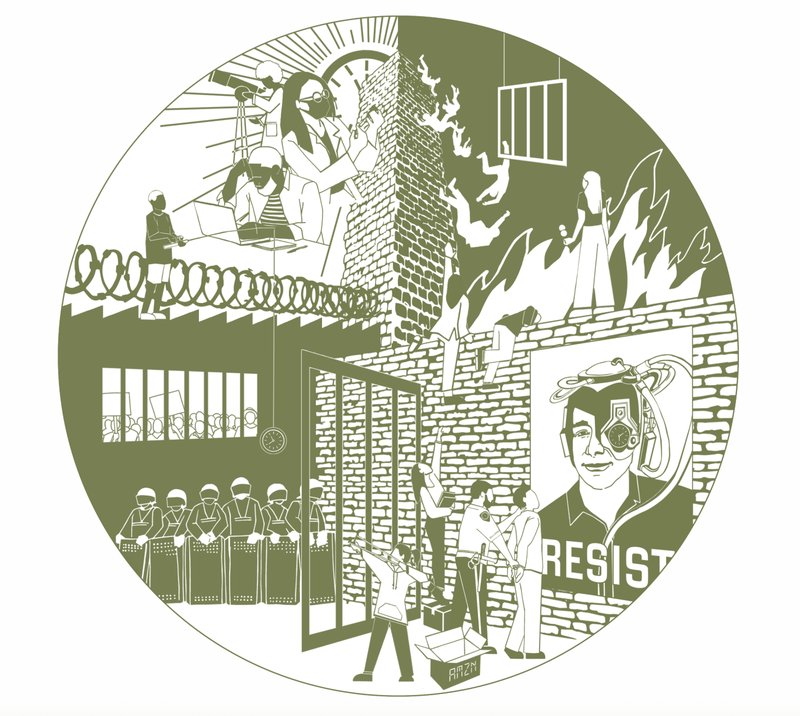
The World After Amazon is a speculative fiction project developed by the Worker as Futurist Project in 2023. It brought together 13 rank-and-file Amazon workers to imagine and write short stories envisioning a future beyond the reach of the corporation. The result is featured on the website afteramazon.world.
Since it was founded in 1994, Amazon has presented itself as a benevolent force in our world, ‘revolutionizing’ many areas of life and the economy, from books and media to robotics and logistics, from groceries and electronics to internet services and much, much more. The corporation promises to bring a utopian future of consumer convenience. But its workers pay the price, often toiling in dystopian conditions to generate profit so great their boss was able to finance his own private space program. Companies like Amazon are indeed shaping the future of humanity, but the workers who generate its wealth have no say in that future.
The Worker as Futurist Project supports workers in reclaiming the tools of imagination and narrative. It provides a platform for them to tell their own stories, articulate their own visions, and assert their collective power to shape the future. This project stands in solidarity with workers and communities across the globe who are organizing to confront the power of Amazon and build more just, equitable futures.
Tools Against Surveillance Capitalism
X VENDETTA
DO NOT SPEAK
We are living in an era where digital life is consolidated under billionaire owned platforms.
Owned by the few to govern the many. Our data is harvested and sold to oppressive regimes. The system profits from compliance and punishes deviation. Our conformity is rewarded. Our dissent is silenced. This is techno-fascism. And it’s not the only way.
De-Google Your Life
Google is not a search engine. It is a global behavioral intelligence contractor.
- Surveillance Capitalism: 80-85% of Google’s revenue comes from targeted advertising. Search, Gmail, Maps, Android = continuous tracking.
- Project Nimbus: Google & Amazon’s $1.2B cloud & Al contract with the Israeli government + military.
- Military Grade Al: Image recognition, data fusion, population surveillance. Used to target civilians in Palestine, the U.S. and worldwide.
- Algorithmic Censorship: Quiet de-ranking, demonetization, visibility control on topics that challenge the ruling ideology.
- Border Enforcement Ties: Cloud and data infrastructure complicity linked to immigration control and oppression by ICE.
- Environmental Extraction: Massive water, energy and resource requirements for AI compute.
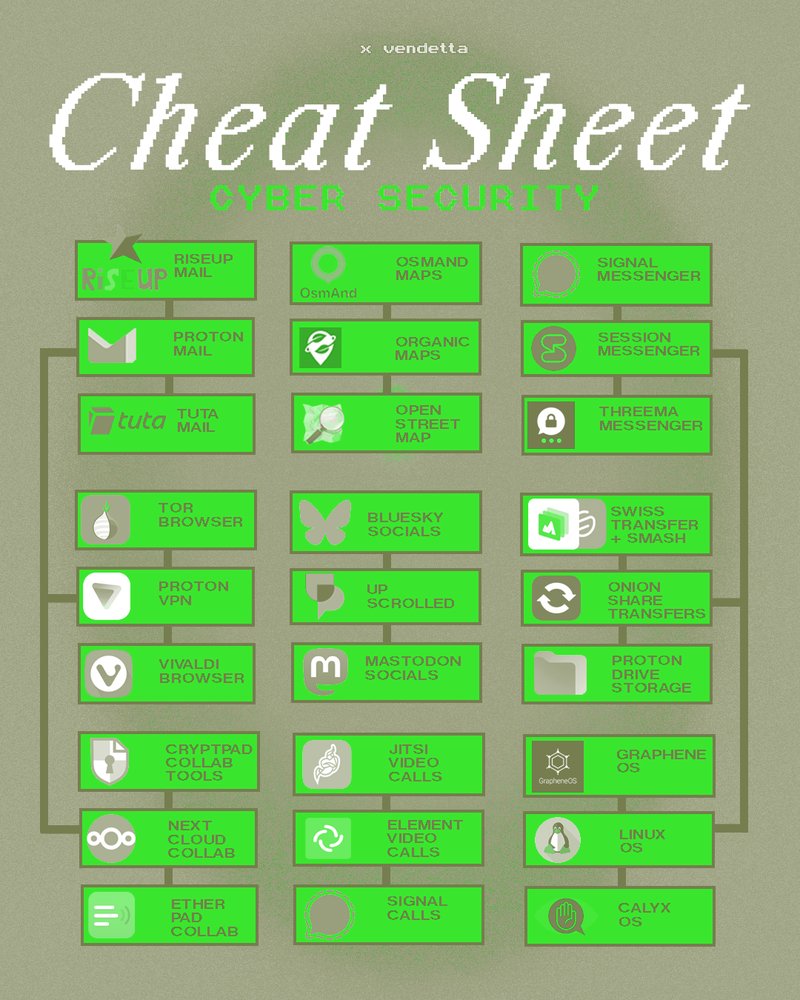
1. LEAVE: GMAIL / OUTLOOK
-
Microsoft tied to state and enterprise surveillance.
-
Gmail reads email content + scans attachments.
2. MOVE TO: END TO END ENCRYPTED, NON AD BASED MAIL
-
PROTON MAIL: Free encrypted mail server with calendar, VPN and other services. Proton cannot read your mail. Public key can be attached to your mail. Proton is a company so there are doubts on capitalization.
-
RISEUP MAIL: Volunteer-run anarchist data project. Offers secure, privacy-focused email and mailing list services. Requires an invite to join.
-
TUTA MAIL: Open source encrypted email service from Germany. Private company without outside investors. Removes IP from messages and uses AES and RSA encryption instead of PGP.
MAPS
1. LEAVE: GOOGLE MAPS
-
Maps = location history, movement patterns, daily routines.
-
Google maps centralizes global mobility data.
2. CHOOSE: OPEN DATA OR FEDERATED ALTERNATIVES
-
OPEN STREET MAP: Community-built, open-source world map. No single owner; data created and maintained by volunteers globally. Anyone can audit, host, or reuse the data.
-
ORGANIC MAPS: Offline-first mobile maps built on OpenStreetMap. No trackers, no ads, no data collection. Works without internet once downloaded.
-
OSMAND MAPS: Highly customizable navigation app using OpenStreetMapdata. Supports offline use, local data storage, and user control over what is shared.
MESSAGING
1. LEAVE: WHATSAPP / FB MESSENGER
-
Easiest ways to infiltrate movements.
-
Avoid meta owned platforms.
2. PRIORITIZE: E2EE + MINIMAL METADATA
-
SIGNAL: Fully open-source, commonly used, based in USA. End-to-end encrypted messaging with minimal metadata. Widely audited - requires phone number.
-
THREEMA: Paid, privacy first messaging app with strong encryption and no data harvesting. Not open source, no self-destruct.
-
SESSION: Decentralized, onion routed messaging that does not require a phone number. Designed for anonymity.
BROWSING
1. LEAVE: CHROME / SAFARI
-
Assume you are being watched. Browsers fingerprint you by default.
-
Isp’s log traffic. States subpoena it. We are exposed to tracking.
2. PRIORITIZE: ANONYMITY + ENCRYPTION
-
TOR BROWSER: Free overlay network for enabling anonymous communication. Built on free, open-source software run by volunteer-operated relays worldwide. Brave browser has one integrated.
-
VIVALDI BROWSER: Built-in ad & tracker blocker. Highly customizable. High privacy and user community. Alternative to Brave browser after concerns of CEO homophobia and big-tech ties. Non open-source.
-
PROTON VPN: Virtual private network change user’s device IP to another location to bypass location-based restrictions and block trackers. Proton is Swiss-based with high data protection laws.
SOCIALS
1. META / X / TIKTOK ARE COOPTED BY ZIO CORPS & BILLIONAIRES
-
Corporate platforms silence and censor dissent.
-
Engagement algorithms = behaviour & belief shaping.
2. CHOOSE: DECENTRALIZED & USER OWNED NETWORKS
-
UPSCROLLED: Palestinian owned, fair algorithms, no shadow-banning, company owned, never biased, social responsibility, more transparency.
-
MASTODON SOCIALS: Part of federated (decentralized) social media network. Open-source, not for sale, interoperable. Allows for photos, videos and microblogging.
TRANSFER / STORAGE
1. LEAVE, AVOID: GOOGLE DRIVE / DROPBOX / ONEDRIVE / ICLOUD / AWS POWERED APPS
-
Files scanned, indexed, retained on centralized servers. Not e2e by default. Can access your files + data.
-
Enterprise + state-aligned infrastructure. Subject to law enforcement access.
2. PRIORITIZE: ENCRYPTION + AUTO-DELETION BY DEFAULT
-
PROTON DRIVE: End-to-end encrypted storage. Provider cannot read your files. Expiring links + user-controlled access. Cloud without surveillance.
-
ONION SHARE: Peer-to-peer file sharing over Tor. No central server, no logs, no permanent storage. Maximum de-centralization.
-
SWISS TRANSFER: Software for free file transfer up to 50GB, files stored in Switzerland, files available 30 days before destroyed, password protection possible.
-
SMASH: Unlimited file size transfer possible, no advertisement, customizable links possible, password protection and file previews possible.
COLLAB TOOLS
1. LEAVE, AVOID: GOOGLE DOCS / OFFICE 365 / NOTION
-
Centralized, enterprise-first infrastructure, no e2e and long data retention.
-
Documents scanned, indexed and retained on Google servers.
2. CHOOSE: PRIVACY-FIRST, SELF-HOSTABLE TOOLS
-
CYPT PAD: Collaborative office suite. End-to-end encrypted. Open-source. Includes docs, forms, spreadsheets and many more. Allows for password protection. True private collaboration, not just storage.
-
NEXT CLOUD: Self-hostable collaboration suite (files, docs, chat). You choose where data lives and who controls it. Collaboration without corporate ownership.
-
ETHERPAD: Lightweight, open-source, real-time text editing. can be self-hosted, no accounts required. Fast, disposable collaboration with minimal data exhaust.
VIDEO CALLS
1. LEAVE, AVOID: GOOGLE MEETS / ZOOM / TEAMS / FACETIME / BOTIM, COMERA
-
Centralized, enterprise-first infrastructure, no e2e and long data retention.
-
Documents scanned, indexed and retained on Google servers.
2. CHOOSE: PRIVACY-FIRST, SELF-HOSTABLE TOOLS
-
JITSI: Encrypted, open-source free software. A one-time custom link can be created within seconds. Allows easy screen sharing and anonymous participation.
-
ELEMENT (MATRIX): Encrypted calls built on a federated protocol. Users can self-host servers and control data. Communication without platform lock-in.
-
SIGNAL CALLS: End-to-end encrypted voice and video. Minimal metadata, no meeting logs or cloud recordings. Conversations stay ephemeral.
OPERATING SYSTEMS
1. BEWARE OF: WINDOWS / MAC OS / ANDROID / IOS
-
OS level surveillance = total visibility. Cloud dependency is baked into core functions.
-
Android & ios track & monetize behavioural data. iCloud ties system behaviour to centralized servers.
2. CHOOSE: OPEN-SOURCE & DE-GOOGLED SYSTEMS
-
LNUX OS (UBUNTU, FEDORA): Safer & faster than Windows since many apps are not automatically pre-installed and virus writers tend to go for lower-hanging fruit. Open source and free with alternative to MS office called Libre.
-
GRAPHENE OS: Private and secure, developed as a non-profit open source project. Currently only works on Google Pixel 6 and above. Is the only mobile OS which Israeli decryption software Pegasus cannot crack.
-
CALYX OS: Privacy-focused Android alternative. Removes Google tracking while keeping usability.
Knitting our internet
Tommi Marmo / ournet.rocks
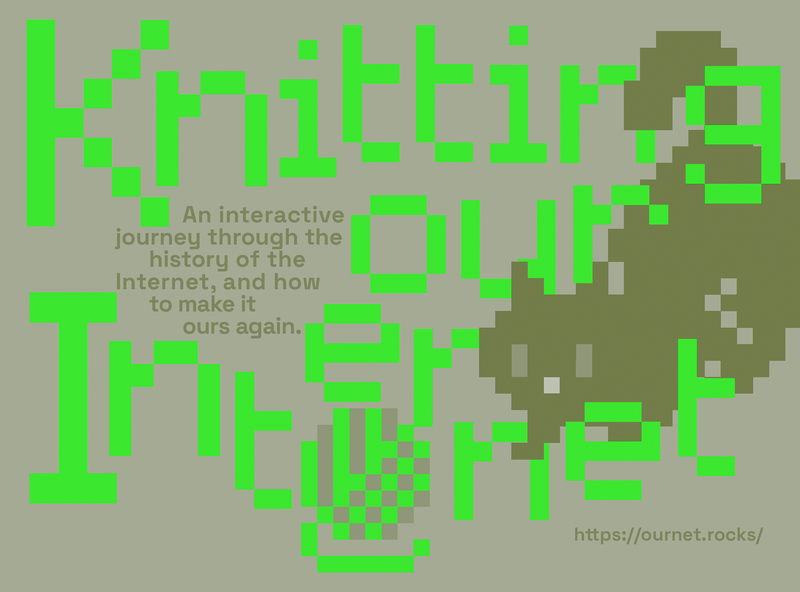
Democracies worldwide are dangerously turning into technocracies, and, thanks to surveillance capitalism, horribly wealthy corporations and individuals have gained widespread power, control, and assets that threaten the core of all liberties.
Among activists and engaged citizens, there is a growing urge of acting, of reclaiming the people’s rights and power. Still, there is a fundamental lack of awareness concerning the chronic problems of the tech industry, and how much its concrete, technical infrastructure plays a role in perpetuating unequal power dynamics. To the many who use digital devices but do not consider themselves technical, the actual functioning of the information technology ecosystem feels obscure, distant, and it’s commonly believed that it can only actually be grasped exclusively by digital experts or nerds.
Nonetheless, we do live in a world run by digital technologies, and those who run them have a blatant interest in maintaining dominance: mainly for-profit multinationals. Never before have the inhabitants of planet Earth been so dependent on tools and services that they cannot control, and, most importantly, that they hardly even understand. On top of this, albeit mainstream media outlets may address the overreaching and troubling power of Big Tech and billionaires, their superficial and oversimplified narrations do not hinder the perceived abstraction and complexity of issues related to digital technology.
While studying and researching for my bachelor thesis Computer Sciences are Social Sciences1, I was disappointed to discover that genuinely insightful tech critique is relegated to a bubble. I felt like it was terribly hard to find tools and resources that can successfully introduce normal people, a.k.a. the ‘users’, to the venomous dynamics of Big Tech, masterfully hidden behind shiny and reassuring advertisements and half-truths, because of billions spent in lobbying, counter-information, and strategic marketing.
As a proud nerd without a technical background, I think of myself as a magnet, pulling together political awareness and technology. Thus, I felt and I feel compelled to channel my enthusiasm and curiosity in the simplest, most captivating and concrete ways to unmask surveillance capitalism.
It all started while I was having lunch at my grandma’s, trying to explain for the thousandth time that typical yet terribly hard question: what is it that you do, again? To finally provide her with a sense of what I study, I asked her if she could lend me the red yarn she was using to knit me a scarf, and I used it to simulate the difference between a centralized network—connecting any extremity of the yarn through a central entity—, and a decentralized one—many points connecting to each other directly, with no intermediary.
Proudly, I can now say that my grandmother knows what decentralization is. This success lit the initial spark of what has now turned into a participatory time-travel through the history of the internet.
I tried to take advantage of the efficacy of storytelling, mixing with the participatory and interactive value of a workshop. I ended up with Knitting Our Internet, a 90-minute face-to-face activity that can be hosted anywhere, anytime, with any kind of public, only using yarn, possibly with a whiteboard, plus 14 printed sheets.
The most important and valuable aspects of Knitting Our Internet are its modularity, flexibility, adaptability, and accessibility. All of its content and resources are explained in The Weaver Kit2, rigorously open-sourced so that anybody can make it theirs. I strongly invite you to skim it, question it, experiment with practical tools we can use to touch, to feel the power of the true web, driven by the people who surf it, who weave it, who hack it, and reclaim it from those who want to profit off of it.
The Internet is Ours! Let’s take it back, together.
-
(1) This can be found at https://tommi.space/csss. ↩
Appendix
Appendix
Bibliography
Introduction by Chloë Arkenbout, Kate A. Babin, Tommaso Campagna and Sepp Eckenhaussen
-
Arkenbout, Chloë. ‘Paranoia and Guilt: A Conversation with Hannah Proctor about the Emotions of Political Defeat and Digital Media’, Institute of Network Cultures, 26 March 2025.
-
Dandridge, Chandler. ‘The Legacy of the “Battle of Seattle”’, Jacobin, June 2024, https://jacobin.com/2024/06/battle-of-seattle-protest-wto.
-
Dieter, Michael, Garcia, David, Barancova, Alexandra, Kluitenberg, Eric, and Batterbee, Rob. Echoes of Tactical Media. YouTube live stream video, 10 July 2024, <https://www.youtube.com/live/88-_3zzrvCI?si=Nj1SHM9Eou37o98s>.
-
Garcia, David and Lovink, Geert. ‘The ABC of Tactical Media’, 1997, https://www.sholetteseminars.com/wp-content/uploads/2018/03/The-ABC-of-Tactical-Media.pdf.
-
Lievrouw, Leah A. Alternative and Activist New Media, 2nd edition, Cambridge: Polity Press, 2024.
-
Lovink, Geert. Platform Brutality: Closing Down Internet Toxicity, Amsterdam: Valiz, 2025.
-
Proctor, Hannah. Burnout: The Emotional Experience of Political Defeat, London: Verso, 2024.
-
Solnit, Rebecca. Hope in the Dark: Untold Histories, Wild Possibilities, Updated ed., Chicago: Haymarket Books, 2016.
Section 1. Broadcasting Resistance
An Incomplete Proto-History of Tactical Video by Jordi Viader Guerrero
-
Telestreet: The Italian Media Jacking Movement (directed by And_, produced by Tim Parish, 2005), 7:44, http://archive.org/details/telestreet2.
-
‘Concepts of Media Archaeology, Anarcheology and Media Ecologies’, in Guerrilla Networks: An Anarchaeology of 1970s Radical Media Ecologies, 1st ed., by Michael Goddard. Amsterdam University Press, 2018, https://doi.org/10.1017/9789048527533.
-
Driscoll, Kevin. The Modem World: A Prehistory of Social Media, London: Yale University Press, 2022.
-
Dyer-Witheford, Nick. Autonomist Marxism, Treason Press, 2004, https://libcom.org/library/autonomist-marxism-information-society-nick-witheford.
-
Galison, Peter. ‘The Ontology of the Enemy: Norbert Wiener and the Cybernetic Vision’, Critical Inquiry 21, no. 1 (1994): 228–66.
-
Galloway, Alexander R. Protocol: How Control Exists after Decentralization, MIT Press paperback ed. Leonardo. MIT Press, 2006.
-
Garcia, David. ‘A Pirate Utopia for Tactical Television’, Tactical Media Files, September 15, 2012. http://www.tacticalmediafiles.net/articles/3568/A-Pirate-Utopia-for-Tactical-Television.
-
Geoghegan, Bernard Dionysius. ‘An Ecology of Operations: Vigilance, Radar, and the Birth of the Computer Screen’, Representations 147, no. 1 (2019): 59–95. https://doi.org/10.1525/rep.2019.147.1.59.
-
Goddard, Michael. Guerrilla Networks: An Anarchaeology of 1970s Radical Media Ecologies, 1st ed. Amsterdam University Press, 2018,https://doi.org/10.1017/9789048527533.
-
Halpern, Orit. Beautiful Data: A History of Vision and Reason since 1945, Experimental Futures. Duke University Press, 2014.
-
Holmes, Brian. ‘Tactical Television. Movement Media in the Nineties’, Regarding Spectatorship, 2015, https://web.archive.org/web/20240702152258/http://www.regardingspectatorship.net/tactical-television-movement-media-in-the-nineties/.
-
Holmes, Brian. ‘Indymedia.Org’, Accessed October 23, 2025, https://indymedia.org/.
-
Jenkins, Henry. ‘What Happened Before YouTube’, in YouTube: Online Video and Participatory Culture, by Jean Burgess and Joshua Green, Digital Media and Society Series, Polity, 2009.
-
Koopman, Colin. ‘Information Before Information Theory: The Politics of Data Beyond the Perspective of Communication’, New Media & Society 21, no. 6 (2019): 1326–43, https://doi.org/10.1177/1461444818820300.
-
Martone, Francesco. ‘From Genoa to Today’, Transnational Institute, 19 July 2024 https://www.tni.org/en/article/from-genoa-to-today.
-
Marx, Karl. Grundrisse. Penguin Press, 1993.
-
Merrin, William. ‘Still Fighting “the Beast”: Guerrilla Television and the Limits of YouTube’, Cultural Politics 8, no. 1 (2012): 97–119, https://doi.org/10.1215/17432197-1572012.
-
Merrin, William. ‘Next 5 Minutes:: Festival of Tactical Media’, Accessed 22 October 2025, http://www.tacticalmediafiles.net/n5m4/about.jsp\_jsessionid=CB33EFD6BD1CEC159F2D91004C23AB1C-jsessionid=CB33EFD6BD1CEC159F2D91004C23AB1C.html.
-
Paoli, Teresa ‘Ze’. ‘Indymedia Italia: Bologna, Genova, Palestina’, in Media Activism: Strategie e Pratiche Della Comunicazione Indipendente, edited by Matteo Pasquinelli, DeriveApprodi, 2002, https://monoskop.org/images/1/19/Pasquinelli_Matteo_cur_Media_Activism_Strategie_e_pratiche_della_comunicazione_indipendente_2002.pdf.
-
Pasquinelli, Matteo. ‘Manifesto of Urban Televisions’, Subsol, 17 February 2003, http://subsol.c3.hu/subsol_2/contributors3/pasquinellitext.html.
-
Pasquinelli, Matteo. (ed.), Media Activism: Strategie e Pratiche Della Comunicazione Indipendente, DeriveApprodi, 2002. https://monoskop.org/images/1/19/Pasquinelli_Matteo_cur_Media_Activism_Strategie_e_pratiche_della_comunicazione_indipendente_2002.pdf
-
Pasquinelli, Matteo. (ed.), MEDIACTIVISMO: Estrategias y Prácticas de La Comunicación Independiente. DeriveApprodi, 2002,https://monoskop.org/images/5/54/Pasquinelli_Matteo_cur_Mediactivismo_2003_ES.pdf.
-
Pasquinelli, Matteo. The Eye of the Master: A Social History of Artificial Intelligence, Verso, 2023.
-
‘Radical Software’, Accessed 23 October 2025, https://www.radicalsoftware.org/e/index.html.
-
Raindance Corporation. ‘Introduction’, Radical Software 1, no. 1 (1970).
-
Roach, Andrew. ‘Guerrilla Television’, Community Media, n.d. Accessed 22 October 2025, https://communitymedia.network/a-brief-history-of-diy-tv/guerrilla-television/.
-
Ryan, Paul. ‘Cybernetic Guerrilla Warfare’. Radical Software 1, no. 3 (1971), https://www.radicalsoftware.org/volume1nr3/pdf/VOLUME1NR3z_art01.pdf.
-
Ryan, Paul. ‘SALTO Amsterdam - Over “Open Access”’, SALTO, n.d. Accessed 3 September 2025, https://www.salto.nl/over/.
-
Shamberg, Michael, and Raindance Corporation. Guerrilla Television, Holt, Rinehart, and Winston, 1971. https://archive.org/details/guerrillatelevis0000sham/page/n5/mode/2up.
-
Telestreet – Il network delle Tv di Strada, 21 June 2002, https://www.telestreet.it/.
The polyphonic potential of mutual aid collectives: Sounding solidarity in experimental audio by Matilda Jones
-
Ahmed, Sara. Strange Encounters: Embodied Others in Post-Coloniality, Transformations, London: Routledge, 2000.
-
Amt für Statistik Berlin-Brandenburg, ‘Einwohnerregisterstatistik Berlin 31. Dezember 2022’, 2024.
-
Berliner Zeitung, ‘No-Go-Areas in Berlin: „Es gibt Bereiche, wo der Rechtsstaat handlungsunfähig ist“’, 5 April 2018, https://www.berliner-zeitung.de/politik-gesellschaft/no-go-areas-in-berlin-es-gibt-bereiche-wo-der-rechtsstaat-handlungsunfaehig-ist-li.11656.
-
Copeland, Stacey. ‘A Feminist Materialisation of Amplified Voice: Queering Identity and Affect in The Heart’, Podcasting: New Aural Cultures and Digital Media, edited by Dario Llinares et al., Springer International Publishing, 2018, pp. 209–25, https://doi.org/10.1007/978-3-319-90056-8\_11.
-
Dean, Jodi. Blog Theory: Feedback and Capture in the Circuits of Drive, Cambridge: Malden, MA: Polity Press, 2010.
-
Der Tagesspiegel Online, ‘Neue Sparrunde: Senat plant weitere Einsparungen im Haushalt’, 18 February 2025, https://www.tagesspiegel.de/berlin/neue-sparrunde-senat-plant-weitere-einsparungen-im-haushalt-13228255.html.
-
Dolbear, Sam, Nichols, Ben and Peppel, Claudia. ‘On the List’, in The Case for Reduction, 253–61, Berlin: ICI Berlin Press, 2022.
-
Egger, Xan, Seefried, Neo, and Naumann, Mascha. ‘The Fluidification of Resistance: Queer Realities and Narratives in Berlin Club and Rave Culture and a Transformative Practice of the Other’, in Living at Night in Times of Pandemic, 85–110, transcript Verlag, 2024.
-
Erckmann, Grete. ‘Urban “Problem Neighborhoods” – Problems for Whom? Marginalized Youths’ Lived Experiences and the Right to the City’, Annual Review of Critical Psychology 18 (2024): 839–68.
-
Foster, Karen R., and Spencer, Dale C. ‘Abjection and Poverty’, in Reimagining Intervention in Young Lives: Work, Social Assistance, and Marginalization, 106–23, University of British Columbia Press, 2012.
-
Gilroy-Ware, Marcus. Filling the Void: Emotion, Capitalism and Social Media, London: Repeater, 2017.
-
Giraud, Eva. ‘Subjectivity 2.0: Digital Technologies, Participatory Media and Communicative Capitalism’, Subjectivity 8, no. 2 (1 July 2015): 124–46.
-
Goh, Annie. ‘Sounding Situated Knowledges: Echo in Archaeoacoustics’, Parallax 23, no. 3 (3 July 2017): 283–304.
-
Goodman, Steve. ‘Contagious Noise: From Digital Glitches to Audio Viruses’, in The Spam Book: On Viruses, Porn and Other Anomalies from the Dark Side of Digital Culture, edited by Tony Sampson and Jussi Parikka, 125–60, Cresskill, NJ: Hampton Press, 2009.
-
Haas, Tobias, and Sander, Hendrik. ‘Die Europäische Autolobby’, Rosa Luxemburg Stiftung, 2019.
-
Hildebrandt, Stefanie. ‘Berlins berüchtigte Linie U8 – so will die BVG hier aufräumen’, Berliner Kurier, 14 February 2024, https://www.berliner-kurier.de/berlin/berlins-beruechtigte-linie-u8-so-will-die-bvg-hier-aufraeumen-li.2187027.
-
Jones, Matilda and Teesdale, Finn. ‘Soli Cooking’, Trouble in Paradise, Cashmere Radio, 7 April 2024, https://cashmereradio.com/episode/trouble-in-paradise-7-w-teplice-floral-notes/.
-
Jones, Matilda. ‘Aural Subject: The Rearticulated Space-Time of Postcolonial Britain in Belinda Zhawi’s “South X South East” (2019)’, Journal for the Study of British Cultures 31, no. 1 (2024): 111–28.
-
Kabuiku, Jean-Hugues. ‘How Berlin’s Clubcommission’s Actions to Save the Nightlife Are the Opposite of Relief’, Substack newsletter, Jean-Hugues Kabuiku Newsletter (blog), 16 April 2021, https://jeanhugueskabuiku.substack.com/p/how-berlins-clubcommissions-actions?utm\_medium=android&triedRedirect=true.
-
Kristeva, Julia. Powers of Horror: An Essay on Abjection, European Perspectives, New York: Columbia University Press, 1982.
-
Kunze, Jenna. ‘The Sound of Intimacy’, Container Magazine, 8 March 2022, https://containermagazine.co.uk.
-
Lambert, Alice. ‘Deep Cuts to Hit Neukölln’s Children, the Homeless and Addiction Services’. The Left Berlin (blog), 2 July 2023, https://www.theleftberlin.com/deep-cuts-to-hit-neukolln-childrens-homeless-and-addiction-services/.
-
LaBelle, Brandon. Sonic Agency: Sound and Emergent Forms of Resistance, MIT Press, 2018.
-
Lindner, Christoph, and Sandoval, Gerard F. ‘Introduction: Aesthetics of Gentrification’, In Aesthetics of Gentrification, edited by Christoph Lindner and Gerard F. Sandoval, 9–24, Amsterdam: Amsterdam University Press, 2021.
-
Lipari, Lisbeth. ‘On Interlistening and the Idea of Dialogue’, Theory & Psychology, vol. 24, no. 4, Aug. 2014, pp. 504–23, https://doi.org/10.1177/0959354314540765.
-
Lovink, Geert. Sad by Design: On Platform Nihilism, Digital Barricades, London: Pluto Press, 2019.
-
‘Netzwerk gegen die Verlängerung der Stadtautobahn A100 in Berlin » Aktionsbündnis A100 stoppen!’, 18 January 2025, https://www.a100stoppen.de/.
-
‘Projekt für mehr Sicherheit und Sauberkeit der Linie U8 gestartet’, 2024 Berlin.de Das offizielle Hauptstadtportal, 14 February 2024, https://www.berlin.de/aktuelles/8717994-958090-projekt-fuer-mehr-sicherheit-und-sauberk.html.
-
Robson, Molly. ‘Intimacy in Isolation: Podcasting, Affect, and the Pandemic’, Perspectives in Biology and Medicine 64, no. 3 (2021): 388–407.
-
Schafer, R. Murray. The Soundscape: Our Sonic Environment and the Tuning of the World, Inner Traditions/Bear, 1993.
-
Soederberg, Susanne. ‘Governing Stigmatised Space: The Case of the “Slums” of Berlin-Neukölln’, New Political Economy 22, no. 5 (2017): 478–95.
-
Spade, Dean. ‘Mutual Aid for Mobilization and Survival’. Social Text, 2020.
-
Spivak, Gayatri Chakravorty. ‘Can the Subaltern Speak?’, in Colonial Discourse and Post-Colonial Theory: A Reader, edited by Patrick Williams and Laura Chrisman, 66–111, London: Routledge, 2015.
-
Thompson, Marie. Beyond Unwanted Sound: Noise, Affect and Aesthetic Moralism, Bloomsbury Publishing USA, 2017.
-
Thompson, Vanessa E, and Tuzcu, Pinar. ‘Policing Palestine Solidarity: Moral Urban Panics and Authoritarian Specters in Germany’, Antipode, 2024.
-
Tize, Carola, and Reis, Ria. ‘Chapter 5 “Neukölln Is Where I Live, It’s Not Where I’m From” Children of Migrants Navigating Belonging in a Rapidly Changing Urban Space in Berlin’, in Refugees Welcome?, 121–41, Berghahn Books, 2019.
-
Wlaszczyk, Kasia. ‘On 21 April, Germany Will Deport Me – an EU Citizen Convicted of No Crime – for Standing with Palestine’, The Guardian, 9 April 2025, Opinion, The Guardian, https://www.theguardian.com/commentisfree/2025/apr/09/germany-deport-me-eu-citizen-no-crime-standing-palestine.
-
Weheliye, Alexander Ghedi. Feenin: R&B Music and the Materiality of BlackFem Voices and Technology, Duke University Press, 2023.
-
Weis, Diana. ‘From Berghain to Balenciaga: Aesthetic Code-Switching between Parisian High Fashion and Berlin Underground Techno’, in Living at Night in Times of Pandemic, 63–82. transcript Verlag, 2024.
-
Zhawi, Belinda. ‘South x South East’, New Creatives, BBC Sounds, 2019, https://www.bbc.co.uk/programmes/p0801pnp.
Can a TV channel save public access? The Case of Offener Kanal Europa by Giacomo Marinsalta and Nora Spiekermann
-
Cities for Rent. ‘How international investments are upending the housing market’, Tagesspiegel, 2 June 2022, https://interaktiv.tagesspiegel.de/lab/berlin-the-rental-market-lab-how-international-investments-are-upending-the-housing-market/.
-
Klein, Hans. ‘Public Access Television: A Radical Critique’, Telecommunications Policy Research Conference (TPRC), Washington, DC, 29 September 2006. Offener Kanal Europa. ‘Der Letzte Bewohner’, posted 17 June 2020 by Offener Kanal Europa, Youtube, 10 min., 52 sec., https://www.youtube.com/watch?v=1IPAtgk7tl8.
-
White, Tim. ‘The strange loophole that transformed Berlin from tenant’s paradise to landlord’s playground’, The Guardian, 22 January 2025, https://www.theguardian.com/commentisfree/2025/jan/22/berlin-housing-crisis-germany-rents-flats.
Radio Communities: Radio as Commons Practice by Juan Fortun and Grégoire Rousseau
-
Bird, Robert. ‘Envoicing History: On the Narrative Poem in Russian Modernism’, Slavic and East European Journal 51, no. 1 (Spring 2007): 53–73.
-
Debord, Guy. ‘Refutation of All Judgments, Pro or Con, Thus Far Rendered on the Film “The Society of the Spectacle”’,1975, UbuWeb Film, 4:12, https://www.ubu.com/film/debord_refutation.html.
Witnessing Gaza on TikTok LIVE by Sarah Al-Yahya
-
Al Jazeera. ‘UN Says Gaza Famine Expanding, 10 More Die from Hunger amid Israeli Siege’, Accessed 28 August 2025, https://www.aljazeera.com/news/2025/8/27/un-warns-gaza-famine-expanding-as-aid-groups-decry-israeli-siege.
-
Auslander, Philip. Liveness: Performance in a Mediatized Culture, 3rd edition, London; New York: Routledge, Taylor & Francis Group, 2023.
-
BELLA CALEDONIA [@bellacaledonia]. ‘This Isn’t a War, or If It Is Its One That’s so Asymmetrical It Doesn’t Fit the Description. This Is the First Livestreamed Genocide… https://Bellacaledonia.Org.Uk/2023/12/21/Crimes-in-the-Darkness/ https://bellacaledonia.org.uk/2023/12/21/Crimes-in-the-Darkness/’, Tweet, Twitter, 21 December 2023, https://x.com/bellacaledonia/status/1737909989744734366.
-
Billy, Kenny. ‘Hear from Adam Wang, Head of TikTok LIVE’, LinkedIn, 9 December 2024, https://www.linkedin.com/posts/billykenny\_hear-from-adam-wang-head-of-tiktok-live-activity-7272011507100528642-bA59?utm\_source=share&utm\_medium=member\_desktop&rcm=ACoAAC63WXwBg7U5g29xrG8cIHI-Y2pmZzOnh8k.
-
Cole, Samantha. ‘Viral TikTok NPC Streamer Pinkydoll Doesn’t Care What You Think’, VICE, 17 July 2023, https://www.vice.com/en/article/viral-tiktok-npc-streamer-pinkydoll-doesnt-care-what-you-think/.
-
Couldry, Nick. (ed.), Media Rituals: A Critical Approach, London New York: Routledge, 2003.
-
Eda Seyhan [@eda\_seyhan]. ‘This Is Liverpool Street Station. 76% of the British Public Support a Ceasefire. Lots of Commuters Sat down and Joined the Protest. These Aren’t “Hate Marches” - They’re a Commonsense Reaction to Watching a Livestreamed Genocide. #CeasefireNOW Https://T.Co/EPRPtliTCv https://t.co/EPRPtliTCv’, Tweet, Twitter, 31 October 2023, https://x.com/eda\_seyhan/status/1719484532187861335.
-
Gelbart, Hannah, Mamdouh Akbiek, and Ziad Al-Qattan. ‘TikTok Profits from Livestreams of Families Begging’, 12 October 2022, https://www.bbc.com/news/world-63213567.
-
Hoskins, Andrew. Televising War: From Vietnam to Iraq, Repr. London: Continuum, 2005.
-
Introduction 1: About TikTok LIVE’, 1 October 2024, https://www.tiktok.com/live/creators/en-UK/article/tiktok-live-intro-ugc-eduaction\_en-GB?name=undefined.
-
Jenkins, Henry, Peters-Lazaro, Gabriel, and Shresthova, Sangita. Popular Culture and the Civic Imagination: Case Studies of Creative Social Change, New York: New York University Press, 2020.
-
Narayanan, Arvind. ‘TikTok’s Secret Sauce’, Knight First Amendment Institute, Accessed 1 April 2025, http://knightcolumbia.org/blog/tiktoks-secret-sauce.
-
Newsroom | TikTok. ‘Supporting Make-A-Wish with TikTok LIVE Feat. Jason Derulo and Alexander Stewart’, 16 August 2019, https://newsroom.tiktok.com/en-us/supporting-make-a-wish-with-tiktok-live-feat-jason-derulo-and-alexander-stewart.
-
Phelan, Peggy. Unmarked: The Politics of Performance, London; New York: Routledge, 1993.
-
Rieff, David. Slaughterhouse: Bosnia and the Failure of the West, New York: Touchstone, 1996.
-
_Starman_ [@91_starman67619]. ‘The Situation in Gaza Is Unbearable. I Can’t Believe We Are Watching a Livestreamed Genocide from the Comfort of Our Homes in the 21st Century. I Can’t Take It Anymore Watching This Unfold’, Tweet, Twitter, 3 November 2023, https://x.com/91\_starman67619/status/1720476390867309055.
-
World Has Failed Gaza in ‘Livestreamed Genocide’, South Africa’s Delegation Says at ICJ, 2024, https://www.youtube.com/watch?v=y0t4aFLYry4.
-
Zidani, Sulafa. ‘Tweet Like It’s Free: Civic Imagination in the 2021 Palestinian Unity Intifada’, Journal of Palestine Studies 53, no. 3 (July 2, 2024): 54–75, https://doi.org/10.1080/0377919X.2024.2419028.
Section 2. Rewiring against the Giants
Disrupting the Doomscroll: Tactics for the Collective Reclamation of Attention from within the Content Machine by Jack O’Grady
-
Aloisi, Alessandra. ‘Art and the Power of Distraction: Bergson, Benjamin, and Simone Weil’, in The Politics of Curiosity, Routledge, 2024.
-
Bevensee, Emmi, Momand, Jahed, and Miroslav, Frank. ‘No Ethical Activism Under Capitalism’, The Anarchist Library, n.d., https://theanarchistlibrary.org/library/emmi-bevensee-jahed-momand-and-frank-miroslav-no-ethical-activism-under-capitalism.
-
Borghi, Vando. ‘Curiosity Among the Ruins of Homo Faber: Infrastructural Capitalism and the Politics of Care’, in The Politics of Curiosity, Routledge, 2024.
-
Cao, Xiongfei and Sun, Jianshan. ‘Exploring the Effect of Overload on the Discontinuous Intention of Social Media Users: An S-O-R Perspective’, Computers in Human Behavior 81, no. Complete (2018): 10–18. https://doi.org/10.1016/j.chb.2017.11.035.
-
Cezar, Bibiana Giudice da Silva and Maçada, Antônio Carlos Gastaud. ‘Cognitive Overload, Anxiety, Cognitive Fatigue, Avoidance Behavior and Data Literacy in Big Data Environments’, Information Processing & Management 60, no. 6 (2023), https://doi.org/10.1016/j.ipm.2023.103482.
-
Croeser, Sky. ‘Rethinking Networked Solidarity’, in Social Media Materialities and Protest, 1st ed., 28–41, Routledge, 2019, https://doi.org/10.4324/9781315107066-3.
-
Dai, Bao, Ali, Ahsan, and Wang, Hongwei. ‘Exploring Information Avoidance Intention of Social Media Users: A Cognition–Affect–Conation Perspective’, Internet Research 30, no. 5 (2020): 1455–78, https://doi.org/10.1108/INTR-06-2019-0225.
-
Dhir, Amandeep, Yossatorn, Yossiri, Kaur, Puneet, and Chen, Sufen. ‘Online Social Media Fatigue and Psychological Wellbeing—A Study of Compulsive Use, Fear of Missing out, Fatigue, Anxiety and Depression’, International Journal of Information Management 40, no. Complete (2018): 141–52. https://doi.org/10.1016/j.ijinfomgt.2018.01.012.
-
‘E-Reader | The Socio-Cognitive Politics of Curiosity and Attention | W’, Accessed 4 February 2025, https://www-taylorfrancis-com.myaccess.library.utoronto.ca/reader/download/442ff914-5754-49ec-b6f6-c8c3f1aad3cc/chapter/pdf?context=ubx.
-
Heckscher, Charles and McCarthy, John. ‘Transient Solidarities: Commitment and Collective Action in Post-Industrial Societies’, British Journal of Industrial Relations 52, no. 4 (2014): 627–57, https://doi.org/10.1111/bjir.12084.
-
‘Join the Community - OpenStreetMap Wiki’, n.d., https://wiki.openstreetmap.org/wiki/Join\_the\_community.
-
Lee, Ae Ri, Son, Soo-Min, and Kim, Kyung Kyu. ‘Information and Communication Technology Overload and Social Networking Service Fatigue: A Stress Perspective’, Computers in Human Behavior 55, no. Part A (2016): 51–61, https://doi.org/10.1016/j.chb.2015.08.011.
-
Liu, Jun. ‘Evolving Digital Repertoires of Contention in Transitional Societies: The Case of China’, in Social Media Materialities and Protest, Routledge, 2019.
-
Scholium. ‘The Hollowing of Anarchy: Exhibition Value’, The Anarchist Library, n.d., https://theanarchistlibrary.org/library/scholium-the-hollowing-of-anarchy-exhibition-value.
-
Schroer, Markus. ‘Sociology of Attention: Fundamental Reflections on a Theoretical Program’, in The Oxford Handbook of Cognitive Sociology, edited by Wayne H. Brekhus and Gabe Ignatow, 0, Oxford University Press, 2019, https://doi.org/10.1093/oxfordhb/9780190273385.013.23.
-
The Anarchist Library. ‘Collective Action Problems Are Not a Capitalist Plot’, Accessed 29 January 2025, https://theanarchistlibrary.org/library/why-collective-action-problems-are-not-a-capitalist-plot.
-
Treré, Emiliano. ‘Nomads of Cyber-Urban Space: Media Hybridity as Resistance’, in Social Media Materialities and Protest, Routledge, 2019.
-
Tucker, Kevin. ‘The Suffocating Void’, The Anarchist Library, n.d., https://theanarchistlibrary.org/library/kevin-tucker-the-suffocating-void.
-
Tufekci, Zeynep. ‘“Not This One”: Social Movements, the Attention Economy, and Microcelebrity Networked Activism’, American Behavioral Scientist 57, no. 7 (July 2013): 848–70, https://doi.org/10.1177/0002764213479369.
Data Liberation, the revolt against the social media oligopoly by Claudio Agosti
-
ActivityPub.rocks. https://activitypub.rocks. — tutorials and test suite for interoperable ActivityPub implementations.
-
AI Forensics. https://aiforensics.org. — nonprofit investigating influential and opaque algorithms.
-
Bridgy Fed, https://fed.brid.gy https://fed.brid.gy? – bridge connecting websites, the fediverse, and Bluesky, syncing profiles and interactions across protocols.
-
Brodkin, Jon. ‘Twitter Front-end Nitter Dies as Musk Wins War Against Third-party Services’, Ars Technica, 15 February 2024, https://arstechnica.com/tech-policy/2024/02/twitter-front-end-nitter-dies-as-musk-wins-war-against-third-party-services/.
-
Kroet, Cynthia. ‘Europe’s Top CEOs Call for Commission to Slow Down on AI Act’, Euronews, 3 July 2025, https://euronews.com/next/2025/07/03/europes-top-ceos-call-for-commission-to-slow-down-on-ai-act.
-
Data Transfer Initiative. https://dtinit.org. — nonprofit developing standards and tools for direct, interoperable service-to-service data transfers.
-
Digital Freedom Fund Case Study. https://digitalfreedomfund.org/non-consensual-tracking-on-pornhub. — non-consensual tracking on Pornhub.
-
Doctorow, Cory. The Internet Con: How to Seize the Means of Computation, London and New York: Verso, 2023.
-
Doctorow, Cory. ‘Adversarial Interoperability: Reviving an Elegant Weapon From a More Civilized Age to Slay Today’s Monopolies’, Deeplinks blog (Electronic Frontier Foundation), 7 June 2019, https://www.eff.org/deeplinks/2019/06/adversarial-interoperability-reviving-elegant-weapon-more-civilized-age-slay?.
-
European Digital Rights (EDRi). ‘Press Release: Commission’s Digital Omnibus Is a Major Rollback of EU Digital Protections’, 19 November 2025, https://edri.org/our-work/commissions-digital-omnibus-is-a-major-rollback-of-eu-digital-protections/.
-
France 24. ‘Under the Radar: Covering Your Online Tracks’, Reporters, television report, 15 April 2022, video, https://www.youtube.com/watch?v=YKQQM1KNXMU.
-
Kaltheuner, Frederike. ‘Europe’s Sovereignty Debate Has a Blind Spot: The AI Bubble’, LinkedIn post, 25 November 2025, https://www.linkedin.com/posts/frederike-kaltheuner\_europes-sovereignty-debate-has-a-blind-spot-activity-7398993891506561024-h5dK.
-
Gancio. https://gancio.org. — federated community events calendar software using ActivityPub.
-
Golumbia, David. ‘We Don’t Know What “Personal Data” Means’, Uncomputing blog, 20 June 2018, https://web.archive.org/web/20181130023848/http://www.uncomputing.org/?p=1983.
-
Irish Council for Civil Liberties, 17 August 2020, https://www.iccl.ie/digital-data/real-time-bidding-evidence/. — Evidence and explanation on how RTB works
-
IndieWeb. ‘POSSE’, https://indieweb.org/POSSE — publish on your own site, syndicate copies elsewhere for user-controlled portability.
-
The Internet’s Own Boy: The Story of Aaron Swartz (dir. Brian Knappenberger, 2014), documentary film, 105 min, available at: https://www.youtube.com/watch?v=M85UvH0TRPc.
-
Joseph. ‘Speech about Community, Free Software, Decentralization, and mobilize.berlin’, The Digital Self (blog), 20 June 2021, https://blogs.fsfe.org/joseph/2021/06/20/speech-about-community-free-software-decentralization-and-mobilize-berlin/.
-
Librevents/Mobilize.Berlin. ‘Librevents “Liberating” Data From Big Tech’, Hacking in Parallel (///HiP-Berlin///) conference, Berlin, 28 December 2022, video, https://diode.zone/w/wy8nDtAQy7HRRtjdeJrLP7.
-
Linker, Felix, and David Basin. ‘SOAP: A Social Authentication Protocol’, arXiv preprint arXiv:2402.03199 [cs.CR], 5 February 2024, https://arxiv.org/abs/2402.03199.
-
marcprux, ‘F-Droid and Google’s Developer Registration Decree’, F-Droid blog, 29 September 2025, https://f-droid.org/en/2025/09/29/google-developer-registration-decree.html. — article on Google’s new worldwide developer registration requirement
-
Mastodon. https://joinmastodon.org. — main onboarding portal to Mastodon, flagship ActivityPub microblogging network.
-
Mirror of the Librevents website https://librevents.vecna.eu (discontinued).
-
Mobilize Berlin. https://mobilize.berlin. — Berlin events platform on Mobilizon, supporting Facebook migration for event organizing.
-
Mobilizon. https://mobilizon.org. — federated events and groups platform, ethical alternative to Facebook Events.
-
Nothing to Hide (dir. Marc Meillassoux and Mihaela Gladovic, 2017), documentary film, 86 min, Deep Docs Films, available at: https://deepdocs.eu/nth/.
-
OpenPortability. https://openportability.org. — moves followers from X to Mastodon/Bluesky, exercising cross-network data portability.
-
Breyer, Patrick. ‘Reality Check: EU Council Chat Control Vote Is Not a Retreat, But a Green Light for Indiscriminate Mass Surveillance and the End of Right to Communicate Anonymously’, Patrick Breyer blog, 26 November 2025, https://www.patrick-breyer.de/en/reality-check-eu-council-chat-control-vote-is-not-a-retreat-but-a-green-light-for-indiscriminate-mass-surveillance-and-the-end-of-right-to-communicate-anonymously/.
-
PeerTube. https://joinpeertube.org. — federated, peer-to-peer video hosting; YouTube alternative.
-
Pixelfed. https://pixelfed.org. — decentralized Instagram-style photo sharing; ActivityPub federation.
-
Reversing Works. https://reversing.works. — reverse engineering holding gig platforms accountable.
-
Ring, Frank. ‘How to Sync Your YouTube Videos to PeerTube’, Fraxoweb blog, 12 August 2024, https://fraxoweb.com/how-to-sync-your-youtube-videos-to-peertube/. — tutorial for importing YouTube channels into PeerTube, enabling video content portability out of YouTube’s silo.
-
The Social Dilemma (dir. Jeff Orlowski, 2020), documentary film, Netflix, 94 min, available at: http://www.netflix.com/title/81254224.
-
throwaway59378. ‘Why Is Nitter Being Discontinued Now, but Wasn’t Before?’, GitHub issue #1175, zedeus/nitter, 16 February 2024, zedeus/nitter#1175, https://github.com/zedeus/nitter/issues/1175.
-
Tracking Exposed. https://tracking.exposed. — inception project exposing platform tracking, spawning this and related experiments.
-
‘What Is Web Scraping? – Definition from Techopedia’, Techopedia,https://www.techopedia.com/definition/5212/web-scraping.
-
Wikipedia contributors. ‘Fediverse’, 27 November 2025, https://en.wikipedia.org/?oldid=1324475159, accessed 28 November 2025.
-
Wikipedia contributors. ‘Garbage in, Garbage out’, https://en.wikipedia.org/?oldid=1324425866, accessed 20 December 2025.
-
WriteFreely. https://writefreely.org — minimalist federated blogging platform, ActivityPub-compatible writing.
-
zedeus. ‘Nitter’, GitHub repository, https://github.com/zedeus/nitter.
In the belly of the meme: Tactical dissemination in the Arab and diasporic digital sphere by Noura Tafeche and Basem Kharma
-
Abu hatab, Wafa. ‘The Arab Spring: A New Era of Humor Consumption and Production’, International Journal of English Linguistics 6, no. 3 (2016): 70–87, https://www.researchgate.net/publication/303554271_The_Arab_Spring_A_New_Era_of_Humor_Consumption_and_Production.
-
Afif, Hadi. ‘The Core of it All: Internet aesthetics as tools of resistance, from driftcore to corecore and other algorithmic undergrounds‘, ICON, July 2025, https://icon.ink/articles/the-core-of-it-all/.
-
‘Handala Zine’. Librarians and Archivists with Palestine, April 2019. https://librarianswithpalestine.org/wpcontent/uploads/2019/04/HandalaZine.pdf.
-
Sbitan, Jamil. ‘Handala Will Age Again Soon’, Jadaliyya, 10 July 2017, https://www.jadaliyya.com/Details/26128.
-
Tafeche, Noura and Basem Kharma, ‘Ecosystem of an Arab Meme’, Do Not Research, 2025, https://donotresearch.substack.com/p/ecosystem-of-an-arab-meme.
Defiant creative investigations and technofascism by Eke Rebergen
-
12 Rules for WHAT. Post-Internet Far Right, Dog Section Press, 2022.
-
Act for Freedom Now!. ‘Berlin, Germany: news from Tesla and a second communique from the Volcano Group’, 10 April 2024, https://actforfree.noblogs.org/2024/04/10/berlingermany-news-from-tesla-and-a-second-communique-from-the-volcano-group/.
-
Al-Sibai, Noor. ‘Ads for Elon Musk’s “Swasticar” Go Viral as Tesla Crumbles’, Futurism, 27 February 2025, https://futurism.com/tesla-stocks-elon-musk-swasticar.
-
Barnard, Gwen and Cohen, Naomi Alizah. ‘Notes Towards an Antifascist Infrastructural Analysis’, 17 October 2022, https://titipi.org/wiki/index.php/Notes_Towards_an_Antifascist_Infrastructural_Analysis.
-
Bilwet. Het Beeldenrijk: over stralingsangst en ruimteverlangen, Raket en Lont, 1985.
-
Blueprint for Free Speech. ‘Lukasz Krupski wins retaliation case against Tesla’, 11 December 2024, https://www.blueprintforfreespeech.net/en/news/lukasz-krupski-wins-retaliation-case-against-tesla.
-
Bratich, Jack Z. On Microfascism: Gender, war, and death, Common Notions, 2022.
-
Brown, Sherronda J. ‘Sci-fi, fantasy, and fascism’, Scalawag Magazine, 4 February 2025, https://scalawagmagazine.org/2025/02/sci-fi-fantasy-and-fascism/.
-
Brunton, Finn. Digital Cash: The Unknown History of the Anarchists, Utopians, and Technologists Who Created Cryptocurrency, Princeton University Press, 2019.
-
Chayka, Kyle. ‘Techno-Fascism Comes to America. The historic parallels that help explain Elon Musk’s rampage on the federal government’, The New Yorker, 26 February 2025, https://www.newyorker.com/culture/infinite-scroll/techno-fascism-comes-to-america-elon-musk.
-
Cross, Katherine Alejandra. Log Off: Why Posting and Politics (Almost) Never Mix, LittlePuss Press, 2024.
-
Daniaux, Magali and Pigot, Cédric. Space Without Rockets, UV Editions, 2022.
-
Disrupt. ‘Block Tesla – Disrupt Elon. Stop the expansion of the Tesla Gigafactory in Grünheide’, 2024, https://oldwp.disrupt-now.org/en/disrupt-tesla/.
-
Error 417. ‘13 Scores Against Tech Fascism’, 2026, https://error417.expectation.fail/13scoresagainsttechfascism/.
-
Eschmann, Rob. When the Hood comes off: racism and resistance in the digital age, University of California Press, 2023.
-
Hobart, Hi′ilei Julia Kawehipuaakahaopulani. Cooling the Tropics. Ice, Indigeneity, and Hawaiian Refreshment, Duke University Press, 2022.
-
Holert, Tom. ‘Transfixing the Fascist Episteme’, in M. Hlavajova & Sven Lütticken, Deserting from the Culture Wars, BAK, 2020.
-
Holmes, Brian. Unleashing the Collective Phantoms, Autonomedia, 2008.
-
Hopper, Frank. ‘In Shadow of SpaceX. Tribe Fighting to Protect Sacred Sites from Elon Musk’, Deceleration News, 3 January 2023, https://deceleration.news/spacex-elon-musk-carrizo-comecrudo/.
-
Howson, Peter. Let Them Eat Crypto, The Blockchain Scam That’s Ruining the World, Pluto Press, 2023.
-
lasade-anderson, temi, & Sobande, F. ‘Ideology as/of Platform Affordance and Black Feminist Conceptualizations of “Canceling”: Reading Twitter’, Television & New Media, 26(1) (2025): 119-131.
-
Klee, Miles. ‘Tesla owners are desperately trying to disguise their cars’, Rolling Stone, 12 March 2025, https://www.rollingstone.com/culture/culture-features/tesla-elon-musk-embarassed-disguise-car-1235294522/.
-
Kleinman, Zoe. ‘Ex-Tesla employee casts doubt on car safety’, BBC News, 5 December 2023, https://www.bbc.co.uk/news/technology-67591311.
-
Kovich, Tammy. Antifacism Against Machismo, Kersplebedeb Publishing, 2023.
-
Kühnafpfel, Niclas, Christian Werling, Hans Niklas Jacob. ‘Back in the Driver’s Seat’, 37C3. 27 December 2023, https://media.ccc.de/v/37c3-12144-back_in_the_driver_s_seat_recovering_critical_data_from_tesla_autopilot_using_voltage_glitching.
-
Led By Donkeys. ‘Heil Tesla’, YouTube video, 23 January 2025, https://youtu.be/NjWl\_RNDMSA.
-
Lewis, Tyson and Hyland, Peter. ‘The Anti-Fascist Politics of Studioing’, Revista Portuguesa De Pedagogia, 56 (2022).
-
Majewska, Ewa. Feminist Antifascism: Counterpublics of the Common, Verso, 2021.
-
McCusker, Kate. ‘Sledgehammer-wielding Musk critics smash up Tesla in London art project’, The Guardian, 10 April 2025, https://www.theguardian.com/technology/2025/apr/10/sledgehammer-wielding-musk-critics-smash-up-tesla-in-london-art-project.
-
McQuillan, Dan. Resisting AI: An Anti-fascist Approach to Artificial Intelligence, Policy Press, 2022.
-
Mehrotra, Dhruv and Cameron, Dell. ‘The Gruesome Story of How Neuralink’s Monkeys Actually Died’, Wired, 20 September 2023, https://www.wired.com/story/elon-musk-pcrm-neuralink-monkey-deaths/.
-
Planka.nu. The Traffic Power Structure, PM Press, 2016.
-
Pontone, Maya. ‘Artist Crushes Tesla With Colossal Olmec Head Sculpture’, Hyperallergic, 21 March 2024, https://hyperallergic.com/878913/artist-chavis-marmol-crushes-tesla-with-colossal-olmec-head-sculpture/.
-
Rose, Janus. You Can’t Post Your Way Out of Fascism, 404 Media, 5 February 2025, https://www.404media.co/you-cant-post-your-way-out-of-fascism/.
-
Rose City Counter-Info. ‘Cars as Cameras’, 7 October 2023, https://rosecitycounterinfo.noblogs.org/2023/10/cars-as-cameras-a-short-overview-of-tesla-surveillance-features-and-lessons-for-attack/.
-
Saraiva, Tiago. Fascist Pigs: Technoscientific Organisms and the History of Fascism, The MIT Press, 2016.
-
Scoop Empire. ‘A bold transformation of the Cybertruck featuring the Palestinian flag and keffiyeh design, blending innovation with a powerful message of unity and support’, Instagram, 13 January 2025, https://www.instagram.com/reel/DEwvxo8i3Id/.
-
Shaw, Devin Z. Genealogies of Antifascism: Militancy, Critique and the Three Way Fight, Kersplebedeb Publishing, 2024.
-
Silverman, Jacob. Gilded Rage. Elon Musk and the Radicalization of Silicon Valley, Bloomsbury, 2025.
-
Toscano, Alberto. Late Fascism: Race, Capitalism and the Politics of Crisis, Verso, 2023.
-
Traverso, Enzo. The new faces of fascism: Populism and the far right, Verso, 2019.
-
Vulkangruppe Tesla Abschalten!. ‘Nachschlag zum Brandanschlag auf Tesla’, Indymedia, 9 March 2024, https://de.indymedia.org/node/345275.
-
Warzel, Charlie. ‘The MAGA Aesthetic Is AI Slop, Far-right influencers are flooding social media with a new kind of junk’, The Atlantic, 21 August 2024, https://www.theatlantic.com/technology/archive/2024/08/trump-posts-ai-image/679540/.
-
Watkins, Gareth. ‘AI: The New Aesthetics of Fascism’, The New Socialist, 9 February 2025, https://newsocialist.org.uk/transmissions/ai-the-new-aesthetics-of-fascism/.
-
Wesseling, Janneke and Cramer, Florian. Making Matters, Valiz, 2022.
-
Whooshn. ‘Quick and Easy: Remove Your Tesla Logos Without a Scratch!’, YouTube video, 4 February 2025, https://youtu.be/a-VNLqm1odk.
Section 3. Frequencies for Better Futures
Convivial Tools for Worlds to Come: The Island School of Social Autonomy by Denise Sumi
-
Bey, Hakim. T.A.Z.: The Temporary Autonomous Zone, Ontological Anarchy, Poetic Terrorism, New York: Autonomedia, 1991.
-
Caffentzis, George, and Federici, Silvia. ‘Commons Against and Beyond Capitalism’, Upping the Anti, 2020, 95.
-
Dragona, Daphne. ‘Affective Infrastructures Editorial’, transmediale, 31 October 2019, https://transmediale.de/en/journal/affective-infrastructures-0.
-
Hardt, Michael, and Negri. Antonio. Empire, Cambridge: Harvard University Press, 2000.
-
Illich, Ivan. Deschooling Society, 1970, Reprint, Chicago: University of Chicago Press, 2023.
-
Tools for Conviviality, New York: Harper & Row, 1973.
-
Island School of Social Autonomy. ‘Conversation with Silvia Federici’, 7 October 2024, https://issa-school.org/reflections/conversation-with-silvia-federici/.
-
Spivak, Gayatri Chakravorty. ‘Can the Subaltern Speak?’, in Marxism and the Interpretation of Culture, edited by Cary Nelson and Lawrence Grossberg, 271–313, Urbana: University of Illinois Press, 1988.
-
Terranova, Tiziana, and Chambers, Iain. ‘Technology, Postcoloniality, and the Mediterranean’, e-flux Journal, no. 123 (December 2021): 12–21, https://www.e-flux.com/journal/123/436918/technology-postcoloniality-and-the-mediterranean/.
-
Thoreau, Henry David. Walden; or, Life in the Woods, Boston: Ticknor and Fields, 1854.
Information Smuggling by Augustina Lavickaite
-
Bridle, James. Ways of Being: Beyond Human Intelligence, London: Allen Lane, 2022.
-
Čekutis, Ričardas. ‘Partizanų Spauda 1944–1953 m’, Genocide and Resistance Research Centre of Lithuania, 11 January 2005, http://genocid.lt/Leidyba/16/cekutis.htm.
-
Gray, Jonathan. ‘”Fake New” as Infrastructural Uncanny’, New Media & Society 22, no. 2 (2020): 317–341.
-
Helmreich, Stefan. ‘Nature/Culture/Seawater’, American Anthropologist 113, no. 1 (2011): 132–144.
-
Hockenberry, Matthew. Assembly Codes, Durham, NC: Duke University Press, 2021.
-
Keshavarz, Mahmoud, and Šahram, Hosrawi. Seeing like a Smuggler: Borders from Below, London: Pluto Press, 2022.
-
Parks, Lisa, and Starosielski, Nicole. Signal Traffic: Critical Studies of Media Infrastructures, Urbana: University of Illinois Press, 2015.
-
Tyla, Antanas. Garšvių Knygnešių Draugija, Vilnius: Mintis, 1991.
-
Wagner, Marc-Christoph, and Weizman, Eyal (dirs.). Forensic Architecture, YouTube video, 18:49, Louisiana Channel, 19 May 2022, https://www.youtube.com/watch?v=M5c9KrHHVMc.
Interconnecting Imaginaries: Networks in a Pluriversal World by Juan Fortun
-
Díaz, Floriberto. Escrito, Comunalidad, energía viva del pensamiento mixe Ayuujktsënää yën - ayuujkwënmää ny - ayuujk mëk äjtën, edited by Sofía Robles Hernández, Mexico City: Dirección General de Publicaciones y Fomento Editorial, UNAM, 2014.
-
Escobar, Arturo. Designs for the Pluriverse: Radical Interdependence, Autonomy, and the Making of Worlds (New Ecologies for the Twenty-First Century), Durham: Duke University Press, 2018.
-
Hui, Yuk. The Question Concerning Technology in China: An Essay in Cosmotechnics, 3rd corrected ed. Mono 003, Falmouth: Urbanomic, 2022.
-
Krenak, Ailton. Futuro ancestral, edited by Rita Carelli, translated by Teresa Arijón, Madrid: Taurus, 2024.
-
Mahashe, George. ‘Mashogojo Mašokošoko Boshokhoshokho’, Handle With Care, Gabi Ngcobo, eds., Javett Art Centre at the University of Pretoria, (Javett-UP): Pretoria, 229-240, ISBN 978-1-991255-00-6.
-
Milan, Stefania. Social Movements and Their Technologies: Wiring Social Change, Basingstoke: Palgrave Macmillan UK, 2013, https://doi.org/10.1057/9781137313546.
-
Serpell, Namwali. ‘Glossing Africa’, The New York Review of Books, 21 August 2017. https://www.nybooks.com/online/2017/08/21/glossing-africa.
-
Shoro, Katleho Kano. Serurubele: Poems, Cape Town: Modjaji Books, 2017.
-
Telecomunicaciones Indígenas Comunitarias AC, Accessed 10 November 2025, https://www.tic-ac.org.
Forking For Future? The Case of the Extinction Rebellion - Just Stop Oil Split by Daniele Gambetta and Alberto Manconi
-
Abramowitz, H. ‘Learning from Mistakes: A Comprehensive Study on Forks and Failures in Open Source Projects’, 2021, arXiv preprint arXiv:2103.03652.
-
Abramowitz, Ben, Elkind, Edith, Grossi, Davide, Shapiro, Ehud, and Talmon, Nimrod. ‘Democratic Forking: Choosing Sides with Social Choice’, in Algorithmic Decision Theory, edited by D. Fotakis and D. Ríos Insua, Lecture Notes in Computer Science 13023, Cham: Springer, 2021, https://doi.org/10.1007/978-3-030-87756-9\_22.
-
Bacon, Jono. The Art of Community: Building the New Age of Participation, Sebastopol, CA: O’Reilly Media, 2009.
-
Bateson, Gregory. Steps to an Ecology of Mind, University of Chicago Press, 1972.
-
Becci, Irene and Manconi, Alberto. Forthcoming, ‘Religion and Environmentalism’, in Religion and Politics in Europe, edited by A. Giorgi and E. Fokas, London: Routledge, 2026.
-
Berardi, Franco ‘Bifo’. Disertate, Milano: Timeo Edizioni, 2023.
-
Castells, Manuel. Networks of Outrage and Hope, Cambridge: Polity Press, 2012.
-
Extinction Rebellion. This Is Not a Drill, London: Penguin Books, 2019.
-
Extinction Rebellion Scotland. ‘In the last week, two widely-shared images […]’, Facebook post, October 19, 2019, 15:31, https://www.facebook.com/XRScotland/posts/pfbid0AtxBHskydJAFmf8orwycYzVcCeUGTUXbzJE8aVbiiGE6titTfPTJ5RVynZYnFnbwl.
-
Extinction Rebellion UK. ‘Today’s Tube Action: How It Happened’, 17 October 2019, https://extinctionrebellion.uk/2019/10/17/todays-tube-action-how-it-happened/.
-
Extinction Rebellion UK. ‘We Quit’, 31 December 2022, https://extinctionrebellion.uk/2022/12/31/we-quit/.
-
Farrell, Clare, Bradbrook, Gail and Hallam, Roger. ‘Telling the truth so we can learn from mistakes - reflections five years on’, Extinction Rebellion Global, 19 October 2023, https://rebellion.global/blog/2023/10/19/reflections-5-years-on/.
-
Galindo, María. Femminismo Bastardo, Milano: Mimesis Edizioni, 2022.
-
Gambetta, Daniele. (ed.), Datacrazia, Ladispoli: D-Editore, 2018.
-
Gayle, Damien. ‘M25 protest recruiter called for “biggest disruption in modern UK history”, court hears’, The Guardian, 25 June 2024, https://www.theguardian.com/uk-news/article/2024/jun/25/m25-protest-recruiter-called-for-biggest-disruption-in-modern-uk-history-court-hears.
-
Gerbaudo, Paolo. The Digital Party: Political Organisation and Online Democracy, Pluto Press, 2019.
-
Guattari, Félix. Les trois écologies, Paris: Galilée, 1989.
-
Hardt, Michael and Negri, Antonio. ‘Empire, Twenty Years On’, New Left Review 120 (November–December), 2019.
-
Hill, Benjamin Mako. ‘To Fork or Not to Fork: Lessons from Ubuntu and Debian’, 2005, http://mako.cc/.
-
Lorusso, Silvio. ENTREPRECARIAT: Siamo tutti imprenditori. Nessuno è al sicuro, Roma: Krisis Publishing, 2019.
-
Manconi, Alberto. ‘Al di là del quadro: Rappresentazione e proteste nel Regno Unito’, Dinamopress, 17 October 2022, https://www.dinamopress.it/news/al-di-la-del-quadro-rappresentazione-e-proteste-nel-regno-unito/.
-
Manconi, Alberto. ‘Tempo scaduto? L’esperienza di Just Stop Oil’, Zapruder 64, Profondo Nero, 2024.
-
News Agencies. ‘UK activist group Just Stop Oil holds its last climate protest’, Al Jazeera, 26 April 2025, https://www.aljazeera.com/news/2025/4/26/uk-activist-group-just-stop-oil-holds-its-last-climate-protest.
-
Nunes, Rodrigo. Neither Vertical Nor Horizontal: A Theory of Political Organization, Pluto Press, 2021.
-
Saunders, Clare, Doherty, Brian and Hayes, Graeme. ‘A New Climate Movement? Extinction Rebellion’s Activists in Profile | A Report’, CUSP Working Paper Series, No 25, 15 July 2020, https://cusp.ac.uk/themes/p/xr-study/.
-
Siddique, Haroon. ‘Just Stop Oil Jail Terms Raise Questions over Harsh Treatment of Protesters’, The Guardian, 19 July 2024, https://www.theguardian.com/law/article/2024/jul/19/just-stop-oil-jail-terms-questions-harsh-treatment-protesters.
-
Squire, Sophie. ‘Just Stop Oil activist—“We aren’t going to stop”’, Socialist Workers, 15 January 2023, https://socialistworker.co.uk/news/just-stop-oil-activist-we-arent-going-to-stop/.
-
Taylor, Matthew. ‘“It has been polarising”: tube protest divides Extinction Rebellion’, The Guardian, 17 October 2019, https://www.theguardian.com/environment/2019/oct/17/london-tube-protest-divides-extinction-rebellion.
-
Javier Toret. (ed.), Tecnopolitica Y 15M: La potencia de las multitudes conectadas, Editorial UOC, 2015.
Colophon
Fragments of Tactical Media
INC Etherport #4
Editors: Chloë Arkenbout, Kate A. Babin, Tommaso Campagna & Sepp Eckenhaussen
Foreword: Geert Lovink
Editorial Assistance: August Kaasa Sundgaard & Anielek Niemyjski
Proofreading: Kate A. Babin
Development of publication tool Etherport: Gijs de Heij (Open Source Publishing)
Design, Web Development & Custom Typography: Alix Stria
Printer: GPS Group
Typefaces: Amiamie (ByeByeBinary), Tactical Media Type (GridType)
Contributors: Alberto Manconi, Anders Visti, Augustina Lavickaite, Basem Kharma, Ben Byrne, Cartography of Darkness, Claudio Agosti, Complicity Map, Daniele Gambetta, Denise Sumi, Eke Rebergen, Elegies of Oil Spills, Geert Lovink, Grégoire Rousseau, Giacomo Marinsalta, Grégoire Rousseau, Internet Core, Jack O’Grady, Jordi Viader Guerrero, Juan Fortun, Learning Palestine, Lumbung Press, Matilda Jones, Nora Spiekermann, Noura Tafeche, Obiezione Respinta, Permacomputing, Radio Alhara, Renée Ridgway, Re-search.site, Sarah Al-Yahya, Slutty Urbanism, Stream Art Network, The World after Amazon, Tommi Marmo, Wanderlynne Selva, X Vendetta.
Published by the Institute of Network Cultures, Amsterdam 2026.
ISBN: 9789083672106
Contact: Institute of Network Cultures
Email: info@networkcultures.org
Web: www.networkcultures.org
Web version of this publication: https://etherport.org/publications/inc/Tactical_Media_Reader
This publication is licensed under the Creative Commons Attribution NonCommercial ShareAlike 4.0 Unported (CC BY-NC-SA 4.0). To view a copy of this license, visit www.creativecommons.org/licences/by-nc-sa/4.0./
Previously Published INC Etherport
The INC Etherport series includes experimental, non-linear, and collaboratively authored publications developed using the open-source Etherport tool. Designed for hybrid publishing, each title is available in different formats, including print, PDF, video, online interactive edition, and more to come. Like all INC publications, they are free to read and download at
INC Etherport #3
Tommaso Campagna, Marta Ceccarelli, Carolina Valente Pinto (eds.), .expub | Exploring Expanded Publishing, 2025
INC Etherport #2
Inte Gloerich (ed.), Artists, Activists, and Worldbuilders on Decentralised Autonomous Organisations: Conversations about Funding, Self-Organisation, and Reclaiming the Future, 2025
INC Etherport #1
Sepp Eckenhaussen, Senka Milutinović, and Carolina Valente Pinto (eds.), Screentime Airtime Facetime: Practicing Hybridity in the Cultural Field, 2023