Co creation
How can researchers, activists, and Civil Society Organisations (CSOs) collaborate while situated within neoliberalism and precarity?
Many researchers and activists operate within neoliberal and precarious contexts, making it harder to come up with sustainable strategies to produce knowledge together.
Photos: © Michelle Geerardyn
Illustrations: © Valentine Zhang (https://www.instagram.com/valentinezhang/)
Cross-country and cross-sector networks built through co-creation
A network of feminist media outlets and magazines from multiple countries was formed organically, growing out of informal contacts made along the way. This will culminate in an in person meeting in Trento in September, building on two earlier preparatory meetings (one in-person, one online).
The project linked up with a global organization of gender professionals to co-produce a series of online “gender profiles” on different topics, including an upcoming one on how anti-gender politics affects professionals in the field. The European partners participate as a minority voice rather than leading it and the partner organization is paid for this work, not just consulted for free.
The Feminist Futures Debate in Budapest succeeded in bringing feminist perspectives into spaces European policy think tanks that don’t normally include them, drawing around 50 participants. This was acknowledged as only a partial win, since the broader “Europe’s futures” conversation still largely excludes feminist framing.
The format was designed to give students a group with little institutional power a structured, assembly-style voice in how their universities are run.
Two concrete examples were shared: one organized in Tenerife, and one run at the University of Edinburgh.
At Edinburgh, the jury focused on student experiences of repression and censorship around Palestine solidarity and trans liberation activism on campus, following a crackdown after October 7th. A trained external facilitator (from an organization specializing in conflict management in activist spaces) ran a half-day workshop designed not just to surface painful experiences of institutional harm, but also to let students imagine and articulate what a genuinely supportive, liberatory university could look like.
The project worked well largely because she was already embedded in the community a PhD student and teacher who knew the participants (many were her own students) personally, having organized alongside them before.
This shared history created a foundation of trust, solidarity, and mutual understanding that made honest, difficult conversations possible participants didn’t have to explain context from scratch, and there was a real sense of being “on the same page” even when new information was distressing.
A model for researcher-activist collaboration
One participant, working with a lesbian association in Hungary, proposed a clear, practical structure: activists and researchers jointly define the research questions from the start, rather than researchers simply studying activists from the outside. Researchers then contribute the technical skills and infrastructure to produce usable data, while activists get the evidence base they need for advocacy in this case, data about LGBT communities currently missing from official statistics, urgently needed now that a political shift in Hungary has opened a window for advocacy.
This was framed as more equal than simply inviting activists to share their perspectives as research subjects.
In a separate project bridging university research and non-academic artists, despite serious structural problems, the team still managed to reallocate a meaningful portion of the project’s funds toward what actually mattered to the artist participants showing some capacity to act on co-creation values even within a flawed system.
Throughout the roundtable, participants directly named uncomfortable structural issues precarity in academic careers, the racial dynamics of whiteness in research relationships, the gap between institutional power and individual researchers’ actual power rather than glossing over them.
One researcher openly stated serious doubt about whether genuine co-creation is even possible given existing power imbalances. This skepticism was treated by the group as a valuable starting point for honest dialogue rather than something to dismiss
Several early-career researchers (PhD students, a recent master’s graduate) openly named the same dilemma: they want to do research that is genuinely bottom-up and community-led, but they operate inside institutions with deadlines, teaching loads, and career pressures that don’t easily accommodate that. One framed it plainly as the conflict between what she believes in and the reality she’s actually in.
A proposed way through this tension: meet community organizations where they’re at, rather than showing up with a fixed research question. Ask what the organization itself needs from the collaboration, not just what the researcher needs from them to avoid simply extracting data, named as a long-standing pattern in research.
What does “co-creating” actually mean and who benefits?
One participant pushed the group to interrogate the term itself: in a neoliberal university where knowledge is quantified and capitalized on, co-created knowledge is “in service of” whom, exactly? She pointed out that much of the real relationship-building researchers do (informal conversations, casual exchanges) happens off the record and isn’t counted as legitimate academic output.
She also raised a sharper critique: “co-creation” can become a buzzword academics use to legitimize and validate their own work and career narrative, rather than a genuine practice.
A related concern: precarious academic contracts (e.g., a contract ending in a few months) make it structurally difficult to build the kind of long-term community trust that real co-creation requires.
The problem of academic language and accessibility
Multiple participants criticized academic writing that claims to denounce capitalism, racism, or oppression while being written in dense, inaccessible, sometimes literally unpronounceable language undermining the stated political goals of the work.
One participant noted that much “critical” research, stripped of jargon, says little more than what an ordinary person on the street already knows.
A structural reason was named too: researchers who try to publish in non-commercial, accessible feminist journals are warned by colleagues that doing so risks their job prospects so individual choices to write accessibly run directly against career incentives.
One participant noted that both academics and activists can fall into the trap of using their identity/label (“activist,” “academic”) as a way of gatekeeping who is allowed to understand or speak on an issue separating “us” who get it from “them” who don’t.
The suggestion was that academics, like activists, should aim to explain things in ways that prioritize being understood over being right or sounding sophisticated.
One researcher described consciously refusing the “produce, compete, produce” model by choosing, for example, to publish a book with a non-academic publisher, at real cost to her academic career as a way of staying true to her values despite the system pushing against it.
Another participant shared a parallel personal choice: leaving university teaching for high school teaching, for less pay and worse conditions, partly for self-preservation from academic pressure. She was honest that this kind of choice is easier for people with financial safety nets (family support, secure legal/residency status) and much harder for others naming this as a question of privilege, not just willpower.
Precarity isn’t unique to academia it runs through activism too
A participant who had worked with a state-funded minority-rights advocacy organization in France described a similar arguably more acute version of the same dynamic: the organization had to self-censor its language on racism to avoid losing government funding, and the funding had actually been pulled before as a consequence of speaking too openly.
This was offered as a reason some people end up choosing academia over activist work: it offers comparatively more stability and more freedom to publish, even if not in top-tier venues.
The broader point raised: academics are not separate from the world they study — like activists, they are “up against” the same systems, even while holding more structural power within them.
Closing exercise
The group was asked to each choose one word that captured what stuck with them from the discussion, to contribute toward a shared set of words:
- vicious cycle
- disconfort
- rejection/reluctance
- safe space
- resources
- constraints
- privilege
- possible
- sacrifice
- research design
- disepowerment/positionality
- choices
- co-dependency
- posture
- accessibility
- data sharing
Transnational anti-gender mobilizations
How can we build a transnational feminist resistance against exclusionary politics? What are the opportunities to create coalitions across contexts?
Anti-gender politics manifest around the globe, and while they share many narratives, there are also significant differences between contexts. As activists resist these narratives in varied settings, transnational coalitions and internationalism must consider local particularities in tandem with the affinities between far-right groups transnationally.
Photos: © Michelle Geerardyn
Illustrations: © Valentine Zhang (https://www.instagram.com/valentinezhang/)
1ST SESSION
12 PARTICIPANTS
CORDINATORS
Emmanuella-KINDO PROJECT
Anastasia- KINDO TEAM- ITALY
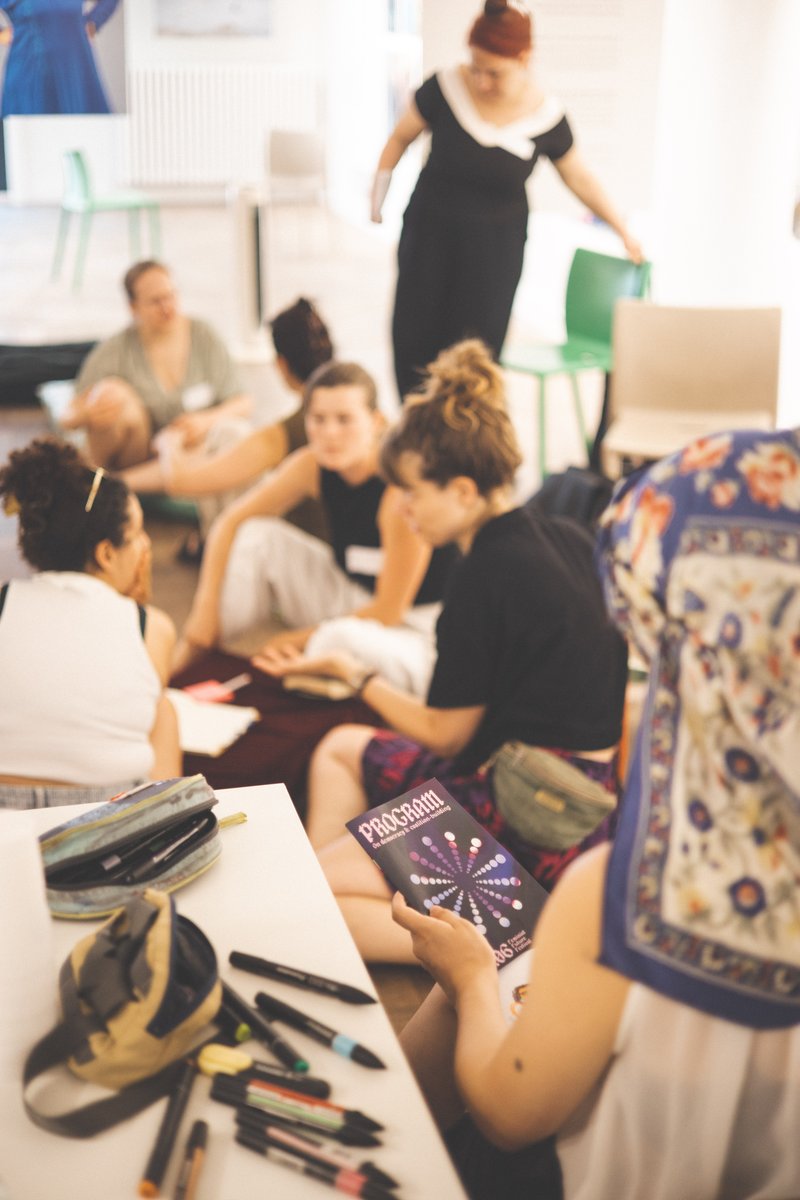
A sheet available for noting our 2 keywords
-
How do we react
-
Ideas from members
Institutional work- Getting out of institutional contexts gives more opportunity
Being socially accepted
Anti gender mobilisatons are transnational and worldwide
Activists research in specific context;
WORK/FINDINGS FROM KINDO TEAM ON FEMINIST MOVEMENT STRATEGIES FOR MOBILISATION
RESULTS:
-
Spoke to policy makers-parliament
-
One key strategy is the use of knowledge
-
Doing studies on Antigender
-
Coalition building at the parliament
-
Strategies on how to interact and when not to
-
Elaboration of rules
-
Informed practices to protect feminists
-
Strategies that confront the anti-gender movement
-
Digital activism
-
Legal and institutional form
-
Watchdog-monitoring
-
Strategic communication
-
Strategic non-engagement
-
Institutional field using care as a strategy
WHICH STRATEGIES WORK BEST- What are the opportunities to create coalitions across contexts?
Participants were asked to brainstorm on sticky notes and post it on the board - to come up with some keywords afterward
KEY ANSWERS FROM PARTICIPANTS WERE :
Knowledge
Transnational meetings and network
Findings
Lobbying and campaign
Being part of policymakers
Learning
Changing the narrative
Creating spaces for discussion
We discussed the ideas brought on board, starting with our experiences
Participants feedback:
-
Activists are struggling because of threats
-
Update the guidelines on the use of abortion pills in Italy- there is a stereotype that they are poisonous
-
Movements tried to fight back on the fear that gripped people, doubting for their lives after taking the pills.
-
Powerful advocate teams for antiabortion groups
-
Breaking some boundaries
-
Finding an entry point with those in the community
-
Creating maps for safe place abortion and contraceptives in Italy and creating underground support for feminists
-
Medical biases by the hospitals
-
Doing a lot of campaigns in the feminist groups locally and internationally
-
Transnational abortion networks strategy should be emulated by other organizations
-
Croatia is similar to Italy, catholic nation more resistant to abortion
-
People are coming up to share their experiences with poor doctors
-
Will be good to have a platform to share the history of feminist movements, tools like the map etc
-
We don’t have money but power to share knowledge
-
Meetings are very relevant
-
Crea- India: they gather global feminists to share ideas
-
European level- institutional funding
-
Need for funding
SHARE TWO KEYWORDS
-
Feminist Networks
-
Knowledge
OTHER IDEAS
AUTONOMY
The session ended with coordinators thanking members for joining, and having a casual interaction with them as they exit the room. It was very lively and interactive.
2ND SESSION
9 PARTICIPANTS
How can we build a transnational feminist resistance against exclusionary politics?
Femininists responses - Speak to the parliaments,
Response
-
Inviting feminist experts in public hearings
-
Coalition building- BETWEEN PARLIAMENT AND CIVIL SOCIETIES
-
Update of guideline
-
Speak to policy makers-parliament
One key strategy is the use of knowledge
-
Doing studies on Antigender
-
Coalition building at the parliament
-
Strategies on how to interact and when not to
-
Elaboration of rules
-
Informed practices to protect feminists
-
Strategies that confront the anti-gender movement
-
Digital activism
-
Legal and institutional form
-
Strategic communication: storytelling, ways to tell stories differently
-
Strategic non-engagement
-
Institutional field using care as a strategy
-
Engaging at the grassroots levels
-
Directly confront -Digital levels, public actions, counter processes
-
Low engagement strategies
-
Legal and institutional levels
-
Watchdog-monitoring and reports fr the public
-
Institutions- feminist societies- strategic withdrawal
-
Alliance coalition building
TASKS FOR PARTICIPANTS: TAKE A REFLECTION OF FEMINIST STRATEGIES THAT WORK BEST AND OPPORTUNITIES TO ENGAGE IN TRANSNATIONAL COALITIONS
They wrote all ideas on sticky notes and pasted them on the board for brainstorming
IDEAS THAT CAME UP
STRATEGIES
-
Sharing of knowledge (climate in the south and north, listening to bottom-up narratives)
-
Transnational meetings (UN activist)
-
Networks (Feminist internationalism, coalition transnational level)
-
Communication (media narratives)
-
Funding and non-material solidarities
-
Constellation strategy (state projects, student organizations)
-
Political strategies
Opportunities –> Social media
How can we build a transnational feminist resistance against exclusionary politics?
What are the most common strategies and what are missing:
-
Knowledge
-
Network building
-
Communication-media
Things missing
-
Where are the anti-gender mobilizations coming from
-
We don’t understand why groups like LGBTQs and feminists are afraid
We can change the approach to match forces
-
Ages need to be considered in our strategies
-
Religious groups and other groups are prohibited from engaging with such marginalized groups
The session ended with the coordinators thanking members for joining and having a casual interaction with them as they exited the room. It was very lively and interactive;
Coalition building and feminist futures
How can we build and foster coalitions between institutions, grassroots organizations, CSOs, and academics? What futures do we envision in coalition?
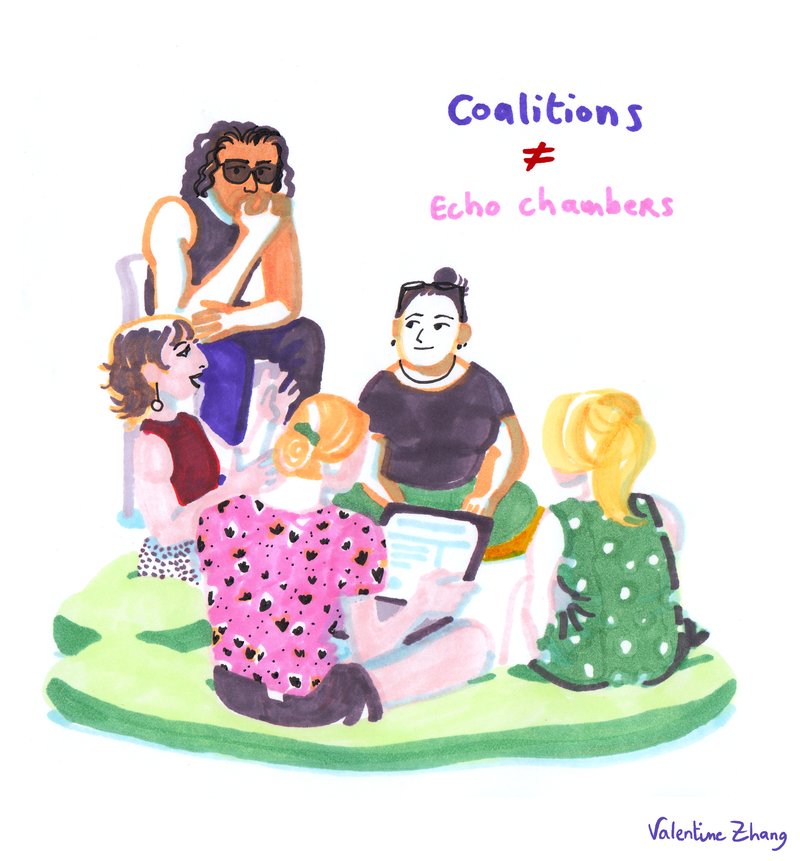
We are witnessing a growing network that unites the far right, Trans-Exclusionary Radical Feminists (TERFs), Christian organizations, and billionaires. The need for sustainable coalitions to build intersectional feminist futures is pressing.
Photos: © Michelle Geerardyn
Illustrations: © Valentine Zhang (https://www.instagram.com/valentinezhang/)
FIRST SESSION
INTRODUCTION - GET TO KNOW EACHOTHER
-
Soralia
-
Rebelle
-
Prisme & podcast
-
IPPF
-
Institut égalité de genre
-
De Roma : spreken is goud.
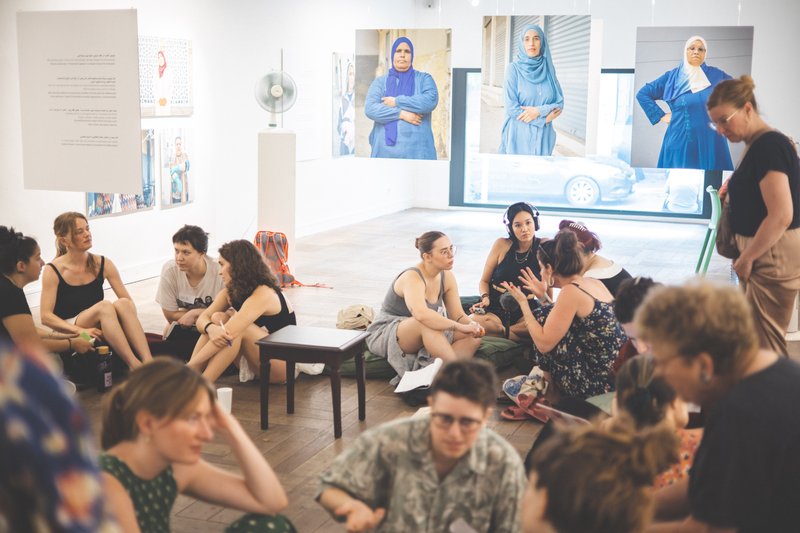
We live in increasingly hostile contexts. Ex: Italian collectives of queer and lgtbqia+ who mapped safe spaces in the city, so they helped people to find areas where they could be safe to seek out (medical) help.
Another example, in Poland the government spies on you, how do you navigate this context?
In coalition building, who do we find safe to cooperate with? How do we deal with the changes in coalitions?
How does it pan out in our experiences, when safety shifts within a group/ coalition?
Forming group of 3-4 ppl to discuss the questions
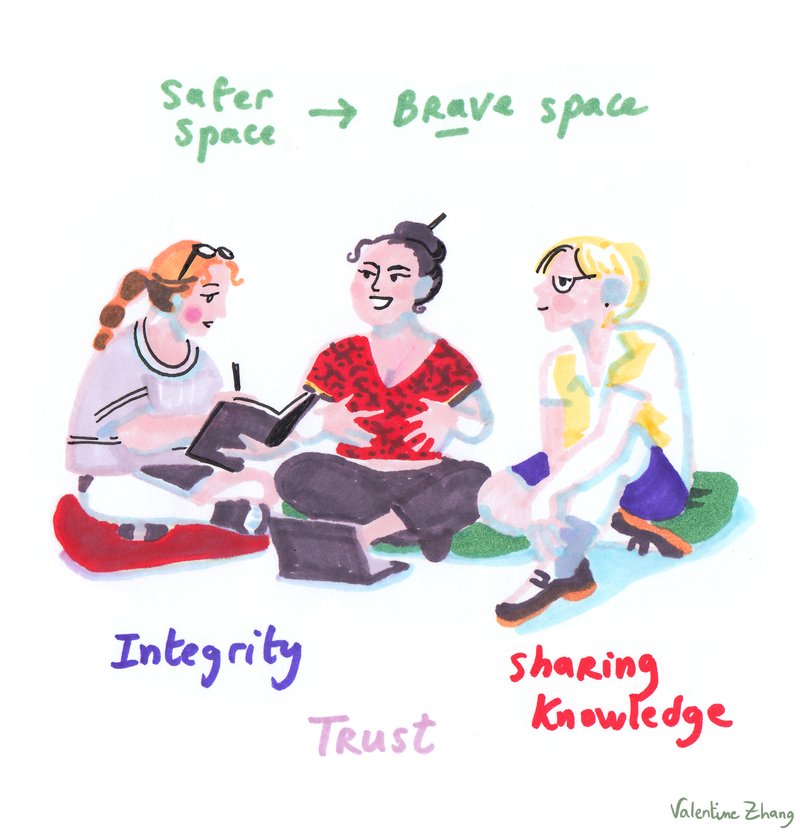
1) How can we build and sustain safe community spaces through coalitions?
- Who do you reach out to and who do you see as (un)trusted and safe partners?
Experience with coalition genre (10 associations+-) funded by the Institute for gender equality between women and women in Belgium. Trust between the associations came with knowing them, and was built around a charter.
-
Safe if we share the same values, resonate with the tone of voice.
-
What is not trustworthy? Or changed? Example of joining the liberal feminism spaces in Poland, it was first easier to join them, but after a while one might not resonate with the lack of consideration for migrant rights.
-
Ambition to create safe-spaces : no control on your audience, eventhough you attract an audience that is attracted to your values. Hire a moderateur that can intervene when an intervention, wich helps to amplify the voices that we want to hear.
-
Try to align with organisations that align with the values: anti-racist, feminist, anti-fascists organisations, that have an experience in fostering safe-spaces. This is an ambition, because you do not control the outcome.
-
No association is considered unsafe until now, nor their programming has been targetted by right-wing politicians.
-
Example of organising an Iftar: the organiser received personal threat. There was a discussion of having the police. But then they decided not to require the police for “safety”, because it would have not fostered a safe-space.
-
Our positionality influence what we consider safe. Here we are mainly white people. So how to foster diversity? Make it inclusive for people from other backgrounds.
2) What kind of futures do we envision through coalitions?
More financing, time and human resources.
-
How do we navigate and addresse different forms of oppression?
-
What kind of practices do you use?
Example for having an inclusive coalition: Academia is very white, changing the topics. Regarding the public: we need to let go of the aim to attract people with all different backgrounds. So they try to diversify by topic each different event of the programs. It works best when they work with associations that work with the public (ex: diaspora organizations). So one of the answer can be partnering with the right organisations, and having a panel with only women, or only racialised people (a rule: only one man per panel, that is more than enough). You can decide which voices you want to hear, and then it happens naturally that you have an only female or racialised people panel.
SECOND SESSION
INTRODUCTION - GET TO KNOW EACHOTHER
Forming group of 3-4 ppl to discuss the questions
1) How can we build and sustain safe community spaces through coalitions?
Brave spaces in een artikel.
Je weet niet wie veilig is of niet. Gemeenschappelijk waarden, maar wat ze doen op andere plekken wat ze kunnen doen is helemaal niet veilig (colonialism, witheid, enzo).
Normaal omgang kunnen veranderen.
Veiligheid =/= moet toegangkelijk zijn voor iedereen? Of toch niet? Toch aan sommige mensen beperkt zijn.
-
benadering van toon
-
vertrouwen personen binnen organisatie is een goed teken voor grote instellingen
-
overeenkomst van vertrouw: wat vind je veilig of niet? Wat heb je nodig? Dat hangt van de context af.
-
Mond op mond: vragen aan je vriendenkring.
-
Kennis van de gedrag is gedeeld in een community/ bubble
-
Code of conduct die zichtbaar is
-
Soms twee personen/ instituten hebben dezelfde einddoel, maar twee verschillende manieren om mee te gaan
-
Bezorgdheid en gesprek, meer stemmigheid hebben, hoe kan je daar ruimte te vinden?
-
Goed voorbereiding : pre-care over te nadenken, voor-zorg zo in te bouwen
-
“Kwetsbaar” en “werk is geen oplossing” van een socioloog Magrit van den Berghe.
-
Who do you reach out to and who do you see as (un)trusted and safe partners?
-
Safe if we share the same values, resonate with the tone of voice.
-
What is not trustworthy? Or changed?
2) What kind of futures do we envision through coalitions?
Een systeem: pluraal samenleving, met verschillende instituties, ongelijkheid en bezit afschaffen om een beter samenleving te creeren.
- How do we navigate and addresse different forms of oppression?
Communistisch ideen. Hoe kunnen we de verschillende mensen met elkaar brengen, zonder iedereen dezelfde maken?
-
What kind of practices do you use?
-
Can you share some examples?
-
Overeenkomst van vertrouw: van kunst en mensen
-
Preperation time
-
Grassroot, burger initiativen
-
Een doel hebben voor onszelf als organisatie, niet altijd reageren,
-
Verbinding: hoe kunnen verschillende stemmen samenkomen, om polarisatie te voorkomen
-
Partnering
Democracy and its legacies
Can and should democracy be revitalized? Who can and will be involved with such a project?
European democracies are often presented as the antidote against exclusionary politics. Yet these democracies are built on/with/through legacies of colonialism, fascism, and capitalism (amongst others).
Photos: © Michelle Geerardyn
Illustrations: © Valentine Zhang (https://www.instagram.com/valentinezhang/)
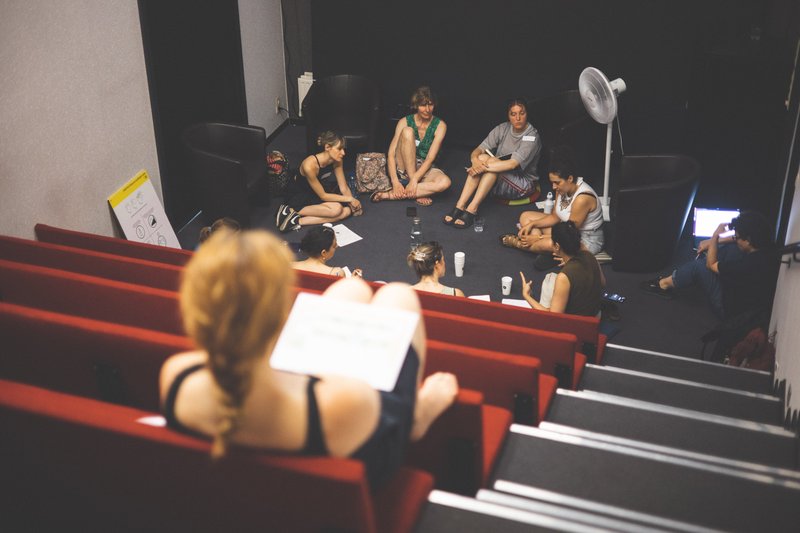
This workshop was based on an open group discussion about democracy, equality and anti-gender movements. Participants came from different backgrounds, including NGOs, research, public institutions and community organisations. Everyone shared their own experiences and perspectives.
One of the main ideas discussed was that anti-gender movements are not completely new. Several participants explained that these movements are connected to older systems such as patriarchy, colonialism and social inequalities. They believed that these existing structures make it easier for anti-gender ideas to spread today.
Another important topic was the meaning of democracy. Many participants said that democracy should not only be about elections, but also about equal access to rights and opportunities. They discussed the difference between having rights on paper and being able to use them in real life. Several examples were mentioned, including migration, women’s rights and LGBTQ+ rights.
The group also talked about the importance of language. It was interesting to hear how words used by politicians and the media can influence the way people understand social issues and political decisions. I had not really thought about the impact of language in this way before, and I found this part of the discussion very interesting.
One point that particularly caught my attention was the discussion about knowledge. Several participants said that a lot of valuable research stays inside universities and does not always reach the general public. They highlighted the importance of translating academic knowledge into simple language so that more people can understand complex topics and participate in democratic discussions. This was probably the idea that stayed with me the most.
The discussion also focused on participation and critical thinking. Many participants agreed that democracy depends not only on institutions but also on informed and active citizens. They believed that encouraging people to participate more and helping them better understand these issues could strengthen democracy.
Personally, I appreciated that the workshop was based on dialogue rather than formal presentations. People came from different professional backgrounds and shared concrete examples from their own work, which made the discussion more engaging and practical.
Overall, the atmosphere was respectful and open. Even when participants had slightly different opinions, they listened to each other and tried to build on each other’s ideas. The workshop focused more on exchanging experiences and reflections than on finding one final answer.
The three key words chosen by the group at the end of the session were (RE) Connecting, Partycipation, and Translating, as they best reflected the overall discussion.
Knowledge strategies in anti-gender politics
How do anti-gender actors challenge knowledge around inclusivity and anti-reactionary politics? What new knowledge is produced through these challenges?
Anti-gender politics are attacking the knowledge produced by feminists, gender, disability, and critical race scholars. Attacks on knowledge impact feminist resistance and where the opportunities lie for feminism to create inclusive bodies of knowledge to transform society.
Photos: © Michelle Geerardyn
Illustrations: © Valentine Zhang (https://www.instagram.com/valentinezhang/)
Setting and purpose of the session
The session examined how antigender politics produces and circulates knowledge, how this knowledge affects researchers, activists, organizations, and communities, and how it might be challenged without allowing the far right to determine the terms of political debate.
Round 1:
Three guiding questions:
1. What is this anti-gender knowledge about?

2. How does it affect us?

3. How do we challenge it?
A related prompt asked participants to consider who produces this knowledge, what it contains, and where it travels. The format was conversational rather than presentational. Participants were invited to speak from research, activism, lived experience, observation, and feeling.
The gathering began with brief introductions in which each person named something they liked, such as walking in the woods, tea, ice cream, or dogs. This light opening helped establish a human scale before the conversation moved into far right politics, racialization, emotional labour, fear, care, and collective strategy.
The three questions were discussed in two rounds. After a break of about twenty minutes, a second group entered. The earlier discussion was summarized for them, followed by another round of introductions. The second group then responded to the same questions from different experiences and political locations.
1. What is it about? Understanding anti-gender knowledge
Antigender politics as a transnational knowledge project
Participants did not treat antigender politics as a single opinion, campaign, or national phenomenon. It was understood as a transnational process of knowledge production that travels through political institutions, cities, streets, media, social media, research, and organizational life. It narrows broad struggles over gender and social justice into apparently simple disputes about the family, children, sexuality, education, and social order.
One contribution proposed that a necessary starting point is to understand the logics of the far right. This means examining not only the claims it makes, but also how those claims become persuasive, which emotions they mobilize, who is positioned as threatened, and which institutions allow the claims to circulate.
The inseparability of gender, racism, and migration
A major part of the first round concerned the relationship between antigender politics and anti migration politics. A researcher working with racialized women who experience street harassment described a difficult political tension. Participants in that research sometimes practised opacity when speaking about harassment because public accounts of gendered violence could be appropriated to racialize men, intensify anti migration narratives, or present racialized communities as culturally deficient. Another participant working on queer Muslim lives identified a related tension the group agreed that gendered violence must be discussed, but it cannot be separated from racism, migration, religion, sexuality, and the political conditions under which testimony is heard. Treating these as independent issues can allow concern about gender to become a vehicle for racialized governance. Anti-immigration and anti-immigrant discourse weaponizes sexual harassment (femonationalism), preventing racialised women from talking about their experiences of harassment as they do not want to participate in racist discourse. It is important to navigate these entanglements as a whole, instead of a series of single issues.
The discussion therefore resisted two inadequate options. One option is silence, which can leave violence unnamed. The other is a generalized discussion of gender that ignores how stories are racialized and politically used. Participants argued for approaches capable of holding both realities at once.
Knowledge across the street, media, and institutions
Participants noted that antigender knowledge does not remain in formal political speech and it moves between street encounters, social media, news media, intimate relationships, research settings, and institutional debates. Narratives that appear spontaneous at street level may be connected to broader media frames and organized political projects. This circulation makes it difficult to identify a single site where the problem begins or can be solved. The conversation also raised the danger of accepting the binary offered by antigender actors and responding only within their framing, which can trap opponents in a debate whose categories, urgency, and limits have already been set by the far right.
2. How does anti-gender knowledge affect us?
These norms are an either or: you either are in them, or outside of them, but you cannot exist besides them? –> this ties to the heaviness of emotional labour and time we have to invest to exist in spite of this knowledge, as well as to resist it. It takes time to fight the distortion of our arguments.
How antigender politics affects people and organizations
Time, exhaustion, and embodied labour
Participants emphasized that engaging with antigender politics has material and bodily costs. They named the time required to study, respond to, and organize against it, as well as pressure, frustration, sensory strain, and emotional labour. The work is not only analytical nd it can affect the body, concentration, relationships, and the capacity to continue organizing. One intervention explicitly named the affective impact of emotional labour on the body. Another stressed that challenging these movements takes time that is often invisible in institutional accounts of research or activism. This prompted a practical question: how can organizations be supported rather than simply asked to absorb more work?
Polarization and the narrowing of acceptable politics
Participants discussed how polarization can create conditional forms of tolerance. An example was the position that being gay may be accepted privately while teaching about sexuality or gender is rejected. Such positions present themselves as moderate, but they restrict public knowledge, education, and collective rights. They also push people toward increasingly rigid positions by defining progressiveness as acceptable only when it remains invisible or politically harmless.
Fear, uncertainty, and control
The group repeatedly returned to fear!! Antigender politics can capitalize on uncertainty and the feeling that familiar worlds are being destabilized. It offers simple explanations, clear enemies, and the promise of restored control. Messages are often designed to feel personally close to people, especially those experiencing insecurity or loss of certainty, which raised a strategic problem. Challenging the limited certainty available to someone may be experienced as further destabilization. At the same time, leaving that certainty unchallenged allows exclusionary narratives to harden. Participants did not resolve this tension, but they agreed that strategy must attend to who is being addressed, why a message is persuasive, and what needs it appears to meet.
The problem of reactive strategy
A strong concern in the first round was that progressive and feminist actors may remain trapped in reaction. Participants asked why so much energy is spent answering the far right rather than centering emancipatory agendas, languages, and worlds. Constant reaction can normalize far right vocabulary, repeat its binaries, and allow it to decide which questions are urgent. The issue was not framed as a call to ignore harmful claims. Rather, participants distinguished necessary response from political dependency; A movement can respond to immediate harm while still refusing to let its adversaries define the horizon of possibility. The desired shift was from protection through endless reaction toward protection connected to imagination, solidarity, and the creation of alternative institutions.
3. How can we challenge it?
Care as a contested political language
Care emerged as both part of the problem and a possible response. Antigender actors frequently claim to care for children, families, communities, morality, or social stability. The language of care can therefore conceal hierarchy, control, exclusion, and fear; A claim to care does not necessarily indicate a caring practice.
Participants nevertheless rejected the idea that emancipatory movements should abandon care because it has been appropriated. Care was described as belonging to feminist, antiracist, queer, and collective struggles too. The task is not to surrender the concept, but to distinguish performed care from material arrangements that actually sustain people. This discussion anticipated the final concept of care infrastructure and the phrase shifts attention away from individual virtue and toward the organization of housing, labour, family life, education, health, safety, and mutual support. It asks what structures make care possible, who provides it, who is depleted by it, and who is excluded from receiving it.
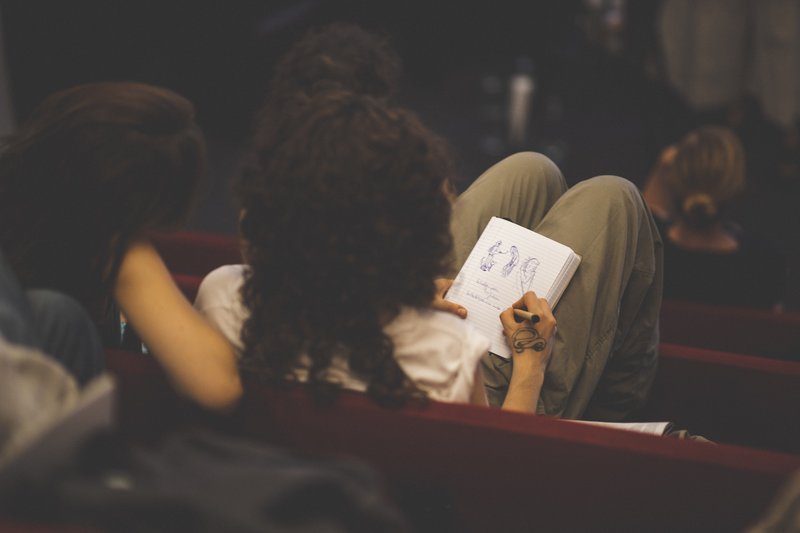
Round 2: moving from reaction toward collective possibility
Imagination without alienation
The second round developed the question of proactive strategy. Participants called for political imagination, but also asked how new imaginaries might be created without alienating people who are uncertain, unconvinced, or located differently. Even emancipatory visions can reproduce othering when they assume that everyone already shares the same language, analysis, or confidence. The group identified elitist language and moral superiority as obstacles. Using specialized political language may demonstrate analytical precision within activist or academic spaces, while making the discussion inaccessible elsewhere. Participants called for approaches that can remain politically clear without treating disagreement, uncertainty, or lack of vocabulary as evidence of moral failure.
Compassion, generosity, and power
Compassion and generosity were proposed as strategic resources, but not as substitutes for conflict or analysis. Participants stressed the need to sit with tension, including the tension between seeing how fear is produced and resisting the politics built through that fear. Compassion becomes politically useful only when combined with an understanding of power and accountability; the distinction matters because calls for kindness can depoliticise violence, while uncompromising political language can isolate people and reproduce moral hierarchy. The discussion sought a position that refuses both sentimental avoidance and punitive superiority.
Coalition building and working across difference
Coalition building was described as the capacity to become politically large enough to work together without pretending that differences do not exist. Participants emphasized solidarity, shared work, and the need for multiple strategies rather than a single method imposed on every context. Lived experience was presented as a source of understanding. One participant reflected that during the COVID period forms of labour that had long existed, including emotional labour, became publicly recognizable. This example suggested that collective crises can reveal work and dependency that dominant frameworks usually hide.
Joy, discomfort, and living otherwise
Joy became one of the most generative themes in the second round nd participants described joy in working together and in collective movement. Joy was not presented as cheerfulness, personal wellness, or the denial of pain. It referred to the political force of relationships, shared activity, and the experience of building a life that is not fully organized by fascist or exclusionary terms. One participant complicated the language of joy by stating that they were not always joyful and were willing to remain in discomfort while continuing the work. This prevented joy from becoming another demand placed on exhausted people. Joyful politics, in this account, allows grief, anger, uncertainty, and discomfort to remain present. The group linked joy to showing that the alternative is already here and social movements are not only instruments for producing a future world. They are also present forms of relation, community, and collective life. The political task is therefore partly to make existing alternatives visible, inhabitable, and durable.
Victimhood, democracy, and the need for power analysis
Participants observed a double use of victimhood. People targeted by antigender politics are victims of concrete violence and exclusion. At the same time, far right actors portray themselves as victims of woke politics, feminism, migration, or social change. This reversal can redirect attention away from institutional power and toward competing claims of injury. The discussion also questioned how democracy has been narrowed into simplified accounts of majority preference, free speech, or electoral choice. Participants argued that a more serious discussion of power is needed. Without power analysis, opposing sides can appear equivalent even when they have very different access to institutions, media, resources, and the capacity to define social reality.
Collective synthesis
At the end of the second round, the group tried to select three terms that could hold together the discussion. The process itself involved negotiation. Several related concepts appeared on the flipcharts, including imagination, protection without reaction, generosity, solidarity, compassion, experience, coalition building, community, care, and the avoidance of alienation.
Political consciousness
Political consciousness referred to understanding the logics of the far right, the production of fear and victimhood, and the links between antigender politics, racism, migration, hierarchy, privilege, and institutional power. It also meant recognizing how language and knowledge become normalized across different settings.
Joyful communities
Joyful communities referred to coalition building, collective movement, lived experience, and the capacity to practise other ways of living in the present. The emphasis was not on permanent happiness, but on forms of community that make resistance sustainable and give people a material experience of another social world.
Care infrastructure
The third term moved from generosity toward care infrastructure. This shift was significant. Generosity can describe an individual disposition, while infrastructure directs attention to systems, institutions, labour, and shared responsibility. Participants asked how care could be organized beyond the limits of the nuclear family, and how existing family forms could be transformed without simply condemning the people who depend on them.
The question that captured this part of the conversation was: How do we organize care in a world that destroys? The wording connected care to survival, abolition, reconstruction, and the creation of durable social arrangements.
Violence in anti-gender politics
What is the role of far-right violence? How can we care for each other while navigating these hostilities? What is the role of care in building feminist futures?
The politics of the manosphere, far right, and anti-gender actors is explicitly sexist, racist, ableist, and transphobic. This creates and targets precarious groups on the streets, at Europe’s borders, and within institutions.
Photos: © Michelle Geerardyn
Illustrations: © Valentine Zhang (https://www.instagram.com/valentinezhang/)
Introduction of CCINDLE and their research
With the increasing far-right violence, it seems the role of violence is changing and we need to rethink in this new context how violence becomes a tool for political campaigns. CCINDLE’s Andrea and Olli research violence in anti-gender politics in countries such as Belgium, Sweden and Spain.
Key findings
Three key findings from their work relevant for this roundtable include:
* There is a different instrumentalization of violence: building on violence already present in political campaigns, that may differ per country (e.g., the state itself becomes a violent actor and perpetrator of violence, such as in Poland and Hungary).
-
Political violence is not what it used to be: political violence does not only happen towards politicians, it also happens towards civil society that stands at the forefront of violent attacks. Nowadays, political violence is not only physical, but also includes threats, intimidation, and bullying. Although they may not count as traditional forms of violence, they are nonetheless harmful.
-
The role of the state is dual: it is a perpetrating actor of committing violence, but also an actor that is condoning violence (lacking in its role to prevent violence and protect against violence).
Andrea and Olli ask us two central questions:
-
What is the nature of violence?
-
What can we do about it?
We took some time to write down our own answers on post-its before discussing our views collectively. Below are some of the reflections that participants gave in answer to the questions.
The nature of violence
What is violence today? How has it changed? How does it show up in your context?
Violence has become instrumentalized by political actors, legimitated, legalized, and normalized in various ways: as “security management” or a “defense system”, as a tool of racism, as border regimes. So many different forms of violence are happening out of sight and explained to wider society as something legal, a last measure. One participant reflects: “How much social acceptance does direct violence get?”
Violence showcases anger and religious hate, instigating mobilization. Hate speech is used commonly in the Brazilian context: allegories (“men are losing rights, women have more rights”), anti-feminism, and aggression is also present within your own environment, with your loved ones.
The denial of non-action. There is a violence in being able to forget, excuse, and deny accountability.
Violent action is obvious (in the Mexican context), especially by state forces through sexual violence or blatant criticization of women and women’s bodies.
Epistemic violence, the way language is used to frame topics, frameworks that are assumed and taken on by states or far-right activists. The normalization of certain rhetorics: violence against women seen as anti-immigration issues.
Violence is contextual: to determine what is violence, you have to take into account the context.
Violence is polarization, to the extent that it sows divide. People are increasingly more inclined to burn bridges rather than work on repair: it’s a black-or-white, “either you’re with us, or you’re against us” dynamic, even among left and activist circles.
Some keywords that already came up during this discussion included:
-
Fear: if you are constantly living in fear, you are not living
-
Dividing: dividing people as an act of violence
-
Control: fear and dividing as a means of control to exert power and control the masses
What can we as feminists do on different levels and engagements?
Violence can also be present within feminist groups. That is why coalition is all the more important.
-
Coalition: it’s difficult to build bridges, also within feminist groups. How to repair ruptures?
-
Sometimes people do not understand something (they did) is violence.
-
The importance of showing support.
Education, e.g., lack of sex education: you cannot denounce it if you don’t know what it is. Knowledge is power.
Re-building narratives: building our own narrative and destroying the existing narrative.
Care as a strategy and a starting point. Building bridges and repairing ruptures, making space for nuance, support. Here the following questions arise: What is care? And how do you show care?
-
Listening to people with less privilege, being aware of your own privileges.
-
Care centered as a lens in research/work: focusing on the felt, lived experience of others, approaching others with empathy can also challenge the way you understand violence. When you see violence not (only) as how it is defined by law, but validating one’s own perception of what violence is. In other words: If it is called and experienced as violent, it is violent.
-
“We have to ask ourselves who we are caring for and what we can do to be more horizontal.” Care as a feeling of togetherness, being one with others.
-
The space to make mistakes and to be welcoming towards each other’s mistakes. To also be accountable and held accountable.
What we can do thus seems to center on two main approaches:
-
Knowledge & awareness: education, knowledge dissemination, and re-building narratives.
-
Care in the form of support, safety & openness: focusing on repair when there are ruptures and interacting with one another from a place of care, centered on empathy, active listening and lived experiences.
Conclusion
Each roundtable came up with three keywords to summarize the discussions.
The first roundtable - Polarization: a way to normalize the use of violence, strategies and weaponization
-
Dehumanization/othering
-
Renaming: naming, recognizing, not hiding away, is essential
The second roundtable - Control: strategies deployed (dehumanization/othering, fear, denial, normalization, etc.) are all done so in order to hold, gain, and maintain control.
-
Omission: in-action, non-response is also a violent tactic.
-
Culture of care: the importance of a culture of care to form a united front of solidarity.
Imagining, building our technological future(s)
Caminante, no hay camino, se hace camino al andar. — Antonio Machado
What do you see when you imagine the future? What role does technology play in that future? Is technology an oppressive force, facilitating constant surveillance and eroding your rights? Or do you imagine a future in which technology allows for social cohesion, human creativity, and collective safety?
Technology and future-thinking go hand in hand. Our imagined futures often feature technology as a propeller for change, as a force capable of transforming our lives, relationships, and society. But neither technology nor future-thinking are neutral – both are deeply political. For one, technologies are imbued with the values, motivations and logics of their makers. And decisions about who gets to imagine, shape, and build futures are also defined by politics. In other words, politics determine which technological futures we imagine, perpetuate, and work towards.
In today’s digital society, a handful of powerful companies have a stranglehold on our capacity to imagine a technological future that is not powered by logics of hypercapitalism, surveillance, security and control. While deeply dystopian, theirs seems to be the only future possible. This deterministic view of technology and the future has eroded our capacity to imagine alternative – technological and political – futures.
During this workshop, we will explore ways to imagine and build new technological futures.
Imagination is a critical step towards political transformation. During this workshop, we will use critical futuring to imagine new technological futures. To do so, we will build on work by SUPERRR and Futures Probes, who define critical futuring as a political practice that allows us to question the status quo, interrogate power relations and foster narratives rooted in care, equity and hope.
Additionally, we will also explore ways to collectively build the technological futures we want. If technology is political, it can also be shaped differently: through collective ownership, digital citizenship, and the democratic governance of digital infrastructures. How can activists and researchers reclaim the democratic potential of technology? And what does digital protection look like while we strive for better technological futures?
Photos: © Michelle Geerardyn
Illustrations: © Valentine Zhang (https://www.instagram.com/valentinezhang/)
Facilitator
Paola Verhaert is an independent researcher, advisor, and writer. She has been working at the intersection of technology and social justice for ten years. As an expert in digital rights and digital equity, she mostly works with (inter)national civil society organisations and public institutions.
She has been researching the social and political impact of digital technologies for ten years. Through her research, she seeks to uncover and understand the impact of emerging technologies on citizens, marginalised communities, and the government. In addition to her work as a researcher, she supports and advises organisations on the responsible use of technology and data. In recent years, she has worked with over 50 organisations across five continents.
As a writer, Paola covers topics related to technology, politics, and culture. Her first book, titled ‘Technology is political: The battle for digital justice’, was published in November 2025. This book is a philosophical and practical introduction to the concept of digital justice. In 2024, she was appointed as ‘Scherpsteller,’ a biyearly honour awarded to an inspiring thinker by the Flemish-Dutch house of literature and debate de Buren and the Hannah Arendt Instituut.
The workshop
This workshop invited participants to think differently about technology and the future. Instead of only focusing on new inventions, the discussion explored how technology is connected to society, politics, power and our everyday lives.
The session was very interactive, with participants sharing their own experiences, questions and ideas. At the beginning, the facilitator explained that technology is not something neutral or natural that simply happens by itself. Technologies are created by people, companies, institutions and governments. For this reason, citizens should also have a voice in the kind of technological future they want to live in.
The first discussion was about technologies that participants were genuinely excited about. The examples were very concrete and personal: medical devices, communication tools, mobility support, privacy-friendly phones, and tools that can help people in difficult situations. I found this a good way to start the workshop because it showed that technology can really improve people’s lives when it responds to real needs.
A key idea in the workshop was “techno-determinism”. This means the belief that technology follows only one fixed direction and that people cannot really change it. The facilitator challenged this idea and reminded us that technological futures are not inevitable. They depend on choices, values and political decisions.
Another important idea was “techno-diversity”. This means that there should not be only one way to imagine or develop technology. Different communities can create technologies based on different needs and values, not only profit, growth or control. This made me think about how much technology is linked to culture, politics and social justice.
During the group exercise, participants imagined different possible futures. One thing I noticed was that many people found it easier to imagine negative futures than positive ones. Discussions often went towards surveillance, artificial intelligence, discrimination, environmental problems and inequalities. Imagining hopeful futures required more effort and creativity.
However, the groups also came up with more positive ideas. Some examples included people building their own technologies, stronger community-based tools, feminist responses to discriminatory AI, better public transport, and more environmentally friendly solutions. These ideas were not always unrealistic. In fact, one of the strongest messages of the workshop was that many desirable futures are already technically possible. The real difficulty is often political will, organisation and cooperation.
I also appreciated that the facilitator did not present technology as only good or only bad. The workshop showed that technology can be useful and empowering, but also dangerous when it is controlled by only a few powerful actors. This balance made the discussion more interesting.
The conclusion of the workshop was that we should not only criticise the current systems, but also imagine what could replace them. The facilitator encouraged participants to think about the tools we already have today, including technological tools, political tools and community tools. This was a very important point for me, because it made the discussion feel more practical.
Overall, I enjoyed this workshop because it encouraged creativity and reflection. It reminded me that technology is not only about innovation, but also about the choices we make as a society. I also appreciated hearing different perspectives from people with different backgrounds, because it made the discussion richer and more concrete. The main idea I will remember is that the future is not already written. If people want more inclusive and fair technologies, they need to be part of the conversation and not leave these decisions only to big companies or political leaders.
Gender, nation and nativity
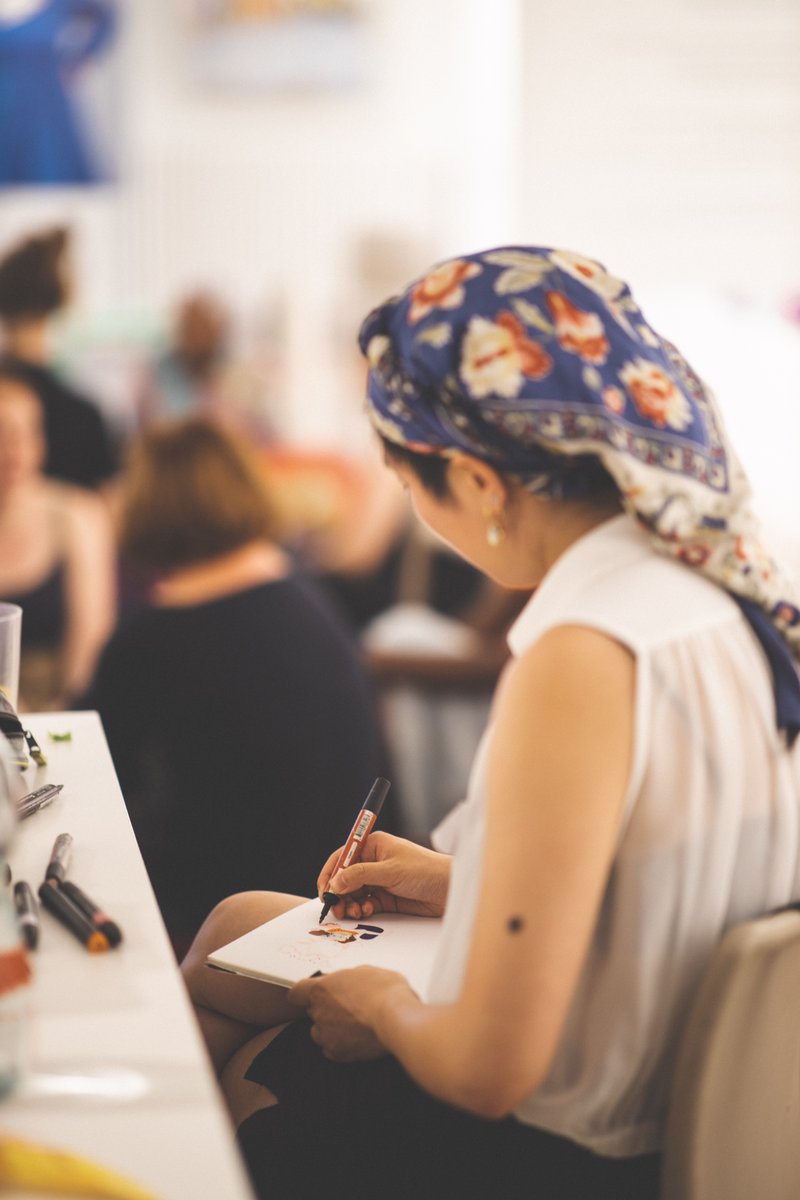
Together with Jeanne of the Insalaha collective and Nina, a socio-architect and public mediator, this workshop invites participants to probe the relation between gender and borders.
Rather than positioning “border violence” as something to be simply added to the existing ledger of gender studies, we begin elsewhere: what becomes possible when gender is thought from the vantage point of borders themselves? And inversely, how can an attention to gender and reproduction enable us to understand borders not just as static walls but as regimes that organise life, distribute vulnerability, and make some forms of existence more livable than others?
Participants will engage with four interconnected thematic clusters – (nation & nativity) (producing a ‘crisis’) (non-state//trans-identities)(the politics of freedom) – through a set of textual and audiovisual materials assembled as “information packages.” From these materials, participants will be invited to collaboratively compose vignettes. Vignette-writing, a method often used in anthropology and experimental literature, resists the pull toward totalising explanation, and allows for forms of expression that remain partial, affective, and open-ended. We will then return to the collective to read these vignettes alongside one another, asking how they relate to and interrupt each other.
The workshop will be conducted in both French and English. Comprehension of French is required, though participants are welcome to express themselves in the language of their choice.
Photos: © Michelle Geerardyn
Illustrations: © Valentine Zhang (https://www.instagram.com/valentinezhang/)
Facilitators
Tinhinane (Nina) Hessani is a socio-architect based in Saint-Josse, Brussels. As a descendant of Amazigh resistance fighters against French occupation and genocide in Algeria, her practice centers on understanding and dismantling spaces of coloniality. She works as a guide and public mediator in various socio-cultural institutions./ Elle
Jeanne Coppens lives and works in Brussels. She is a member of the abolitionist collective Insalaha, and is completing an anthropological research project on citizenship-withdrawal practices in Belgium. To earn a living, she gives exhibition tours to kids and adults.
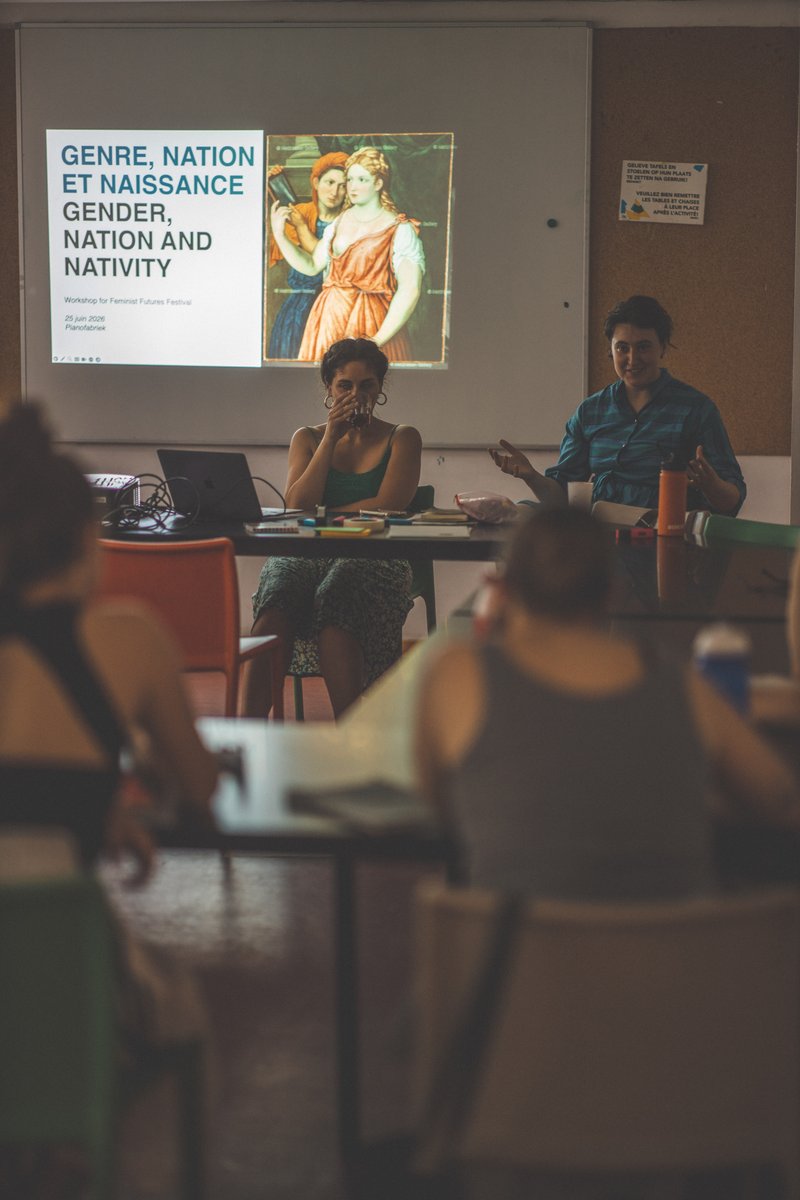
Workshop framing and stance
The workshop was facilitated bilingually (French/English) by two organizers, Jeanne and Nina, who met through their work in cultural and social media. Their collaboration grew out of a previous short-lived collective formed in response to the announced deployment of Frontex in the south of France, focused on questions of borders and abolitionism. It was through this earlier work that the organization Sophia invited them to lead this workshop on borders and Frontex.
The facilitators were careful to state upfront that they weren’t speaking as academic experts, but as engaged individuals carrying multiple experiences and reflections, from an anti-colonial perspective. They explicitly named a stance of “epistemic humility”: aware that they themselves had internalized dominant what they called Western forms of knowledge, they invited participants with experiences closer to the margins, or more exposed to risk, to enrich, nuance, or correct what they were presenting.
L’une des intervenantes, sociologue et architecte de formation, a expliqué pourquoi elle avait choisi de ne pas faire carrière dans une institution académique classique, préférant un travail freelance pour préserver du temps pour la recherche tout en restant fidèle à ses valeurs. Elle a affirmé qu’un héritage familial et communautaire dans son cas, lié à ses origines algériennes, à l’histoire de résistance de ses ancêtres contre la colonisation française, et à son ancrage dans une communauté musulmane contemporaine luttant contre le racisme constitue une richesse au moins aussi importante que la formation universitaire. Elle s’est elle aussi revendiquée d’une position d’apprentissage permanent plutôt que d’expertise, notamment sur les questions de tradition et de culture, précisant qu’elle se déconstruit continuellement sur ces sujets plutôt que de prétendre détenir des réponses figées.
The ground rules offered to the group were simple: an open space welcoming all positions (social, racial, economic, health-related, gender-related), with the sole limit being a ban on insulting one another; freedom to react at any point; an explicit trigger warning about the heaviness of the subject matter systemic violence, racism, sexism with the option to leave the space at any time without needing to justify it; and freedom to speak in whichever language each person felt most comfortable in.
Round of introductions
The round of introductions revealed a range of backgrounds and motivations: someone simply curious and carrying open questions; a staff member at a Belgian non-profit working within a coalition against far-right ideology and for gender-related rights; a public-facing activist interested in immigration and restorative justice; an Italian-Argentinian researcher on an institutional placement focused on gender equality, diversity, and inclusion policy, also an academic specialist in sexual violence research, who shared a personal reflection on her complicated relationship to national identity after extensive travel describing herself not as a “citizen of the world” but as someone who feels at home wherever she is (she used “she” pronouns); as well as several other participants present to observe, take notes, or simply learn in a collective, creative format. One participant, Charazade, also specified “she” pronouns. Another participant, going by “Miss,” mentioned a pronoun preference, but the transcript is unclear on exactly which one.
Challenging reductive media narratives about migrant women
A central point developed by the facilitators concerned how mainstream media typically covers migrant women: coverage dominated by narratives of sex trafficking, smuggling, suffering, and victimhood — what they called a deeply one-sided story of migration. They stressed that even where real hardship exists, these women must never be reduced to a single stereotype or characteristic of their experience. This critique fed into a broader argument about how border-related regimes, practices, and discourses consistently produce gendered stereotypes of men, of women, of migrants, and more broadly of anyone positioned outside a normative “center.”
A historical framing of colonial gender systems
The facilitators offered a historical framing, describing how the Spanish empire, during the Renaissance, implemented specific gender hierarchies in service of its colonial project, and comparing this to other historical contexts where gender was instrumentalized differently in some cases in service of genocidal logics. The central idea was that while the concrete forms vary considerably across contexts, the structural function of gender organizing hierarchy, legitimizing domination, distinguishing who is included from who is excluded remains strikingly consistent across history.
The border as privilege, not a neutral boundary
One of the workshop’s strongest arguments concerned how deeply unequal the very concept of a border is. For the facilitators, the border meaningfully exists only for those without privilege: discourse around freedom of movement, and claims that it’s impossible to “welcome everyone,” already assumes largely secured access for white and privileged people, while other populations are structurally excluded from it. To illustrate this, they introduced the concept of a “border industrial complex,” echoing the “prison industrial complex”: a system in which public funds finance private companies that build walls, develop drones, and install alarm systems, extracting profit and labor from extremely precarious areas. In their view, this isn’t an isolated state of exception, but part of a continuum of security measures increasingly entrenched in law.
Current political context: the EU and Belgium
The facilitators connected this analysis to current events, pointing to the legal and rhetorical consolidation of “securing” the EU’s external borders, framed around efficiency and defending “European values” - the metaphor of “Fortress Europe” came up notably through practices like “voluntary returns,” which they argued are voluntary in name only.
At the Belgian level, they referenced the direction of the so-called “Arizona” coalition government and statements from an Interior Minister aiming to sharply restrict migration, as well as legislative changes expanding police powers to enter private homes.
Gender, nation, and birthright
To close this part of the workshop, the facilitators offered an etymological and conceptual reflection tying the themes together: the word “nation” originates from the idea of birth. This etymology, they argued, illuminates how the nation functions symbolically as an entity meant to reproduce “ideal” citizens while expelling those who don’t fit that norm a process they consider inherently racialized and gendered. This was paired with visual material showing different border infrastructures around the world (including Bordeaux and the Syrian border), meant to prompt a central question for the group: who do these systems actually protect, from whom, and who do they ultimately choose to include or exclude?
<3 good luck with what lies ahead. Never stop fighting for you rights. <3 love

Imagining radically different futures
This workshop is the result of that commitment to catalyzing radical transformative power within social movements. It departs from the idea that in order to create a better future, we first need to imagine it being a possibility. It also departs from the observation that, currently, little concrete imaginations that go beyond capitalist or fascist ideologies exist in Europe. This is a problem. As we can see, the far-right is imagining away. Technocrats like Elon Musk dare to dream of Mars and politicians on the far-right sway the public with their imaginaries of a “pure” Europe.
The workshop is an invitation to leave this doom-and-gloom behind for a moment. As a fellow anthropologist once said: the world is what we make it to be, and we could just as easily make it otherwise. Once we make the time and space within our movements to imagine that “otherwise” and bring it back to work in the present, we’ll make those futures happen. Building on a broad literature and praxis, among which Black Quantum Futurism and Rob Hopkins’ How to Fall in Love with the Future, the workshop inspires to do just that.
hotos: © Michelle Geerardyn
llustrations: © Valentine Zhang (https://www.instagram.com/valentinezhang/)
Facilitator
Jan Jelles Rupert (he/him) does ethnographic research into social movements, social change and the role of the imagination in both. He graduated from the University of Amsterdam with an ethnography on the radical imagination and its effect on practices in two Dutch social movement groups. Without translating research to practice in the research context, it stays within the privileged context of academia. This is why he is committed to doing research that works with and for movements.
THEME: I HAVE BEEN TO THE FUTURE AND WE WON.
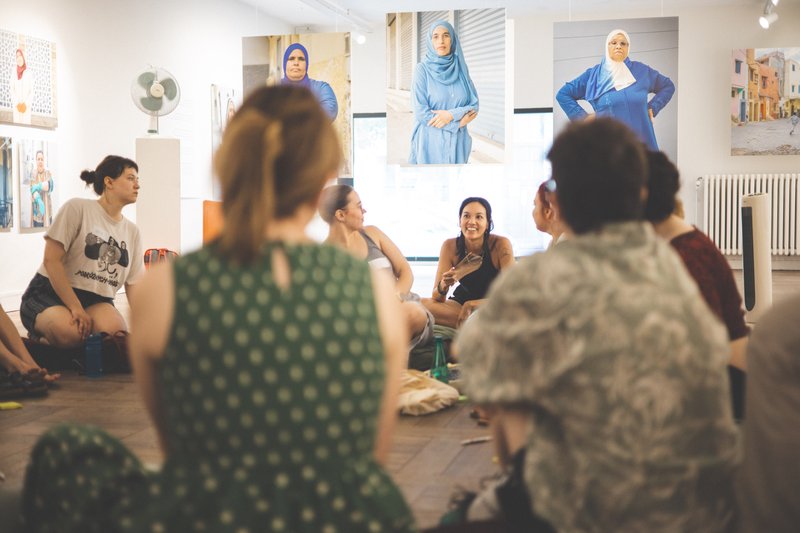
TASK 1
Open up for your imagination: module it in a way we can bring the future to the present
How different could the world be?
Think beyond the present
TASK 2
Go around and talk to other people on how to bring them into your space –> participants share their thoughts
FEEDBACK FROM PARTICIPANTS (each in groups of 3)
Groups that shared their thoughts struggled with the concept WE WON
Activists and people in general focus to live in certain contexts because of peoples imaginations.
People create a mental space which is theoritical, fun and playful –> “everything can be different”
TASK 3
Why should we imagine the world differently - active imagination exercise using sticky notes to verbalise what we can imagine as different.
FEEDBACK FROM PARTICIPANTS FROM PARTICIPANTS:
-
Not an easy exercise at first
-
Imagination is social
Theoritical concept
-
Exploring the world
-
Seeing the world as a institution brings imagination back to the present
STRATEGIES
-
Privilege: We have the privilege of thinking into the future. However, we are different and things hold people back from imagining the future
-
Manifestation: If i manfest my self as something, the world will give it to me
The world can be different, and our imagination may not be relevant now but informs how the future can be.
TASK 4 & 5
-
Participants go to each other and express what they imagine for the future, arguing that it is possible and feasible. Others will react by arguing against their ideas.
-
Participants start the exercise against and instead of fully rejecting it, others will start by saying “yes, but” and debate from there.
FEEDBACK/OBSERVATION FROM PARTICIPANTS: Everything participants say to each other is immediately rejected, which made the experience quite funny.
TASK 6
Talk to your group members with the preamble “In my future, …”
FEEDBACK FROM PARTICIPANTS:
-
Good exercise for activists
-
Creates a space to share common ideas
-
It’s a fun exercise but it can be a bit upsetting as well
-
Helps imaging something that is not real (yet)
FINAL TASK
We formed a circle, closed our eyes and were given guidelines on things to imagine like a door to another dimension and what the world looks like behind it.
Each group was given a sheet to draft and draw whatever the exercise inspired them to think about their own lives:
-
Restructuring the educational system in the participant’s country (Hungary)
-
A creative curriculum
-
Security in the educationalk system
-
Intellectual reforms in schools
-
Visions of community
-
The university as an actor of change
-
Growing together and supporting each other
-
Spaces for empowerment as a tool for thriving
-
Leadership
-
Grief
-
Different emotions and ways to relate with each other
-
Nature, green hills, nature, trees
-
People on the street collectively
-
People grieving in sanctuaries
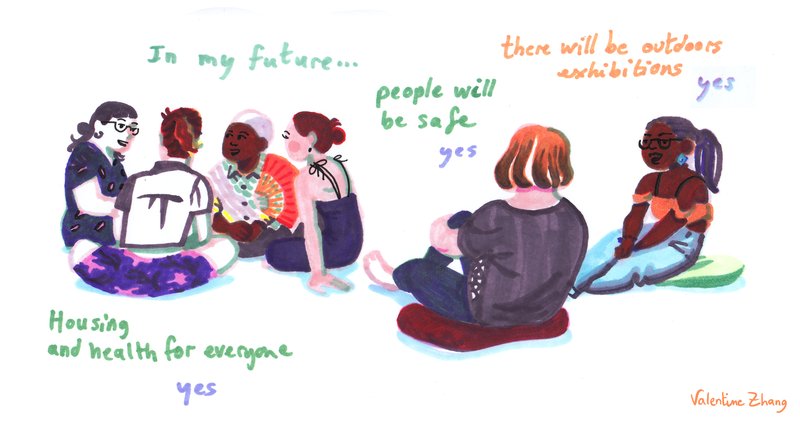
Even though every team had different members and different imaginaries, participants were able to put things together and relate to each other. Things discussed in the warm-up came back in the final session.
At the end of the session, small papers were given out to write something that participants are going to do next week with the things discussed during the session. The papers were put in a box and each participant picked one paper back to accomplish in the following week as a “to do”, in order to collectively involve each other in our imaginations and our tasks based on the exercises the participants did together.
Our Bodies, Their Battleground: Reproductive rights in the age of the anti-gender movement
A workshop on reproductive rights, the grey zone, and ourselves.
We are all in favour of reproductive rights. But the fight for those rights also requires honesty about our own blind spots. This workshop zooms in on the pink pill movement as an emerging and underexposed front, explores how the anti-gender movement uses our own language against us, and asks the questions we tend to avoid.
Photos: © Michelle Geerardyn
Illustrations: © Valentine Zhang (https://www.instagram.com/valentinezhang/)
Facilitators
Alina Chakh and Juul Priester are both members of Ava, a Dutch advocacy organisation that stands up for people of reproductive age who use abortion care and contraception.
Ava put the lack of pain relief during IUD placement on the national agenda in the Netherlands, with tangible results. The organisation collaborated with doctors to launch the first online platform for abortion pills in the Netherlands, and was the first to ask users about their experiences with ultrasound during early abortion care. Ava conducts research, gathers experiences and needs, and uses this to improve policy and care.
Alina Chakh is chair and founding board member of Stichting Ava. She is a moderator and speaker on women’s health and reproductive rights, writes and is politically active in the city of Amsterdam. Juul Priester leads research within Ava and works alongside this at Ipsos I&O, a leading research agency.
Brief introduction of Ava
(Ava stands for Anticonceptie Vrije keuze Abortus or “voice” in Persian)
Ava has worked on various different projects, one of which is on IUD placement and pain relief. They had conversations with many doctors about pain during IUD placement, pushing to include pain relief options as part of the standard treatment protocol.
They recently finished their first research on abortion care and how women perceive the care they had gotten.
The first half of the workshop is centered around introducing Ava and the work they have done in the Netherlands; discussing abortion rights in other countries together with the participants, majority of whom are actively working towards protecting reproductive rights in their respective countries. The second half of the workshop sets to challenge our ideas and beliefs regarding abortion rights and contraception as we break into smaller groups to discuss topics to a deeper extent.
Agree or disagree?
“The greatest threat to reproductive rights in Europe currently comes from politics, not from society.”
Agree
-
Society is in odds with the political agenda against reproductive rights, in the Netherlands, in Poland, … There is a broad consensus on abortion from society.
-
Politicians are responsible for the law; “there is no good law on abortion”.
-
Politics is not an accurate representation of society either: women are underrepresented.
Disagree
- Politics and the rhetoric used holds the power to influence society’s views, i.e., abortion stigma in Poland. The rhetoric that when abortion is easily accessible, it will be used as a form of birth control.
Politics as it is today does not represent society’s view on abortion, nor does it form an accurate representation of society. At the same time, politicians possess the power to change, challenge and normalize views of society as a whole, and actively do so as well.
“We are currently losing the battle for reproductive rights in Europe.”
-
Rights, yes, because abortion rights are being restricted. However, reproductive justice: access to abortion in Poland has never become this easy.
-
Anti-abortion actors have been organizing massively and created a steady, coherent story on why abortion should not be accepted. Fear of the coherence they are representing.
“In practice, doctors have more power over our bodily autonomy than politicians.”
-
Even if politicians rule that abortion is legal now, doctors can still be scared due to fear of having their license revoked.
-
Doctors can also practice illegally, going against the law to make abortion possible.
-
Through the abortion pill, the power shifted more toward our own hands.
-
Destigmatization, decriminalization, demedicization
Both doctors and politicians are external authorities who hold power over the bodily autonomy of individuals with a uterus. Politicians’ regulations not only affect our own bodies directly, but can also be argued to interfere with the agency of doctors when they have to choose between potentially losing their license and doing their job. At the same time, doctors are able to go against the law if they so wish.
Barriers
-
In Belgium: lack of knowledge on where to go in order to get help and language barrier(s)
-
In Italy: shame surrounding the topic of abortion (and emergency contraception), e.g., pharmacy giving the emergency contraception under the counter
-
In Poland: lack of finances and limited resources of activists (which are ending in Poland)
The state of abortion law in EU
Financial barriers, forced requirements (waiting periods, approval from three doctors, refusal of care, criminal regulation, information deficit all form barriers.
EU is still in a danger zone, and even when it comes to countries such as the Netherlands, abortion policies can still be improved. Ava exists to also insert the user’s point of view into the discussion on abortion.
A lot of ongoing discussion is still present about abortion pills in the Netherlands, e.g., GPs and pharmacies who are against abortion pills or refusing abortion access, concerns about non-consensual/forced abortions, …
Influence from the US: funding cuts of organizations that work with reproductive health rights in EU, conservative political parties that fund anti-abortioin organizations.
The anti-gender movement
Definition from Atria: an international movement playing out on different levels (politicians, organizations, opinion makers, influencers) who try to push anti-gender narratives into the mainstream, centralizing traditional gender roles in society.
-
For example, physical threats to Rutgers a couple years ago for their “week van de lentekriebels”, hate campaign, concerns of parents that children are learning about blowjobs, …
-
Wellness influencers on the far-right: the use of birth control is declining in multiple places in the world, including the Netherlands. Scientists and the government point towards misinformation (“people are afraid of birth control”), at the same time people want different contraceptives + the Pink Pill movement restricting access.
Discussion
Some questions that we discussed in smaller groups include:
“If someone says they feel better without the pill; I always believe her.”
“An abortion in week 20 deserves as much support as abortion in a week.”
When does a pregnancy start?
How do you feel about these terms?
-
Right to life
-
Holistic wellbeing
-
…
How to tackle it? Do we need new frames or do we reclaim the old ones?
Take-aways
-
“Abortion = contraception: so what?” The rhetoric used by right-wing politicians that access to abortion means people will use it as a form of contraception: Does that even matter? Instead of being pulled in by the tactics deployed, we chose to actively challenge it instead. Conflation of anti-rights movement between abortion and contraception: Is it really that bad or is it really so different? Instead of leaning into it, accepting it.
-
At the same time, publicly it could not be a good strategy/a counterproductive statement. So: a new frame is needed.
-
Burdens are often put on an individual to be medically informed. This also highlights the need for accessible knowledge dissemination networks.
-
The idea of thinking as menstruation as natural abortion - a different lens to look at abortion and your own body.
-
Pregnancy starts when you are pregnant: in the end it doesn’t matter, because you should still have the option to end it if it’s unwanted.
-
Respect for the felt experience and definition: if they call it/they feel pregnant, it is a pregnancy; whatever they call the embryo/fetus is valid.
Key words:
-
Aborception
-
So what?!
Resources for our Future
What resources do we need to organise and care for the futures we imagine? How do you break the grant cycle of going from grant to grant, and why is this important for our futures? In this workshop we’ll talk about resources; money and material resources that are needed to organise in a sustainable way. Our conversation on resource justice will provide us a lens for resource autonomy, an indispensable factor if we want to realise the futures we imagine.
Photos: © Michelle Geerardyn
Illustrations: © Valentine Zhang (https://www.instagram.com/valentinezhang/)
Facilitators
Latifah Abdou has been involved in several projects related to decolonization and social justice throughout the years. She founded WeDecolonizeVUB, a project centralizing racialized youth’s knowledge, experiences, and needs in higher education. In addition, she worked on creating the Blueprint Study: Master in Critical Diaspora, Race and Liberation Studies and co-organized the Braver Spaces Summer School. Through her work on decolonization and social justice, she always emphasizes the need for spaces for social critique, which is exactly what she aims to create - as a moderator - or contribute to - as a speaker.
Nina Poels is one of the founders of Jezebel Studio, a Brussels-based grassroots organisation and queer space for sports and movement. She studied Journalism and later completed a Master’s degree in Gender and Diversity, interests that continue to shape her approach to organisational work. Within Jezebel Studio, she mainly focuses on administration and financial management, helping to build sustainable structures that allow the studio to be independent and self-sufficient while still being socially engaged.
Salmana Ahmed is a feminist resource justice advocate based in the UK. She is co-director of Weaving Liberation, an entity dedicated to resourcing and supporting digital justice organising in Europe.
The discussion
Introduction
Going from non-profit as for-profit for being financially sustainable. How can we move beyond going from grant to grant? How can we rethink funding, resources, acquiring them?
How should we think about resources regarding organising?
S: Resources justice. New initiative coordinating and vision for Europe –> transform the issues of technologies are addressed, discussed and shaped. Decolonizing: 2020. Develop program of ideas to respond to why the ppl wo are the most impacted by technologies, why are they not being centered? Conversation about technology were severed from the reality, and the technology is embedded in a long line of colonialism and accumulating wealth. ==> Program to address how technology is addressed and how it moves in this space.
Worked for luminate to fund in a “progressive” way compared to other foundations. Analysis of philantropic harm, it severes issues from deep political analysis. For example: data and privacy, in EU there is legislative discussion to GDPR. Most marginalized groups are being harmed by these infrastructures.
The silosation of issues, not many grouping of issues to gather finances. Because Philanthropy was never designed in resources justice.
Rolling back and reactive fighting, but stops in order to really make you thrive. Ex: we are reacting to big tech, but little discussion on how it would look like to create community in tech.
Top-down to what constitutes … : philanthropy does not see itself being part of the system it tries to influence.
Organizing: is about money and to redistribute it towards small grass-roots groups, to people who are excluded from getting funding. Organizing with other founders, artists, etc to think about the ecosystem and infrastructure to mobilize resources to leave resources behind when it ends.
L: subsidies are state-funded in Belgium. But the foundation are less-known or non-existent, or you have to know them to penetrate them in our Belgian culture. So this perspectives about foundations shows us how it works elsewhere.
N: Jezebel started as friends have an idea, they started a vzw-asbl and positive about the fact that they could get money under this form of status for organisation. They went to the City of Brussel and VGC: the paradox started: you need to be already established to get money, … but you need money to start and get known..! So they started a crowdfunding, pop-up, and they started to get their own space.
But the forms to fill in where not adapted to what they were doing, because it was between sport and culture, no real door to “knock on”, also very binary approach.
Opleiding on sustainable financing ‘cultuurlokket’, subsidies and grant are not the solution to everything. Test on how independent you are as an organisation. Jezebel was 95% independent thanks to their community: both angry because it should be free (solidarity prices), but also a good thing in a fascist regime that Belgium is becoming.
Letting go of the dream to be fully funded. Anti-kraak (short-term, low price lease for build that will be renovated, sometimes not up to date with latest safety): not a real solution, because the space is so important for the community to feel safe in.
L: Oftentimes the govt does not fund spaces because it is structural.
S: Space: organising. Land justice: who owns land? Who inherits land? From a tech angle: big companies buying land for data center and ruining our lives (climate, expulsing, noise, etc).
Tension of wanting ppl to –> We need to organize strategically to get funding with other intermediary founders (raise money for other groups and use more radical redistribution techniques). These groups find solution to what traditionals philanthropy “struggles with”. On the principle of collective abundance: you get the money and you know what needs to be done with it.
2024 in Bosnia: Cross-movement space in Europe, to rest in nature and connect with other people who work on the same subject as you (tech). But the amount to run this event could have afforded to buy land to own property and organise this year after year.
We have to continue to push founders for good funding, and pusch for autonomy within groups. Solidarity structures starts with infrastructures, servers to store knowledge, outsource the financing of staff in case of loss of funding.
Grants: as creative writing essay, as long as the money can be used flesxibly.
The money gotten for EU Grant gets you to hire someone to do it full time, because of how tedious it is as a process.
N: Mistake of writing something in the comment section for a grant for the VGC.
Bloso certificates for teacher/ athletes, but there is no certificate for a good erotic dancer.
They were labelled as sluts who will not receive their money.. because it was a sport grant used to football team (binary, locker teams, etc). ==> the conditions of grants are impossible.
Getting structural subsidies can break your organizations, because you will need to fit their standards, and makes it impossible to stay in touch with your community.
L: Started project of WeDecolonizeVUB; started a space, and every year they had to fight for it, because no grant would be structural, or allow it. How does the Flemish govt see non-profits org: they let them scramble and make them not sustainable.
What is the downside of being labelled a vzw? Experience from Jezebel?
N: jezebel is a vzw and do not need to pay taxes. Advantage because they do classes –> go above this due to the “education” aspect of their work.
Disadvantages: idea that it is easy to get funding, but it is not. Having to survive on your own money. Feels like they are going quite commercial, but they are not.
//cultural management: cooperative entreprises would be interesting.
Guerilla foundation: intergenerational wealth that is passed down to the next generation. Lots of resources.
How much money do you need? Space to give as a gift to an organization.
Discussion
-
Toestand vzw: occupies vacant buildings, started as grassroots and now is funded by the city.
-
Where you can secure money from, you should. But what about big companies funding, like google or meta? We can see it as reparation from them (ex: Mackenzie the ex-wife of Jeff Bezos giving away huge amounts to feminist associations). Whereas other will not accept it under any circumstances. And also, what is the trade-off? Sometimes, you also have to use other language to get access to funding (ex: USA and the ban of terms such as diversity, feminist, etc.).
-
Money is abundant, but the scarcity for the associations is true. Also, having money as an association can be frowned upon, for examle in the queer community. for example: Jezebel makes their funding publicly known on their website.
-
Applying as an employee for your own salary: scarcity and instability, and you work so much and it is exhausting.
-
Lead with what your org is doing, and align it with what the govt does.
-
Who gets the power, who is excluded from wealth?
Ex: in the US, we are going to release 6% instead of 5%, (of what? the general budgete of the govr?? not sure), it generated 150M$ for the field. But it could have been 10-15%, and it would have been huge for the field. Movements are good at story-telling and narrative, so we need to change them. There is a lot that can be done.
Guerilla foundation for example.
Concluding remarks: This panel gave insights on resources are, and funding is one of them.
-
you can get into dialogue with banks, to dissuade them from their association with harmful companies
-
participatory funding
-
get into the will of people, that gift their houses to vzw’s
-
get money from foundation, not in the Belgian culture, but it can be done.
RECAP - TAKE-AWAYS
-
Research should be collective-based
-
Look at radical redistribution practices of wealth
-
Organize to leave something behind
-
importance of space for building community
-
the importance of Wealth; no need to demonize money. It can come from ‘dirty’ org (no money is clean), but it can be used for good, and not keep ourselves in marginalized spaces. Song “Clean money does not grow, dirty money does” –> untrue! Activist funds will get the money to the org. ==> We should take that money!
-
The need for collective based and embedded in solidarity
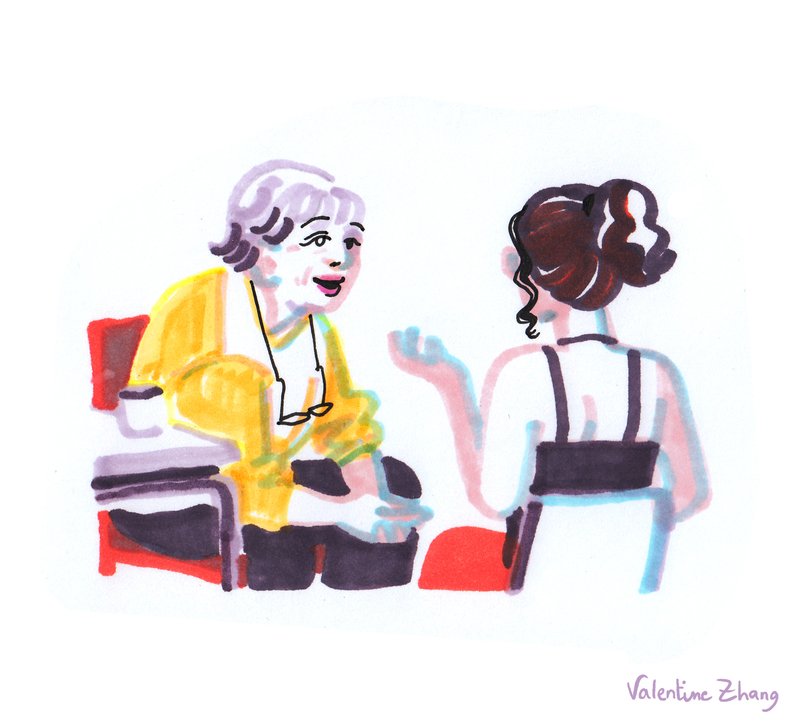
Everything, Everywhere, All at Once: Queer Migrant Organizing in Belgium
How are our lived realities interconnected with our political mobilizing? How do our backgrounds and personal histories play a role in movement building, in challenging and resisting the rise of anti-gender movements?
As two queer migrant facilitators, our lived realities situate us within a new in-between, queer space(s) between here and there. We often find ourselves limited by Western advocacy, human rights discourse, identity politics, and funding structures. Having to navigate systems and structures that are not built for us, even often against our queerness, we come to ask how to co-build sustainable spaces centered around community care, resistance, and collective imagination.
Together, we want to delve into how we are able to navigate queer spaces in Brussels, and how our lived experiences as queer migrants are interwoven, while our community organizing transcends into Europe, remaining rooted in our previous grassroots organizing and activism ecosystems.
We invite both racialized queer folxs and community organizers to co-create the space for collective political imagination, and we invite allies to listen and to question their privileges, and how to use their access and resources to support more effective and direct solidarity. Together, we will map ways to build solidarities through shared responsibility, mutual support, and the equitable redistribution of resources and privileges.
Photos: © Michelle Geerardyn
Illustrations: © Valentine Zhang (https://www.instagram.com/valentinezhang/)
Facilitators
Meriç G. Doğan (he/him) is a multidisciplinary researcher and community organizer from Istanbul. His work spans from queer-feminist epistemology, urban anthropology, and human rights. He explores how queer and trans communities navigate surveillance, exclusion, and public space, with particular attention to the affective, linguistic, and relational infrastructures that sustain, or fracture, activist worlds. Alongside his academic work, he has coordinated protection and advocacy programs, drawing on both his research interests and lived experience to examine how grassroots queer and migrant organizing engages with institutional demands, internal hierarchies, and the everyday labor of building livable futures. He is also an emerging performance artist who creates and holds spaces for racialized and queer individuals through sensual and playful movement practices.
Sarah Kadry (they/them) is a feminist researcher, content creator, translator, writer, and community organizer from Cairo. They earned their Master’s degree in Social and Cultural Anthropology from the University of KU Leuven in Belgium in 2023. They are actively engaged in grassroots and feminist organizing, focusing on nurturing linkages and networks across movements and fostering alternative forms of transnational solidarity that transcend borders. They are also part of Queers on the Move (QOM), a grassroots collective based in Belgium. Previously, they worked as an Intercultural Mediator at Médecins Sans Frontières (MSF) in Brussels. Prior to that, they were a member of the Ikhtyar African feminist collective, which primarily focused on feminist production of knowledge in Arabic.
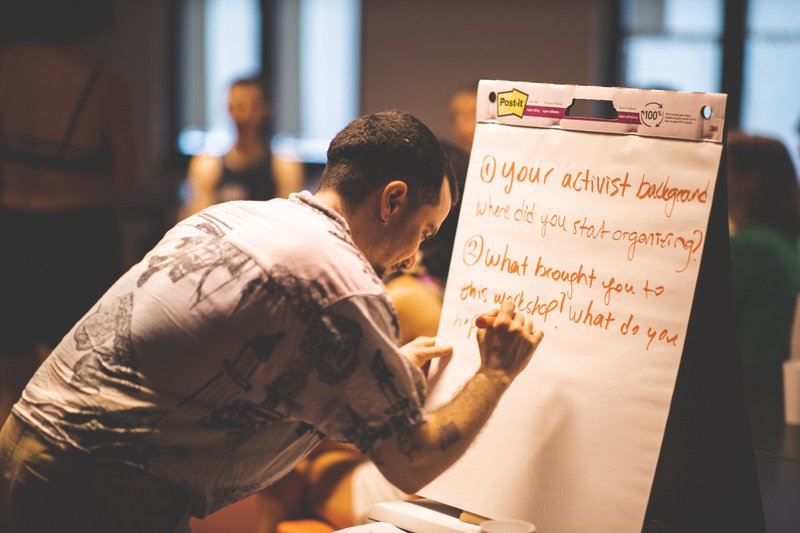
Opening and workshop structure
The workshop opened by asking participants to bring their chairs into a circle, the facilitators introduced themselves, identified the note taker, and invited a round of names and pronouns. The room was arranged to support participation rather than a front facing presentation. An icebreaker followed and then the facilitators named ordinary preferences or activities, and participants moved around the room depending on whether the statement applied to them. The facilitators then explained the workshop structure and participants received paper with three prompts: their activist background and where they began organizing, what brought them to the workshop and what they hoped to take away, and one word describing how they arrived that day. Participants were numbered into three small groups, discussed the prompts together, and later returned to the larger circle.
Who was in the room and what brought them there
The first small group which the note taker was part of included participants with different relationships to activism; one person described involvement in queer and gender activism. Another did not identify as an activist, had recently arrived in Brussels, and was interested in coloniality through experience connected to Cyprus. Another participant was Romanian and involved in Queers on the Move. A journalist and organizer based between Greece and Brussels also participated. The group contained people working through activism, migration, journalism, dance, research, social work, and academic life. This diversity shaped the discussion and some people came from long term organizing, while others were entering the field or trying to connect research and creative practice with activism.
Collective agreements and limits of safety
Before moving further, a facilitator shared their background with Queers on the Move and introduced collective guidelines. The framing was careful: the workshop could work toward a safer space, but safety could not be guaranteed.
The agreements included awareness of how much space one takes, awareness of privilege, respect for identities and pronouns, a call in rather than cancel culture, privacy, attention to access needs, collective care, and an anti oppression approach. The guidelines treated safety as an ongoing collective practice rather than a condition that facilitators could simply promise.
Organizing across migration, queer struggle, and racial capitalism
The next discussion asked participants to describe their current form of organizing, how it had changed over time, and how their work connected “here” and “there.” Queers on the Move was discussed as an intersectional movement working around migration and queer organizing, including solidarity with rescue efforts in the Mediterranean. One participant described entering anarchist organizing around 2015 and encountering a lack of intersectionality and gender awareness within a largely white community. Later, while doing doctoral research in Brussels, they struggled to hold together activist and academic spaces. They worked on racial capitalism, labour, precarious labour, and local realities, yet experienced the academy and the street as divided. Academic institutions tended to recognize them as an individual researcher rather than as someone situated within collective struggle.
Other contributions raised narration and deconstruction, religion and political engagement, and the desire to connect research and dance more directly to organizing. Across the room, participants were negotiating how to move between different institutions, communities, and political languages without splitting themselves into separate identities.
Conditions shaping queer organizing
When the groups reconvened, several recurring conditions were identified that were discussed by other groups too that the note taker was not part of. The first was shifting positionality, people’s locations, identities, legal situations, employment, and access to institutions changed what organizing was possible and how they were perceived.
A second condition was the project based nature of much organizing; funding cuts and gatekeeping around money made work unstable. Groups could be forced to organize according to short funding cycles rather than community needs. Participants also discussed how people find one another and how organizing differs across contexts, including cities, rural areas, and transnational movements. The discussion noted that challenges and fears shift by context. Organizing can emerge through anger, mutual support, occupations, and other forms of protest. Yet movements also face fragmentation, including divisions around Pride events, race, migration, and political strategy. Participants criticized approaches in which racism appears only as a limited critique rather than as part of an encompassing analysis. They noted that the far right was once treated as politically marginal, but has widened its agenda beyond migration to include gender, sexuality, education, and other social issues. Extreme police violence has also become normalized.
A major inequality remains between white and non white organizing. This includes differences in visibility, legitimacy, access to funding, institutional recognition, protection from policing, and the ability to survive long enough to organize.
The positionality and privilege exercise
After a break, the facilitators introduced an exercise on positionality and privilege. They acknowledged that the exercise would be uncomfortable and thatt the purpose was not simply to reveal who had more privilege, but to ask what participants could do with their positions, resources, and access. Participants stepped forward or backward in response to questions about privilege, producing a spatial map in the room. Two groups formed at different ends, while a third group was intended to stand in the middle as a bridge. The workshop then moved away from merely ranking privilege and toward examining how different positions could be worked with collectively.
The three groups received different questions: One group considered what participants could offer and what constrained them. A second asked what people brought and what support could make organizing sustainable. A third asked what dignified support looks like now and what bridges can be built across differences.
In betweenness, translation, and bridge work
The bridge group discussed social workers and others who occupy in between positions and how being able to move between communities and institutions can make someone approachable and reliable, and can help people access systems that otherwise remain closed. However, the bridge is not neutral and obviously carries tension and often requires substantial emotional caregiving. Participants asked who performs this emotional labour, how often the same people are expected to translate, and whether bridge work becomes another form of exhaustion. The discussion connected in betweenness to migration and identity. Moving at a young age can create a dual relationship to a previous identity and a current one. Participants asked what freedom means in this context and how translation works across languages, institutions, political cultures, and personal histories.
The group emphasized decentering Western identities and celebrating heterogeneity. Participants spoke about discomfort, legitimacy, recognition without erasure, and the need for a critical approach to European identity and institutions. Experiences should be translated into questions and criticism directed at the system, rather than into evidence that one has successfully assimilated. Assimilation and rerooting were described as connected processes; A person may spend years learning to assimilate and then need to recover or rebuild relationships to histories, communities, and identities that were pushed aside.
Rethinking care
A central intervention was to dismantle the idea that care must mean exhaustion and instead participants proposed care as joy, reciprocity, and a collective process rather than endless sacrifice by the same people. Care also requires awareness that the roles people occupy are not singular meaning a person may be a worker, migrant, organizer, translator, researcher, friend, or caregiver at different moments. During times of care, these roles can be interrupted or redistributed. The group asked what it would mean to care for one another without exhaustion and this included holding space, sharing emotional labour, normalizing the offering of care, and treating care as interrelational rather than as an individual virtue.
The notes also warn that bridge figures can become trapped in fixed roles. Additionally awareness is needed around documentation, alienation, and the expectation that the same people will always interpret institutions, mediate conflict, or make others comfortable.
What people with greater access can offer
The group positioned as more privileged focused on practical redistribution and suggestions included doing work so others can rest, sharing networks and contacts, offering time, and redistributing resources from institutions or workplaces. Participants stressed that sharing must be based on what is actually accessible. Support can include lending legitimacy, amplifying someone’s voice, listening without taking over, giving space, making work visible, and reassuring people that they are allowed to pause. People also proposed sharing opportunities that lead to income, including jobs, funded work, and institutional contacts. Practical accompaniment was important for example going with someone to an institution, helping with translation, or hiring a person who is excluded from established networks can make later access easier.
The discussion noted that this group often answered from academic and employment perspectives and this reflected both the resources available in those spaces and the widespread precarity now affecting researchers, workers, and organizers.
Constraints on sustainable organizing
The workshop produced a collective list of constraints and these included part time work, funding cuts, widespread precarity, difficulty finding politically aligned spaces, colonial funding structures, and patriarchal gatekeeping in academic and professional environments. Mental health, burnout, and neurodiversity were named as material organizing conditions rather than private problems. Participants also mentioned hesitation to act, hostile political environments, political backlash, spatial barriers, and uncertainty about how to locate places compatible with one’s politics. Funding itself can reproduce domination and selectivity and the criteria used to decide who receives support determine which struggles become legible. The statement “charity is not solidarity” captured the difference between helping from above and redistributing power, access, and resources.
The closing notes identified needs for learning and unlearning. Sustainable organizing requires not only more resources, but changes in how legitimacy, expertise, safety, and deservingness are understood.
Dignified support without domination
The final discussion asked what support without domination could look like; Participants named care, reflexivity, relational labour, patience, kindness, trust, self education, relationship building with key actors, and knowledge of past struggles. Reflexivity meant considering how one’s support can reproduce hierarchy, Relational labour meant helping without claiming ownership of a struggle or taking the space of those most affected. Patience and kindness were presented as political practices, not signs of avoiding conflict.
Support also involves localization and attention to context for example participants resisted universal models that ignore differences between cities, rural areas, migration regimes, labour conditions, racialization, and political histories. Meaningful care included sharing space, opportunities, translation, contacts, and material support. It also meant receiving help, rather than constructing organizers as permanently self sufficient.
The workshop ended with an emphasis on building together from unequal positions. The goal was not to pretend that everyone enters with the same power, but to use differences in access and resources without turning those differences into domination.
Main tensions left open
The workshop did not resolve several difficult questions; bridge work can open institutions while exhausting the people who perform it. Visibility can create legitimacy while increasing surveillance or pressure and funding can sustain movements while forcing them into institutional priorities.
Care can be reciprocal, but it is often unevenly distributed and thus calls to share resources can become symbolic unless they include money, employment, time, access, infrastructure, and the willingness to step back.
Finally, positionality exercises can reveal inequality, but they can also flatten complex lives into a single spatial ranking. The most productive part of the exercise was therefore not where people stood, but what they decided to do with their positions afterward.
Everything for Everyone
At the end of such a rich programme, we understand that you might be feeling tired or overwhelmed. You’ve been studying the programme, doing some intellectual gymnastics, and trying to figure out which session to attend. The FOMO might have been strong for some of you, so we want to provide a landing spot after the sessions to make sure you didn’t miss anything out! So don’t panic, we’ve got you!
To wrap up the day, Labo vzw is bringing everyone back together to ensure you don’t miss a thing, taking along insights from different workshops for a collective check-out moment. For us, sharing is caring: new life will be breathed into the ideas and conversations sparked during the individual workshops for a bit of collective magic! Through participatory methods, popular education, and embodied work, the facilitators of Labo vzw will guide us into weaving together the threads from the parallel sessions into one shared tapestry. Get ready to be inspired and catapulted into action!
Photos: © Michelle Geerardyn
Illustrations: © Valentine Zhang (https://www.instagram.com/valentinezhang/)
Facilitators
LABO vzw is a Belgian non-profit organization and socio-cultural movement based in Ghent. The organization promotes critical citizenship, social justice, and democratic participation from the grassroots level. Through workshops, training programs, campaigns, community organizing, and support for local initiatives, LABO encourages people to engage critically with social, political, ecological, and economic challenges.
LABO’s work is inspired by the ideas of Paulo Freire and Augusto Boal, with a strong focus on participatory education, collective action, and solidarity. The organization creates spaces for dialogue, reflection, and civic engagement, enabling individuals and communities to strengthen their capacity for social change.
In November 2025, LABO lost its structural funding within the Flemish government’s socio-cultural subsidy framework. The organization has appealed this decision, arguing that it undermines independent socio-cultural work, critical civic engagement, and grassroots participation in Flanders. While awaiting the outcome of the appeal, LABO’s volunteers continue the organization’s activities as a grassroots collective, ensuring the continuity of its mission and programs.
Hanae (she/her) is a womanist facilitator, trainer, and freelance educator working at the intersection of gender, class, and neurodiversity. Raised in a working-class environment, she began questioning gender norms and classism from an early age. After migrating to Belgium and receiving a late autism diagnosis, she deepened her commitment to exploring how systems of inequality shape people’s lives and opportunities.
A young mother, Hanae brings both personal and professional experience to her work. After starting her career in industry, she transitioned into coordination and leadership roles within the nonprofit sector, where she supports collective learning and social justice. She is a trained joker in Theatre of the Oppressed and specializes in collective leadership, using participatory methods that invite dialogue, critical reflection, and shared action.
Hanae describes herself as a “space activist”: someone who intentionally occupies and reshapes spaces that are often dominated by white, middle-class norms, creating room for diverse experiences, voices, and ways of being.
For Mees (they/he), change is not a distant goal - it has to happen in the doing.
As a psychologist, facilitator, and seasoned activist, they have transitioned from the barricades to focusing entirely on sustainable activism and self and collective care.
Mees is a white, West-European, trans, middle-class parent to three neurodivergent young adults. They currently specialize in long-term coaching and training trainers, weaving resilient and colorful underground networks.
Driven by a genuine interest in the human being, Mees uses deep questioning, creative energizers, and a focus on somatic and emotional awareness to center unheard voices and embrace the unpredictable magic of group life.