chapter
Coalition building and feminist futures
How can we build and foster coalitions between institutions, grassroots organizations, CSOs, and academics? What futures do we envision in coalition?
We are witnessing a growing network that unites the far right, Trans-Exclusionary Radical Feminists (TERFs), Christian organizations, and billionaires. The need for sustainable coalitions to build intersectional feminist futures is pressing.
Photos: © Michelle Geerardyn
Illustrations: © Valentine Zhang (https://www.instagram.com/valentinezhang/)
FIRST SESSION
INTRODUCTION - GET TO KNOW EACHOTHER
-
Soralia
-
Rebelle
-
Prisme & podcast
-
IPPF
-
Institut égalité de genre
-
De Roma : spreken is goud.
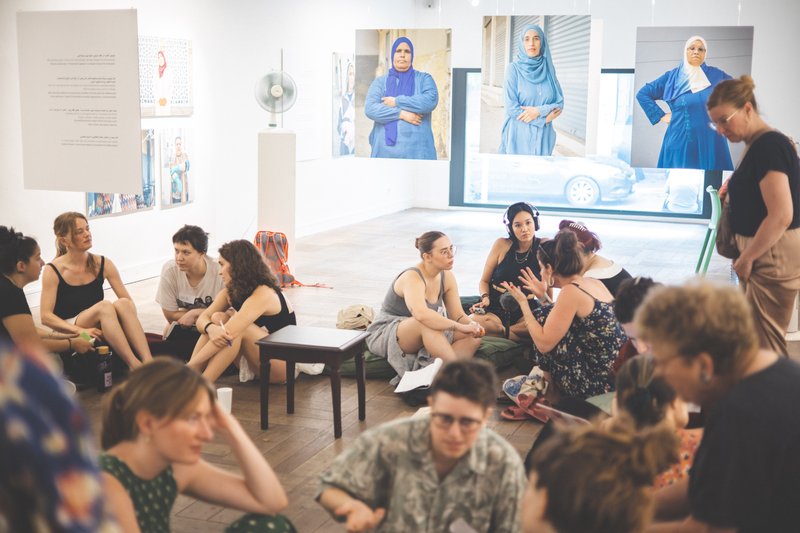
We live in increasingly hostile contexts. Ex: Italian collectives of queer and lgtbqia+ who mapped safe spaces in the city, so they helped people to find areas where they could be safe to seek out (medical) help.
Another example, in Poland the government spies on you, how do you navigate this context?
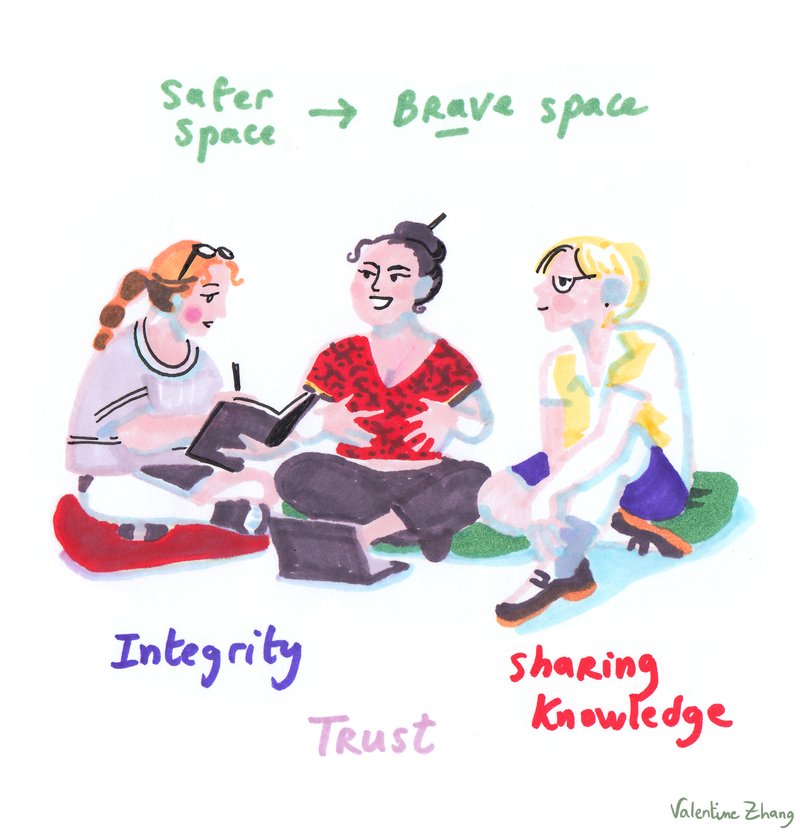
In coalition building, who do we find safe to cooperate with? How do we deal with the changes in coalitions?
How does it pan out in our experiences, when safety shifts within a group/ coalition?
Forming group of 3-4 ppl to discuss the questions
1) How can we build and sustain safe community spaces through coalitions?
- Who do you reach out to and who do you see as (un)trusted and safe partners?
Experience with coalition genre (10 associations+-) funded by the Institute for gender equality between women and women in Belgium. Trust between the associations came with knowing them, and was built around a charter.
-
Safe if we share the same values, resonate with the tone of voice.
-
What is not trustworthy? Or changed? Example of joining the liberal feminism spaces in Poland, it was first easier to join them, but after a while one might not resonate with the lack of consideration for migrant rights.
-
Ambition to create safe-spaces : no control on your audience, eventhough you attract an audience that is attracted to your values. Hire a moderateur that can intervene when an intervention, wich helps to amplify the voices that we want to hear.
-
Try to align with organisations that align with the values: anti-racist, feminist, anti-fascists organisations, that have an experience in fostering safe-spaces. This is an ambition, because you do not control the outcome.
-
No association is considered unsafe until now, nor their programming has been targetted by right-wing politicians.
-
Example of organising an Iftar: the organiser received personal threat. There was a discussion of having the police. But then they decided not to require the police for “safety”, because it would have not fostered a safe-space.
-
Our positionality influence what we consider safe. Here we are mainly white people. So how to foster diversity? Make it inclusive for people from other backgrounds.
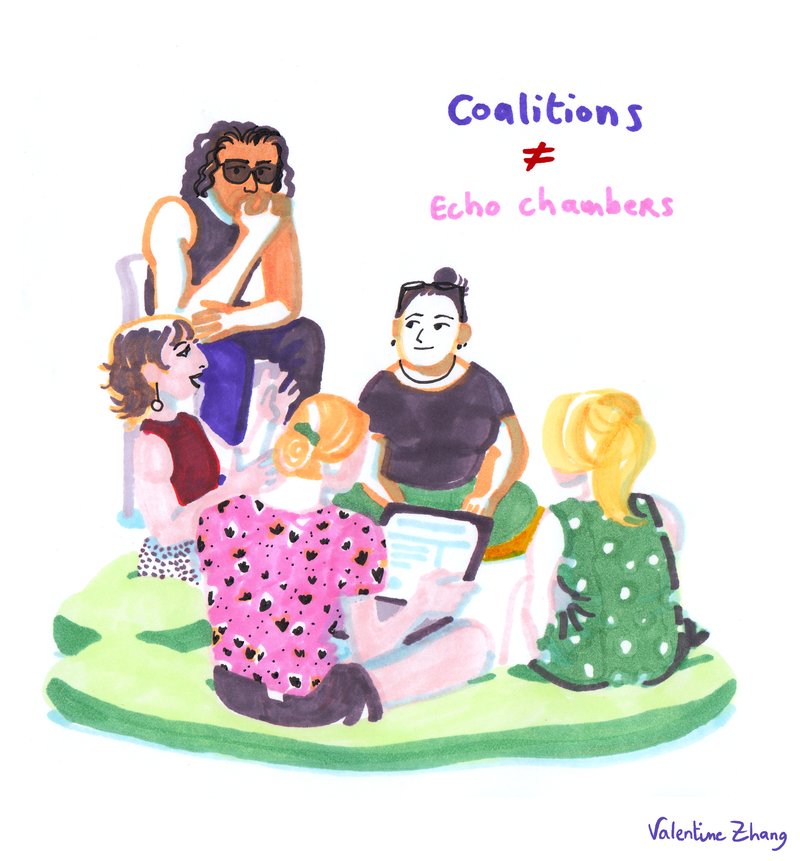
2) What kind of futures do we envision through coalitions?
More financing, time and human resources.
-
How do we navigate and addresse different forms of oppression?
-
What kind of practices do you use?
Example for having an inclusive coalition: Academia is very white, changing the topics. Regarding the public: we need to let go of the aim to attract people with all different backgrounds. So they try to diversify by topic each different event of the programs. It works best when they work with associations that work with the public (ex: diaspora organizations). So one of the answer can be partnering with the right organisations, and having a panel with only women, or only racialised people (a rule: only one man per panel, that is more than enough). You can decide which voices you want to hear, and then it happens naturally that you have an only female or racialised people panel.
SECOND SESSION
INTRODUCTION - GET TO KNOW EACHOTHER
Forming group of 3-4 ppl to discuss the questions
1) How can we build and sustain safe community spaces through coalitions?
Brave spaces in een artikel.
Je weet niet wie veilig is of niet. Gemeenschappelijk waarden, maar wat ze doen op andere plekken wat ze kunnen doen is helemaal niet veilig (colonialism, witheid, enzo).
Normaal omgang kunnen veranderen.
Veiligheid =/= moet toegangkelijk zijn voor iedereen? Of toch niet? Toch aan sommige mensen beperkt zijn.
-
benadering van toon
-
vertrouwen personen binnen organisatie is een goed teken voor grote instellingen
-
overeenkomst van vertrouw: wat vind je veilig of niet? Wat heb je nodig? Dat hangt van de context af.
-
Mond op mond: vragen aan je vriendenkring.
-
Kennis van de gedrag is gedeeld in een community/ bubble
-
Code of conduct die zichtbaar is
-
Soms twee personen/ instituten hebben dezelfde einddoel, maar twee verschillende manieren om mee te gaan
-
Bezorgdheid en gesprek, meer stemmigheid hebben, hoe kan je daar ruimte te vinden?
-
Goed voorbereiding : pre-care over te nadenken, voor-zorg zo in te bouwen
-
“Kwetsbaar” en “werk is geen oplossing” van een socioloog Magrit van den Berghe.
-
Who do you reach out to and who do you see as (un)trusted and safe partners?
-
Safe if we share the same values, resonate with the tone of voice.
-
What is not trustworthy? Or changed?
2) What kind of futures do we envision through coalitions?
Een systeem: pluraal samenleving, met verschillende instituties, ongelijkheid en bezit afschaffen om een beter samenleving te creeren.
- How do we navigate and addresse different forms of oppression?
Communistisch ideen. Hoe kunnen we de verschillende mensen met elkaar brengen, zonder iedereen dezelfde maken?
-
What kind of practices do you use?
-
Can you share some examples?
-
Overeenkomst van vertrouw: van kunst en mensen
-
Preperation time
-
Grassroot, burger initiativen
-
Een doel hebben voor onszelf als organisatie, niet altijd reageren,
-
Verbinding: hoe kunnen verschillende stemmen samenkomen, om polarisatie te voorkomen
-
Partnering