chapter
Imagining, building our technological future(s)
Caminante, no hay camino, se hace camino al andar. — Antonio Machado
What do you see when you imagine the future? What role does technology play in that future? Is technology an oppressive force, facilitating constant surveillance and eroding your rights? Or do you imagine a future in which technology allows for social cohesion, human creativity, and collective safety?
Technology and future-thinking go hand in hand. Our imagined futures often feature technology as a propeller for change, as a force capable of transforming our lives, relationships, and society. But neither technology nor future-thinking are neutral – both are deeply political. For one, technologies are imbued with the values, motivations and logics of their makers. And decisions about who gets to imagine, shape, and build futures are also defined by politics. In other words, politics determine which technological futures we imagine, perpetuate, and work towards.
In today’s digital society, a handful of powerful companies have a stranglehold on our capacity to imagine a technological future that is not powered by logics of hypercapitalism, surveillance, security and control. While deeply dystopian, theirs seems to be the only future possible. This deterministic view of technology and the future has eroded our capacity to imagine alternative – technological and political – futures.
During this workshop, we will explore ways to imagine and build new technological futures.
Imagination is a critical step towards political transformation. During this workshop, we will use critical futuring to imagine new technological futures. To do so, we will build on work by SUPERRR and Futures Probes, who define critical futuring as a political practice that allows us to question the status quo, interrogate power relations and foster narratives rooted in care, equity and hope.
Additionally, we will also explore ways to collectively build the technological futures we want. If technology is political, it can also be shaped differently: through collective ownership, digital citizenship, and the democratic governance of digital infrastructures. How can activists and researchers reclaim the democratic potential of technology? And what does digital protection look like while we strive for better technological futures?
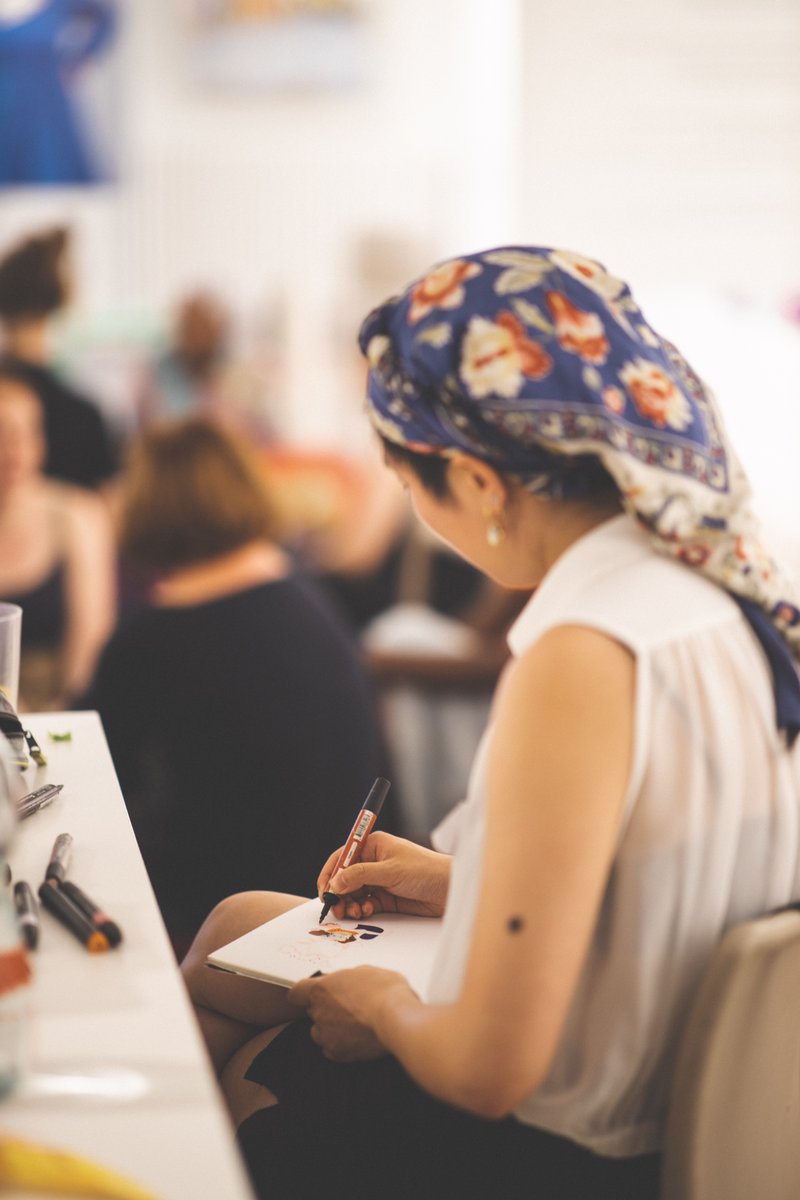
Photos: © Michelle Geerardyn
Illustrations: © Valentine Zhang (https://www.instagram.com/valentinezhang/)
Facilitator
Paola Verhaert is an independent researcher, advisor, and writer. She has been working at the intersection of technology and social justice for ten years. As an expert in digital rights and digital equity, she mostly works with (inter)national civil society organisations and public institutions.
She has been researching the social and political impact of digital technologies for ten years. Through her research, she seeks to uncover and understand the impact of emerging technologies on citizens, marginalised communities, and the government. In addition to her work as a researcher, she supports and advises organisations on the responsible use of technology and data. In recent years, she has worked with over 50 organisations across five continents.
As a writer, Paola covers topics related to technology, politics, and culture. Her first book, titled ‘Technology is political: The battle for digital justice’, was published in November 2025. This book is a philosophical and practical introduction to the concept of digital justice. In 2024, she was appointed as ‘Scherpsteller,’ a biyearly honour awarded to an inspiring thinker by the Flemish-Dutch house of literature and debate de Buren and the Hannah Arendt Instituut.
The workshop
This workshop invited participants to think differently about technology and the future. Instead of only focusing on new inventions, the discussion explored how technology is connected to society, politics, power and our everyday lives.
The session was very interactive, with participants sharing their own experiences, questions and ideas. At the beginning, the facilitator explained that technology is not something neutral or natural that simply happens by itself. Technologies are created by people, companies, institutions and governments. For this reason, citizens should also have a voice in the kind of technological future they want to live in.
The first discussion was about technologies that participants were genuinely excited about. The examples were very concrete and personal: medical devices, communication tools, mobility support, privacy-friendly phones, and tools that can help people in difficult situations. I found this a good way to start the workshop because it showed that technology can really improve people’s lives when it responds to real needs.
A key idea in the workshop was “techno-determinism”. This means the belief that technology follows only one fixed direction and that people cannot really change it. The facilitator challenged this idea and reminded us that technological futures are not inevitable. They depend on choices, values and political decisions.
Another important idea was “techno-diversity”. This means that there should not be only one way to imagine or develop technology. Different communities can create technologies based on different needs and values, not only profit, growth or control. This made me think about how much technology is linked to culture, politics and social justice.
During the group exercise, participants imagined different possible futures. One thing I noticed was that many people found it easier to imagine negative futures than positive ones. Discussions often went towards surveillance, artificial intelligence, discrimination, environmental problems and inequalities. Imagining hopeful futures required more effort and creativity.
However, the groups also came up with more positive ideas. Some examples included people building their own technologies, stronger community-based tools, feminist responses to discriminatory AI, better public transport, and more environmentally friendly solutions. These ideas were not always unrealistic. In fact, one of the strongest messages of the workshop was that many desirable futures are already technically possible. The real difficulty is often political will, organisation and cooperation.
I also appreciated that the facilitator did not present technology as only good or only bad. The workshop showed that technology can be useful and empowering, but also dangerous when it is controlled by only a few powerful actors. This balance made the discussion more interesting.
The conclusion of the workshop was that we should not only criticise the current systems, but also imagine what could replace them. The facilitator encouraged participants to think about the tools we already have today, including technological tools, political tools and community tools. This was a very important point for me, because it made the discussion feel more practical.
Overall, I enjoyed this workshop because it encouraged creativity and reflection. It reminded me that technology is not only about innovation, but also about the choices we make as a society. I also appreciated hearing different perspectives from people with different backgrounds, because it made the discussion richer and more concrete. The main idea I will remember is that the future is not already written. If people want more inclusive and fair technologies, they need to be part of the conversation and not leave these decisions only to big companies or political leaders.