chapter
Everything, Everywhere, All at Once: Queer Migrant Organizing in Belgium
How are our lived realities interconnected with our political mobilizing? How do our backgrounds and personal histories play a role in movement building, in challenging and resisting the rise of anti-gender movements?
As two queer migrant facilitators, our lived realities situate us within a new in-between, queer space(s) between here and there. We often find ourselves limited by Western advocacy, human rights discourse, identity politics, and funding structures. Having to navigate systems and structures that are not built for us, even often against our queerness, we come to ask how to co-build sustainable spaces centered around community care, resistance, and collective imagination.
Together, we want to delve into how we are able to navigate queer spaces in Brussels, and how our lived experiences as queer migrants are interwoven, while our community organizing transcends into Europe, remaining rooted in our previous grassroots organizing and activism ecosystems.
We invite both racialized queer folxs and community organizers to co-create the space for collective political imagination, and we invite allies to listen and to question their privileges, and how to use their access and resources to support more effective and direct solidarity. Together, we will map ways to build solidarities through shared responsibility, mutual support, and the equitable redistribution of resources and privileges.
Photos: © Michelle Geerardyn
Illustrations: © Valentine Zhang (https://www.instagram.com/valentinezhang/)
Facilitators
Meriç G. Doğan (he/him) is a multidisciplinary researcher and community organizer from Istanbul. His work spans from queer-feminist epistemology, urban anthropology, and human rights. He explores how queer and trans communities navigate surveillance, exclusion, and public space, with particular attention to the affective, linguistic, and relational infrastructures that sustain, or fracture, activist worlds. Alongside his academic work, he has coordinated protection and advocacy programs, drawing on both his research interests and lived experience to examine how grassroots queer and migrant organizing engages with institutional demands, internal hierarchies, and the everyday labor of building livable futures. He is also an emerging performance artist who creates and holds spaces for racialized and queer individuals through sensual and playful movement practices.
Sarah Kadry (they/them) is a feminist researcher, content creator, translator, writer, and community organizer from Cairo. They earned their Master’s degree in Social and Cultural Anthropology from the University of KU Leuven in Belgium in 2023. They are actively engaged in grassroots and feminist organizing, focusing on nurturing linkages and networks across movements and fostering alternative forms of transnational solidarity that transcend borders. They are also part of Queers on the Move (QOM), a grassroots collective based in Belgium. Previously, they worked as an Intercultural Mediator at Médecins Sans Frontières (MSF) in Brussels. Prior to that, they were a member of the Ikhtyar African feminist collective, which primarily focused on feminist production of knowledge in Arabic.
Opening and workshop structure
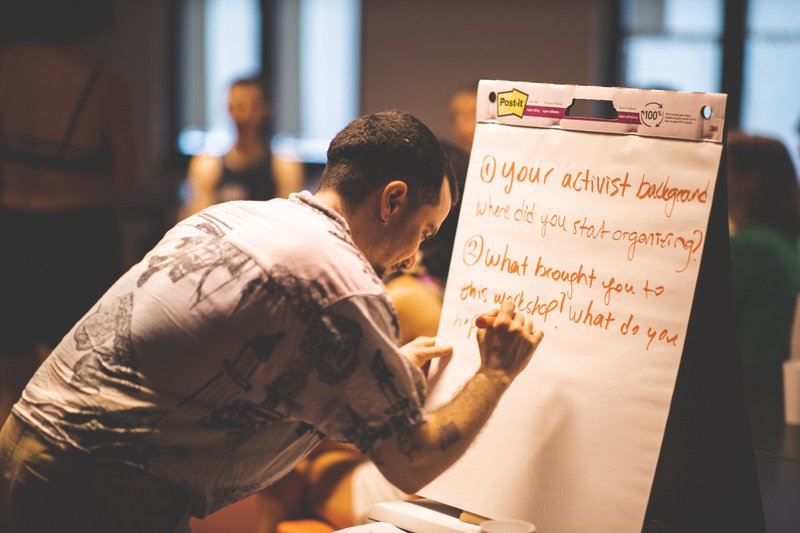
The workshop opened by asking participants to bring their chairs into a circle, the facilitators introduced themselves, identified the note taker, and invited a round of names and pronouns. The room was arranged to support participation rather than a front facing presentation. An icebreaker followed and then the facilitators named ordinary preferences or activities, and participants moved around the room depending on whether the statement applied to them. The facilitators then explained the workshop structure and participants received paper with three prompts: their activist background and where they began organizing, what brought them to the workshop and what they hoped to take away, and one word describing how they arrived that day. Participants were numbered into three small groups, discussed the prompts together, and later returned to the larger circle.
Who was in the room and what brought them there
The first small group which the note taker was part of included participants with different relationships to activism; one person described involvement in queer and gender activism. Another did not identify as an activist, had recently arrived in Brussels, and was interested in coloniality through experience connected to Cyprus. Another participant was Romanian and involved in Queers on the Move. A journalist and organizer based between Greece and Brussels also participated. The group contained people working through activism, migration, journalism, dance, research, social work, and academic life. This diversity shaped the discussion and some people came from long term organizing, while others were entering the field or trying to connect research and creative practice with activism.
Collective agreements and limits of safety
Before moving further, a facilitator shared their background with Queers on the Move and introduced collective guidelines. The framing was careful: the workshop could work toward a safer space, but safety could not be guaranteed.
The agreements included awareness of how much space one takes, awareness of privilege, respect for identities and pronouns, a call in rather than cancel culture, privacy, attention to access needs, collective care, and an anti oppression approach. The guidelines treated safety as an ongoing collective practice rather than a condition that facilitators could simply promise.
Organizing across migration, queer struggle, and racial capitalism
The next discussion asked participants to describe their current form of organizing, how it had changed over time, and how their work connected “here” and “there.” Queers on the Move was discussed as an intersectional movement working around migration and queer organizing, including solidarity with rescue efforts in the Mediterranean. One participant described entering anarchist organizing around 2015 and encountering a lack of intersectionality and gender awareness within a largely white community. Later, while doing doctoral research in Brussels, they struggled to hold together activist and academic spaces. They worked on racial capitalism, labour, precarious labour, and local realities, yet experienced the academy and the street as divided. Academic institutions tended to recognize them as an individual researcher rather than as someone situated within collective struggle.
Other contributions raised narration and deconstruction, religion and political engagement, and the desire to connect research and dance more directly to organizing. Across the room, participants were negotiating how to move between different institutions, communities, and political languages without splitting themselves into separate identities.
Conditions shaping queer organizing
When the groups reconvened, several recurring conditions were identified that were discussed by other groups too that the note taker was not part of. The first was shifting positionality, people’s locations, identities, legal situations, employment, and access to institutions changed what organizing was possible and how they were perceived.
A second condition was the project based nature of much organizing; funding cuts and gatekeeping around money made work unstable. Groups could be forced to organize according to short funding cycles rather than community needs. Participants also discussed how people find one another and how organizing differs across contexts, including cities, rural areas, and transnational movements. The discussion noted that challenges and fears shift by context. Organizing can emerge through anger, mutual support, occupations, and other forms of protest. Yet movements also face fragmentation, including divisions around Pride events, race, migration, and political strategy. Participants criticized approaches in which racism appears only as a limited critique rather than as part of an encompassing analysis. They noted that the far right was once treated as politically marginal, but has widened its agenda beyond migration to include gender, sexuality, education, and other social issues. Extreme police violence has also become normalized.
A major inequality remains between white and non white organizing. This includes differences in visibility, legitimacy, access to funding, institutional recognition, protection from policing, and the ability to survive long enough to organize.
The positionality and privilege exercise
After a break, the facilitators introduced an exercise on positionality and privilege. They acknowledged that the exercise would be uncomfortable and thatt the purpose was not simply to reveal who had more privilege, but to ask what participants could do with their positions, resources, and access. Participants stepped forward or backward in response to questions about privilege, producing a spatial map in the room. Two groups formed at different ends, while a third group was intended to stand in the middle as a bridge. The workshop then moved away from merely ranking privilege and toward examining how different positions could be worked with collectively.
The three groups received different questions: One group considered what participants could offer and what constrained them. A second asked what people brought and what support could make organizing sustainable. A third asked what dignified support looks like now and what bridges can be built across differences.
In betweenness, translation, and bridge work
The bridge group discussed social workers and others who occupy in between positions and how being able to move between communities and institutions can make someone approachable and reliable, and can help people access systems that otherwise remain closed. However, the bridge is not neutral and obviously carries tension and often requires substantial emotional caregiving. Participants asked who performs this emotional labour, how often the same people are expected to translate, and whether bridge work becomes another form of exhaustion. The discussion connected in betweenness to migration and identity. Moving at a young age can create a dual relationship to a previous identity and a current one. Participants asked what freedom means in this context and how translation works across languages, institutions, political cultures, and personal histories.
The group emphasized decentering Western identities and celebrating heterogeneity. Participants spoke about discomfort, legitimacy, recognition without erasure, and the need for a critical approach to European identity and institutions. Experiences should be translated into questions and criticism directed at the system, rather than into evidence that one has successfully assimilated. Assimilation and rerooting were described as connected processes; A person may spend years learning to assimilate and then need to recover or rebuild relationships to histories, communities, and identities that were pushed aside.
Rethinking care
A central intervention was to dismantle the idea that care must mean exhaustion and instead participants proposed care as joy, reciprocity, and a collective process rather than endless sacrifice by the same people. Care also requires awareness that the roles people occupy are not singular meaning a person may be a worker, migrant, organizer, translator, researcher, friend, or caregiver at different moments. During times of care, these roles can be interrupted or redistributed. The group asked what it would mean to care for one another without exhaustion and this included holding space, sharing emotional labour, normalizing the offering of care, and treating care as interrelational rather than as an individual virtue.
The notes also warn that bridge figures can become trapped in fixed roles. Additionally awareness is needed around documentation, alienation, and the expectation that the same people will always interpret institutions, mediate conflict, or make others comfortable.
What people with greater access can offer
The group positioned as more privileged focused on practical redistribution and suggestions included doing work so others can rest, sharing networks and contacts, offering time, and redistributing resources from institutions or workplaces. Participants stressed that sharing must be based on what is actually accessible. Support can include lending legitimacy, amplifying someone’s voice, listening without taking over, giving space, making work visible, and reassuring people that they are allowed to pause. People also proposed sharing opportunities that lead to income, including jobs, funded work, and institutional contacts. Practical accompaniment was important for example going with someone to an institution, helping with translation, or hiring a person who is excluded from established networks can make later access easier.
The discussion noted that this group often answered from academic and employment perspectives and this reflected both the resources available in those spaces and the widespread precarity now affecting researchers, workers, and organizers.
Constraints on sustainable organizing
The workshop produced a collective list of constraints and these included part time work, funding cuts, widespread precarity, difficulty finding politically aligned spaces, colonial funding structures, and patriarchal gatekeeping in academic and professional environments. Mental health, burnout, and neurodiversity were named as material organizing conditions rather than private problems. Participants also mentioned hesitation to act, hostile political environments, political backlash, spatial barriers, and uncertainty about how to locate places compatible with one’s politics. Funding itself can reproduce domination and selectivity and the criteria used to decide who receives support determine which struggles become legible. The statement “charity is not solidarity” captured the difference between helping from above and redistributing power, access, and resources.
The closing notes identified needs for learning and unlearning. Sustainable organizing requires not only more resources, but changes in how legitimacy, expertise, safety, and deservingness are understood.
Dignified support without domination
The final discussion asked what support without domination could look like; Participants named care, reflexivity, relational labour, patience, kindness, trust, self education, relationship building with key actors, and knowledge of past struggles. Reflexivity meant considering how one’s support can reproduce hierarchy, Relational labour meant helping without claiming ownership of a struggle or taking the space of those most affected. Patience and kindness were presented as political practices, not signs of avoiding conflict.
Support also involves localization and attention to context for example participants resisted universal models that ignore differences between cities, rural areas, migration regimes, labour conditions, racialization, and political histories. Meaningful care included sharing space, opportunities, translation, contacts, and material support. It also meant receiving help, rather than constructing organizers as permanently self sufficient.
The workshop ended with an emphasis on building together from unequal positions. The goal was not to pretend that everyone enters with the same power, but to use differences in access and resources without turning those differences into domination.
Main tensions left open
The workshop did not resolve several difficult questions; bridge work can open institutions while exhausting the people who perform it. Visibility can create legitimacy while increasing surveillance or pressure and funding can sustain movements while forcing them into institutional priorities.
Care can be reciprocal, but it is often unevenly distributed and thus calls to share resources can become symbolic unless they include money, employment, time, access, infrastructure, and the willingness to step back.
Finally, positionality exercises can reveal inequality, but they can also flatten complex lives into a single spatial ranking. The most productive part of the exercise was therefore not where people stood, but what they decided to do with their positions afterward.