chapter
Imagining radically different futures
This workshop is the result of that commitment to catalyzing radical transformative power within social movements. It departs from the idea that in order to create a better future, we first need to imagine it being a possibility. It also departs from the observation that, currently, little concrete imaginations that go beyond capitalist or fascist ideologies exist in Europe. This is a problem. As we can see, the far-right is imagining away. Technocrats like Elon Musk dare to dream of Mars and politicians on the far-right sway the public with their imaginaries of a “pure” Europe.
The workshop is an invitation to leave this doom-and-gloom behind for a moment. As a fellow anthropologist once said: the world is what we make it to be, and we could just as easily make it otherwise. Once we make the time and space within our movements to imagine that “otherwise” and bring it back to work in the present, we’ll make those futures happen. Building on a broad literature and praxis, among which Black Quantum Futurism and Rob Hopkins’ How to Fall in Love with the Future, the workshop inspires to do just that.
hotos: © Michelle Geerardyn
llustrations: © Valentine Zhang (https://www.instagram.com/valentinezhang/)
Facilitator
Jan Jelles Rupert (he/him) does ethnographic research into social movements, social change and the role of the imagination in both. He graduated from the University of Amsterdam with an ethnography on the radical imagination and its effect on practices in two Dutch social movement groups. Without translating research to practice in the research context, it stays within the privileged context of academia. This is why he is committed to doing research that works with and for movements.
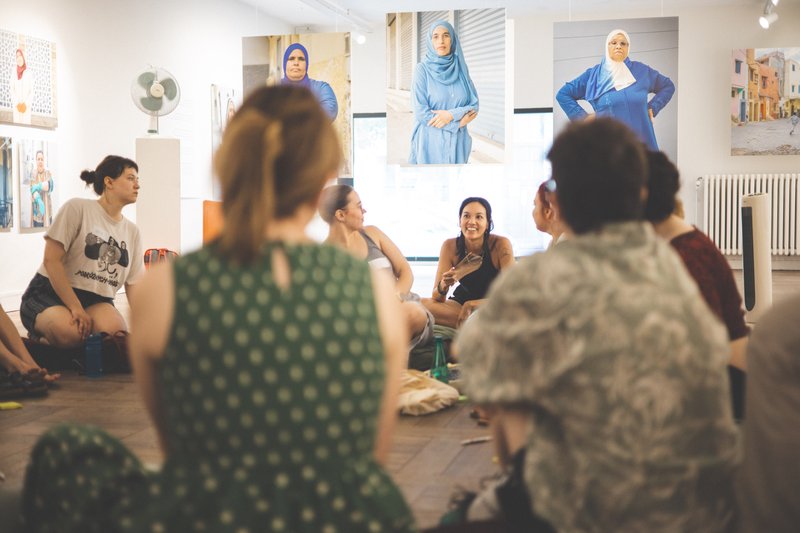
THEME: I HAVE BEEN TO THE FUTURE AND WE WON.
TASK 1
Open up for your imagination: module it in a way we can bring the future to the present
How different could the world be?
Think beyond the present
TASK 2
Go around and talk to other people on how to bring them into your space –> participants share their thoughts
FEEDBACK FROM PARTICIPANTS (each in groups of 3)
Groups that shared their thoughts struggled with the concept WE WON
Activists and people in general focus to live in certain contexts because of peoples imaginations.
People create a mental space which is theoritical, fun and playful –> “everything can be different”
TASK 3
Why should we imagine the world differently - active imagination exercise using sticky notes to verbalise what we can imagine as different.
FEEDBACK FROM PARTICIPANTS FROM PARTICIPANTS:
-
Not an easy exercise at first
-
Imagination is social
Theoritical concept
-
Exploring the world
-
Seeing the world as a institution brings imagination back to the present
STRATEGIES
-
Privilege: We have the privilege of thinking into the future. However, we are different and things hold people back from imagining the future
-
Manifestation: If i manfest my self as something, the world will give it to me
The world can be different, and our imagination may not be relevant now but informs how the future can be.
TASK 4 & 5
-
Participants go to each other and express what they imagine for the future, arguing that it is possible and feasible. Others will react by arguing against their ideas.
-
Participants start the exercise against and instead of fully rejecting it, others will start by saying “yes, but” and debate from there.
FEEDBACK/OBSERVATION FROM PARTICIPANTS: Everything participants say to each other is immediately rejected, which made the experience quite funny.
TASK 6
Talk to your group members with the preamble “In my future, …”
FEEDBACK FROM PARTICIPANTS:
-
Good exercise for activists
-
Creates a space to share common ideas
-
It’s a fun exercise but it can be a bit upsetting as well
-
Helps imaging something that is not real (yet)
FINAL TASK
We formed a circle, closed our eyes and were given guidelines on things to imagine like a door to another dimension and what the world looks like behind it.
Each group was given a sheet to draft and draw whatever the exercise inspired them to think about their own lives:
-
Restructuring the educational system in the participant’s country (Hungary)
-
A creative curriculum
-
Security in the educationalk system
-
Intellectual reforms in schools
-
Visions of community
-
The university as an actor of change
-
Growing together and supporting each other
-
Spaces for empowerment as a tool for thriving
-
Leadership
-
Grief
-
Different emotions and ways to relate with each other
-
Nature, green hills, nature, trees
-
People on the street collectively
-
People grieving in sanctuaries
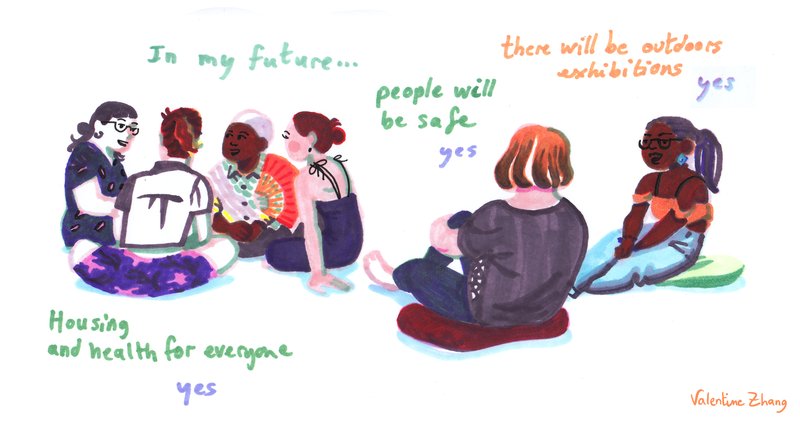
Even though every team had different members and different imaginaries, participants were able to put things together and relate to each other. Things discussed in the warm-up came back in the final session.
At the end of the session, small papers were given out to write something that participants are going to do next week with the things discussed during the session. The papers were put in a box and each participant picked one paper back to accomplish in the following week as a “to do”, in order to collectively involve each other in our imaginations and our tasks based on the exercises the participants did together.