chapter
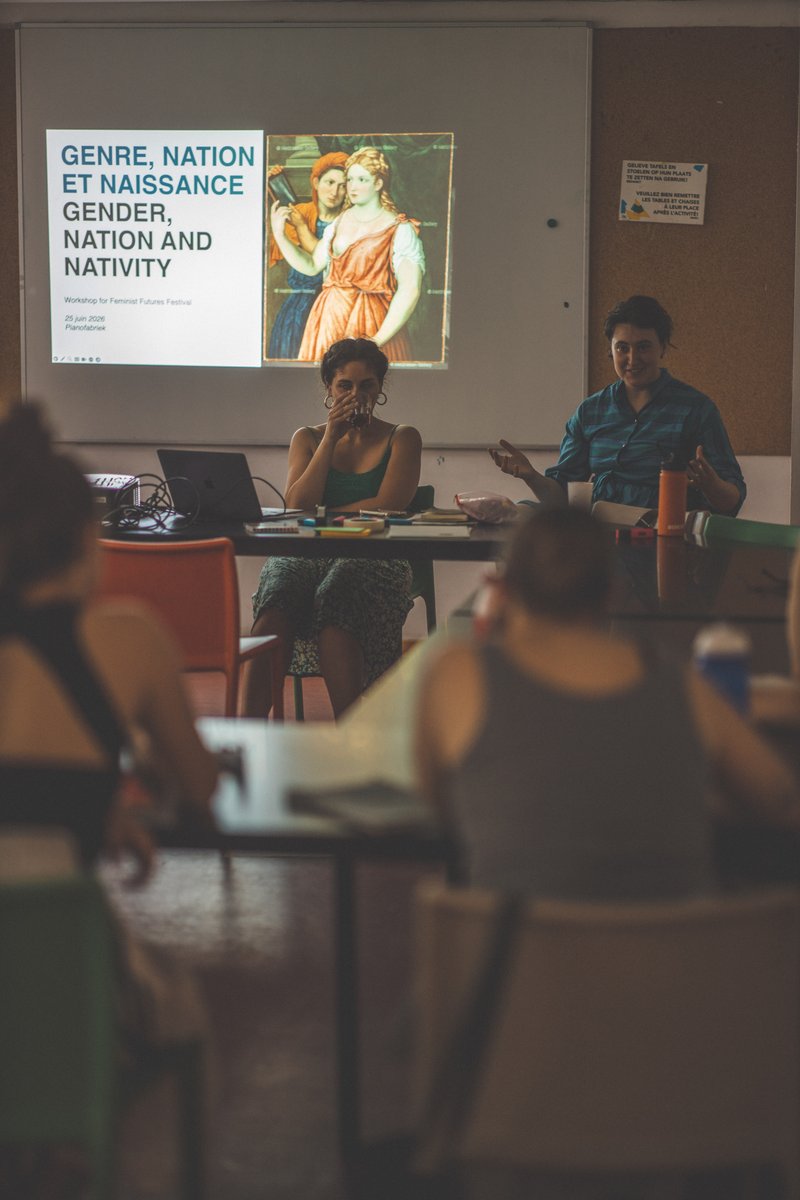
Gender, nation and nativity
Together with Jeanne of the Insalaha collective and Nina, a socio-architect and public mediator, this workshop invites participants to probe the relation between gender and borders.
Rather than positioning “border violence” as something to be simply added to the existing ledger of gender studies, we begin elsewhere: what becomes possible when gender is thought from the vantage point of borders themselves? And inversely, how can an attention to gender and reproduction enable us to understand borders not just as static walls but as regimes that organise life, distribute vulnerability, and make some forms of existence more livable than others?
Participants will engage with four interconnected thematic clusters – (nation & nativity) (producing a ‘crisis’) (non-state//trans-identities)(the politics of freedom) – through a set of textual and audiovisual materials assembled as “information packages.” From these materials, participants will be invited to collaboratively compose vignettes. Vignette-writing, a method often used in anthropology and experimental literature, resists the pull toward totalising explanation, and allows for forms of expression that remain partial, affective, and open-ended. We will then return to the collective to read these vignettes alongside one another, asking how they relate to and interrupt each other.
The workshop will be conducted in both French and English. Comprehension of French is required, though participants are welcome to express themselves in the language of their choice.
Photos: © Michelle Geerardyn
Illustrations: © Valentine Zhang (https://www.instagram.com/valentinezhang/)
Facilitators
Tinhinane (Nina) Hessani is a socio-architect based in Saint-Josse, Brussels. As a descendant of Amazigh resistance fighters against French occupation and genocide in Algeria, her practice centers on understanding and dismantling spaces of coloniality. She works as a guide and public mediator in various socio-cultural institutions./ Elle
Jeanne Coppens lives and works in Brussels. She is a member of the abolitionist collective Insalaha, and is completing an anthropological research project on citizenship-withdrawal practices in Belgium. To earn a living, she gives exhibition tours to kids and adults.
Workshop framing and stance
The workshop was facilitated bilingually (French/English) by two organizers, Jeanne and Nina, who met through their work in cultural and social media. Their collaboration grew out of a previous short-lived collective formed in response to the announced deployment of Frontex in the south of France, focused on questions of borders and abolitionism. It was through this earlier work that the organization Sophia invited them to lead this workshop on borders and Frontex.
The facilitators were careful to state upfront that they weren’t speaking as academic experts, but as engaged individuals carrying multiple experiences and reflections, from an anti-colonial perspective. They explicitly named a stance of “epistemic humility”: aware that they themselves had internalized dominant what they called Western forms of knowledge, they invited participants with experiences closer to the margins, or more exposed to risk, to enrich, nuance, or correct what they were presenting.
L’une des intervenantes, sociologue et architecte de formation, a expliqué pourquoi elle avait choisi de ne pas faire carrière dans une institution académique classique, préférant un travail freelance pour préserver du temps pour la recherche tout en restant fidèle à ses valeurs. Elle a affirmé qu’un héritage familial et communautaire dans son cas, lié à ses origines algériennes, à l’histoire de résistance de ses ancêtres contre la colonisation française, et à son ancrage dans une communauté musulmane contemporaine luttant contre le racisme constitue une richesse au moins aussi importante que la formation universitaire. Elle s’est elle aussi revendiquée d’une position d’apprentissage permanent plutôt que d’expertise, notamment sur les questions de tradition et de culture, précisant qu’elle se déconstruit continuellement sur ces sujets plutôt que de prétendre détenir des réponses figées.
The ground rules offered to the group were simple: an open space welcoming all positions (social, racial, economic, health-related, gender-related), with the sole limit being a ban on insulting one another; freedom to react at any point; an explicit trigger warning about the heaviness of the subject matter systemic violence, racism, sexism with the option to leave the space at any time without needing to justify it; and freedom to speak in whichever language each person felt most comfortable in.
Round of introductions
The round of introductions revealed a range of backgrounds and motivations: someone simply curious and carrying open questions; a staff member at a Belgian non-profit working within a coalition against far-right ideology and for gender-related rights; a public-facing activist interested in immigration and restorative justice; an Italian-Argentinian researcher on an institutional placement focused on gender equality, diversity, and inclusion policy, also an academic specialist in sexual violence research, who shared a personal reflection on her complicated relationship to national identity after extensive travel describing herself not as a “citizen of the world” but as someone who feels at home wherever she is (she used “she” pronouns); as well as several other participants present to observe, take notes, or simply learn in a collective, creative format. One participant, Charazade, also specified “she” pronouns. Another participant, going by “Miss,” mentioned a pronoun preference, but the transcript is unclear on exactly which one.
Challenging reductive media narratives about migrant women
A central point developed by the facilitators concerned how mainstream media typically covers migrant women: coverage dominated by narratives of sex trafficking, smuggling, suffering, and victimhood — what they called a deeply one-sided story of migration. They stressed that even where real hardship exists, these women must never be reduced to a single stereotype or characteristic of their experience. This critique fed into a broader argument about how border-related regimes, practices, and discourses consistently produce gendered stereotypes of men, of women, of migrants, and more broadly of anyone positioned outside a normative “center.”
A historical framing of colonial gender systems
The facilitators offered a historical framing, describing how the Spanish empire, during the Renaissance, implemented specific gender hierarchies in service of its colonial project, and comparing this to other historical contexts where gender was instrumentalized differently in some cases in service of genocidal logics. The central idea was that while the concrete forms vary considerably across contexts, the structural function of gender organizing hierarchy, legitimizing domination, distinguishing who is included from who is excluded remains strikingly consistent across history.
The border as privilege, not a neutral boundary
One of the workshop’s strongest arguments concerned how deeply unequal the very concept of a border is. For the facilitators, the border meaningfully exists only for those without privilege: discourse around freedom of movement, and claims that it’s impossible to “welcome everyone,” already assumes largely secured access for white and privileged people, while other populations are structurally excluded from it. To illustrate this, they introduced the concept of a “border industrial complex,” echoing the “prison industrial complex”: a system in which public funds finance private companies that build walls, develop drones, and install alarm systems, extracting profit and labor from extremely precarious areas. In their view, this isn’t an isolated state of exception, but part of a continuum of security measures increasingly entrenched in law.
Current political context: the EU and Belgium
The facilitators connected this analysis to current events, pointing to the legal and rhetorical consolidation of “securing” the EU’s external borders, framed around efficiency and defending “European values” - the metaphor of “Fortress Europe” came up notably through practices like “voluntary returns,” which they argued are voluntary in name only.
At the Belgian level, they referenced the direction of the so-called “Arizona” coalition government and statements from an Interior Minister aiming to sharply restrict migration, as well as legislative changes expanding police powers to enter private homes.
Gender, nation, and birthright
To close this part of the workshop, the facilitators offered an etymological and conceptual reflection tying the themes together: the word “nation” originates from the idea of birth. This etymology, they argued, illuminates how the nation functions symbolically as an entity meant to reproduce “ideal” citizens while expelling those who don’t fit that norm a process they consider inherently racialized and gendered. This was paired with visual material showing different border infrastructures around the world (including Bordeaux and the Syrian border), meant to prompt a central question for the group: who do these systems actually protect, from whom, and who do they ultimately choose to include or exclude?
<3 good luck with what lies ahead. Never stop fighting for you rights. <3 love