chapter
An Incomplete Proto-History of Tactical Video
Jordi Viader Guerrero
During the 1990s, 2000s, and up to the early 2010s, the user-generated internet was in many ways regraded as a democratic advancement over the one-way and ‘authoritarian’ regimes of 20th century mass media. The broadcast model of radio and television was framed as a regressive enemy that networked communications would end. The hopes for a self-organized and bottom-up participatory culture were placed on the technological development of networked communications. High on techno-determinism, the 2000s era of techno-optimism saw in networked technologies the kernel for a horizontal political culture of participation or, better yet, cooperation between autonomous agents.
I bring up this well-known narrative for two purposes: First, I want to highlight that the link between alternative media production and current networked technologies, such as machine learning, is not a far-fetched one. Both are techno-political proposals to assemble the online media ecologies of so-called user-generated content. They are both an answer to the question of how to approach our current state of generalized media production. And, in fact, they both take the diagram of the network, although implemented at different levels, as a starting point to produce modes or organizations different from top-down models of information/media production, processing, and distribution. For the alternative and tactical media producers I wish to address, the network appeared to be the evolution to the broadcast model, allowing the masses of passive spectators to ‘broadcast themselves’ even if the receiving audience was itself not massive. A narrative that today strikes almost tragic after networked technologies, from the platformized internet to neural networks, have brought about the further centralization and concentration of power and control into the hands of the few.1
Second, and performing a movement away from techno-determinism and towards the matrix of social relations underlying technological development, I wish to argue that, while networked technologies do present an opportunity to reorganize social relations bottom-up, practices of self-organization existed way before their technological abstraction. Mirroring Matteo Pasquinelli’s recent social history of AI,2 Henry Jenkins argued years earlier that it was not Web 2.0 that allowed people to create self-organized media initiatives. Instead, people were broadcasting themselves way before YouTube showed up:
If YouTube seems to have sprung up overnight, it is because so many groups were ready for something like YouTube; they already had communities of practice that supported the production of DIY media, already evolved video genres and built social networks through which such videos could flow.3
To put it differently, the social network of cooperative relations came before its diagramming. Moreover, Jenkins gives several examples to make the case that the culture the user-generated web profited from had its roots specifically in countercultural and grassroots media initiatives. By pointing this out, he asserts that ‘by reclaiming what happened before YouTube, we may have a basis for judging how well YouTube really is serving the cause of participatory culture’.4 Like Pasquinelli, Jenkins makes the case for social cooperation preceding the technology that captures and abstracts it for future replication, scaling, and, ultimately, profit.
I would like to mention some of the activist and participatory video practices that came before the platformized internet to position them as a vector in the buried matrix of social relations from where machine learning emerges form. I wish to resurface this layer to argue that an alternative to AI, understood as the subsuming eye of the master, can emerge from retelling its history otherwise. This history is not one of inevitable technical developments from powerful corporate and state actors, but a messy and non-linear conjunction of cultural techniques that intersect with those of participatory and tactical media.5 By viewing this history as one of unrealized potentials, I want to frame the low-tech, self-organized initiatives of tactical media (within which I wish to include THE VOID) not only as sharing a genealogy with today’s power concentrating corporate AI, but as alternative sociotechnical assemblages of what an artificial intelligence or better yet, a media ecology, that lets us ‘shape and reassert control over our lives’6 could be.
I will now concentrate on three historical examples that are relevant for THE VOID but are definitely not exhaustive of the wide array of cybernetically-inspired video activism tactics that held media production as a radical act: Paul Ryan’s and Michael Shamberg’s Guerilla Television7 in the context of the cybernetic counterculture of the early 1970s in the US, the urban television initiatives in Italy during the early 2000s, and the squatter-led, community access, local televisions of 1970s and 80s in Amsterdam. These latter two are connected to a larger movement of tactical television (later on renamed tactical media) that coalesced around the Next 5 Minutes Festivals8 starting in 1993.
All of these are examples of video activism that saw in community-led video-making not only the potential of recording and distributing alternative dissident content, but also the possibility of creating new social relations based on cooperation. Video—an assemblage linking cameras, magnetic tape, cable TV infrastructure, and cathode ray TV sets—was regarded as a diagram triggering new self-organized/cybernetic social relations.
Guerrilla Television and the Failures of the Mediatic Battlefield
Michael Shamberg and Paul Ryan were both founders of the countercultural video activist collective, the Raindance Corporation. One of the many groups in New York’s DIY media scene, the Raindance Corporation published a regular journal titled Radical Software.9 The journal effectively documented this scene and theorized about the political possibilities of democratized video-making afforded by the introduction of relatively cheap videotape recorders in the 1970s.10 For the Raindance Corporation, video allowed people to revert the flow of media production enabling them to see themselves and their everyday lives on the TV screen. Video is thus a tool for self-representation, reflexivity, and self-correction. It was a very literal Foucauldian ‘technology of the self’, although not a disciplinary one: the relatively simple gesture of recording oneself was a way to give oneself an image, thus defining one’s own parameters of existence among others. Ryan wrote an algorithm for this experimental video practice of reflexivity:
Taping something new with yourself is a part uncontained.
To replay the tape for yourself is to contain it in your perceptual system.
Taping yourself playing with the replay is to contain both on a new tape.
To replay for oneself tape of self with tape of self is to contain that process in a new dimension…11
Through video, everyone would be able to represent and enact a recursive process of electronic mediation. A process of constant differentiation through which a static unexamined subject became a flow of subjectivating subjects. Paul Ryan gave this process an image, the Klein worm, an organic-looking and almost visceral schema that depicts reversible relations between inside and outside (and are another inspirational example for THE VOID’s diagraming practices). Drawn by artist Claude Ponsot and named after Klein bottles, a non-orientable surface that has no inside nor outside, every Klein worm paradoxically contains itself. Consequently, the relation between contained and container is not a static one but one of constant becoming.
Ryan introduced these diagrams in his text ‘Cybernetic Guerrilla Warfare’, published in 1971 on the third issue of Radical Software. As the title of the article suggests, Ryan, himself a radical video practitioner, was influenced by cybernetic ideas of self-regulating and self-organizing systems. An assistant to Marshall McLuhan, Ryan regarded himself as an activist version of the media guru/theorist. Not only had he wanted to analyze and critique media, but also transform it.12
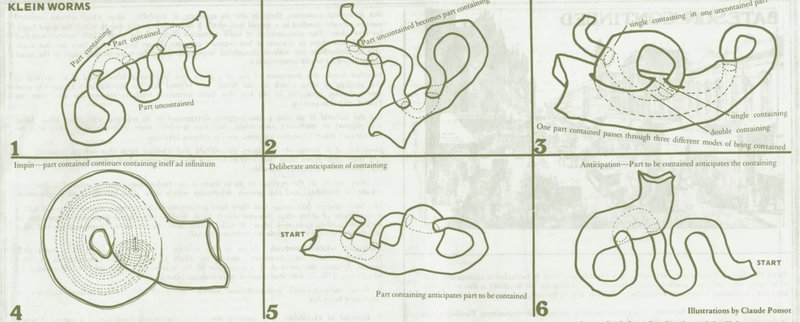
Klein Worms drawn by Claude Ponsot for Paul Ryan’s ‘Cybernetic Guerrilla Warfare’.13
In his article, Ryan presents these worms just after mentioning Warren McCulloch’s (yes, that notorious Cold War engineer, MIT person, and theoretical inventor of the perceptron) problem of emergent orders from multiplicity:
The problem that I’m up against is the problem of organization of many components, each of which is a living thing, each of which in some sense, senses the world, each of which tells others what it has sensed, and somehow a couple million of these cells get themselves organized enough to commit the whole organism.14
For Ryan these worms are an attempt to display abstraction without subsumption. The organization of multiple parts into a whole without reducing them to that totality. This is because the totality is not expressed via a self-perpetuating circle, an infinitely large grid, or a progressively ascending spiral, but an ugly worm. As Brian Holmes puts it:
What one sees, in varying configurations each time, is a whole with emergent parts that split off and are then reintegrated, only to emerge again without ever being fully subsumed. This is quite different from a dialectic that constructs its higher unities through the suppression and sublation of opposites. The underlying notion appears to be that of cooperation without subordination, within a social whole whose differences go on differing.15
For the time being, I would just like to pin that cyberniticians (Cold War proto-AI engineers) as well as countercultural video makers were both invested in the same ideas, not only regarding emergent orders that keep on differing, but also cooperation without subordination, and abstraction without subsumption.
Viewed from the vantage point of the 2020s, these promises of recursivity16 and differentiation seem way too grand for the all-too-mundane selfies, vlogs, Twitch streams, or YouTube video essays. However, this is not the entire picture of the cybernetic hopes of video. In his seminal text Guerrilla Television,17 Michael Shamberg’s and the Raindance Corporation’s views on television were not limited to the electronic improvement of the self. Video feedback loops were only one part of a larger ecological critique of video production’s political economy. For the Raindance Corporation, Guerrilla Television was a tactic to fight ‘the beast’ of the broadcasting system.18
Inspired by Marshall McLuhan and Gregory Bateson’s ecological theories of the mind, the Raindance Corporation understood that each form of media produces an ecology or environment in which humans are in constantly evolving symbiotic relationships with machines. The broadcasting system beast was a specific form of media ecology that ‘has to lust after huge numbers of people per program to stay alive, […] producing a crowd-pleasing mentality and a collective mass consciousness that reduces diversity […] [The beast] has no capacity for feedback, […] its one-way transmitters helping to “condition passivity”’.19
The potential of video didn’t rest on broadcasting the ‘right’ kind of content, but on the possibility for every citizen to produce, distribute, and access their own content through video tapes and cable TV. As media theorist William Merrin explains:
Shamberg’s goal was the creation of a popular movement of ‘community video’: an ‘indigenous production’ without professional mediation, in which local groups shoot, edit, and present their own footage, directly expressing their own concerns. ‘Guerrilla Television is grassroots television […] it works with people, not from up above them’, helping to produce a new network, community consciousness, and an ‘information structure’.20
Merrin’s article ‘Still Fighting the Beast: Guerrilla Television and the Limits of YouTube’, points out that the Raindance Corporation applied the language of cybernetics and computation (feedback, self-organization, and self-processing) to media production in order to articulate a critique of broadcasting and imagine a radically democratic media ecology. I wish to point out once again that this is the same cybernetic jargon that a few decades prior guided the development of the perceptron with the intention to create an alternative model of bottom-up, topological computation. This vocabulary also implied changing the site for tactics of resistance and organizing away from the labor-centric strikes and mass protests to a struggle that plays out in the territory of information and media. A shift that also mirrors the alleged immaterialization of cognition and military strategies in the work of cold war AI engineers like Warren McCulloh and Walter Pitts,21 or communication in general in Claude Shannon’s theory of information.22
Even if it hasn’t lived up to all its promises, especially those regarding the ownership of the means of distribution, Web 2.0’s participatory culture can be linked back to the media ecology Guerrilla Television wanted to achieve. And, making an even greater historical and conceptual leap, to the topological computational paradigm of neural networks. It’s kind of obvious today that participatory culture and neural networks feed into each other: participatory culture produces the cultural conditions and desires to produce content that will later be used to train the network and will be deployed to produce digital environments (algorithmic social media) and content (slop), that will further encourage content production and consumption. The advent of machine learning has successfully leveraged what social media platforms captured, networks of bottom-up localized production, and transformed it into a fundamental part of a privatized, global, production-driven, digital media ecology.
Nevertheless, this cooption is not obvious nor necessary. There is nothing inherent to participatory cultures that calls for data intensive computation and social relations mimicking the factory plant’s conveyor belt, neither is there causal connection between platformization and user-created content. That is, participatory culture enjoys an autonomy towards networked technologies. As the Italian autonomist Marxist movement has noted, while capital needs labor for its reproduction, the inverse doesn’t hold true.23 Analogously, while networked technologies of abstraction de facto act as a mechanism for the reproduction of participatory cultures, the latter can survive and thrive without the former.
If community video and Web 2.0’s participatory cultures haven’t lived up to their cybernetic emancipatory promises, it was precisely because of the high hopes they placed on the cybernetic jargon of abstraction. A blind faith in diagrams and structures rather than the living ecology of practices that activate them. This surreptitiously shifted community media’s goal from ‘fighting the beast’ to producing a totalizing system of cybernetic loops of subjectivation (it is not hard to see how you go from here to infinite scrolling feeds) that relegated the problem of distribution and archiving to a new version of that same beast.24
But this doesn’t mean that the problem lies solely in technologies of abstraction and that we should wholly reject them. It is rather about the social relations we want to vessel through them. What do we want technology for? Designed by whom and addressed to whom?
TeleStreet or Nostalgia for Early 00s Progressive Techno-optimism
In a similar way to the Raindance Corporation and its Guerrilla Television, the Telestreet movement25 in Italy during the early 2000s sought to counter the RAI-Mediaset media monopoly. Starting in the summer of 2002 with Franco Berardi’s Bologna-based OrfeoTV, Telestreet was a network of tactical pirate television stations broadcasting lo-fi videos for few hours a week using a 1000 €, 400-meter-range equipment.
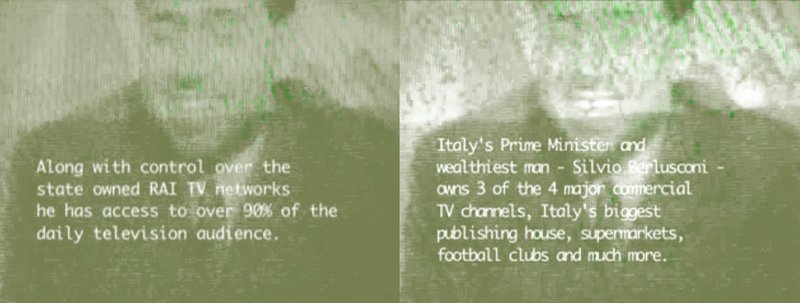
Stills from the 2005 documentary Telestreet: The Italian Media Jacking Movement.26
From today’s platformized present, the early 2000s look like a heated yet bustling period for independent media. IndyMedia,27 an open publishing network of activist journalist collectives that emerged after the police repression of the protests against the 1999 Seattle WTO Ministerial Conference, was quickly expanding into global community. Two years later, in the summer of 2001, media activists and independent journalists from around the world, including those of IndyMedia, put together a media center at the Genoa Social Forum.28
The Genoa Social Forum was a counter summit organized by a network of movements, civil society associations, unions, and political parties to protest capitalist globalization during the G8 summit taking place simultaneously in the Italian port city. It’s not hard to see how this counter summit represented a high point of what networked communications could achieve: civil society and grassroots initiatives now had the means to build global bridges. This time not for commerce and geopolitical strategizing as the leaders of the post-war order had done for decades, but for international solidarity and collective action.
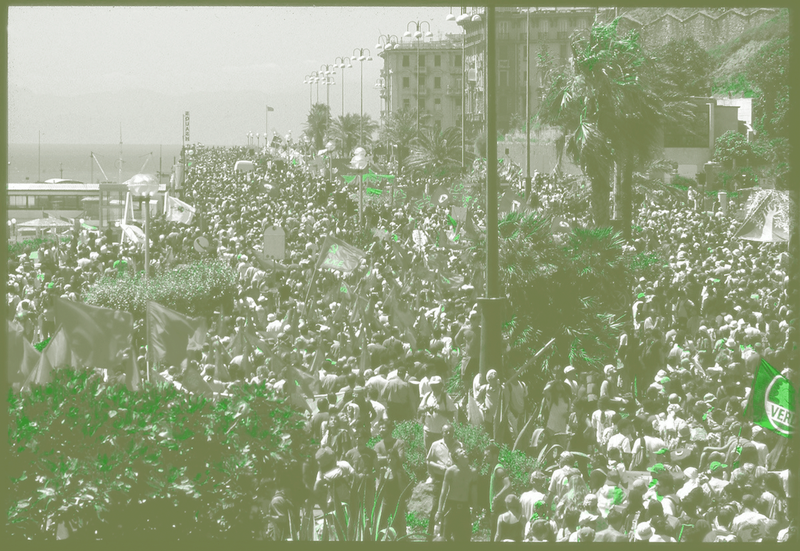
Demonstration of 21 July 2001 on the Corso Italia during the Genoa Social Forum. Michele Ferraris, CC BY-SA 4.0, via Wikimedia Commons.
Nevertheless, these days of gatherings and protest are nowadays notoriously remembered, once again, for the violent police repression of the mass protests of the 20th and 21st of July. And, importantly, for the unjustified police assault to the media center, located in the Pascoli School and the Pertini-Díaz school, where activists and organizers were sleeping.29 These were still the times before cameraphone witness-activism but, as media activists, the victims knew the importance of heavily documenting what happened. The events in Genoa represent an early case of the kind of hybrid political confrontations that are now commonplace: violence against media producers that produce media to counter violence. While cybernetic guerrilla warfare made class struggle immaterial, the assault to the Pertini-Díaz school as well as today’s smartphones standing against police batons, remind us that the struggle for a new media ecology has always had a very real, material ground.
Against this backdrop of agitation and repression, but also optimism about the new ways political action can hybridize with media production, the Telestreet network was born. In an edited volume on media activism from 2002,30 Matteo Pasquinelli writes on the theoretical and political aspirations of this community television movement. Focusing on UrbanTV, another Bologna-based Telestreet initiative he was part of, he distinguishes community television from (American) public-access television initiatives. This meant that TV was not only a tool for the free access information via publicly owned (state owned) channels. TV was not an accessory communication channel for a pre-existing society, but the vessel through which communities and their corresponding subjectivities are produced bottom-up. In contrast to the to the liberal American slogan ‘Information wants to be free’, Pasquinelli brings up the autonomist-favorite notion of the ‘General Intellect’ from Marx’s Fragment on the Machines31 and proclaims that ‘Information wants to be General Intellect’. So he advances that the issue at stake in community TV is reclaiming the autonomy of the technological and symbolic means of social production.32
Reclaiming the means of social production begs for autonomously managed media production, distribution, and archiving infrastructure at a local/urban level. TV’s ability to weave a social fabric is deeply linked to a local context, which was, as the name UrbanTV suggest, urban. A local and community-managed TV network was the means to reopen the apartment buildings in the dormitory city sprawls that TV itself had closed decades ago.33 At its grandest, community TV was advanced as the way to (at last!) build a bottom-up ‘Europe of the cities’.34 A call to action made, ironically, during the historical turning point that consolidated today’s bureaucratic EU of the non-sovereign nations.
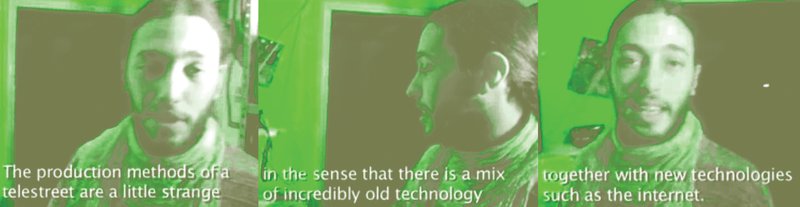
Interview with TeleAut, a TeleStreet station that used to broadcast from a squatted apartment building in Rome to the neighborhood of San Lorenzo. Interview extracted from the 2005 documentary Telestreet: The Italian Media Jacking Movement.35
Paradoxically, this early 2000s version of reterritorialization or the ‘go touch grass’ meme was heavily mediatized by the deterritorializing technology it was fighting against. One might argue that the master’s tools will never dismantle the master’s house, yet I think that this mediatic optimism provides us with an insight that is difficult to shrug at: the Telestreet movement was able to see how TV was full of inactivated potentialities. This is true of any technology or media form; use exceeds design intention.
UrbanTV and Telestreet saw in community television an opportunity not only to reclaim the communications infrastructure that the state, and increasingly the private sector, held a monopoly of, but also an ‘alternative transmission schema, a different collective narrative, new content not as much informational but as motors of desire and community’.36 An insight that Pasquinelli will repeat twenty years later in his social history of AI and that also inspires the main argument of this essay: connecting the untapped potentialities of machine learning with those of tactical and participatory video. It is then not only about technological infrastructure, an affair seemingly reserved to hackers and tech bros, but also about socially and ideologically rearticulating it to produce a new imaginary superstructure. Producing new diagrams at, both, the infra- and the supra- level.
The Ground We Stand On: The Remains of Amsterdam’s Pirate Media Ecology
To close this incomplete and brief, but hopefully politically progressive, proto-history of cybernetic video, I would like to mention the squatter-led community media initiatives in the Amsterdam of the 1970s, 80s, and 90s. Pasquinelli continuously references community television in the Netherlands as an example of what could be done in Italy. Brian Holmes also goes back to this movement when narrating the tactical television scene of the 90’s.37 David Garcia writes that, what started as a pirate radio movement to organize the flourishing Amsterdam squatter movement against evictions in the 70s, eventually transformed into a robust media scene publishing newspapers, zines, and broadcasting television in the 1980s.
Anyone visiting Amsterdam in the 70’s and early 80’s would have found a [sic] that some of the best places in town were the squatted bars and clubs and if they had stayed longer and looked deeper they would have also found a vivid squatter’s media, of news papers, zines, pirate radio stations, and television.38
At the time, the Netherlands was one of the few countries with wide-spread access to cable television, regarded a public good rather than luxury for profit service as in many other countries. The squatter movement polemically and illegally took advantage of this situation to broadcast their own transmissions.
What’s interesting to me here is that the popularity of their programming led to the creation of a legal framework to regulate it, Open Channel, and an authority to oversee it, SALTO. According to Garcia ‘[SALTO’s] statutory obligation is to make the open channel culturally representative. In other words, ensure that the main ethnic and social groups and movements are visible.’39 He then proceeds to make the community-access vs public-access TV distinction that Pasquinelli deems key to untap television’s political potential: ‘It is this approach is that distinguishes community access from public access which is open to anybody and is based on a simple first come first served principal. Public access is the dominant system in the US, the birthplace of open channels on cable’.
SALTO still exists today, and it is now firmly embedded in the traditional media landscape of the city. It provides a valuable service ‘support[ing] programme makers with broadcasting on the radio stations and television channels through affordable broadcasting facilities, technical support and training’.40 In many ways, it is an example of a successful yet somewhat disappointing institutionalization of a bottom-up initiative. I want to underline this movement from grassroots cooperation to regulation and institutionalization—that can be seen as cooption—to historically restate Pasquinelli’s point of the sociomorphism of technology. In this case, technology not only understood as a device or a collection of devices, but an assemblage composed of diverse institutions, social groups, political projects and ideologies, technical artifacts and infrastructures.
The histories of Amsterdam’s squatter TV stations, Italian Telestreet, and American Guerrilla Television, show how these technological assemblages often intersect with highly politicized social movements that, more often than not, are in a conflictual relation with the powers that be, even if they’re later absorbed by them. This portrays a different picture of technological design and development: design tables, academic labs, control rooms, ethical committees or parliamentary hearings are not necessarily at the center of all technological design processes. The relations that get abstracted into diagrams by professional designers extract from specific cultures, minor media ecologies, whose practices tend to have a political motivation.
Reclaiming the Tools of the Master?
This shift in perspective is somewhat of a provocation: the technological world we live in is as much a result of big technological corporations that have monopolized the control over the communities of practice of technological design, as of the politically engaged self-organized initiatives that use technology as instruments against oppression, vessels for community-making, or networks for support and solidarity. My hope is that making explicit the link between these two histories partially saves the latter from being solely regarded as the not-to-be-trusted tools of the master. Current machine learning is undoubtedly embedded in a capitalist mode of production, and it is definitely not neutral nor a-ideological. Yet, it is the product of a multiplicity of not necessarily coherent nor linear historical processes and not the direct result of a monolithic master plan. More than inherent politics or values, the non-neutrality of technological tools means that they have a conflicting, contingent, and messy history.
However, highlighting these alternative histories and untapped potentialities does not imply taking today’s AI ideology at face value. The above provocation is not a wholehearted acceptance of the technologies that came out from the heyday of cybernetics, but a demonstration that they can be something different to what they are today precisely because they have already been something different. For these media activist movements, the key technological advancements were radio, video, television, and the internet, not large language or diffusion models implemented in deep neural networks.
My guess is that this is not only due to these groups using the technologies available at the time, but that this is also an implicit techno-political decision. Media activism requires articulating a technological assemblage in some ways over others. Frank Rosenblatt was already implementing cybernetic ideas of self-organization into hardware almost two decades prior to Guerrilla Television’s publication. Yet, for the Raindance Corporation implementing recursive feedback loops was not about creating a system for trait reduction, categorization, identification, and prediction. It was rather about fighting The Beast and its monopoly over perception to allow for the emergence of a different media ecology. Their concerns were not placed on emulating the human ability for prediction or correctly targeting military projectiles,41but as the UrbanTV manifesto42 underlines years later, on producing different modes of relating to one another.
Participatory video production culture is ever more crucial for predictive machine learning systems. Terabytes of online video are used as training data for energy-intensive solutions to questionable design problems. When framed within the assumptions and expectations of AI, a participatory media ecology turns out to be just a moment subsumed to an assemblage that reinterprets media production as data production and, therefore, defines the producer solely as a user or a motor for the latter. The community-making potential of localized televisions is replaced by the repetitive prompting of globe-spanning infrastructures. This assemblage displaces the tactical non-user/video activist as a node of action and privileges the software-maker/designer/engineer, the corporate stakeholder, and, more recently, the tech ethicist as the ‘humans-in-the-loop’.
So, what is there to save from AI? Not its aspirations of becoming a general-purpose, consumer-facing technology, but its proto-history: the interconnected participatory initiatives it has captured. The task is then about resurfacing these obscured elements to completely rearrange this assemblage into something else. To connect parts differently and produce new diagrams. From an automated master’s eye to a network of cooperating urban televisions.
Writing this in 2024 (and published in 2026), the Amsterdam of the 80s or the Bologna of the 2000s appear as nostalgic memories of a time full of political potential. At THE VOID we’re still too attached to platformized services and institutional contexts to sincerely claim that we are tactically parasitizing on existing infrastructure while resisting capitalist capture. The ‘creative’ culture we live in, either online or localized in Amsterdam, seems too constrained by the institutions and platforms it depends on even when trying to overcome them. The promises of DYI video have long been fulfilled by the user-created internet, so what’s the point of cultivating new participatory and activist media cultures today after their exhaustion? Isn’t everything that’s uploaded to the internet ending up as training data on perpetually heating data centers? What should we do different to avoid cooption?
First, as the UrbanTV manifesto noted, it’s not that much about creating the right type of content. Second, and this is my addition, I believe that this is not a design problem. It’s not about nudging other people somewhere else to do this or that using technology: designing just the right integrated tech solution to get the common citizen into video activism. It is also not about designing the right, fair, or value-driven machine learning model, but about practicing the kind of social relations we want to have in the first place and then, maybe, abstracting them with technology. How do we create a social infrastructure of cooperation rather than that of identification, targeting, prediction, and micro-managing that the platformization of the social web, and now AI, have created? The politics of design processes have still much to learn from the politics of self-organization.
Our diagrams for THE VOID are not necessarily a blueprint to scale-up our operations, but a way of creating our own shared habits over our tools. Paths of action that will enable us to go live once again. But more than trying to provide a fixed workflow, our congealed know-how in a diagram is a reminder of what self-organization is all about: gathering collective forces to make the improbable happen again. That even if the past feels unrepeatable now, it probably also felt unattainable back then.
-
(1) For an acute critique of the network as a decentralized and emancipatory structure for information and society, see Alexander R. Galloway, Protocol: How Control Exists after Decentralization, MIT Press paperback ed., Leonardo, MIT Press, 2006. ↩
-
(2) See Matteo Pasquinelli, The Eye of the Master: A Social History of Artificial Intelligence, Verso, 2023. ↩
-
(3) Henry Jenkins, ‘What Happened Before YouTube’, in YouTube: Online Video and Participatory Culture, by Jean Burgess and Joshua Green, Digital Media and Society Series, Polity, 2009, 110. ↩
-
(4) Jenkins, ‘What Happened Before YouTube’, 125. ↩
-
(5) This argument is heavily inspired by Kevin Driscoll’s alternative history of the internet as social space centering amateur electronic bulletin board systems over the military ARPA Net. Moreover, after writing this piece I came across Michael Goddard’s book Guerrilla Networks, which not only exhaustively delves into the histories of the very same countercultural and minor media ecologies I touch upon more superficially, but also shares this (an)archeological presupposition that any given technological or media assemblage is contingent and not the endpoint of a necessary teleological development. See Kevin Driscoll, The Modem World: A Prehistory of Social Media, London: Yale University Press, 2022; Michael Goddard, Guerrilla Networks: An Anarchaeology of 1970s Radical Media Ecologies, 1st ed., Amsterdam University Press, 2018, https://doi.org/10.5117/9789089648891. ↩
-
(6) Raindance Corporation, ‘Introduction’, Radical Software 1, no. 1, 1970. ↩
-
(7) Michael Shamberg and Raindance Corporation, Guerrilla Television, Holt, Rinehart, and Winston, 1971, https://archive.org/details/guerrillatelevis0000sham/page/n5/mode/2up. ↩
-
(8) ‘Next 5 Minutes :: Festival of Tactical Media’, accessed 22 October 2025, http://www.tacticalmediafiles.net/n5m4/about.jsp_jsessionid=CB33EFD6BD1CEC159F2D91004C23AB1C-jsessionid=CB33EFD6BD1CEC159F2D91004C23AB1C.html. ↩
-
(9) ‘Radical Software’, accessed 23 October 2025, https://www.radicalsoftware.org/e/index.html. ↩
-
(10) For a more detailed exploration of this scene, see Andrew Roach, ‘Guerrilla Television’, Community Media, n.d., accessed October 22, 2025, https://communitymedia.network/a-brief-history-of-diy-tv/guerrilla-television/. ↩
-
(11) Quoted in Brian Holmes, ‘Tactical Television. Movement Media in the Nineties’, Regarding Spectatorship, 2015, https://web.archive.org/web/20240702152258/http://www.regardingspectatorship.net/tactical-television-movement-media-in-the-nineties/. ↩
-
(12) See William Merrin, ‘Still Fighting “the Beast”: Guerrilla Television and the Limits of YouTube’, Cultural Politics 8, no. 1 (2012): 97-119, https://doi.org/10.1215/17432197-1572012; Brian Holmes, ‘Tactical Television. Movement Media in the Nineties’. ↩
-
(13) Paul Ryan, ‘Cybernetic Guerrilla Warfare’, Radical Software 1, no. 3, 1971,https://www.radicalsoftware.org/volume1nr3/pdf/VOLUME1NR3_art01.pdf. ↩
-
(14) Ryan, ‘Cybernetic Guerrilla Warfare’, 1. ↩
-
(15) Holmes, ‘Tactical Television. Movement Media in the Nineties’. ↩
-
(16) It’s interesting to note here that recursivity or recursion, a recurring theme in the history of philosophy from Proclus to Hegel, Yuk Hui, and Douglas Hofstadter, which was later ‘secularized’ by information and communication sciences as the cybernetic feedback loop, is too an algorithmic technique in computer programming (the ability for a program to call itself), and is currently heralded by AGI simps as a first sign of artificial consciousness awakening. ↩
-
(17) Shamberg and Raindance Corporation, Guerrilla Television. ↩
-
(18) Merrin, ‘Still Fighting “the Beast”’. ↩
-
(19) Shamberg and Raindance Corporation, Guerrilla Television; quoted in Merrin, ‘Still Fighting “the Beast”’, 103. ↩
-
(20) Merrin, ‘Still Fighting “the Beast”’, 104. ↩
-
(21) For a detailed intellectual and technical history of how cybernetics shifted ideas of mind and communication to informational paradigms, see Orit Halpern, Beautiful Data: A History of Vision and Reason since 1945, Experimental Futures, Duke University Press, 2014. ↩
-
(22) See Colin Koopman, ‘Information before information theory: The politics of data beyond the perspective of communication’, New Media & Society 21, no. 6 (2019): 1326-43, https://doi.org/10.1177/1461444818820300. ↩
-
(23) Nick Dyer-Witheford, Autonomist Marxism, Treason Press, 2004, 7, https://libcom.org/library/autonomist-marxism-information-society-nick-witheford. ↩
-
(24) Although, in the case of THE VOID, our production techniques are still highly attached to the tools, both hardware and software, of corporate giants. ↩
-
(25) Telestreet - Il network delle Tv di Strada, 21 June 2002, https://www.telestreet.it/. ↩
-
(26) Telestreet: The Italian Media Jacking Movement (directed by And_, produced by Tim Parish, 2005), 7:44, http://archive.org/details/telestreet2. ↩
-
(27) ‘Indymedia.Org’, accessed 23 October 2025, https://indymedia.org/. ↩
-
(28) Francesco Martone, ‘From Genoa to Today’, Transnational Institute, 19 July 2024, https://www.tni.org/en/article/from-genoa-to-today. ↩
-
(29) For a recounting of these events (in Italian or Spanish) see Teresa ‘Ze’ Paoli, ‘Indymedia Italia: Bologna, Genova, Palestina’, in Media Activism: Strategie e Pratiche Della Comunicazione Indipendente, ed. Matteo Pasquinelli (DeriveApprodi, 2002), https://monoskop.org/images/1/19/Pasquinelli_Matteo_cur_Media_Activism_Strategie_e_pratiche_della_comunicazione_indipendente_2002.pdf; Matteo Pasquinelli (ed.), MEDIACTIVISMO: Estrategias y Practicas de La Comunicacion Independiente (DeriveApprodi, 2002), https://monoskop.org/images/5/54/Pasquinelli_Matteo_cur_Mediactivismo_2003_ES.pdf. ↩
-
(30) Matteo Pasquinelli (ed.), Media Activism: Strategie e Pratiche Della Comunicazione Indipendente, DeriveApprodi, 2002, https://monoskop.org/images/1/19/Pasquinelli_Matteo_cur_Media_Activism_Strategie_e_pratiche_della_comunicazione_indipendente_2002.pdf; Pasquinelli (ed.), MEDIACTIVISMO: Estrategias y Practicas de La Comunicacion Independiente, DeriveApprodi, 2002, https://monoskop.org/images/5/54/Pasquinelli_Matteo_cur_Mediactivismo_2003_ES.pdf. ↩
-
(31) Karl Marx, Grundrisse, Penguin Press, 1993. ↩
-
(32) Pasquinelli (ed.), MEDIACTIVISMO: Estrategias y Practicas de La Comunicacion Independiente, 14. ↩
-
(33) Pasquinelli (ed.), MEDIACTIVISMO: Estrategias y Practicas de La Comunicacion Independiente, 143. ↩
-
(34) Pasquinelli (ed.), MEDIACTIVISMO: Estrategias y Practicas de La Comunicacion Independiente, 142. ↩
-
(35) Telestreet: The Italian Media Jacking Movement (directed by And_, produced by Tim Parish, 2005). ↩
-
(36) Pasquinelli (ed.), MEDIACTIVISMO: Estrategias y Practicas de La Comunicacion Independiente, 16. (Translation own.) ↩
-
(37) Brian Holmes, ‘Tactical Television. Movement Media in the Nineties’. ↩
-
(38) David Garcia, ‘A Pirate Utopia for Tactical Television’, Tactical Media Files, 15 September 2012, http://www.tacticalmediafiles.net/articles/3568/A-Pirate-Utopia-for-Tactical-Television. ↩
-
(39) Garcia, ‘A Pirate Utopia for Tactical Television’. ↩
-
(40) ‘SALTO Amsterdam - Over “Open Access”’, SALTO, n.d., accessed 3 September 2025, https://www.salto.nl/over/. (Translation own.) ↩
-
(41) See Peter Galison, ‘The Ontology of the Enemy: Norbert Wiener and the Cybernetic Vision’, Critical Inquiry 21, no. 1 (1994): 228-66; Bernard Dionysius Geoghegan, ‘An Ecology of Operations: Vigilance, Radar, and the Birth of the Computer Screen’, Representations 147, no. 1 (2019): 59-95, https://doi.org/10.1525/rep.2019.147.1.59. ↩
-
(42) Matteo Pasquinelli, ‘Manifesto of Urban Televisions’, Subsol, 17 February 2003, http://subsol.c3.hu/subsol_2/contributors3/pasquinellitext.html. ↩