chapter
Can a TV channel save public access?
The Case of Offener Kanal Europa
Nora Spiekermann and Giacomo Marinsalta
Public Access TV: A participatory model
Television has long played a formative role in shaping public consciousness, reporting news, hosting political debates, and airing entertainment across social and geographic divides. Yet within a capitalist media system, broadcasting has become increasingly commercialized, with a few corporations and institutions controlling what can be seen, said, and remembered. Access to mainstream media remains largely top-down, leaving little room for public or grassroots participation.
Already in the 1960s and 70s, a social answer to this imbalance emerged with what has been ‘perhaps America’s most radical telecommunication policy’: Public Access TV (PA TV).1 As pay-TV networks expanded, the U.S. government mandated that private cable companies provide resources and infrastructure for locally produced programming. Free from commercial or governmental interests, PA TV fosters a decentralized, bottom-up model of media production that empowers citizens to produce their own content on TV. This type of TV stations were established in many cities, and some still function today as meeting points for participants, offering spaces for learning and community-building on public issues, from city politics to the arts, health or religion. They not only offer technical equipment and training, but also allow local people to set topics, craft narratives, and experiment with video making. That’s how PA TV’s open-access embodies participatory media, blurring the line between producers and consumers. In the 1980s the model made its way to Europe, where for example in Germany, it became known as ‘Bürgerfernsehen’ or ‘Offener Kanal’. All in all, these DIY media formats champion free speech, offering a counterpoint in a public sphere drawn by the commodification of media.
Today broadcast TV seems to have lost its cultural importance, in a digitized platform economy, where again access to online communication channels lies in the hands of a few (tech bosses). ‘Cyberspace’, once envisioned as a virtual commons where knowledge and exchange could circulate freely, has gradually been colonized by the same commercial interests, audit systems, and paywalls that had already begun to redefine broadcast media in the United States from the 1960s, as public service ideals gave way to corporate-controlled programming. Our screens are now personalized echo chambers; our participation is profiled, and reduced to metrics.
Against this backdrop of individualized media experiences, can the model of PA TV still offer inspiration?
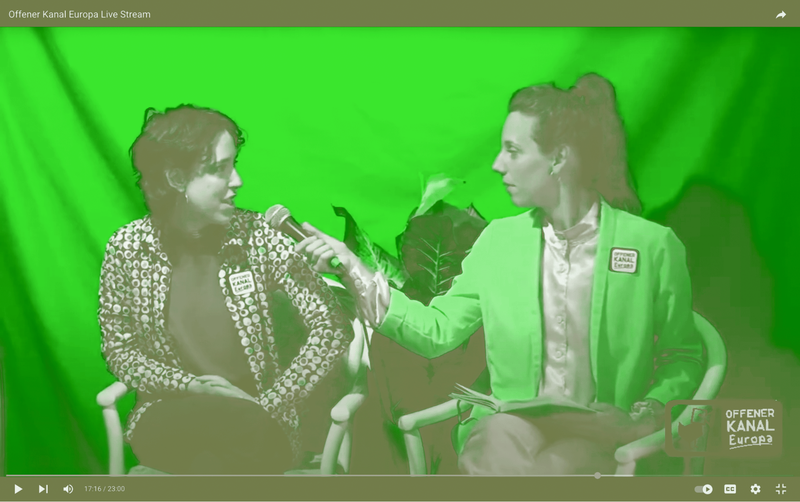
Offener Kanal Europa’s first ever live stream reenacting the model of PA TV (2020). Image Credit: Offener Kanal Europa
From Participation to Isolation: Privatizing Media and Space
While many PA TV stations in the U.S. have been defunded or marginalized since the early 2000s, the principles they foregrounded remain deeply relevant. These channels pushed not only expressive autonomy, but also situated knowledge, with a form of engagement grounded in place, real life relationships, and embodied action. In a time when activism is often reduced to likes, shares, or comments, such media practices remind us that urgent social issues cannot be addressed solely through virtual infrastructures. They demand collective presence, organized effort, and most importantly the reclaiming of space. After all, the atomization of online engagement mirrors a broader erosion of public access: as corporate communication platforms enclose digital discourse, our urban environments, the ground for protest, direct intervention, and commoning, are more and more privatized, monitored, and designed to inhibit spontaneous gathering. This hinders both our right to communicate and our right to the city itself.
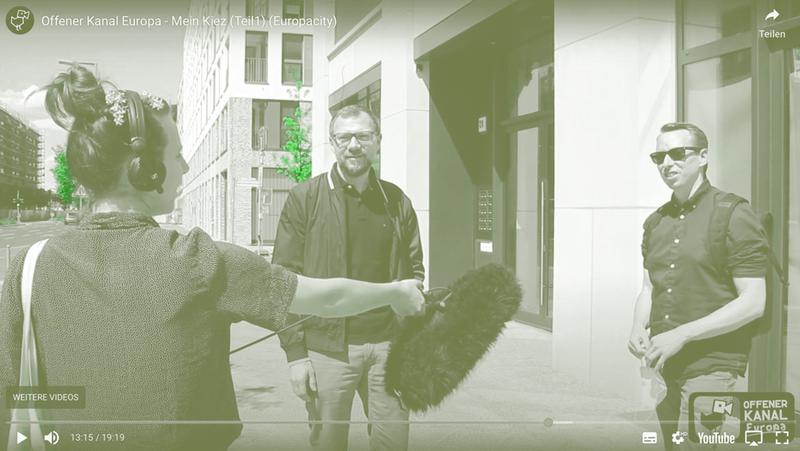
Public access TV street-interview with passersby of Europacity on Heidestraße, Berlin (2020). Image Credit: Offener Kanal Europa
Urban Financialization: Berlin’s Europacity
Over the past decade, Berlin has become one of Europe’s cities most affected by rising rents and housing prices.2 After the fall of the Wall, a cash-strapped local government sold off large portions of public land, allowing private and international investors to shape the city’s development. Public housing is now scarce, and even stable earners often rely on costly, short-term rentals that bypass tenant protections.3 Once a haven for creatives, Berlin’s growing economy has shifted toward service industries and online enterprises. Iconic sites like the East Side Gallery and the Tacheles art squat have given way to corporate buildings, including an Amazon tower looming over Warschauer Straße. Urban design in the capital now favors standardized, modular buildings marketed through sleek visuals that sell the city as an investment opportunity rather than a place to live.
Europacity4, a newly built district beside Berlin’s central station, exemplifies this transformation. Once a railway yard and part of the Wall until 1989, the area was privatized during Deutsche Bahn’s restructuring. The real estate company Vivico (later acquired by C.A. Immo) initiated its redevelopment in the early 2000s, demolishing most existing structures to make space for offices, luxury apartments, coworking spaces, and retail outlets. Corporations like KPMG, SAP, and TotalEnergies now sit alongside high-end residences. The result is a sterile, glass-and-concrete landscape monitored by surveillance and private security, where public infrastructure, such as schools, libraries, or institutions, is absent. This lack of low-barrier, communal spaces severely limits access to social life and chance encounters among neighbors.
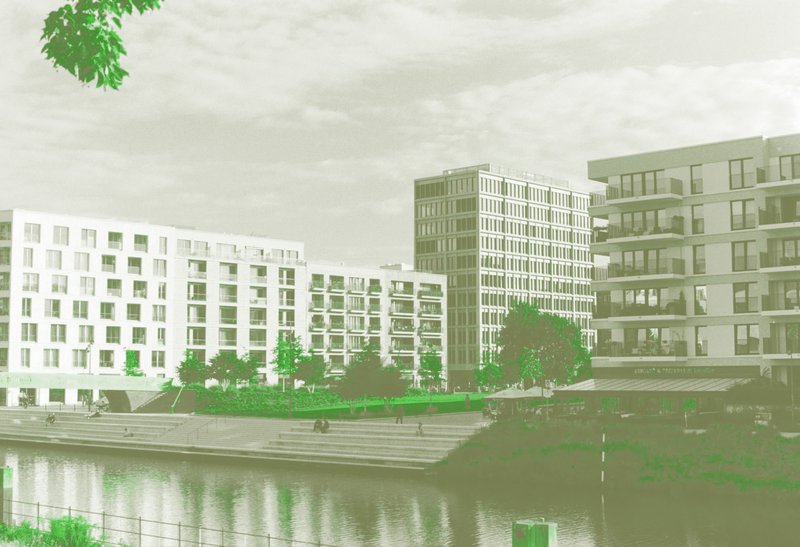
A view of Otto-Weidt Platz, main square of Europacity. Image Credit: Giacomo Marinsalta
Neoliberal privatization processes have not only reshaped economic activity but also social and spatial relations. Much like how corporate media monetize users’ attention and prioritize profit over public interest, public space is increasingly replaced by privately owned or pseudo-public areas, where access is conditional and non-commercial uses are discouraged or banned. In this context, streets, parks, and squares are reduced to legal obligations rather than foundations for communication and human connection. In Europacity, the main street Heidestraße is a passive promenade, while the main square, Otto-Weidt-Platz, offers little beyond unfinished landscaping and retail. The ‘city’ here feels more like a curated product than a lived environment, where civic voices and neighborhood identity are hard to recognize. Without shared, unregulated spaces, ties between long-term and new residents cannot take root. What grows instead is isolation.
Despite its central location, Europacity feels cut off, flanked by railway tracks, a canal, and, back in 2020, a third layer of isolation caused by the pandemic. The social disconnection was palpable, and residents, new or old, struggled to form a community.
What could an artistic response to this look like? The desire emerged to work closely with local inhabitants, while also inviting people from other parts of Berlin to visit a neighborhood many don’t even know exists. Though, how could a dialogue be established, not only among interested individuals, but also a critical one about the area and its public spaces?
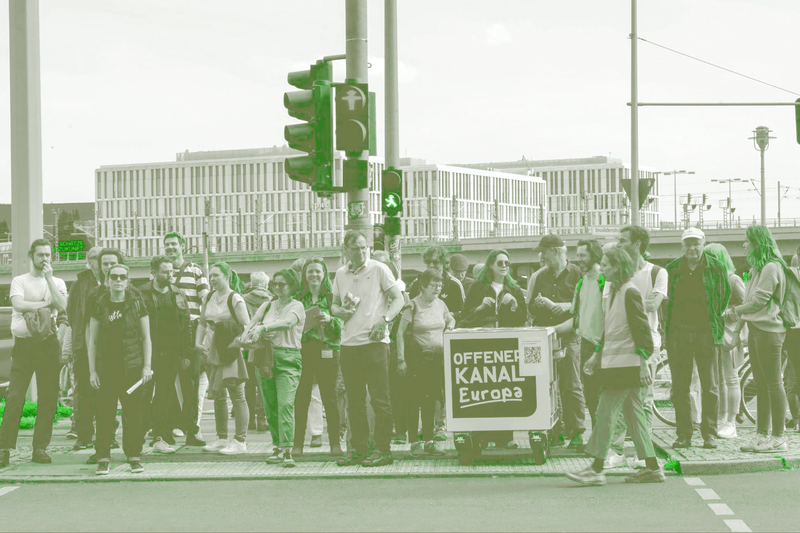
‘Europacity – who are you?’ Walking tour joined by Offener Kanal Europa (2024). Image Credit: K. Froschmann
Broadcasting the Right to the City
It was in this context, during the first summer of COVID-19, that Offener Kanal Europa5 was born. With the world on pause, the idea of a physical meeting point, bridging digital participation with local presence, took shape. When the chance came to rent a small, birdhouse-shaped Imbiss (snack stand) on Heidestraße, artist Nora Spiekermann, who had already worked in the area for several years, invited a group of creatives to transform it into a TV station. Two chairs, a fake plant and a green screen became an interview set. A cozy cabin was an invitation to reflect on isolation. Community dinners were cooked in the former Imbiss kitchen and served in the small garden and on the sidewalk. Talk shows, performance broadcasts, and interventions took place in public space. We came up with several TV formats that were designed to interact and talk to people whom we met in the streets. ‘Sport and Spiel’ for example, engaged with kids and adults, offering a variety of toys to play with and simultaneously chat with each other. Those formats were also documented on a phone camera, edited and uploaded later online. The aesthetics of the channel contrasts to Europacity’s corporate branding, being raw, makeshift and honest. The project blends analog and digital: livestreams on Instagram6 and YouTube7, as well as a growing online archive on the website documents stories that had no place within private real estate brochures, creating a memory repository for a neighborhood which did not yet have one (or anymore?).
Investors have erased nearly all formerly existing built structures in the area. What remains from the previous asset is a couple of old buildings. Former tenants of the area were very interesting to talk to, because they had experienced the immense changes brought by the erection of Europacity. Offener Kanal Europa’s activities create chances to connect these inhabitants with new residents. Being regularly present in Europacity made us meet people over and over again, so helped to build relationships, and learn about local stories and dynamics as well as hidden ownership structures.
In this way we also got in touch with Christian, the last tenant of an apartment building from the late 1890s heated with coal stoves. After the landlord didn’t clean the house and yard anymore, Christian turned into the superintendent. We would meet him often in the street or at the new local supermarket. One day, we were in need of electricity for a radio live stream, and so he invited us to use his backyard, which overlooks a newly built fancy hotel. He reported that he had received a letter, announcing that his house was about to be sold soon. Shortly after that Christian died and his house was finally sold. As the contact with the last resident of the house broke up, information about further developments were hard to get. A spontaneous interview8, once recorded with Christian has become a document of the development of the area and first of all, a testimony of self-initiative and care surrounded by international capital and its unsocial effects.9 Caring for your own building, the yard, the adjacent street is a form of appropriating the city, and going into contact with your surroundings, the neighbors. This is what is missing in the high-prized micro apartments next to Christian’s house, which are highly anonymous.
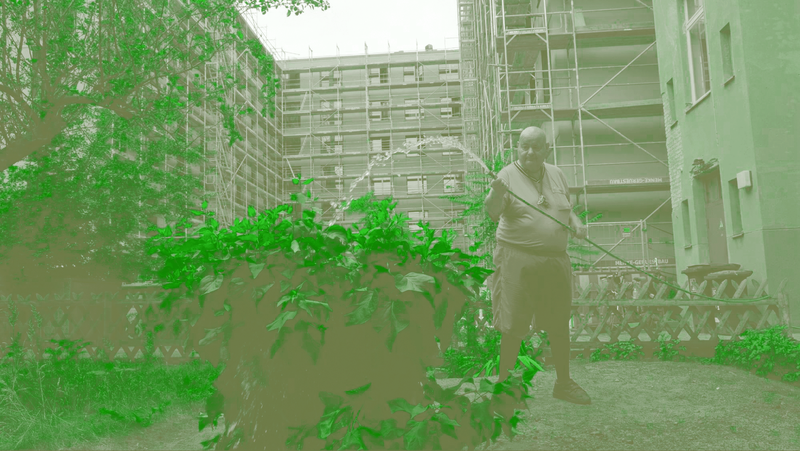
Christian waters the plants of his garden facing the newly built ‘Urban Loft’ Hotel in Europacity (2022). Image Credit: Nora Spiekermann
The initial idea of Offener Kanal Europa was to provide a platform based on physical presence in order to connect local residents, people from the neighboring districts, who did not have a reason to visit the site before, as well as activists and artists dealing with Europacity.
The local environment with its artificiality made it hard to reach and connect with people. After leaving the Imbiss-TV station due to lack of funds and capacity, this task turned out to be almost impossible: without a place as a meeting point, a long term artistic engagement in Europacity cannot work. Since 2020 we have continued with a number of interventions and public events, a big 2 day critical street festival and experimental city tours. This way, we managed to stay connected with the area and some of the local people. To this day, our social media accounts are used to report and communicate infrastructural developments and artistic actions in Europacity.
In 2024, C.A. Immo, the main investor of the area, staked out a video-watched area on Europaplatz opposite to the main railway station, called ‘Europacity Vibes’. Surrounded by raised beds, the site features tables, benches and a stage built out of wood. They wanted it to look homemade and cool and, above all, to simulate a social and artsy ‘vibe’. Throughout the summer, there was a program featuring food trucks, music events, a ‘weekly market’… Following their Instagram documentation, you could see that there was mostly a yawning emptiness and the described ‘neighborhood feeling’ was probably more of a joke. The ‘owner’ of Europacity seems to increase the value of its properties with this promotion and the appearance of a fake community leveraging on a well curated media outlet of the neighborhood that refers to Berlin as a creative hub and bottom up self made city. Social media is used here to create a non-existing picture of the city – one that might soon be from the past. In a public intervention in September 2024 in Europacity, we invited passersby to an interactive and fun self made game, built on a mobile trailer that would thematize the living conditions in the area, as well as their personal experiences in it. For the advertisement of the event, we wanted to answer artistically to ‘Europacity Vibes’, so we came up with new, ironic slogans, creating our own ‘vibe’.
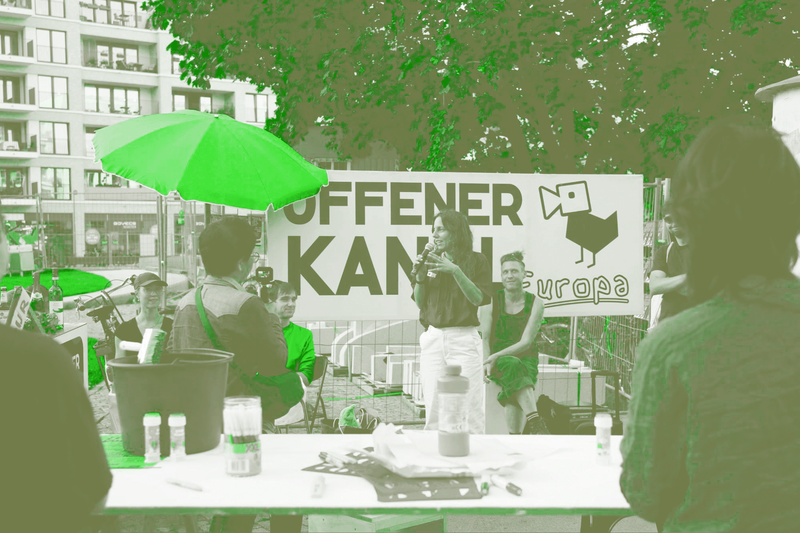
A snapshot of ‘Europacity Volltexten’, a public intervention on the main square Otto-Weidt-Platz (2023). Image Credit: Constanze Flamme
Reclaiming Presence
Can a TV channel reclaim public access? As Offener Kanal Europa shows, PA TV offers many tools that can mediate and connect different groups, activating a dialogue about urban developments that fail socially and democratically. Transforming the concept of PA TV to public space by the means of live interaction, on a media platform and in real life, was probably the most relevant to the whole project. This could involve reviving old media formats with a green screen, improvising a backyard interview, or challenging desert streets with interventions that are surprising and mobile. Site-specific actions are tactical steps to question local issues in public space. Their imperfection and spontaneity are maybe the only correct answer to a dry, polished cityscape. Today’s challenge is to resist privatization in all its dimensions and to invent new forms of interruption. Small collective gestures that question access to public space can act as glitches in the system, fracturing the seamless order of a rendered city shaped by financial interests.
-
(1) Hans Klein, ‘Public Access Television: A Radical Critique’, Telecommunications Policy Research Conference (TPRC), Washington, DC, 29 September 2006. ↩
-
(2) Cities for Rent, ‘How international investments are upending the housing market’, Tagesspiegel, 2 June 2022, https://interaktiv.tagesspiegel.de/lab/berlin-the-rental-market-lab-how-international-investments-are-upending-the-housing-market. ↩
-
(3) Tim White, ‘The strange loophole that transformed Berlin from tenant’s paradise to landlord’s playground’, The Guardian, 22 January 2025, https://www.theguardian.com/commentisfree/2025/jan/22/berlin-housing-crisis-germany-rents-flats. ↩
-
(4) https://www.caimmo.com/de/portfolio/projekt/europacity/ ↩
-
(9) Offener Kanal Europa, ‘Der Letzte Bewohner’, posted 17 June 2020 by Offener Kanal Europa, Youtube, 10 min., 52 sec., https://www.youtube.com/watch?v=1IPAtgk7tl8. ↩