chapter
Witnessing Gaza on TikTok LIVE
Sarah Al-Yahya
In November 2024, I joined a TikTok LIVE stream hosted by Adam,1 a young and sarcastic streamer from the Gaza strip who often broadcasts from his tent. I was watching the stream silently until, locking eyes with the camera, Adam stated in Arabic: ‘Some people are hiding in this LIVE! They are not even responding to my greetings or anything I say!’ My eyes traveled to the viewer count, which Adam was pointing at (Fig 1), knowing that the platform feature, TikTok LIVE, allows him to see who each of these viewers are. There were only 11 accounts watching, most of which were active in the comments. ‘He must be talking about me’, I thought to myself, in shame, and double-tapped the screen to ‘like’ the LIVE, a small digital gesture to show Adam that I was still listening to him.
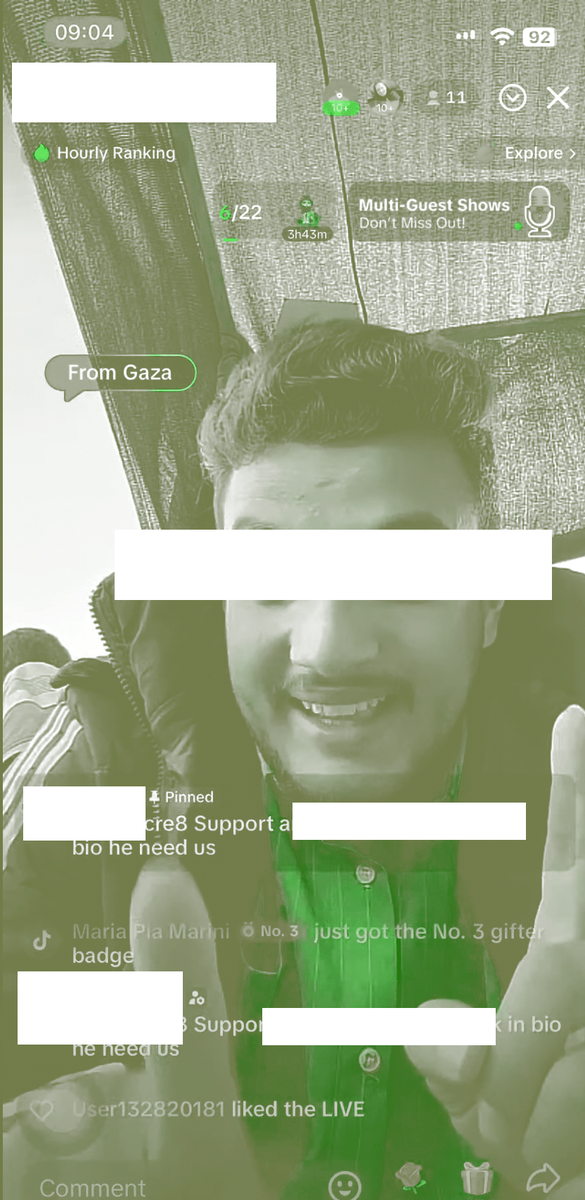
Fig 1: Still from Adam’s stream, where he points at the viewer count on the top right.2
In that moment, the phrase ‘livestreamed genocide’ which for months saturated my feed took on a new life. Livestreamed genocide became more than a descriptor of media saturation, but a dynamic that singularly addressed and implicated me in witnessing. I felt like what I had long owed to those broadcasting from Gaza could be partially satisfied if I stayed a bit longer, remaining visible to Adam.
With TikTok LIVE, it often happens like this. Streams with tens of viewers – sometimes hundreds, never thousands – insisted at my presence. What I witnessed on LIVE did not match the dominant image of livestreamed genocide elsewhere. It was not spectacular and bloody. Of course, it was still violent, but in a different register, one that is slow, mundane, and unstable.
What appears on TikTok LIVE is not only a different mode of livestreamed atrocity, but a testament to the profound mediation of this ongoing and escalating genocide, and the tactical fluency of those broadcasting and receiving it: Gazan streamers working within, and against, a platform built to erase them, and their viewers. These low-viewed, ephemeral streams are not just documentary records or urgent pleas, but tactical interventions.
‘Livestreamed Genocide’ as a Media Paradigm
A few weeks into the war on Gaza, users online began describing the ongoing crisis as a ‘livestreamed genocide’.3 In January 2024, Irish barrister Blinne Ní Ghrálaigh cemented the idea in public discourse as she presented South Africa’s case against Israel before the International Court of Justice (ICJ). She decried the inaction of the ‘international community’ despite the ‘overt […] rhetoric’ of Israeli officials and ‘despite the horror […] being livestreamed from Gaza to our mobile phones, computers, and television screens, the first genocide in history where its victims are broadcasting their own destruction in real time […]’4 Her words place the war on Gaza in a long history of modern crisis mediation, from Vietnam, the ‘first living room war’,5 to the 1991 Gulf war being the first ‘live’ war,6 Ní Ghrálaigh is invoking a similar sentiment that came up in the historical predecessors: How can we see it all and do nothing?
David Rieff, in his book Slaughterhouse, issues a similar indictment of Western governments and the United Nations for watching the genocide of Bosnian Muslims without taking action. He wonders, rhetorically, about the gap between knowledge and action: ‘In reality, no slaughter was more scrupulously and ably covered.’7 ‘Livestreamed genocide’, as a paradigm, carries the assumption that this genocide is made visible through mass exposure, and that witnessing ‘horror-in-real-time’ happens at a large scale. TikTok LIVE complicates this mode. Such streams do not often deliver horror as spectacle, nor do they deliver the clarity associated with ‘genocide in full view’, which has pushed Gazan streamers to develop a particular set of tactical practices. To understand how the terms of witnessing shift on LIVE and how these tactics take shape, we must first examine the infrastructure of TikTok LIVE itself.
LIVE on TikTok
Although TikTok LIVE is structurally embedded in the larger platform, it exists beyond the primary activity the platform is best known for, the ability to create, edit, and share short videos8 on an algorithmic feed. LIVE, is the platform’s broadcasting feature launched in August 2020.9 LIVE videos sometimes appear on users’ home pages as they scroll through short videos, but ultimately, there is a separate feed designated for them, accessed by clicking on the small ‘LIVE’ television-shaped icon in the top corner of the screen (Fig 2).

Fig 2: TikTok LIVE’s television-shaped icon.
The use of the television icon here is curious, implying a deliberate framing that separates the sequence of fragmented clips (TikTok ‘proper’) to an ongoing flow of broadcasts, temporally extended, or even temporally ambiguous. Still, however, the algorithmic ‘For You’ feed, described as the ‘For You Page’ or FYP by TikTok users, remains central to the platform’s live feature too. The centrality of this feature translates into the platform’s design, where the FYP is the first page users encounter upon logging in, as opposed to a feed that prioritizes creators whom users follow, which is what we see on platforms like Facebook and Instagram.10 Similarly, upon entering the LIVE feed, you mostly get a feed of algorithmically recommended streams, further decentering the follower-creator dynamic. This condition underlies much of the practices that Gazan streamers and their viewers take up in the mediation of livestreamed genocide on the platform, such active co-streaming across many accounts.
This pursuit for algorithmically-driven visibility is not just about narrative circulation. It is also tied to TikTok’s internal economy, for which LIVE is the cornerstone. This economy is built on the circulation of a virtual currency, TikTok Coins, that users purchase on the platform. Viewers can then use this currency to send TikTok creators virtual gifts, themed items that often appear animated on the screen (Fig 3).
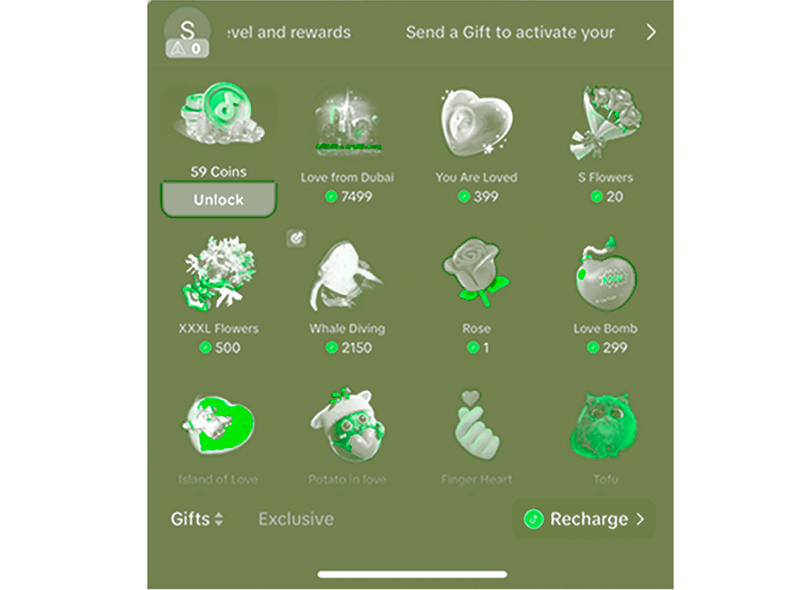
Fig 3: TikTok LIVE’s gifting panel, where users can recharge their coin balance, and choose gifts to send streamers.
When a creator receives TikTok gifts, their value is translated into a different currency called Diamonds, which creators can cash out into real currency through PayPal. The percentage TikTok receives from this transaction chain is unclear, but it seems to be extremely significant, adding up to between ~50%-70% of the streamer’s earnings.11 In Gaza, these gifts punctuate scenes of rubble and soundscapes of onslaught from the Gaza strip, a visual dissonance that streamers and viewers alike grow accustomed to. In one stream, Kareem explains to his audience how they have nothing to eat or drink in the North of Gaza. Shortly after, a viewer sends him an orange juice gift (Fig 4). It is in these absurdities, which continue to intensify with time, that TikTok LIVE mediates livestreamed genocide.
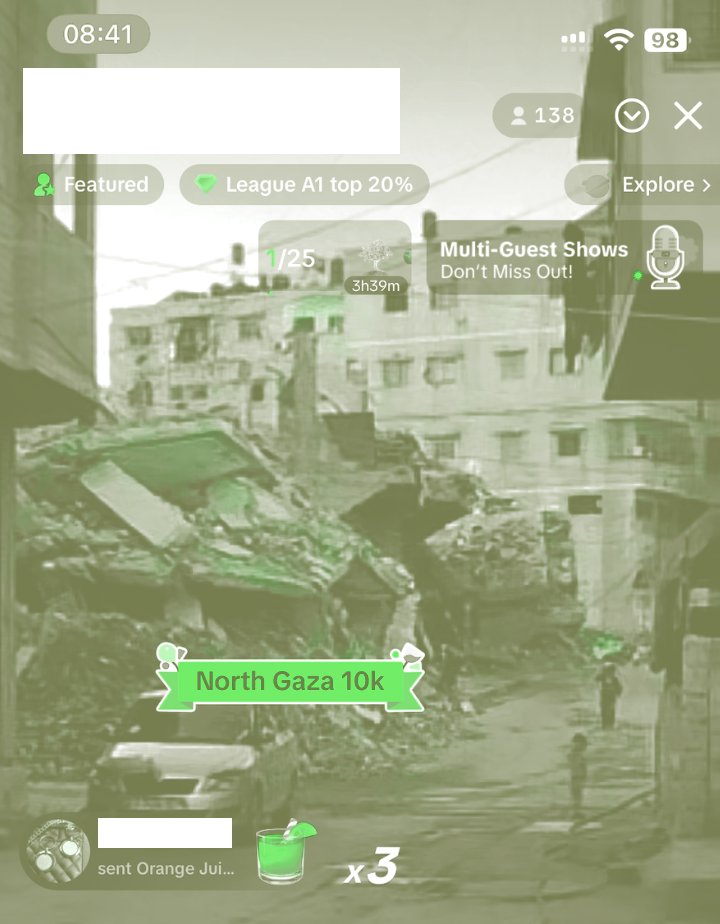
Fig 4: Kareem, broadcasting a scene from North Gaza, receives 3 ‘orange juice’ gifts.
Through TikTok LIVE in Gaza and other corners of LIVE as well, monetization often assumes the language of charity,12 with viewers sending gifts as a demonstration of humanitarian concern. This may seem intrinsic to content streamed live from a crisis zone, but TikTok actively promotes this framing. In a clip shared on LinkedIn, Adam Wang, head of TikTok LIVE, states: ‘I constantly hear stories of LIVE changed my life.’13 This sentiment is echoed in TikTok LIVE’s official partnerships with organizations like the Make-A-Wish Foundation,14 signaling that the platform is not only creating but exploiting this dynamic. In Gaza, these gifts are not mere symbolic support. As Um Naji states in a group stream, where she presents her situation to an audience of 25 viewers: ‘These days we go on TikTok LIVE just so we can have cash in hand and provide vegetables for our kids’.
It is crucial to note here that as time passes, with the enforced material conditions of genocide in Gaza continuously worsening, it becomes significantly harder for streamers to both convert their TikTok Diamonds to physical cash or find the food to spend it on.15 In a LIVE from September 2025, a streamer that goes by Daughter of Gaza is sharing with the stream host: ‘I’ve been promising the kids with some chocolate and sweets since I started joining your streams as a guest streamer, but I swear we really cannot find anything… Nowadays we crave anything, even if rotten’. Furthermore, she continues explaining that LIVE is not the same as it was in the beginning of the war on Gaza, indicating that viewers might be gifting less now.
This format where host streamers, often Palestinians in diaspora, invite a panel of Gazans to speak, became common on Gaza’s TikTok LIVE. The host gives participants the center stage, one by one, to describe their living conditions in a testimonial manner and receive virtual gifts from viewers. In one of the streams, a host, Kifah, addresses one of the Gazan women who is hesitant to share: ‘You are not begging! This is not how we Gazans do it! You are just presenting your situation for the people’. The articulation for dire need for Gazans is carefully managed on TikTok LIVE, framed beyond desperation as dignity and solidarity, an affective mode that streamers and their audiences co-produce in real time.
Group live panels and other gifting strategies in the cycle of monetization are not merely economic tactics. They also function, in part, as live performances carrying affective and political stakes. When deployed in TikTok LIVE streams from Gaza, these performances exhibit a form of liveness that holds one’s attention in a different way. The stakes extend beyond visibility; they lie in the ability of remaining in-range to the crisis in an intimate manner. This invites us to interrogate more deeply what ‘liveness’ means on LIVE.
LIVEness
The paradigm of ‘horror-in-real-time’ and the increasing degree of live mediation in modern crises could invite many viewers to assume that liveness, as a characteristic of content, guarantees legibility. If we assume that viewing something live offers a more immediate image of crisis or more truthful witnessing, then perhaps TikTok LIVE is as clear as it gets. It promises real-time access and co-presence, direct communication with live streamers, and unedited footage – unlike live news coverage, which is annotated with commentary, or pre-recorded and pre-edited social media content such as Instagram or standard TikTok posts.
Yet the liveness of TikTok LIVE does not necessarily guarantee visibility or legibility. Despite its real-time nature, it resists easy documentation and archiving. This is due in part to its ephemeral nature, existing only at the moment of broadcast, often leaving no trace. This fleetingness creates a precarious liveness, one that complicates assumptions about access and witnessing live.
As Philip Auslander argues, liveness is not an ontologically fixed condition, but a historically contingent concept, a variable effect of mediatization.16 What counts as ‘live’ shifts and mutates across various media and contexts. What was once defined by the spatio-temporal co-presence of theater has later expanded to include ‘live broadcasts’ and even televisual content ‘recorded live’, terms that Auslander describes as oxymoronic.17 Liveness, then, is produced through cultural and technological processes, not through the unfolding of a transparent representation of reality.18 It is a self-aware construct that borrows from and mimics specific mediatized forms to be recognized as live by audiences.19 As such, liveness is not a direct image of reality on the ground as it unfolds. It does not necessarily render what is difficult to interpret more legible, or the unseen more visible. Through this, we understand that despite TikTok LIVE’s more immediate real-time nature, it is no exception.
Faced with this precarious visibility, Gazan streamers on TikTok LIVE reach for performative practices that attempt to anchor attention. One of the most striking examples is the use of scripts – brief sentences, repeated rhythmically by streamers to request and sustain engagement. For example, one of the streamers I watched regularly, Abu Ahmed, can often be found on stream repeating a multilingual script, in Malay or Indonesian, English, and Arabic, in a hushed cadence.
Bantu Bantu [id: Help help], follow follow, share share, from Gaza, from Gaza Palestine… no water, no food, sick children, tap tap and share live Gaza ‘al Shamal [ar: North of Gaza]. Hasbiya Allah wani’m Al Wakeel [ar: Allah is sufficient for me, and He is the best disposer of affairs.]
He sits amid the rubble in the North of Gaza, streaming on TikTok LIVE for hours, repeating the same script over and over. The hum of drones accompanies his quiet speech, along with the distant boom of airstrikes and the high-pitched cracks of gunfire. Between the mundanity of the foreground and the destruction lurking in the background, his broadcasts testify to a ‘livestreamed genocide’ in a different register. The script, a staple of polished and narrativized televisual war coverage, is reshaped on TikTok LIVE. LIVE streamers globally rely on repetitive, robotic scripts to solicit gifts, in a manner often likened to video game non-playable characters, NPCs.20 Viewers grow curiously attuned to moments of rupture, when the streamer goes off script. In Gaza, these moments carry heightened stakes, such as urgent violence or escalation targeting a streamer only few are watching. The script thus becomes a minimal signal of presence prompting viewers to remain ‘in range’. They watch Abu Ahmed for hours, not for his scripted performance, but should he need to go off it.
Nick Couldry’s insights on liveness can help us understand this dynamic. He argues that liveness is a socially constructed category, and that the experience of liveness is less about what is transmitted than about the event of transmission itself. This does not mean there is no connection between liveness and real-world events, but rather that it is indirect. The live broadcast offers a potential link between shared realities, an ability to remain ‘in range’. Couldry cites an example from Joshua Meyrowitz who contrasts listening to a cassette with listening to the radio, arguing that the liveness experienced through the radio is that of remaining connected to the possibility that something unexpected might break in, that there will be ‘news’ about the world which interrupt the broadcast.21
Let’s return to Abu Ahmed. Most of his streams, as I mentioned, are dominated by a repetitive script and a still frame, often of himself, but sometimes of the surrounding environment (Fig 5).
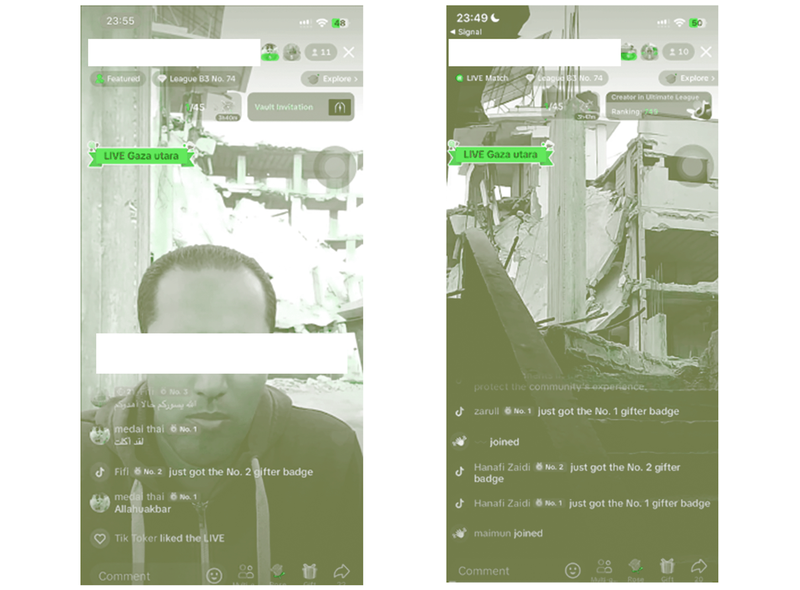
Fig 5: Stills from Abu Ahmed’s livestreams. (Left: Front-facing frame of Abu Ahmed, his commonly used one. Right: Outwardly framed still of Abu Ahmed’s surrounding environment).
In the everyday performance on his TikTok LIVE stream, Abu Ahmed is producing an image unfamiliar to audiences. It is a repetitive, almost static image that lasts for a long time, quite unlike the common landscapes seen in mediated content from Gaza, or even war zones in general. If you were to watch the war on Gaza live elsewhere, you would be faced with content of a different pacing and affect. His script here maintains Gazan presence without spectacle. The image is ephemeral by nature of TikTok LIVE, but once you are on the stream, the image of Abu Ahmed is stable, just him, facing the screen, framed by rubble. As the hours pass, audiences hear everything in the background and discuss frantically in the chat what the sounds may be – creating a visceral sense of connection, an anxious anticipation that holds them accountable and keeps them watching, as if they are waiting or fearing that at any moment the content of this mundane stream might be interrupted by the more ‘predictable’ tragedies of genocide in real-time. As we wait, we might recognize that this perceived mundanity, this deliberate scripted repetition, is also ‘livestreamed genocide’.
This mode of ‘in-range’ liveness complicates conventional media logic. Nick Couldry suggests that liveness frequently functions as a ritual that legitimizes what he calls the ‘myth of the mediated center’, that is ‘the belief, or assumption, that there is a center to the social world, and that […] the media speaks “for” that center’.22 This is the implicit power of traditional liveness, the fact that watching something live feels like being connected straight to that center, alongside others watching too.23 But TikTok LIVE operates outside the bounds of this mythical mediated center. It is often actively excluded from it. The image is fragile, its visibility precarious, often ignored by institutional media. Streams like Abu Ahmed’s are not legitimized by proximity to a media center, nor by connection to an official platform or a shared ritual of live viewing. Instead, their weight lies in this distance from the mythical center. His stream holds viewers not through spectacle, or institutional power, but because they deviate from both.
The ephemerality and precarity of TikTok LIVE are central to the affective force generated by the streamers. Content on the platform feature is not archived, and, so far, is rarely incorporated as part of the broader mediated narrative of this crisis. This fragility recalls Peggy Phelan’s foundational argument about the ontology of performance. The ephemerality of the live performance, argues Phelan, in contrast to Auslander, is what makes it real. 24 Phelan sees this absence from circulation, this inherent distance from the so-called ‘media centre’, as its most radical potential: ‘Performance’s only life is in the present’, she writes.25
On TikTok LIVE, the stream’s ephemerality – sometimes intensified by censorship and structural silencing – can be transformative for the viewer. For audiences, the horror of the content from Gaza, mediated through mundane scripts and nearly static images with low viewership, reinforces the persistence of the crisis, instead of dulling it. The disappearance of the live image does not necessitate the disappearance of horror. In fact, it provokes deeper concern, one that I have faced recently, when I failed to find the profile of a streamer I often checked on. In this way, ephemerality reinforces the moral imperative of remaining in range and watching LIVE.
Scripts, for Gazan streamers, offer a way to stabilize presence within the otherwise unstable visuality and temporality of LIVE. Once viewers are drawn in by these scripts, the streamers take to other tactics which more explicitly address their viewers, such as the usage of VPNs to reach particular geographic regions. An example of this emerged in a co-stream between Abu Ahmed and another streamer, Ameer, in December 2024. With only 5 viewers when I joined, I noticed that the conversation was less scripted than usual. Rather than sticking to a rehearsed routine, the streamers engaged in a more organic and personal conversation, occasionally giving instructions to their audience with a simple ‘tap and share!’.
At one point, Abu Ahmed discussed switching to a paid VPN to connect to Indonesia, explaining that he had more success streaming to audiences there, as they were more generous with donations. Ameer, on the other hand, struggled with a free VPN that did not achieve that desired outcome. This clarified a previous point of confusion for me about Abu Ahmed’s script which, as demonstrated earlier, infuses terms from Indonesian such as ‘Bantu’ (translating to ‘help’), and ‘Terima Kasih’ (translating to ‘Thank you’) signaling how he has adapted to welcome his new audience.
The conversation between Abu Ahmed and Ameer sheds light on the trial-and-error nature of their streaming practice, where even the mundane and repetitive elements of their broadcasts are shaped by a cycle of experimentation and active decision-making about self-representation. Live and publicly on the platform, they share tactics and methods to become better streamers and master the craft. In doing so, they make the practice more lucrative and their engagement more meaningful. Indeed, these tactics appear to be working. Abu Ahmed now draws a loyal viewer-base from Indonesia and Malaysia as a result of his script. Sometimes, they join as guest streamers and translate his Arabic words to expand viewership for him in their country.
The call to remain in-range, this in-range liveness, is shaped and sustained by the streamers’ devised tactics. Additionally, it is also reinforced by the algorithmic logic of the platform which, I have observed, further imposes a responsibility on the viewer. On LIVE, which is already marginalized within the app’s interface, the algorithm’s role expands beyond content discovery to audience positioning. Viewers, addressed by the script, might wonder, what does it mean that I received this image on my feed, when evidently so few others have?
Algorithmic Flow
TikTok and its live feature, LIVE, embeds the logic of algorithmic flow into the paradigm of vertical scrolling. Each unit of content feels intimately connected to the one before and says something about the agent, or user, scrolling through. Arvind Narayanan attributes the success of the platform to this vertical scroll, which he calls the ‘secret sauce’.26 He argues that TikTok’s secret is not really the algorithm, but all the ways it is embedded and presented. The centralization of the algorithmic feed as an apparently omniscient machine that knows the users ‘more than they know themselves’ produces powerful effects on LIVE as well.
Beyond shifting the viewing experience from a public sphere to an individual feed, the algorithmically governed selection of content you see creates an implied affective proximity. What appears on one’s screen is understood, whether consciously or not, as a reflection of the self. To scroll away from it is to reject the idea that the content speaks to you; to linger with it is to confirm that the content you are receiving says something about who you are. This implication, alongside streamer practices and small viewer counts, pushes these viewers to also be more active on the stream, devising their own tactics, and breaking out from their passive roles. This is the backdrop for my own experience stumbling upon LIVEs from Gaza. I approached this material with the knowledge that years of my data, harvested and extracted by TikTok, has created an image of me that, somehow, is delivered livestreams with fewer than 20 viewers of Gazans sitting amidst their destroyed homes. It feels like a responsibility. The intimacy of the content, often with just a handful of viewers, made it feel as though I ended up on these streams because I had to do something about it. I needed to stay, to witness, and maybe to record or write about it. Moments such as my interaction with Adam that I led this piece with cemented this responsibility.
This dynamic is not unique to me. I have observed how other viewers are motivated to take on roles in the livestream, such as moderating the comment section, or even joining the stream as silent co-streamers for reach or helping facilitate the conversation. In another stream, led by a Palestinian outside of Gaza – who hosts Gazan streamers to increase their visibility, among other things – we can observe a similar interaction. The host streamer, Hana, invites Fadil, a Gazan journalist and photographer to address the audience. He shares a heartfelt message with his camera on, thanking everyone who has supported the people of Gaza and Palestine, and suggesting ways people can help. He is interrupted by another guest streamer, an Iraqi. ‘My dear brother, my dear brother, I am interrupting. I know the Iraqi resistance is trying to support, but this is not enough…our hearts are wrung with pain for you.’ Fadil tries to continue, but the guest interrupts again: ‘Habibi, my eyes, I’m interrupting you again, but you are not indebted to us. We are indebted to you.’ Viewers in the chat are instructing this guest to stop interrupting Fadil, but he keeps breaking into the conversation, as if he has been waiting for this moment, to finally address a Gazan directly, so he can share all of the guilt, gratitude, and worry that he holds.
These dynamics become even more complex in streams that cross linguistic boundaries, like those of Abu Ahmed. In another stream on Abu Ahmed’s account, during the temporary first stage of the ceasefire deal in January 2025, the chain of communication becomes even more intricate. Abu Ahmed was joined by a guest named Hind, who asked him questions in Arabic, and relayed the answers to another French-speaking guest streamer. She asks: ‘They say the drone is buzzing 12 hours a day, is it true?’ Abu Ahmed promptly responds: ‘It leaves 8 hours a day, or maybe less.’ Hind responds: ‘Mmm..’ and immediately calls on the other guest, ‘Kim!’ and translates for her. Shortly, Kim responds: ‘Bzzzz, bzzz… désolé (fr: I’m sorry)… I am so sorry, I am so sorry, Abu Ahmed’. These entangled transnational exchanges reflect a form of witnessing in which viewers feel called to engage actively, moving beyond passive consumption.
While this arises from multiple elements (platform affordances, in-range liveness, and so on), I suggest that it is also the underlying structure of personalized algorithmic flow, the sense that one was meant to see something, that plays a central role in turning viewers into active participants with tactical sensibility. Additionally, TikTok’s creator tools – such as the ability to join a stream, moderate the comment section, and on-screen prompts – being embedded in the medium of viewing, as well as the diminished presence of traditional influencer dynamics give the burdened, implicated, and eager witness more room to engage. On TikTok LIVE, where streamers devise modes to remain present on the platform, the viewing experience shifts from ‘I am helplessly watching livestreamed genocide on my phone’, to ‘Livestreamed genocide found its way to me because maybe I can do something about it.’
Dream and Imagination as Tactics
While carving out a nook of agency on TikTok LIVE under algorithmic pressure is itself a tactical feat for the streamers and their viewers, their engagements move beyond the survival of the image toward radical imaginative practices. In these streams, what begins as documentation or witnessing, shifts into collaborative storytelling and narrative work.
During a TikTok LIVE session in January 2025, a Palestinian streamer based outside Gaza managed an intimate streaming space with eight guest co-streamers from Gaza, and 14 other viewers. Structured like a radio show, the session blended music, testimonies, conversation, and collective reflection. At one point, he played a nostalgic song lamenting the loss of the past, and then addressed his co-streamers from Gaza, imagining aloud: ‘The war will end, and the people will walk down the streets again.’ When a commenter addressed him, saying, ‘Prepare yourself to go to Gaza.’ He replied emotionally: ‘God willing! Who told you I didn’t want to go to Gaza anyway?’ before continuing, ‘The rubble will be cleaned up, and there will be vendor stalls again on Omar Al Mukhtar Street.’
Such moments of imaginative participation present a brief respite in livestreamed genocide, one that is not captured or indicated by metrics or visibility. As Sulafa Zidani argues, drawing on Jenkins et al., civic imagination, ‘the capacity to imagine alternatives to current cultural, social, political, or economic conditions’27 is a vital tactic of Palestinian resistance online. ‘Indeed, the very infrastructure and tools of Israel’s military occupation are meant to contain, limit, and hold captive Palestinian mobility, creating an imagination of the future that is uncertain and ominous – a “checkpoint future.”’28
In various streams I tuned into, streamers were engaging in such a practice. This imagination takes various scales and possibilities. For example, in a group stream hosted by a Palestinian who used to work as a bricklayer, one of the women on the stream described the situation of her own home, wondering whether it could be rebuilt. The host, with ease, immediately described a possible structural solution. She responds: ‘God willing, when this war is over’, to which he replies: ‘When the crossing opens, my cousin told me to be ready. He wants to go and purchase wood, and a trailer, so we can work in bricklaying as before. So, for example, if someone has a room he cannot rebuild, we can rebuild it for him for free… In Gaza, you have wise people! If they weren’t all killed… There are talented people who will help you rebuild.’
In another stream, Hamzah, a younger streamer with a friendly and animated personality, is chatting with his viewers, many of whom seem to be US-based, in broken English. He describes his dreams of visiting New York, saying: ‘I’m never travel from Gaza, by the way I hope… my hope to travel to New York City. Crazy Brother67 I will coming to you, but I can’t because the border is close, every time close, and it’s forbidden for us to travel. You got me Crazy Brother, right? or not?’ Later, he says: ‘My dream city’ then questions his English and says ‘My city dream? Is New York’ A viewer comments saying ‘I’m from New York yalla come habibi [ar: come on, come my beloved!]’ to which Hamzah covers his mouth shyly and says ‘I hope I hope, but I live in Gaza and we are arrounded [surrounded].’
While these dreams might seem simple to the regular viewer, engaging in such imaginative interactions amongst each other and with their viewers seemed to excite and ground the streamers I watched, preparing them for the respite they hope for from this real-time horror.
Such instances of collaborative dreaming and planning that find space on TikTok’s LIVE feature, solidify that livestreamed genocide looks different on the platform. Through these networks of streamers and viewers, sometimes families and friends, imagination is a radical tactic and a refusal of narrative and algorithmic flattening. Beyond documentation and helpless witnessing, streamers on LIVE forge a path of possibility.
Yet still, as I reflect on TikTok LIVE in Gaza, situated within TikTok proper, where horror-in-real-time is mediated and censored, I am reminded again of the key question: How can we see it all and do nothing? This question, or dilemma, that has echoed throughout countless instances of mediatized crises historically, still resonates. Whether TikTok LIVE can truly address this outrage perhaps remains uncertain. However, what this case asserts is that Gazans on TikTok LIVE and their viewers, despite it all, continue to cultivate potential in the most constrained digital spaces and under the most devastating circumstances. This potential often lives in the simplest exchanges. As Hamzah once expressed, very sincerely,
‘Really, really I’m so happy you guys, because you watch me. You care about me. You remember me, and when you remember me, you make me happy guys.’
His words highlight the power of being seen more wholly, as more than a decontextualized subject of ‘livestreamed genocide’ but someone to be known, engaged with, and remembered fondly.
-
(1) All streamer names have been pseudonymized. ↩
-
(2) All identifying features of streamers, such as usernames and faces, have been blurred or covered. ↩
-
(3) A search filtered by date on Twitter reveals the expression was already in circulation within the first few weeks of the war on Gaza. For example, see: Eda Seyhan (@eda_seyhan), ‘This is Liverpool Street Station. 76% of the British public support a ceasefire. Lots of commuters sat down and joined the protest. These aren’t “hate marches”—they’re a commonsense reaction to watching a livestreamed genocide. #CeasefireNOW’, Twitter, 31 October 2023, https://x.com/eda_seyhan/status/1719484532187861335; Other examples from the first few months: Starman (@91_starman67619), ‘The situation in Gaza is unbearable. I can’t believe we are watching a livestreamed genocide from the comfort of our homes in the 21st century. I can’t take it anymore watching this unfold’, Twitter, 3 November 2023, https://x.com/91_starman67619/status/1720476390867309055; BELLA CALEDONIA (@bellacaledonia), ‘This isn’t a war, or if it is it’s one that’s so asymmetrical it doesn’t fit the description. This is the first livestreamed genocide’, Twitter, 21 December 2023, https://x.com/bellacaledonia/status/1737909989744734366. ↩
-
(4) World Has Failed Gaza in ‘Livestreamed Genocide’, South Africa’s Delegation Says at ICJ, 2024, https://www.youtube.com/watch?v=y0t4aFLYry4. ↩
-
(5) Andrew Hoskins, Televising War: From Vietnam to Iraq, London: Continuum, 2005, 13. ↩
-
(6) Hoskins, Televising War, 50. ↩
-
(7) David Rieff, Slaughterhouse: Bosnia and the Failure of the West, New York: Touchstone, 1996, 459. ↩
-
(8) D. Bondy Valdovinos Kaye, Jing Zeng, and Patrik Wikström, TikTok: Creativity and Culture in Short Video, Digital Media and Society Series, Cambridge, UK; Medford, MA, USA: Polity, 2022, 4-5. ↩
-
(9) ‘Introduction 1: About TikTok LIVE’, 1 October 2024, https://www.tiktok.com/live/creators/en-UK/article/tiktok-live-intro-ugc-eduaction_en-GB?name=undefined. ↩
-
(10) Stefanie Duguay and Hannah Gold-Apel, ‘Stumbling Blocks and Alternative Paths: Reconsidering the Walkthrough Method for Analyzing Apps’, Social Media + Society 9, no. 1 (January 2023): 20563051231158822, https://doi.org/10.1177/20563051231158822, 6. ↩
-
(11) Hannah Gelbart, Mamdouh Akbiek, and Ziad Al-Qattan, ‘TikTok Profits from Livestreams of Families Begging’, 12 October 2022, https://www.bbc.com/news/world-63213567; Kaye, Zeng, and Wikström, TikTok, 151. ↩
-
(12) Gelbart, Akbiek, and Al-Qattan, ‘TikTok Profits from Livestreams of Families Begging’. ↩
-
(13) Kenny Billy, ‘Hear from Adam Wang, Head of TikTok LIVE’, LinkedIn, 9 December 2024, https://www.linkedin.com/posts/billykenny_hear-from-adam-wang-head-of-tiktok-live-activity-7272011507100528642-bA59?utm_source=share&utm_medium=member_desktop&rcm=ACoAAC63WXwBg7U5g29xrG8cIHI-Y2pmZzOnh8k. ↩
-
(14) Newsroom TikTok, ‘Supporting Make-A-Wish with TikTok LIVE Feat. Jason Derulo and Alexander Stewart’, Newsroom | TikTok, 18 November 2024, https://newsroom.tiktok.com/en-us/supporting-make-a-wish-with-tiktok-live-feat-jason-derulo-and-alexander-stewart. ↩
-
(15) ‘UN Says Gaza Famine Expanding, 10 More Die from Hunger amid Israeli Siege’, Al Jazeera, accessed 28 August 2025, https://www.aljazeera.com/news/2025/8/27/un-warns-gaza-famine-expanding-as-aid-groups-decry-israeli-siege. ↩
-
(16) Philip Auslander, Liveness: Performance in a Mediatized Culture, 3rd edition, London; New York: Routledge, Taylor & Francis Group, 2023, 40. ↩
-
(17) Auslander, Liveness, 60. ↩
-
(18) Auslander, Liveness, 39. ↩
-
(19) Auslander, Liveness, 15. ↩
-
(20) Samantha Cole, ‘Viral TikTok NPC Streamer Pinkydoll Doesn’t Care What You Think’, VICE, 17 July 2023, https://www.vice.com/en/article/viral-tiktok-npc-streamer-pinkydoll-doesnt-care-what-you-think/. ↩
-
(21) Nick Couldry, (ed.), Media Rituals: A Critical Approach, London New York: Routledge, 2003, 96. ↩
-
(22) Couldry, Media Rituals, 2. ↩
-
(23) Couldry, Media Rituals, 99. ↩
-
(24) Peggy Phelan, Unmarked: The Politics of Performance London; New York: Routledge, 1993, 146. ↩
-
(25) Phelan, Unmarked, 146. ↩
-
(26) Arvind Narayanan, ‘TikTok’s Secret Sauce’, Knight First Amendment Institute, accessed 1 April 2025, http://knightcolumbia.org/blog/tiktoks-secret-sauce. ↩
-
(27) Henry Jenkins et al., (eds.), Popular Culture and the Civic Imagination: Case Studies of Creative Social Change, New York: New York University Press, 2020, 5 quoted in Sulafa Zidani, ‘Tweet Like It’s Free: Civic Imagination in the 2021 Palestinian Unity Intifada’, Journal of Palestine Studies 53, no. 3, 2 July 2024, 56, https://doi.org/10.1080/0377919X.2024.2419028. ↩
-
(28) Zidani, ‘Tweet Like It’s Free’, 56. ↩