chapter
Knitting our internet
Tommi Marmo / ournet.rocks
Democracies worldwide are dangerously turning into technocracies, and, thanks to surveillance capitalism, horribly wealthy corporations and individuals have gained widespread power, control, and assets that threaten the core of all liberties.
Among activists and engaged citizens, there is a growing urge of acting, of reclaiming the people’s rights and power. Still, there is a fundamental lack of awareness concerning the chronic problems of the tech industry, and how much its concrete, technical infrastructure plays a role in perpetuating unequal power dynamics. To the many who use digital devices but do not consider themselves technical, the actual functioning of the information technology ecosystem feels obscure, distant, and it’s commonly believed that it can only actually be grasped exclusively by digital experts or nerds.
Nonetheless, we do live in a world run by digital technologies, and those who run them have a blatant interest in maintaining dominance: mainly for-profit multinationals. Never before have the inhabitants of planet Earth been so dependent on tools and services that they cannot control, and, most importantly, that they hardly even understand. On top of this, albeit mainstream media outlets may address the overreaching and troubling power of Big Tech and billionaires, their superficial and oversimplified narrations do not hinder the perceived abstraction and complexity of issues related to digital technology.
While studying and researching for my bachelor thesis Computer Sciences are Social Sciences1, I was disappointed to discover that genuinely insightful tech critique is relegated to a bubble. I felt like it was terribly hard to find tools and resources that can successfully introduce normal people, a.k.a. the ‘users’, to the venomous dynamics of Big Tech, masterfully hidden behind shiny and reassuring advertisements and half-truths, because of billions spent in lobbying, counter-information, and strategic marketing.
As a proud nerd without a technical background, I think of myself as a magnet, pulling together political awareness and technology. Thus, I felt and I feel compelled to channel my enthusiasm and curiosity in the simplest, most captivating and concrete ways to unmask surveillance capitalism.
It all started while I was having lunch at my grandma’s, trying to explain for the thousandth time that typical yet terribly hard question: what is it that you do, again? To finally provide her with a sense of what I study, I asked her if she could lend me the red yarn she was using to knit me a scarf, and I used it to simulate the difference between a centralized network—connecting any extremity of the yarn through a central entity—, and a decentralized one—many points connecting to each other directly, with no intermediary.
Proudly, I can now say that my grandmother knows what decentralization is. This success lit the initial spark of what has now turned into a participatory time-travel through the history of the internet.
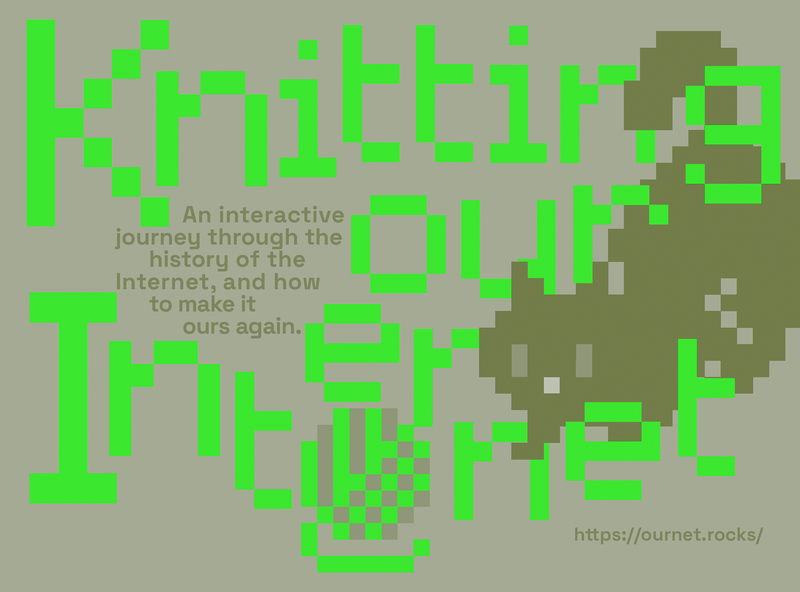
I tried to take advantage of the efficacy of storytelling, mixing with the participatory and interactive value of a workshop. I ended up with Knitting Our Internet, a 90-minute face-to-face activity that can be hosted anywhere, anytime, with any kind of public, only using yarn, possibly with a whiteboard, plus 14 printed sheets.
The most important and valuable aspects of Knitting Our Internet are its modularity, flexibility, adaptability, and accessibility. All of its content and resources are explained in The Weaver Kit2, rigorously open-sourced so that anybody can make it theirs. I strongly invite you to skim it, question it, experiment with practical tools we can use to touch, to feel the power of the true web, driven by the people who surf it, who weave it, who hack it, and reclaim it from those who want to profit off of it.
The Internet is Ours! Let’s take it back, together.
-
(1) This can be found at https://tommi.space/csss. ↩