chapter
re-search.site
Renée Ridgway and Anders Visti
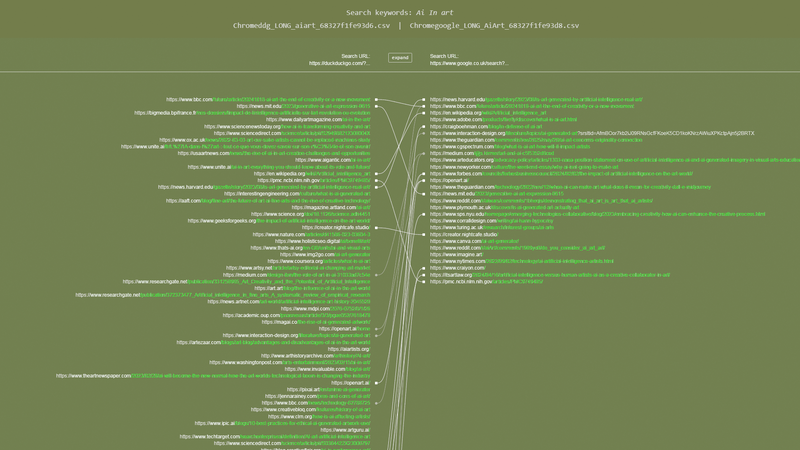
Operating as an increasing invisible information infrastructure,1 Google still has a hegemony on search, with a worldwide market share of around 90%. People still ‘ubiquitously google’ yet the actors and dynamics of search are changing with the uptake of generative artificial intelligence aka chatbots, which often provide one answer or an overview to all queries, instead of ten ranked hyperlinks.2 Investigating the ethics and politics of these search technologies becomes crucial in an era of surveillance capitalism, along with exploring their workings. Transient as well as opaque, what are some of the criteria determining search results, how can they be visualized, compared and better understood?
In a workshop setting, a bespoke platform (https://re-search.site) enables users to visualize, compare and interpret their search results based on different keywords and browser/search engine/operating system settings.3 The participants can (re)search their own interests by carrying out keyword searches within the platform itself, which is able to parse the results into comparative data visualizations. As a critical deep-dive into technology, the front-end interface design positions search results obtained with diverse browsers/engines side-by-side, reflecting their similarities and differences, visually. Matches and ranking show Google’s own agenda of hierarchizing its own products, whilst alternatives provide diversity in the search results. It also takes on the contemporary condition of GenAI by surfacing responses from the most used chatbots (Gemini, OpenAI, Llama) in the platform’s interface through the ‘art of prompting’. By querying with phrases and specific questions, the platform demonstrates how users’ results change with every iteration, thereby facilitating a comparative analysis of the answers.
The re-search.site is a media artwork and a functional web interface that also engenders the social relevance of search as a knowledge infrastructure. As practices of representation, the platform seeks to intervene and give shape to the world by making invisible infrastructures more tangible and comprehensible to the public. In both search methods, the platform collects participants’ search results on a server, making permanent online search habituations as it constructs a commons of collective memory. By enabling new forms of intervention that accentuate connections between activism and media art, it produces a conducive space for critical reflection as it attempts to anticipate uncertain futures. Contributing a post-digital perspective, the platform encourages collaboration and cross-disciplinary interactions, embodying tactical visions of the techno-social in regard to the future of search.
-
(1) Jutta Haider and Olof Sundin, Invisible Search and Online Search Engines: The ubiquity of search in everyday life, Routledge, 2019, https://doi.org/10.4324/9780429448546. ↩
-
(2) Renée Ridgway, ‘Deleterious consequences: How Google’s original sociotechnical affordances ultimately shaped “trusted users” in surveillance capitalism’, Big Data & Society, 10(1) (May, 2023), https://doi.org/10.1177/20539517231171058. ↩
-
(3) The project received financial support from the SHAPE centre, Aarhus University, Denmark, https://shape.au.dk/en/. ↩