chapter
Disrupting the Doomscroll
Tactics for the Collective Reclamation of Attention from within the Content Machine
Jack O’Grady
We know we’re trapped by our phones, for sure, but aren’t we at least trapped on the scroll together?1
What covert rescue operations could our posts and content run to retrieve each other’s vital attention from the algorithm?
What can you say to the million strangers who see you every day tO get them to look away and back toward their real lives?
‘Nothing.’
This was the first response I received while leading a workshop on the potential applications of ‘Disruption Content’—social media content posted with the express purpose of motivating anyone who finds it to get the hell out of there. As folks around the room began to nod in agreement with the quick negation of my entire thesis, I realized that I might have been asking a stupid question.
‘To get it [Disruption Content] in front of anyone the algorithm has to pick it up’, someone else added in. ‘It wouldn’t boost you if you’re trying to get people offline. And even the people who see it can just scroll past it to something new.’
Once the workshop was over, as everyone shuffled out and I stayed behind to sort through note cards and doodles, I couldn’t shake that initial rejection of the very possibility of this kind of action having significant impact. The easy assertion that there is nothing we can do for each other out there on the Scroll, nothing we can say to disrupt the machine and rescue each other from its neon interior. The lights are simply too dazzling, the world beyond it too grim.2
I had intended for the workshop3 to be focused on co-creation, brainstorming a protocol for creating Disruption Content. We spent most of our time instead arguing over whether this work was a massive waste of time. No one in the room could conceive of a message potent enough to prevent someone from just scrolling on to the next or keep them from coming back. Would it be more effective to just start throwing random people’s phones into the trash? Is that praxis?
By the end, all we agreed on was that putting art out there to try and get each other back some free attention4 was a noble cause most saw as too easy to scroll right past. Despite my commitment to said cause, after all the attendees had left, I was on Instagram Reels in seconds, feeding myself back into the machine for the price of: a million renditions of the same deeply evil man’s stupid face, Reddit posts regurgitated in AI voiceover being interpolated over an AI-generated mobile gameplay clip, nonconsensual gore, etc.
Living/Organizing in a State of Cyclical Paralysis
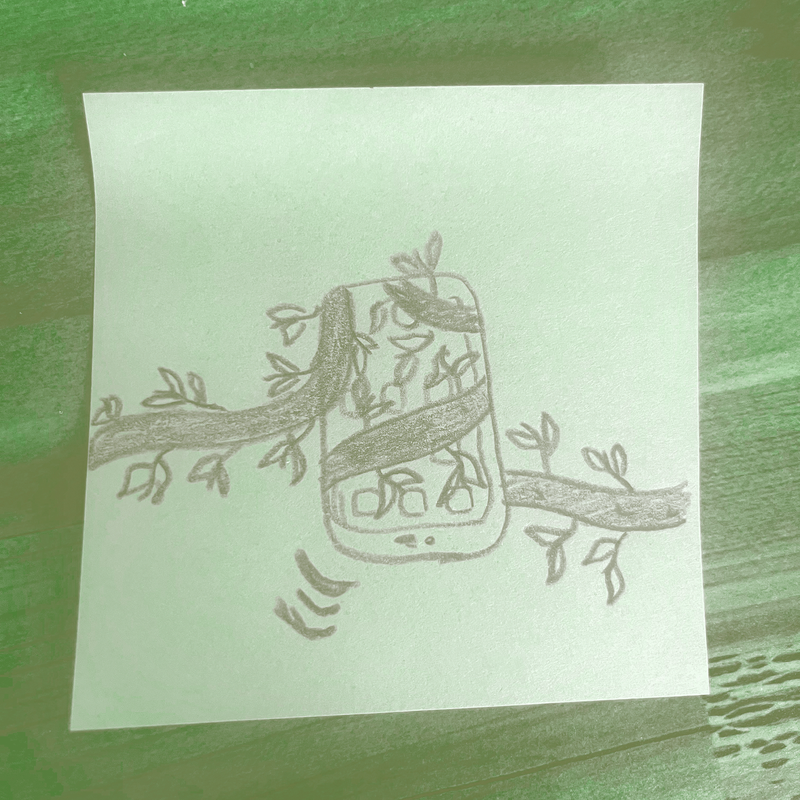
The question I had most looked forward to asking my workshop participants, which received no real response, was: ‘what does doomscrolling do to a community?’ Yet I also had to ask myself what I was doing? Giving all this thought to disrupting scrolling behavior whilst spending at least half an hour every night propped up in bed virtually raising my cortisol levels.
There’s a lot going on in my phone. There’s a lot going on in the world. When I look down at this little screen, it feels like everything happening anywhere is happening right here, and only if I scroll past it. The interweave of algorithmic nonsense with sheer reality beamed directly at our amygdala rapidly exhausts any remaining mental capacity and pushes the scroller into an overloaded state.5 Demanded to process an onslaught of content either impossible to rationalize or too distant to resolve, the mind empties.6 It’s not silence so much as unresponsiveness, the lurch of an old car when you slam on the gas pedal to get up a hill. That overload can be paralyzing; unmitigated it’s one of, if not the primary mechanism to push you from empty mind overload to a state of utter cognitive fatigue: ‘paralysis of the analytical capacity’.7
Even when the phone is out of hand, fatigue doesn’t dissipate so easily.8 What does diminish is that capacity for free, critical thought in the face of dense information.9 You start again with less room than before, less time to process before the new boundary10 is breached and you cannot bear all this thinking any longer. It’s all paradoxically brainless and maddening, but that’s the environment in which we must communicate now. When I asked that first question – ‘how does doomscrolling affect a community?’ – folks thought mostly of the misinformation you encounter on the Scroll. This is one dimension, but I was interested in the act itself, the overall reduction of one’s capacity to process busier and busier mental environments.11
At a time when the need for legitimate on-the-ground organizing is escalating day-by-day, what does it do to a community for so many of its people to be trapped online in thought-degrading panic cycles?
The overloading environment that might induce the overload-anxiety-fatigue progression is extremely social. The Scroll is not all on-its-face insidious as the deluge of AI-slop nonsense and hateful punditry, most everything else encountered online now has something urgent to ask of us. The average person can be rapidly depleted of the energy to respond to all these requests for connection.12 Fed into the familiar feedback loop, this can lead to a ‘social networking fatigue’13 that precludes interest in social behavior. Like cognitive fatigue, networking fatigue reduces one’s social capacity, and with it, your ability to tell a real request for connection from another exhausting sell among a million other exhausting sells.
When discussing communities, I’m thinking specifically about communities interested in organizing amongst themselves. This organizing criterion could, and often does focus in on activist communities, but it also includes neighborhoods, affinity groups, or support circles; all are needed to maintain healthy and just societies. While social technologies have enabled some astounding movements to thrive and endure,14 the reality so far has been that these artifacts are deployed in, and carry with them, a world strictly hostile to any re-imagination or re-interpretation of their core, technocratic systems.15 Life online also remains easily separated from life in-the-world,16 limiting collective imaginations over what modern emancipation and organization can look like. Organizing social networks, especially culturally subversive ones, would be difficult enough in this environment without the fatiguing of our baseline capacity for social behavior.17 When individuals are subject to the Scroll, subject to the degrading overload-anxiety-fatigue cycle, communities of effective and active organizing degrade right along with them.
Considering Disruption
This is the environment in which I first began encountering content that screamed at me about how much of an idiot I was for being on my phone. Every time I encountered a piece of content like this I was, for at least a moment, forced to look up, out of my screen but not into the ‘real world,’ but into the gap between.18
Disruption Content pursues an interventionist approach to organizing in a mass attention deficit environment.19 The thesis of this approach is that, if the modern individual is most likely embedded in a hostile feedback loop that degrades both their capacity for analysis20 and social connection,21 then the modern community’s survival is dependent on its ability to cut directly through that loop. Disruptive approaches to connecting with potential community members online demand a collapse of the binary between our physical and virtual social worlds22 by refusing to respect the ‘fourth wall’ separating the scroller from the world. The effect, if successful, is to deprive the symbol of its ability to speak with the symbolized by any means necessary, collapsing the performance and driving the viewer out of this neon cave and, hopefully, into a complementary system of authentic dialogue and world-building.

Beginning with this definition, I was quickly aware of every way this method could, and often did, fail. For how much I had encountered it, I still went on my phone every night before bed and in most moments of free time. And, doing as capitalism does, any successful disruptive approach often contributes a template for future nonsense content to more effectively cannibalize the aesthetics of resistance.23 So that’s the message in the medium, right? When a workshop participant contributed a media studies point-of-view and evoked McLuhan, this is what they were getting at. The message is: ‘you’ll be back’. And we usually are.
This line of thinking poses ‘content activism’ as a fully captured or compromised method. All approaches to action, though, are compromised,24 and this one quite a bit, but that doesn’t immediately deprive it of value. What it does is pose the activist a more challenging negotiation when engaging with it as a tactic. And the activist must negotiate it, at some point, as everyone who could be reached by a message will likely be receiving it in some way mediated through or impacted by the Scroll; it’s a force one must contend with, either through direct disruption or passive acceptance of the limitations it places on the operative space for communication. But rather than allowing the binary between virtual and physical action25 to remain unchallenged, this is an insistence on the possibility for approaches to exist that effectively disrupt the Scroll.
Following this insistence, it follows that certain approaches to Disruption Content will be better fit for purpose, either more or less compromised. Identifying those approaches and evaluating their effectiveness can help us put together a protocol to add to our repertoire when negotiating resistance on social media. I had initially envisioned the Disruption Content taxonomy as diverse and specific, but it is content in the end, change is its only constant. I’m instead dividing the genre for analysis much more generally, typifying examples by intention and mood over form. From this view, we can look at Disruption Content as either:
A Passive Reminder. Gentle in its approach to the viewer, but insistent in its goals. Reminders are passive in that they don’t do much in and of themselves to stand out but are focused on impacting the viewer through repeated encounters.
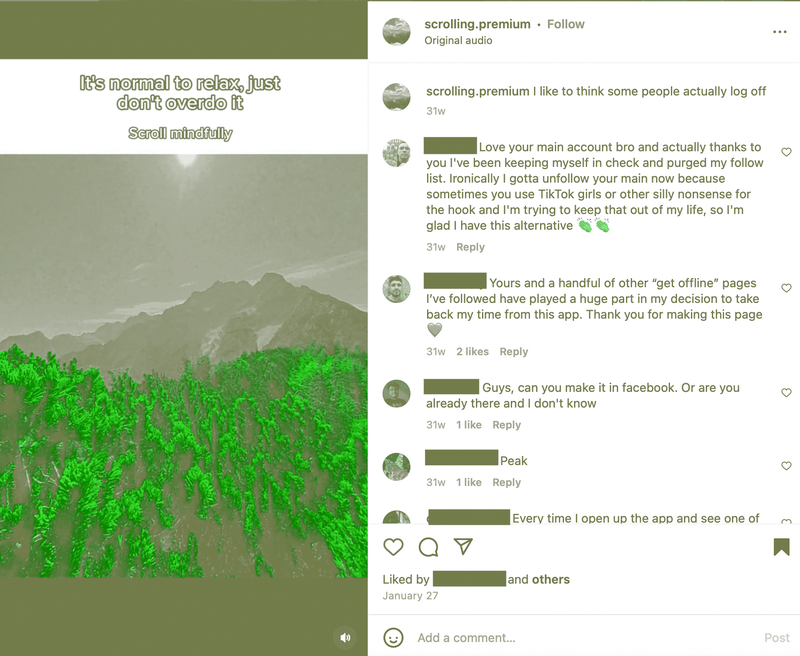
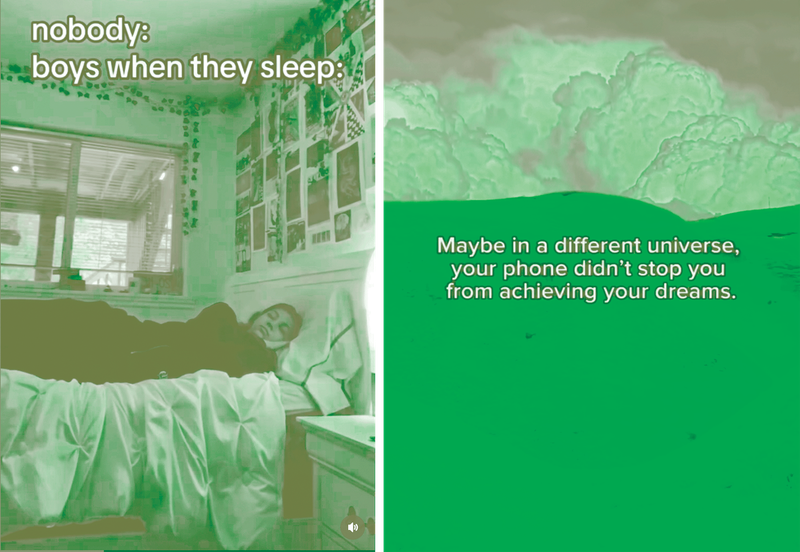
A Deliberate Intrusion. Tries to compete directly in the attention arms race by finding new ways to scream at the viewer. Intrusive content posits the Scroll as a kind of stupor that the viewer must be shocked out of through discomforting and often personally insulting attacks.
A Direct Appeal. Unlike other approaches, making an Appeal usually requires a face, someone speaking through the fourth wall to the scroller as a person. This is the most bare-bones approach to disruption, at least on its face, by focusing on the ability of one person to appeal to another. Direct appeals often took the form of someone speaking to the camera, either encouraging scrollers to adopt new behavior, commiserating on the challenge of kicking screen addiction, or proposing some new, usually media-based, solution to this problem.
Each of these approaches to Disruption Content inevitably must survive out there on the Scroll. I can’t follow every viewer of a post to ascertain how successful an approach was for motivating them to do much more than comment or like. However, the fragments of intention they’ve left behind do produce an affective environment which tells us something of the world this kind of content might promote. The perspectives rendered invisible by my focus on comments are, of course, those who don’t comment at all, those who scrolled right past, and those who heeded the call promptly and never came back. Here’s hoping they all did the latter.
Responses to Disruption Content
How Scrollers Feel
Online and in-conversation, the general attitude toward anti-screentime messaging is positive. However, a widespread feeling that we should spend less time on our phones, whether communicated through revolutionary-adjacent imagery or not, doesn’t pose a sustainable foundation for organizing.26 Without a clear intention to act, a part of me wants to view every fire emoji or ‘so true’ as just another thumb that scrolled past after a brief respite—a stand-in of sorts for those who, as folks at the workshop predicted, agreed with the message but couldn’t help checking out what came next.
The most common ‘negative’ response was disbelief and exasperation, a kind of annoyance that someone would even try this; I think, again, of the vacant stares and blank negation when I posed this genre as a possibility. However, the space left for conversation on the idea, even if the specific stimulus fell flat, did give the poster plenty of room to continue operating in if they were willing to remain involved.
While the negative responses offer a chance to negotiate, the proliferation of memes as a stand-in for social connection presents a more difficult obstruction. It might come as no surprise that ironic comments were never associated with any real intention or motivation. Other scrollers tended to flock to ironic comments, however, generating a kind of magnetism that might have colored their capacity to seriously engage with the idea.
How Scrollers Act
If this is a movement – and each disruptive post a ‘landing page’ for it – it’s a movement that draws on common feelings of discomfort with screentime to unify potential members but seems to pass on little obligation to actually act.27 Maybe this is McLuhan again, and we’re still losing this war with the medium. However sincerely a post might offer a space for users to find motivation, it will inevitably be sorted off their feeds, and most leave it up to the algorithm to bring it back around again. Discussion does not guarantee action nor solidarity, but it’s a foundation for moving in that direction that ‘almost instantly dissipate(s)’28 when it loses a focal point.
The individual focus of comments expressing motivation tracks with the often-personal tone taken by disruptive posts, which confront or encourage or engage the ‘person watching this’. Self-discipline was a common discussion point: the idea that there was ‘more you could be’ and that your screentime was ‘holding you back’. The ephemeral communities of commenters reminding each other to stay on the grind are limited examples of anything effective29—endless self-improvement in a world settled on decay.
How Scrollers are Paralyzed
The last complication was brought to my attention during the workshop discussion, when participants realized through their conversations that almost all of them related feelings of intense shame with self-awareness of their social media usage. The shame described by participants welled up rapidly in confrontations with their behavior but often dissipated with similar haste once the stimulus was gone.
Sources of shame are deeply individual, but we can think about the affective states that might trigger it. The fact is that the online environment is a tremendously overloaded information space30 and disruptive content demands additional cognitive labor from its audience to reflect on their own shortcomings. Even a gentler message still exposes a scroller to a baseline accusation that they’re spending too much time here—have done something ‘wrong’. Processing this while experiencing the Scroll’s inherent overload stresses the limit of a user’s information capacity and is likely to induce the anxiety that bridges the gap between overload and fatigue and frustration at their inability to act.31
Shame, along with most difficult emotions, is a natural progression of frustration,32 and no more productive. The outcome of frustration might be a temporary break from mindless social media usage, but it’s correlated over a longer term with adopting avoidance behaviors when encountering similar content.33 Workshop participants echoed this when they noted that the kind of disruptive content I was describing sounded like the sort of post they’d be in a hurry to scroll past because of how it made them feel. Attaching that emotional aversion to a message meant to be disruptive might sound effective – in a theater of the absurd or cruel type of way – however, when we view disruption content as one tactic in a repertoire meant to free up mental capacity for action, it becomes a serious barrier to successful work.
What Can be Done Now
The outlook seems to be that motivating social media discontinuance is ineffective, and even counter-productive, when conducted through mass communication channels. The ever-escalating urgency needed to catch a scroller’s attention34 inherently leans disruptive content toward tactics that stress the limits of a viewer’s coping ability. Whether you scroll past it or give the post a minute of your time, there’s a good chance you’ll leave it feeling worse about yourself and your ability to change your circumstances. In a media environment saturated with exhibitions of shock factor, irony, sheer noise, and real horrible things happening in the world, a disruption aimed at the viewer can be much more alienating than motivating.
However, I still hold that Disruption Content has more to offer as a tactic than its initial deployments have shown. In order to do so, however, I believe the genre would benefit from embracing a few key axioms:
This work is valuable even when it fails. Most viewers who do get offline will likely find their way back on again. This can be described as a failure, but there is still something gained. A small break to foster focus away from the screen is a valuable lived experience for someone who might now be more receptive to alternative approaches to technology in the future.35 If forcing folks offline is a gamble that usually backfires, accepting the tactic as spreading an idea more than it is affecting change can be enough.
Embracing this axiom requires a certain level of acceptance with our lives as fully realized both on and offline. This might appear to go against the ethos of Disruption Content, but it speaks more to how my own initial conception of the genre was flawed, hyper-focused on the act of going offline over the possible changes in behavior and gradual erosion of habits these kinds of posts might foster. If the purpose of every disruption is to get someone to put their phone down, falling into the self-defeating arms race of attention-grabbing stunts rapidly becomes inevitable. Turning away from that narrow definition of successful work, finding value in disruptions which might not change anyone’s minds right now, opens up the genre to explore new ways of approaching scrollers which don’t rely so much on the tugging of ultimately unproductive emotional responses like shame, anxiety, and guilt.
We’re better offline, but we can’t abandon it. A line advocating strict rejection of the virtual only reinforces a binary between it and the real, limiting the capacity for organizing to span both. Folks already working in the world understand the constraints digital platforms place on them and negotiate them as part of their daily tactics.36 Activists against the Scroll must provide space in their messaging for the continuance of these new communities.
To be an advocate only against the Scroll, with nothing more to stand for than more people looking up from their screens, is inevitably to be an advocate for almost nothing real. The message that ‘we should spend less time on our phones’ is a neutral interjection which most have been shown to receive with a vague positivity; it must be augmented with purpose and direction toward a specific cooperative vision to become meaningful. The reason to produce Disruption Content needs to be more than just cumulatively lower screentime; it must aspire toward the rejection of the Scroll as both a physical act and a mindset of dull anxiety and paralysis. That latter purpose allows Disruption Content to live in better harmony with the virtual world, seeing it as a place it doesn’t seek necessarily to abolish, but reclaim from the vampiric forces which have made of it a feeding ground. Without this clarity of vision and acceptance of a world split between the virtual and the physical, Disruption Content makes itself vulnerable to that same process of capture. By spouting an easily accepted message, it becomes just as easily co-opted to serve the cults of hustle culture and toxic productivity, among others.
We ought to expand our chosen theatres for contention to include the community, the real, and the small. Speaking of hustle culture and toxic productivity, the isolated attitude of commenters on disruptive posts reflected how most content was framing its message—a personal battle between you and your phone. Most disruption posters uploaded frequently, but didn’t publicly engage much with commenters to offer more than the same message, again and again. Many commenters engaged with posts as personal diaries or motivational touchpoints they could return to when needing a reminder to get off their phone and go do push-ups or something. The result was countless comment sections filled with energized individuals generally not communicating with each other, or not recognizing each other as already forming a kind of ephemeral community. Most energy produced by a post seemed to travel inward, re-purposed by each commenter – or their employer – to improve productivity without fundamentally changing their relationship to the machine.
Avoiding this outcome requires an extension of the work involved in disruption to include the maintenance of public response, the intentional work of meeting people where they are as they feel moved to respond to a post and helping them understand where this energy could go. We should re-imagine disruptive posts as communal spaces recognizing a shared purpose and finding in that purpose a means for collaboration. Emphasizing reciprocal behavior, group accountability, and identification with a common obligation can foster connections that extend beyond the few seconds your thumb gives a post to live.
To wrap up, let’s consider how these axioms around productive disruption online can transform into specific content tactics deployed on the Scroll.
Empowering scrollers. Overload is the baseline mental state that provides disruptive content and scrollers with such little room to operate. However, a scroller’s experience of overload is innately related to their personal capacity to cope with the information presented.37 Enhancing that capacity to intake, process, and integrate information can protect scrollers from overload38 while discouraging avoidant behavior.39
Content that disrupts the Scroll to give viewers a quieter place to recharge or discuss personal tactics for healthy mental habits online could at least improve the likelihood that more overtly transgressive messaging won’t trigger an immediate progression into anxiety and fatigue.
While not expressly pursuing a disruptive agenda, there are accounts which create content like this already, creating little pockets of calm intended to give scrollers a break from the noise. I have a post saved which I like to visit before bed, when I’m trying to detach myself from a Scroll and go to sleep, containing just a blank screen and a calming tone. These posts receive high engagement, and many commenters also mention saving them for later, making the format well-suited to deployment as a more overtly disruptive tactic.
Keeping the costume on. The bait-and-switch – where a disruptive post presents as standard nonsense before abruptly turning on the viewer – was a popular method for intruding into the Scroll. However, lulling scrollers into a sense of familiarity and then bombastically shattering it only exacerbates the misfit between them and their mental environmental.40 In this sense, presenting disruptive information in an identifiable and more or less ‘algorithm-approved’ format enhances that information’s likelihood of surviving the scrolling environment and being fully processed by a viewer. The Direct Appeal works particularly well here, as the algorithm loves human faces and hard sells. Looking at comments, as well, Direct Appeals seem to be getting the message over much easier by playing closer to the rules of the game.
Intervening between overload and anxiety. Despite best efforts, it’s still likely that many scrollers encountering disruptive posts are already experiencing some level of overload. While we can’t always avoid stressing that mental limit, overload doesn’t have to snowball into cognitive fatigue, frustration, and avoidance. That transition is highly dependent on the introduction of anxiety as a mediator.41 Staying aware of this, posters should consider how both their content and how they engage with commenters can intervene in the development of anxious feelings. Avoiding the kind of shame-inducing tactics discussed already and remaining engaged with commenters expressing those feelings once a post is out there can help keep folks from spinning into defeatism.
To avoid inducing feelings of shame, posts which take a more collective stance over isolating the viewer can promote more productive engagement with the idea. Workshop participants discussed a sense of shared struggle as a counterweight to shame, noting that others identifying with the same ‘failings’ made them feel less personally at fault for experiencing this screen addiction. Avoiding accusatory and overly urgent messaging can also work to slow the onset of anxiety over having to abandon your phone—a lifeline to the world for many.
Directing attention to structures. If you can get someone’s attention, there’s more to do with it than point out that we spend too much time on our phones. Disruption Content can be more effective by drawing attention to the structural, normative forces enforcing this negative media experience. One workshop participant shared an anecdote of immediately dropping their phone after seeing a post of a laughing Mark Zuckerberg encouraging them to continue scrolling so he could scrape off just a little more data. Changing the message from ‘you are failing yourself’ to ‘you are being used’ associates it with a higher order of struggle. The goal, in the end, is to direct the energy captured by the Scroll to meaningful organization against these very structures, so using our shared suffering under them as a catalyst for action dovetails with the entire scheme.
Organizing with other posters. One workshop participant brought up the idea of a social media strike, a mass content denial to break the dopamine loop and force viewers to do something else with their time. Whether or not that could ever be feasible, I was excited by the prospect of setting an example. Disruption can be a post screaming at you to get off your phone, it could also be your favorite meme page shutting down because there’s more important things to be posting about. It could be more public-facing organizers42 embracing offline communication as a substantive part of their cultivated media orbit. It could be smaller virtual communities disrupting their own routines by committing to more offline action and message distribution.
Disruption can be throwing open a window to let the whole void in43 and seeing who doesn’t drown in it. But I’m not sure now who that ever really helped, because disruption could also be a door opening, a welcoming gesture from a stranger in a hostile place, a spot to rest where you least expect and most need it. It’ll always be easy to ignore, might feel a little stupid to even consider, but it’ll matter to those whom it reaches. There’ll be a little more of the good distraction than there was before, a little more free attention back to get curious about what we could be doing instead, who we could become together. In a world running out of better futures, that might make at least the slightest difference.
-
(1) Charles Heckscher and John McCarthy, ‘Transient Solidarities: Commitment and Collective Action in Post-Industrial Societies’, British Journal of Industrial Relations 52, no. 4 (2014): 627–57, https://doi.org/10.1111/bjir.12084. ↩
-
(2) Kevin Tucker, ‘The Suffocating Void’, The Anarchist Library, n.d, https://theanarchistlibrary.org/library/kevin-tucker-the-suffocating-void. ↩
-
(3) I experienced this crisis of faith while leading ‘Touching Grass: How Do We Protect Our Attention Spans and Energy from the Doomscroll’, and I’m grateful to my graduate school’s student council for organizing the conference where I conducted it. ↩
-
(4) Alessandra Aloisi, ‘Art and the Power of Distraction: Bergson, Benjamin, and Simone Weil’, in The Politics of Curiosity, Routledge, 2024. ↩
-
(5) Bibiana Giudice da Silva Cezar and Antônio Carlos Gastaud Maçada, ‘Cognitive Overload, Anxiety, Cognitive Fatigue, Avoidance Behavior and Data Literacy in Big Data Environments’, Information Processing & Management 60, no. 6 (2023), https://doi.org/10.1016/j.ipm.2023.103482. ↩
-
(6) Xiongfei Cao and Jianshan Sun, ‘Exploring the Effect of Overload on the Discontinuous Intention of Social Media Users: An S-O-R Perspective’, Computers in Human Behavior 81, no. Complete (2018): 10–18, https://doi.org/10.1016/j.chb.2017.11.035. ↩
-
(7) Cezar and Maçada, ‘Cognitive Overload, Anxiety, Cognitive Fatigue, Avoidance Behavior and Data Literacy in Big Data Environments’. ↩
-
(8) Amandeep Dhir, Yossiri Yossatorn, Puneet Kaur, and Sufen Chen, ‘Online Social Media Fatigue and Psychological Wellbeing—A Study of Compulsive Use, Fear of Missing out, Fatigue, Anxiety and Depression’, International Journal of Information Management 40, no. Complete (2018): 141–52, https://doi.org/10.1016/j.ijinfomgt.2018.01.012. ↩
-
(9) Cezar and Maçada, ‘Cognitive Overload, Anxiety, Cognitive Fatigue, Avoidance Behavior and Data Literacy in Big Data Environments’. ↩
-
(10) Dhir, Yossatorn, Kaur and Chen, ‘Online Social Media Fatigue and Psychological Wellbeing’. ↩
-
(11) Vando Borghi, ‘Curiosity Among the Ruins of Homo Faber: Infrastructural Capitalism and the Politics of Care’, in The Politics of Curiosity, Routledge, 2024. ↩
-
(12) Cao and Sun, ‘Exploring the Effect of Overload on the Discontinuous Intention of Social Media Users: An S-O-R Perspective’. ↩
-
(13) Ae Ri Lee, Soo-Min Son, and Kyung Kyu Kim, ‘Information and Communication Technology Overload and Social Networking Service Fatigue: A Stress Perspective’, Computers in Human Behavior 55, no. Part A (2016): 51–61. https://doi.org/10.1016/j.chb.2015.08.011. ↩
-
(14) Sky Croeser, ‘Rethinking Networked Solidarity’, in Social Media Materialities and Protest, 1st ed., 28–41, Routledge, 2019, https://doi.org/10.4324/9781315107066-3. ↩
-
(15) Croeser, ‘Rethinking Networked Solidarity’. ↩
-
(16) Emiliano Treré, ‘Nomads of Cyber-Urban Space: Media Hybridity as Resistance’, in Social Media Materialities and Protest. Routledge, 2019. ↩
-
(17) Lee et al., ‘Information and Communication Technology Overload and Social Networking Service Fatigue: A Stress Perspective’. ↩
-
(18) Tucker, ‘The Suffocating Void’. ↩
-
(19) Attention deficit may not be the right terminology to use here, though it is the most commonly deployed. Our ‘attention deficit’ is much more so a ‘distraction deficit.’ We are well-attuned to our screens and poorly clued into the world around us. What is lacking is more so the ‘free attention’ than it is attention in and of itself. ↩
-
(20) Cezar and Maçada, ‘Cognitive Overload, Anxiety, Cognitive Fatigue, Avoidance Behavior and Data Literacy in Big Data Environments’. ↩
-
(21) Lee et al., ‘Information and Communication Technology Overload and Social Networking Service Fatigue: A Stress Perspective’. ↩
-
(22) Treré, ‘Nomads of Cyber-Urban Space: Media Hybridity as Resistance’. ↩
-
(23) Scholium, ‘The Hollowing of Anarchy: Exhibition Value’, The Anarchist Library, n.d., https://theanarchistlibrary.org/library/scholium-the-hollowing-of-anarchy-exhibition-value. ↩
-
(24) Emmi Bevensee, Jahed Momand, and Frank Miroslav, ‘No Ethical Activism Under Capitalism’, The Anarchist Library, n.d., https://theanarchistlibrary.org/library/emmi-bevensee-jahed-momand-and-frank-miroslav-no-ethical-activism-under-capitalism. ↩
-
(25) Treré, ‘Nomads of Cyber-Urban Space: Media Hybridity as Resistance’. ↩
-
(26) Heckscher and McCarthy, ‘Transient Solidarities: Commitment and Collective Action in Post-Industrial Societies’. ↩
-
(27) Heckscher and McCarthy, ‘Transient Solidarities: Commitment and Collective Action in Post-Industrial Societies’. ↩
-
(28) Croeser, ‘Rethinking Networked Solidarity’, 38. ↩
-
(29) Croeser, ‘Rethinking Networked Solidarity’. ↩
-
(30) Cezar and Maçada, ‘Cognitive Overload, Anxiety, Cognitive Fatigue, Avoidance Behavior and Data Literacy in Big Data Environments’. ↩
-
(31) Cezar and Maçada, ‘Cognitive Overload, Anxiety, Cognitive Fatigue, Avoidance Behavior and Data Literacy in Big Data Environments’. ↩
-
(32) Bao Dai, Ahsan Ali, and Hongwei Wang, ‘Exploring Information Avoidance Intention of Social Media Users: A Cognition–Affect–Conation Perspective’, Internet Research 30, no. 5 (2020): 1455–78, https://doi.org/10.1108/INTR-06-2019-0225. ↩
-
(33) Dai, Ali, and Wang, ‘Exploring Information Avoidance Intention of Social Media Users: A Cognition–Affect–Conation Perspective’. ↩
-
(34) Markus Schroer, ‘Sociology of Attention: Fundamental Reflections on a Theoretical Program’, in The Oxford Handbook of Cognitive Sociology, edited by Wayne H. Brekhus and Gabe Ignatow, 0, Oxford University Press, 2019, https://doi.org/10.1093/oxfordhb/9780190273385.013.23. ↩
-
(35) Bevensee, Momand, and Miroslav, ‘No Ethical Activism Under Capitalism’. ↩
-
(36) Treré, ‘Nomads of Cyber-Urban Space: Media Hybridity as Resistance’. ↩
-
(37) Cezar and Maçada, ‘Cognitive Overload, Anxiety, Cognitive Fatigue, Avoidance Behavior and Data Literacy in Big Data Environments’. ↩
-
(38) Cezar and Maçada, ‘Cognitive Overload, Anxiety, Cognitive Fatigue, Avoidance Behavior and Data Literacy in Big Data Environments’. ↩
-
(39) Cao and Sun, ‘Exploring the Effect of Overload on the Discontinuous Intention of Social Media Users: An S-O-R Perspective’. ↩
-
(40) Lee et al., ‘Information and Communication Technology Overload and Social Networking Service Fatigue: A Stress Perspective’. ↩
-
(41) Cezar and Maçada, ‘Cognitive Overload, Anxiety, Cognitive Fatigue, Avoidance Behavior and Data Literacy in Big Data Environments’. ↩
-
(42) Zeynep Tufekci, ““Not This One”: Social Movements, the Attention Economy, and Microcelebrity Networked Activism’, American Behavioral Scientist 57, no. 7 (July 2013): 848–70, https://doi.org/10.1177/0002764213479369. ↩
-
(43) Tucker, ‘The Suffocating Void’. ↩