chapter
Forking For Future?
The Case of the Extinction Rebellion - Just Stop Oil Split
Alberto Manconi and Daniele Gambetta
Schizoplacement
The two of us – like everyone – are already many. We met over the years by trying, more or less smoothly, to stick together, among ourselves and with others, to make class, to organize. In the process, we tried to assemble our respective obsessions, interests, addictions, skills… in groups, sure, but also as a pair—as friends, comrades in a collective, and white male students of computer science and social science, outwardly cis and hetero. When we first met, more than ten years ago, Alberto was pursuing a degree in Political Science, while Daniele was studying Mathematics. Our encounter took place in a specific context that also resonates throughout this article: a student-run space in front of the Science Department at the University of Pisa. There, together with others in a newly formed collective, we sought to bring critical thinking and political theory into dialogue with the large community of scientists in the academic town.
Those were the years of the first Facebook, but also of the long wave of hackerspaces and DIY self-productions. We found a peculiar and ‘new’ point of convergence in the digital world, in the political and strategic uses of technological innovation tools. We ended up decrypting the winds of organizational novelty blowing from the Arab world in the early 2010s, but when we struggled to parse that language, we interfaced with its Spanish translation in May 2011: the squares and ‘nascent’ social networks were being occupied.1 This interplay between the political and the digital, between street-based and network-based organizational forms, was the ‘unusual encounter’2 that nourished our collaboration. But as increasingly happens, we wrote about it while everything was mutating. It’s like mapping a terrain amid floods, fires, and earthquakes. Or collecting and processing data from a proprietary, militarized platform.
Meanwhile, we’ve also witnessed and participated in, suffered and even fueled, countless political clashes and splits. We both also split apart, polarizing between one side of us caught in the schizoid stream of ‘always-new’ social movements and ecological struggles, and the other fascinated by the contradictory, even hedonistic, contamination with digital, tech, and cultural innovation spaces. Our dichotomy reflected an open debate in the countercultural spaces connected to social movements, with those on one side more connected to the practices of grassroots politics and activism, and on the other, those seeking even clumsy and contradictory hybridizations with new environments and seemingly distant paths - makers, fab-lab, STEM entreprecariats… The first pings the second: ‘Instead of overthinking your stuff, do something militant—give us a hand!’; the other replies: ‘Instead of wasting time, write, play and learn to code!’
Naturally, we both were right and wrong. But the synergy we hoped for never happened—pretending we’ve worked on it until now, we can admit it.
Debugging these ubiquitous polarizations, we ask what protocols and affects compile them, what topologies they render. In short, we want to address the divisions fracturing political subjectivities today from the standpoint of mental and social ecology.3 We’re scanning the ambivalent emergence of new trajectories of subjectification, now that the cost of instantiating new ‘subjects’—or better, assemblages of enunciation—has dropped to zero. Not ‘on paper’, but on-line.
On the one hand, networked movements4 demonstrate infinite capacity for proliferation and singularization—of the new. On the other, when physical squares and streets empty out, profiles become identity, digital oligarchs tweak algorithms, and neo-liberal fascists learn and invest, subjectivities shrivel into followers primed for generalized war. The exit code is desertion.5 But the query remains: ‘How to do it together?’—without forgetting this isn’t about permanent unity in a suffocating class, but parsing how the multitude self-organizes into class6 and thus how the organizational eco-system articulates itself.7
We’re in the kernel of bad schismogenesis8 and polarizations: rather than replacing identities with the multiple, identities multithread and individualize. So how to fork, how to split, from this point?
We look at the split that gave rise to Just Stop Oil (JSO), which in 2022 forked from the organizing model first developed by Extinction Rebellion (XR). This fork matters because it shows how two climate movements in the UK used media in creative and effective ways, and how a fork can be a smart response when the original organizing framework no longer fits the changing context—even if that framework was carefully designed and codified.
For today’s organizers and campaigners, this is a chance to think differently about splits. Instead of seeing them only as moments of division or weakness, forks can become opportunities for the wider movement ecosystem. In this case, the fork between XR and JSO offers lessons for the climate movement as a whole.
But first, we look at the debate within open-source (OS) communities, where the idea of a ‘fork’ originally comes from. Understanding how OS communities have discussed and practiced forks helps us see why the concept can be useful for social movements today.
Forking in Open-source Communities
The hacker and OS world has been an environment for experimenting with and codifying collaborative practices. The reasons are simple: the hacker community was one of the first to build vast collaborative networks among strangers scattered across the globe. Consequently, the attempt to construct shared protocols—to borrow a telecommunications analogy—was inevitable.
This doesn’t mean that defining shared rules alone guarantees smooth sailing. However, paving the way in this direction made it possible to identify certain concepts that later proved useful for increasingly widespread processes, roles, and phenomena. Here, we’ll focus on one concept: the fork, which denotes splits in OS projects.
In the OS environment, the term fork refers to the process where, starting from an original project, a group of developers decides to create a different version, initiating an independent development line—and thus splitting the programmers, typically dividing them between those who remain tied to the original and those who join the new version. The concept of a fork has a dual interpretation: it’s both a technical bifurcation (due to the software’s features) and a social one (due to the community’s division).
The decision to fork a project is socially ambivalent. On one hand, it’s resisted and seen as a crisis for the OS community, especially given the wasted energy and resources resulting from broken cooperation ties. On the other hand, it’s the very essence of OS practice, which, at scale, enables the multiplication and differentiation of projects, effectively proliferating planned cooperation relationships.
Moreover, forked projects, remaining within the community and thus faithful to OS ethics, are distributed under free licenses with attribution to the original project (per OS and Creative Commons licenses). This ensures that even when a fork sparks conflict or friction within the community, it remains part of the same organizational eco-system.
The codification of these processes also allows us to detail the nuances of such divisions: how and how much the secondary project maintains symbiotic relations with the primary one. Observing post-fork project evolution reveals varied outcomes: most commonly, the secondary fork dies from lack of energy or commitment; in rarer cases, it surpasses the original in activity and adoption; or it may remerge with the primary via a merge of properties, driving overall innovation and progress. To quote journalist and hacker Jono Bacon in The Art of Community:
It seems to be working. In the kernel community, we’ve had lots of forks, but they tend to be technical in nature. Not all of them work, and I’m not claiming that people are happy when their fork doesn’t necessarily end up being used, and there is obviously always jockeying for position, etc., but on the whole I think it’s still a pretty “healthy competition” rather than the kinds of ugly forks that some projects have had.9
The term fork initially referred generically to a division in a project’s development, but over time, it became a codified technical term. Crucially, this codification reveals its dual nature: a split that enables new collaborations.
In software development, the term appears as early as 1980, when Eric Allman mentioned ‘forks off’ to describe divergent software versions. By the 1980s, forums like Usenet used fork to denote the creation of discussion subgroups. In the 1990s, with the rise of open-source development groups, a software fork began to imply a social fork, closer to the idea of a split, fracturing community cohesion.
While fork was initially generic and non-technical, this changed in the 2000s with the advent of Git, a version-control system (a tool to organize and streamline collaborative software development among distributed contributors). Before Git, global teams working on the same code had to manually coordinate parallel modifications, risking conflicts when simultaneous edits contradicted each other—a recipe for chaos.
Git structures and tracks code changes, managing approvals to prevent conflicts. Over time, online platforms like GitHub have emerged, built atop Git’s logic. At Git’s core is the repository—an empty project ‘space’ for code and content. Collaborative work relies on commands like:
- Clone: Create a local copy of the project to modify.
- Pull/Push: Download the project’s current state or upload your own versions.
- Merge: Combine proposed changes.
Critically, Git formalizes forking: creating a new repository from an original to develop independent modifications, which can later be proposed back to the upstream (original project).
What makes forking remarkable in open source is twofold:
- It’s a well-codified process for collaborative work.
- By formalizing division, it aligns splits with a broader macro-goal—the open-source project’s collective advancement—turning even the ‘worst-case’ scenario (schism) into a functional outcome, however potentially contested in the moment.
In To Fork or Not to Fork, hacker-activist Mako Hill analyses historical open-source forks, exploring how to maximize their benefits. A key case study is Ubuntu, a Linux distribution forked from Debian to create a more user-friendly alternative, sacrificing customization for accessibility.10
Hill highlights the unique relationship Ubuntu maintains with its parent project, questioning whether Debian is a fork or pseudo-fork, periodically incorporating modifications from the original into its fork—a dynamic of constant mutual dependence and updating.
It’s worth noting how codifying as fork a process like project division requires its abstraction and generalization, and so it’s possible to apply it in other ecosystems. Shortly after OS, though with entirely different values and spirit, the cryptocurrency world adopted the fork concept to describe the splitting of a single crypto (e.g., Bitcoin Gold and Bitcoin Cash from Bitcoin) into two distinct blockchains.
The analysis of risks and benefits of a fork has a lot to do with tools and methods of decision theory and game theory, and this could be considered as an example of study inside the bigger context of computational social science, where using mathematical tools and simplifications, models are built to search for – possible – optimal equilibrium points within complex social systems.
Thus, while the primary effect of codifying the fork process is its abstraction, the secondary effect is analogical transfer: applying these inherited structures to other ecosystems and communities. Therefore, we can propose introducing the fork concept in ecological movements’ design.
Forking in Climate Justice Movements: XR and JSO
We now turn our attention to a sphere that might seem far removed from open-source software development but shares similar organizational challenges and innovations: the climate movement. Specifically, we’ll trace the XR’s development in the UK, framing the JSO as its fork. We initially understand XR, and later the broader XR-JSO ecosystem, as a new typology of organizational ecosystem—a social operating system.
XR functioned according to a rigorously codified model outlined in its Handbook.11 Its actions followed a social software called the ‘Civil Resistance Model’ (CRM), developed by its most well-known co-founder, Roger Hallam. While Hallam drew inspiration from historical examples of civil disobedience prominent in the Anglosphere – Gandhi, Martin Luther King Jr., and the suffragettes – our activist and research experience reveals another crucial element: the tactical use of media, both social and traditional, bolstered by allies within media outlets, like George Monbiot, one of the Guardian’s leading writers in the UK who got himself arrested working with XR in 2019.
XR’s impact and its ability to merge direct action with self-mediated visibility resonates with the technopolitical strategies of Spain’s 15M movement.12 This approach aligns with the open-source ethic of transparency, treating media as an essential tool and a strategic target. Alongside transparency, XR amplified a defining feature of climate movements: participants’ moral motivation to act, measured at 95% in XR’s early London actions.13 Given XR’s intergenerational composition and its recruitment of people with no prior direct-action experience, this moral drive highlights its social operating system as a mobilizing force, framing Nonviolent Direct Action (NVDA) as a personal commitment that risks self-sacrifice through arrest.
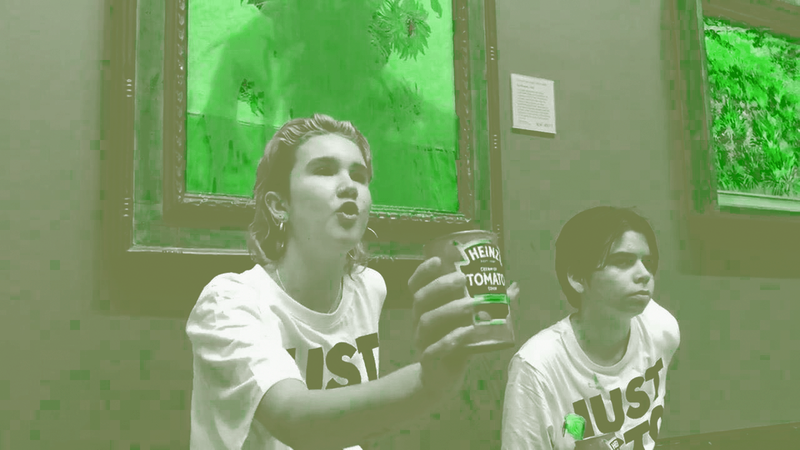
The fusion of transparency ethics and sacrificial morality becomes even more explicit in JSO, where activists declare on camera their moral obligation to carry out disruptive actions—even as they’re being arrested. One might remember the images of JSO activists Phoebe Plummer and Anna Holland who threw tomato soup at a (glass-covered) Van Gogh sunflower painting in London’s National Gallery, glued their hands to the wall, and loudly declared that there is no art on a dead planet.
XR emerged in late 2018 with just a few dozen activists and grew into a global movement following its mass civil disobedience campaigns in April 2019. Following the CRM, it brought central London to a standstill with creative, festive blockades, resulting in over 1,000 arrests within days. This drew intense media coverage, particularly in the UK but also globally, positioning XR as the radical wing of the climate movement just as Greta Thunberg’s school strikes spread to over 100 countries.
Local XR groups proliferated rapidly. To form a chapter, activists only needed to endorse XR’s three core demands (‘Tell the Truth’, ‘Act Now’, and ‘Beyond Politics’) and ten principles, disseminated through ‘Intro to XR’ events and NVDA trainings—rather than through horizontal assemblies. Coordination happened via Mattermost, though the founding group retained leadership. This structure enabled decentralized creativity within a tightly codified framework for mass NVDA. It is interesting to note how Mattermost, an open-source platform for secure collaboration in software development born in 2015, has over the years been increasingly adopted by NGOs (such as the Wikimedia community) as well as informal activist groups and political organizations to handle and manage their communication.
We can thus interpret XR as a social operating system, with the CRM as its software for executing NVDA. This ‘software’ worked during XR’s expansion, but three systemic flaws soon emerged, corresponding to adaptations made in JSO’s fork. While CRM tenets 2–5 (target capitals, break laws, remain nonviolent, repeat actions) stayed the same in A22, points 1 (mass participation) and 6 (festive/artistic protest) were significantly altered.
These flaws arise from the tension between codification and mediatization: XR’s media exposure allowed external forces to disrupt its internally coded functions. Using software metaphors, we categorize them as: 1) Bug; 2) Glitch; and 3) Error compatibility.
1. Bug
XR mobilized tens of thousands of activists, within a determined social composition: hyper-educated white middle class, predominantly urban. This represents a bug because the social operating system is functioning exactly as designed. However, this functionality becomes a system vulnerability, revealing that the design process failed to adequately account, from the outset, for how the prescribed strategy would open itself to both grassroots criticism and media exploitation—particularly during periods of rapid proliferation.
The predictable outcome emerged: an operating system designed by a small group with specific backgrounds (the known co-founders are all white professionals in research or creative fields), explicitly based on a software of individual sacrifice and willingness to be arrested, inevitably created strict social boundaries. Moreover, the fact that XR launched in a complex global city like London made these compositional limitations glaringly evident.
A particularly notorious incident laid bare this bug. Though perfectly consistent with the social software’s programming, it revealed a critical flaw that media systems then exploited. On October 17, 2019, during the ‘International Rebellion’ campaign (a two-week NVDA concentration in London and other capitals abroad), two activists boarded a Tube train at Canning Town station to disrupt service. Frustrated working-class commuters, needing to reach jobs or care responsibilities, physically confronted them. In a viral video, one activist kicked a black commuter attempting to remove them from the train.

This incident became XR’s most media-recognized moment, cementing its white middle-class image just as the movement sought maximum CRM software proliferation. Instead of planned expansion, it prompted organizational setbacks. Media exposition showed antecedent divisions: it emerged that 72% of members had already opposed actions to the Tube in an internal poll on Mattermost,14 and XR’s website clarified that the action was organized by ‘a very small group’ not involved in XR’s national decision-making bodies.15 XR Scotland criticized the movement’s lack of a class-conscious and decolonial perspective before the event.16
This wasn’t the only event exposing XR’s unaddressed bug—its specific social composition. Materials revealed problematic patterns: romanticizing imprisonment, heroizing NVDA activists, and displaying extreme benevolence toward police officers, all while ignoring how risks are differentially distributed based on class, gender, and especially race. These issues were exacerbated by involving activists with no prior experience and encouraging self-organization in both actions and material production. XR’s coded assumptions about sacrifice and arrest created exclusionary parameters that media amplification then hardened into public perception.
The Tube protest became the media’s opportunity to stamp an ‘anti-social’ and ‘racist’ label onto XR’s collective identity, which until then had been endogenously and strategically coded by its co-founders.
When JSO later adapted CRM, they maintained its core elements: the mobilized social composition didn’t fundamentally change. However, JSO introduced a simple but clear awareness of privilege that early XR had failed to convey. Based on exchanges and interviews with JSO activists, their stance can be summarized as:
‘NVDA isn’t for everyone, but we use it precisely because we recognize our privilege. That’s why we feel morally compelled to face the legal and physical consequences of disruptive actions. The severity of the crisis demands that those with the social standing to take risks must step up and do so’. This will help JSO to collaborate with workers on strike.17
The fork on ‘composition bug’ interpretation became explicit in XR-UK’s December 31, 2023, ‘We Quit’18 announcement, where it abandoned public disruption as a primary tactic, aiming to broaden participation. JSO immediately countered, declaring ‘we won’t stop’.19 This codified the terms of their split less than a year after JSO’s formation, which had begun through joint actions with XR.
Yet, from what we’ve observed, this clarification (or codification) of the division via XR’s statement hasn’t significantly heightened tensions or distance between activists in the two movements. Instead, it has formalized their differing strategic approaches while allowing continued collaboration.
2. Glitch
The glitches stem from temporary computational overloads. In XR’s case, this refers to the strain caused by the difficult interplay between apocalyptic narratives and horizontalism, but it also applies to the challenge of reconciling that same apocalyptic tone with (self)care and celebration.
Horizontalism is broadly embedded in XR’s adoption of networked-movement logics. This included tools like Mattermost for coordination and the third demand ‘Beyond Politics’—which emphasized the movement’s radically democratic nature. There, XR calls for citizens’ assemblies, with members selected by sortition (reflecting societal demographics) and binding votes on climate emergency policies. However, XR’s horizontalism was inherently contradictory compared to networked movements like Occupy, which were far more radically decentralized. As seen in XR’s official response to the ‘Tube affair’, the movement had ‘national decision-making bodies’—revealing a leadership structure above local groups. Even local groups had coordinators and, if large enough, other formalized roles. In short, while XR’s operations were highly codified, its rapid growth into a mass organization also created ambiguity. This ambiguity often led to disorientation:
- Those accustomed to traditional organizational structures (e.g., religious or union settings) perceived XR as chaotic.
- Those from grassroots or countercultural activism saw it as overly rigid and hierarchical.
To avoid projecting our own biases regarding the glitch’s media event – particularly the episode culminating in Hallam’s expulsion from XR – we directly quote from Wikipedia’s entry on XR and JSO’s co-founder:
In an interview with Die Zeit on 20 November 2019, Hallam said that genocides are “like a regular event” in history and he also called the Holocaust “just another fuckery in human history”. He made this comment in the context of a broader discussion about genocides which have been committed throughout human history, in which Hallam compared the Nazi Holocaust to the atrocities in the Congo Free State in the late 19th century; as he stated, the “fact of the matter is, millions of people have been killed in vicious circumstances on a regular basis throughout history” and he also stated that the Belgians “went to the Congo in the late 19th century and decimated it.” Hallam’s controversial comparison drew support from African activists, the Stop the Maangamizi: We Charge Genocide/Ecocide! Campaign, who were critical of the tone of his language but lauded him for his honesty and his willingness to highlight the crimes which colonial powers committed in Africa. However, his comments about the Holocaust, perceived by some as anti-Semitic, resulted in his expulsion from Extinction Rebellion in 2020.
The interview, published in the German magazine just one month after the Tube incident, appears in the context of media attacks against XR, where Hallam’s eccentric figure played a particularly attention-grabbing role. This role continued until late 2022, when, as co-founder and organizer of JSO, Hallam again found himself at the center of a scandal in the right-wing media. A ‘The Sun’ journalist, pretending to be interested in participating in an action, infiltrated an online JSO organizational meeting that was planning a major action, which was then actually carried out—blocking the M25 London Orbital Motorway. Before the action took place, the journalist reported the story in The Sun and to the police, who then preemptively entered Hallam’s home and seized his computer equipment. His main offence had been telling participants in this meeting that they would take part in the ‘biggest disruption in modern UK history’.20
Years later, in the same week when JSO saw its demand approved by the (new) government led by the Labour Party, Hallam was sentenced to 5 years in prison, with four other activists receiving 4-year sentences for conspiracy to commit public nuisance.21
Hallam’s language is markedly apocalyptic. This tone corresponds to the urgency of organizing increasingly ‘disruptive’ actions, as evidenced by his incriminating statement. Such an approach appears to disregard other crucial elements of XR’s overall operating system, such as decision-making horizontality, regenerative care-based culture, and festive artistic expression. Or, more precisely, these elements are conceived by Hallam – and by many activists later involved in JSO – as clearly subordinate to the moral urgency of acting to stop climate and societal collapse.
The modification implemented by JSO involves subordinating any horizontality, as well as any care practices and aesthetic/attire choices characterizing activists, to NVDA understood in a distinctly disruptive sense. Point 6 of the CRM originally stated: ‘If we can’t dance at it, it isn’t a real revolution. The artistic communities need to be on board: it’s a festival. We are going to show the media that we’re not sitting around waiting to die any longer. We’re gonna have a party. Obviously.’22 But this was completely overturned: JSO’s actions would instead bring disruption into the quintessential spaces of artistic communities—museums.
The effectiveness of museum actions has been endlessly debated. Yet despite JSO beginning by blocking fossil fuel infrastructure, it was the museum actions that ultimately allowed it to recapture global media attention, after the 2019 London Bridge blockades and Tube incident. This shocking move took apocalyptic narratives to their extreme conclusion, while following in the footsteps of the Suffragettes and ‘respecting’ protective glass: they draw attention to time running out due to the climate crisis, on this side of the glass.23
3. Compatibility error
The conception of temporality and its narrative framework represents a defining feature for climate justice movements, particularly those emerging in Europe and spreading globally during 2018-19. The necessity to embed urgency so fundamentally within the organizational system substantially differentiates XR from any other operating system, social or otherwise.
To complete our technological analogy, we propose framing the last XR issue in the shifting external context as a ‘compatibility error’ arising from these changes.
XR’s mobilizing capacity was initially enabled by two ‘temporal’ and external factors:
- The IPCC’s stark declaration that ‘only 12 years remain to meet Paris Agreement targets’ (marking the first time a concrete temporal limit had been established).
- The media spotlight on Greta Thunberg’s early speeches.
XR was designed to harness this wave of mobilization. However, the sudden emergence of the pandemic crisis radically altered the landscape, abruptly terminating the climate movements’ mass participation capacity. Hence, our analogy to a compatibility error—when software becomes incompatible with its broader operating system and environment.
This pandemic shift in the human, political, and media ecosystem directly undermined a core CRM requirement (point 1.) articulated by Hallam: ‘First, you need the numbers. Not millions, but not a few dozen people either. You need several thousand: ideally, 50,000’.24
Tens of thousands was the scale of XR in 2019. Therefore, XR in the UK never completely faded, even when, from 2020 onward, it could no longer mobilize tens of thousands for NVDA, but continued to engage thousands nationwide through legal and public actions, artistic activities, and community regeneration. By contrast, JSO—and the entire Western A22 network it references and belongs to—operates as a single-issue campaign where self-sacrifice is key. While it recruits activists from XR, its aim isn’t to build an equally broad alternative: it focuses on one specific yet substantial demand—halting new oil extraction. Through this narrow focus, it manages to radicalize the dramatic urge for action against the climate and social collapse, and to forge new alliances. But once its demand was recently met, it chose to dissolve.25
The emotional and bodily expression during disruptive actions made the climate crisis tangible—a crisis otherwise confined to a hypothetical future in media discourse and collective imagination.
What’s interesting about the XR-JSO fork is that many activists continued collaborating with both ‘wings’ of the movement. Even Hallam and prominent figures of XR, co-authored shared assessment documents.26 In our view, this marks a new possibility for rethinking organizational forms in such movements, where the branches of a fork remain parts of the same ecosystem, still recognizing themselves as such despite actual divisions.
This is why we believe framing XR as an operating system—using a modifiable, adaptable social action software like the CRM—ultimately captures a shift within the system itself: XR, through the JSO fork and the ‘We Quit’ statement, does something significant that can’t be understood through traditional leftist ‘political splits’ where division creates identitarian conflicts. Instead, XR de facto positions itself as ‘one part’ of a broader whole – a new social operating system? – while JSO represent another partial approach within a larger organizational and operational framework, inspired by radical flank theory.
Whether this was a fork or pseudo-fork, conscious or subconscious, planned or not, seems largely irrelevant. What matters is that these moves politically, mediatically, and organizationally define an ecosystem. Not the ‘complete’ one which Nunes’ organizational philosophy alludes to, but still—a functioning, adaptive one that reveals new possibilities of thinking through relationships and splits between organizations.
Conclusions
During the 2010s, scattered experiments in organizational innovation occasionally redefined the relationship between internal processes and external communication. These attempts—sometimes successful, sometimes clumsy—sought to blend digital tools with process design to create organizations that could potentially break free from traditional forms. These efforts reflected a broader tension: the desire to leverage digital platforms for rapid scaling and decentralized coordination, while still grappling with the need for sustainable structures beyond mere viral moments. This was evident in networked movements and later reflected in digital parties,27 but, in our view, this drive continued more substantially – and away from the spotlight – within transfeminist, antiracist and ecological movements, which defined grassroots politics in our times.
In short, a growing tendency toward codifying the social processes emerges through which movements develop and reproduce themselves, rising from the ruins of traditional organizations.
With this text, we aimed to introduce a concept – that of the socio-political fork – which we believe can help deepen and innovate how divisions within social movements are understood, particularly concerning the challenges they encounter in their development. This includes exploring both the parallels and differences with collaborative models in software development.
We argue that the trajectory of XR, and later the fork represented by JSO in the UK, provides a meaningful foundation for grounding the notion of the socio-political fork in contemporary movements. Indeed, the fork analogy has already been used to analyze social organizations, but primarily in studying structures operating within competitive ecosystems—whether political or market-oriented.
We therefore define – provisionally, of course! – the socio-political fork as a division that occurs based on a rather precise codification of a social movement. It clearly signals, from the outset, the potential to expand both the capacity for action and external collaboration within the original or main organizational ecosystem—what we have here called the ‘operating system’.
Indeed, identitarian divisions have historically proven prevalent and devastating for workers’ movements and the left. The Italian term ‘scissione’ – like religious schism – marks the onset of fratricidal, identity-driven conflict. By contrast, the open-source concept of forking reveals the potential for alternative yet complementary paths of development. We are certainly not the first to highlight the urgency of non-identitarian organizational bifurcations transcending horizontal dreams and vertical nightmares: more than others, Bogdanov and Guattari developed theoretical approaches deeply rooted in the pivotal political events of Russia 1917 and Paris 1968. Their concepts of tektology and disingression, or ecosophy and transversality, embody lifetimes of committed theoretical and practical research toward alternative ways of organizing – and even of ‘fighting out’ constructively – while drawing nourishment from the political and technological innovations of their eras.
The modest question we wish to raise through this text is whether our times, now that the house is burning and we’re out of time, might finally be ripe for fighting it out… if not less, then at least better!
-
(1) Daniele Gambetta (ed.), Datacrazia, Ladispoli: D-Editore, 2018. ↩
-
(2) Maria Galindo, Femminismo Bastardo, Milano: Mimesis Edizioni, 2022. ↩
-
(3) Felix Guattari, Les trois ecologies, Paris: Galilee, 1989. ↩
-
(4) Manuel Castells, Networks of Outrage and Hope: Social Movements in the Internet Age, Cambridge: Polity Press, 2012. ↩
-
(5) Franco “Bifo” Berardi, Disertate, Milano: Timeo Edizioni, 2023. ↩
-
(6) Michael Hardt and Antonio Negri, ‘Empire, Twenty Years On’, New Left Review 120 (Nov-Dec 2019). ↩
-
(7) Rodrigo Nunes, Neither Vertical Nor Horizontal: A Theory of Political Organization, London: Pluto Press, 2021. ↩
-
(8) Gregory Bateson, Steps to an Ecology of Mind, Chicago: University of Chicago Press, 1972. ↩
-
(9) Jono Bacon, The Art of Community: Building the New Age of Participation, Sebastopol, CA: O’Reilly Media, 2009. ↩
-
(10) Benjamin Mako Hill, ‘To Fork or Not to Fork: Lessons From Ubuntu and Debian’, 7 August 2005, https://mako.cc/writing/to_fork_or_not_to_fork.html. ↩
-
(11) Extinction Rebellion (ed.), This Is Not a Drill: An Extinction Rebellion Handbook, London: Penguin Books, 2019. ↩
-
(12) Javier Toret (ed.), Tecnopolitica y 15M: La potencia de las multitudes conectadas, Barcelona: Editorial UOC, 2015. ↩
-
(13) Clare Saunders, Brian Doherty, and Graeme Hayes, ‘A New Climate Movement? Extinction Rebellion’s Activists in Profile: A Report’, CUSP Working Paper Series, no. 25, 15 July 2020, https://cusp.ac.uk/themes/p/xr-study/. ↩
-
(14) Matthew Taylor, ‘“It has been polarising”: tube protest divides Extinction Rebellion’, The Guardian, 17 October 2019, https://www.theguardian.com/environment/2019/oct/17/london-tube-protest-divides-extinction-rebellion. ↩
-
(15) Extinction Rebellion UK, ‘Today’s tube action: how it happened’, 17 October 2019, https://extinctionrebellion.uk/2019/10/17/todays-tube-action-how-it-happened/. ↩
-
(16) Extinction Rebellion Scotland, ‘In the last week, two widely-shared images […]’, Facebook update, 19 October 2019, 15:31, https://www.facebook.com/XRScotland/posts/pfbid0AtxBHskydJAFmf8orwycYzVcCeUGTUXbzJE8aVbiiGE6titTfPTJ5RVynZYnFnbwl. ↩
-
(17) Alberto Manconi, ‘Tempo scaduto? L’esperienza di Just Stop Oil’, Zapruder 64, Profondo Nero, 2024. ↩
-
(18) Extinction Rebellion UK, ‘We Quit’, 31 December 2022, https://extinctionrebellion.uk/2022/12/31/we-quit/. ↩
-
(19) Sophie Squire, ‘Just Stop Oil activist - “We aren’t going to stop”’, Socialist Worker, 15 January 2023, https://socialistworker.co.uk/news/just-stop-oil-activist-we-arent-going-to-stop/. ↩
-
(20) Damien Gayle, ‘M25 protest recruiter called for “biggest disruption in modern UK history”, court hears’, The Guardian, 25 June 2024, https://www.theguardian.com/uk-news/article/2024/jun/25/m25-protest-recruiter-called-for-biggest-disruption-in-modern-uk-history-court-hears. ↩
-
(21) Haroon Siddique, ‘Just Stop Oil jail terms raise questions over harsh treatment of protesters’, The Guardian, 19 July 2024, https://www.theguardian.com/law/article/2024/jul/19/just-stop-oil-jail-terms-questions-over-harsh-treatment-of-protesters. ↩
-
(22) Extinction Rebellion (ed.), This Is Not a Drill, London: Penguin Books, 2019. ↩
-
(23) Alberto Manconi, ‘Al di la del quadro: rappresentazione e proteste nel Regno Unito’, Dinamopress, 17 October 2022, https://www.dinamopress.it/news/al-di-la-del-quadro-rappresentazione-e-proteste-nel-regno-unito/. ↩
-
(24) Extinction Rebellion (ed.), This Is Not a Drill, London: Penguin Books, 2019. ↩
-
(25) News Agencies, ‘UK activist group Just Stop Oil holds its last climate protest’, Al Jazeera, 26 April 2025, https://www.aljazeera.com/news/2025/4/26/uk-activist-group-just-stop-oil-holds-its-last-climate-protest. ↩
-
(26) Clare Farrell, Gail Bradbrook, and Roger Hallam, ‘Telling the truth so we can learn from mistakes - reflections five years on’, Extinction Rebellion Global, 19 October 2023, https://rebellion.global/blog/2023/10/19/reflections-5-years-on/. ↩
-
(27) Paolo Gerbaudo, The Digital Party: Political Organisation and Online Democracy, London: Pluto Press, 2019. ↩