chapter
Obiezione Respinta
obiezionerespinta.info/en/
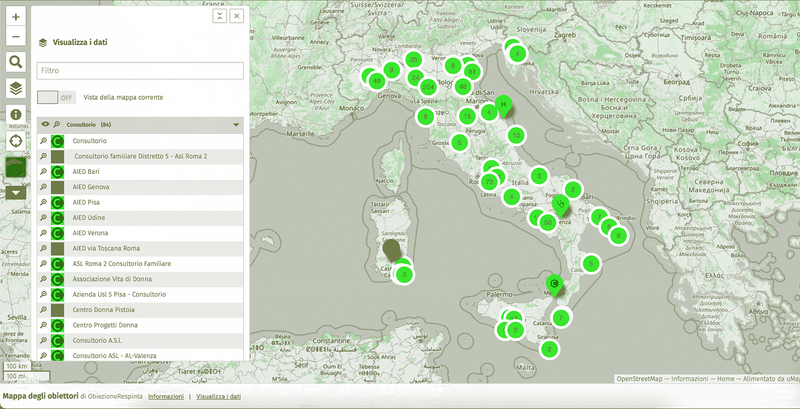
Obiezione Respinta is a transfeminist, counter-institutional infrastructure situated at the intersection of reproductive justice, data activism, and feminist media practice. Emerging from within the Non Una Di Meno network, the project responds to the pervasive mechanism of obiezione di coscienza (conscientious objection) that continues to obstruct abortion access and reproductive care across Italy. Conceived as both a digital platform and a collective tactic, Obiezione Respinta reclaims cartography as a feminist tool of resistance—transforming the logic of mapping from an instrument of control into a medium of solidarity, visibility, and epistemic disobedience.
Built from anonymous testimonies, the project’s interactive map traces the lived geographies of access and denial in hospitals, counseling centers, and pharmacies. More than a dataset, this cartography functions as a performative archive: a dynamic interface where affect, experience, and situated knowledge converge. By turning individual testimonies into collective intelligence, Obiezione Respinta generates a counter-cartography of reproductive injustice that makes visible the hidden architectures of refusal and neglect embedded in the national healthcare system.
Operating as a horizontal and self-managed network, through hybrid assemblies across regions, the project enacts a feminist politics of infrastructure. It transforms the act of mapping into a form of commoning—an ongoing process of collective autoformazione (self-education) that redefines data as a site of care and shared responsibility. This distributed model resists institutional capture, fostering new modes of collaboration and solidarity across feminist, queer, and activist communities.
Obiezione Respinta simultaneously performs a juridical and epistemic critique. Re-reading Article 9 of Law 194, which grants the ‘right to objection’, the project exposes how patriarchal jurisprudence constructs conscience as a privilege exercised over the bodies of others. Against this asymmetry, it posits reproductive freedom as a collective right: to free, safe, and guaranteed abortion, to bodily autonomy, and to non-binary, decolonial healthcare that transcends gender and ethnic hierarchies.
Through its open-access mapping platform, the collective develops a feminist infrastructural aesthetics—a tactical media practice where interface design, testimony, and activism merge into a shared site of political composition. The map becomes both an investigative and generative device: a living topology of resistance that documents and disrupts the biopolitical management of reproduction.
By reframing data as a field of feminist struggle, Obiezione Respinta intervenes in the colonial and patriarchal logics of visibility that structure contemporary governance. It transforms witnessing into world-making, reclaiming the right to narrate, to know, and to decide.
Obiezione respinta. Sul nostro corpo, sulla nostra sessualità decidiamo noi.
(Obiezione respinta. Over our bodies, our sexuality—we decide.)