chapter
Defiant creative investigations and technofascism
Eke Rebergen
‘How can we continue to attack this panoptic hellscape and get away with it?’ This question was posed in a rather provocative text titled ‘Cars as Cameras’ from 2023.1 The authors aim for bold resistance against large-scale police surveillance made possible by unprecedented data collection. They promote fighting back against existing proliferation of harmful high-tech machines and to try to halt the ecologically destructive technological infrastructures of big tech companies. These interlocking systems and devastating effects for them constitute a panoptic hellscape that they resolutely oppose. They don’t rely on reflexive methods or ethical frameworks, nor believe in developing so called responsible technology or more cautious implementation strategies. Following their line of reasoning: artist and designers today are stuck in a slumber of ever more undecisive critical approaches and abstract conservative strategies, while there is plenty need for thorough and defiant counter investigations and decisive oppositional action. It is time to break through the current creative apathy.
The authors of ‘Cars as Cameras’ propagate direct action. They advocate forms of sabotage and destruction. Their specific target: Tesla. They give examples of previous attempts of smashing car windows, suggest many other points of intervention ranging from the network of charging stations to vehicle lots, and explain how to minimize the chance of getting caught. When fighting against something that constantly monitors and oppresses, caution is advised to avoid unwanted consequences, lawsuits, or unpleasant repercussions. Strike wisely, the authors proclaim.

Fig 1: Front of Cars as Cameras booklet made by No Trace Project, text by Rose City Counter-Info.
Designers and artists are in a good position to strike wisely. They can develop and iterate all kinds of experimental forms of resistance and work towards clever creative disruptions. Some indeed are already demolishing Tesla cars as a public art event2 or dropping enormous Olmec head sculpture on top of these cars as an artistic statement.3 Others decided to make ‘I bought this before I knew Elon was crazy’ stickers, suggested creative projects for debadging4 or disguising the car.5 Also, culture jamming projects were carried out like the Swasticar campaign making hatred for Elon Musk visible on the street6 or the contradictory cybertruck7 featuring the Palestinian flag and keffiyeh design. Still, there is a risk of getting caught up in mere pranksterism and niche critical creative work. Few creatives seem willing to explore the boundaries of what art and design can achieve beyond the more well-known rhetorical designs and aesthetic art performances. Let us proceed with determination in developing further creative research for attacking the panoptic hellscape. For this we will delve into voltage glitching, rescuing snails, and understanding tiki bars in Texas.
Disturbing and disclosing Tesla
We remain focused on Teslas as the primary target for exploring further creative possibilities. Based on investigations from the No Trace Project (an activist collective that also turned the ‘Cars as Cameras’ text into an easily printable zine), Tesla cars are to be understood as part of the vast state’s surveillance network and the omnipresent security systems. All nine Tesla cameras are actively recording while the car is moving, but also when the car is parked and turned off in what is called the ‘sentry mode’. The publication offers insights into the Samsung cameras used and the AI programs that process the data. The videos can be recovered afterwards and in some cases the footage might be kept indefinitely. In the ‘Cars and Cameras’ text concrete examples are mentioned of how such data is used by the police. The authors refuse being constantly recorded and oppose the possibility of being identified all the time. They offer some interesting insights into the technologies used and point to promising directions for further investigation.
Their main concern is to stay unrecognizable, for example through wearing loose-fitting clothing and sunglasses, and by staying out of the field of view of these cameras. And to use spray paint to cover the cameras when needed. Although such practical suggestions are informative to dodge the omnipresent technologies of control, it seems necessary to get beyond mere keeping out of sight and a little window smashing or spray paint now and then. Both staying under the radar and engaging in forms of vandalism do not provide much further insight into the ongoing innovations and inner workings of these systems, nor the possibilities for scaling up resistance. There must be more diverse, thoughtful and investigative ways and embodied experimentation to counter these complex systems. It would be helpful if we can single out further specific malicious code or functioning, share insights with others and collaborate, and more thoroughly counter harmful technological infrastructures that surround us.
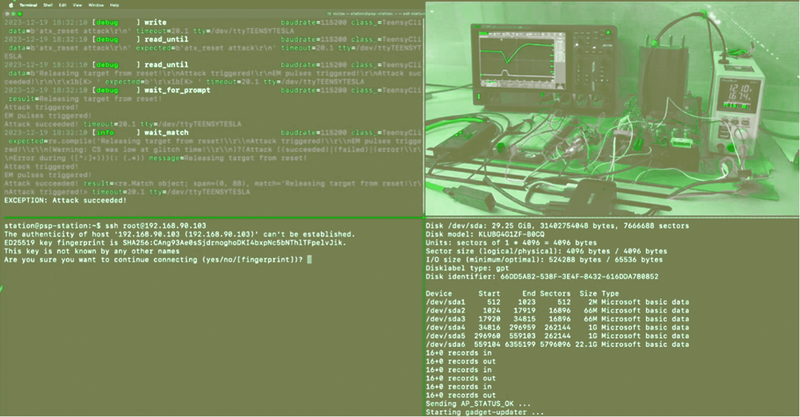
In their presentation for the Chaos Computer Club of December 2023 in Hamburg, one of the main European hacking conferences, Niclas Kühnapfel, Christian Werling and Hans Niklas Jacob explained how to get ‘back in the Driver’s Seat’ of Tesla.8 These presenters had been researching the Autopilot Hardware of the Tesla and they presented a successful so called ‘fault injection attack’ and extraction of encrypted keys to make it possible to connect to Tesla’s autopilot API. The method used for fault injection was ‘voltage glitching’. That is a creative and elusive trick to get access to software by manipulating hardware. Don’t worry: it does not matter if you haven’t got a clue what this means. The setup in the picture will give you at least some idea of the kind of technological skills needed, and the type of work done. They showed how to defiantly dig into these complex technological systems and disclose what these powerful black boxes do, uncovering what rules it is programmed to perform, and what its makers wish to hide from us in inaccessible domains of these machines. They showed it is possible to develop new ways to indeed attack Tesla’s most locked away technological systems and understand its hidden inner workings. Although it certainly is not easy, they considered it fun and self-empowering. They got a big round of applause from the crowd.
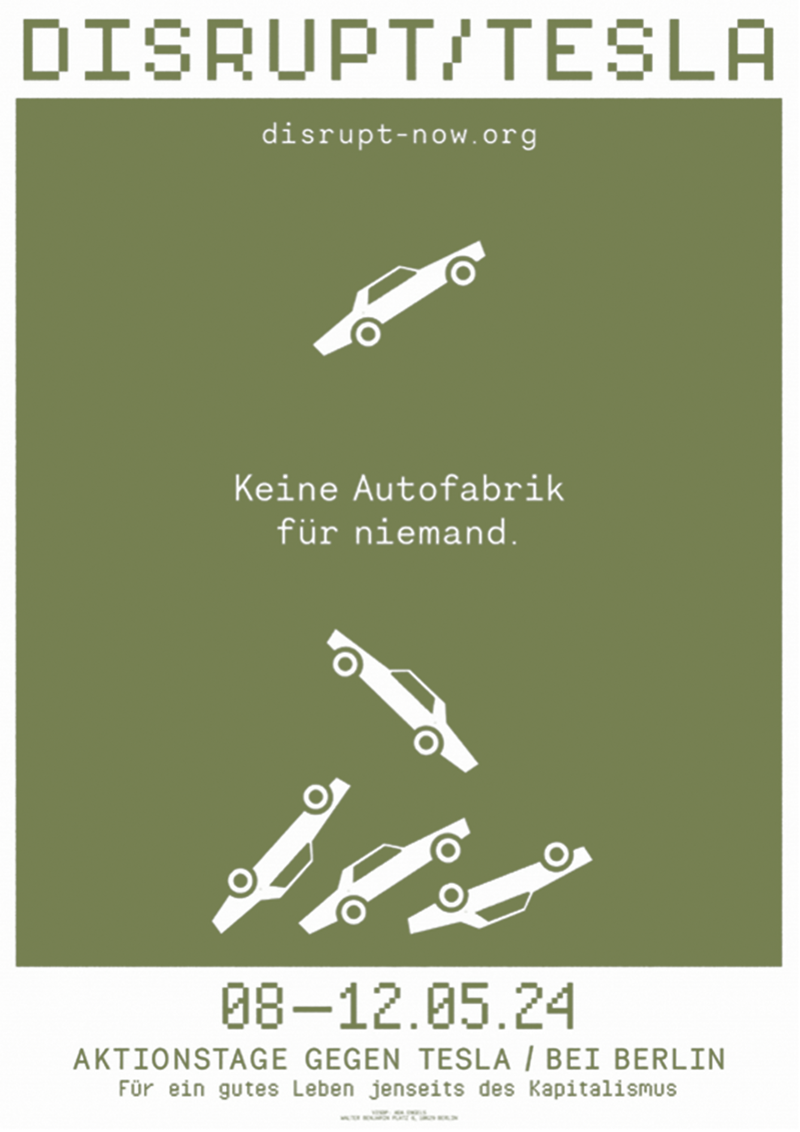
A couple of months later a diverse group of activists tried to halt Tesla’s expansion of its Gigafactory in Grünheide’s forest near Berlin. It was organized by groups such as the Grünheide Citizens’ Initiative, the ‘Turn Tesla off’ alliance, and other groups like Fridays for Future. From March 2024 onwards people already occupied the adjacent forest, creating tree top houses and working together with the residents of the area. It culminated in large scale action days encouraged and strengthened by Disrupt, an alliance including ‘Ende Gelände’ which is known for earlier occupations and large-scale protests. Together they protested ‘car capitalism in a green guise’ including the supply chains, felling of trees and destruction of forests, immense water usage, and more general the proliferation of individual transport in the face of the evolving climate catastrophe.9 Leading up to these protests, some engaged in further militant action like the ‘Switch off Tesla! volcano group’ that disrupted the functioning of the Tesla factory by setting a power station on fire, claiming that ‘the longer the Gigafactory remains closed, the better for the planet’.10 In their statement they claimed they even rescued snails from electricity pylons before setting these pylons on fire a few minutes later.11 I suppose mentioning these snails was important to them because rescuing them symbolized something bigger. They were not out to destroy but to save lives. And while not everyone will feel like setting power stations on fire or risk getting arrested, there is something sympathetic in their way of reasoning: ‘We don’t make people mine lithium in horrible conditions. We don’t destroy the earth. We don’t trade grain on the stock market. We don’t want to kill other people or shrug off their deaths to maximize profits.’ They wanted to take out some of the infrastructure, find out what this would set in motion, protect what should not suffer from these vast tech expansi
ons, and be sure to fight for life for all. They showed it can indeed be done and by staying anonymous they got away with it.
As a final example, again a couple of months later, the ex-Tesla employee Lukasz Krupski was in court for revealing critical safety issues of Tesla’s cars. He had disclosed Tesla vehicles ‘unexpectedly accelerating or braking when their autopilot function is switched on’ by bringing ‘thousands of safety complaints from Tesla customers to German business paper Handelsblatt and US regulators, after trying to raise the alarm about company procedures internally.’12 A recurring consequence is for example that Tesla taxis collide with outdoor seating areas. As he explained in an interview with BBC this is a matter of general concern: ‘It affects all of us because we are essentially experiments in public roads. So even if you don’t have a Tesla, your children still walk in the footpath’.13 Krupski got away with it in court. The judge affirmed he had acted as a whistleblower and ruled that Tesla ‘unlawfully retaliated’ against him. But the point is obviously not to win such court cases. It is the whistleblowing and disclosing. It is about making sure other people know what is happening even though it unfolds out of sight and to adjust the general impression of smooth functioning of these complex technological systems we encounter every day.
What all these examples have in common is that they develop oppositional stances that point out programmed harm and try to disclose the unacceptable consequences of tech functionalities. As such it highlights but also attacks aspects of the hellscape we are living in. They show there are creative ways to disrupt the technology in these cars and counter their uncharted development and functioning. They emphasize it is possible to find supportive platforms and reach like-minded communities the moment you reveal things that the Musks of this world don’t like revealed. And the list can be extended towards other branches of his tech imperium. Like the Carrizo Comecrudo Tribe of Texas that are currently fighting SpaceX to protect Boca Chica Beach land with DIY documentaries and heartfelt personal stories.14 Or the Black feminists that explicated the white supremacist ideology that underpins platform affordances after Twitter was taken over by Musk.15 Or the Neuralink employee who released information to Wired about the death of a monkey that was euthanized after a brain implant broke off.16 As these examples show, it is possible to go beyond scratching the surface and ventilating a minimal sort of critical awareness. It extends the current search for ways to get beyond symbolic actions, tweet wars and digital activism, and get away from the self-referential and often obsessively used online platforms to work towards more in-depth investigations, alternative infrastructures and community action.17
The question ‘how can we continue to attack this panoptic hellscape and get away with it?’ points towards this kind of upping the creative stakes. We should desperately (re)learn ourselves to further probe, speak out, reveal, disclose, obstruct, destroy, organize, collectivize, conspire. Today, this is the challenge for meaningful creative experimentation in the face of technological injustice, extraction, and surveillance. Let’s channel our creative and investigative powers and defiantly experiment with attacking and countering the panoptic hellscape. And make sure we point out the most pressing and worrisome aspects of it.
Understanding technofascism’s specifics
Unfortunately, it is not just about some technical details that are instrumental for some well-defined social problems. Technology today plays a multifaceted role in all kinds of societal issues and gets often infused with dangerous ideologies or unjust future scenarios. We need to be aware of the dark historical lineages and hardly noticeable oppressive social dynamics that might be at play. This is where it gets particularly interesting. Here the need for additional creative research becomes even more apparent.

Fig 4: Cover of book Cooling the Tropics.
Recent academic research has developed interdisciplinary approaches to address the entanglements of technological functioning, undesirable social tendencies and broader oppressive systems. Specific technological details and disclosing can make us aware of how nasty histories and problematic ideologies can continue to shape, and be reaffirmed by, these high-tech everyday products. The devil is often in the details. Like the tiki bar near the SpaceX launchpads in Texas. It is just a small detail of the resort village in Brownsville, shown in a journalist’s photo of the SpaceX campus. There is nothing particularly special about it at first sight. But this simple fact of having this tiki bar at SpaceX becomes significant when connected to the histories of imported commodification and still pervasive colonial imaginaries. As Hobart’s recent mind-blowing research highlights,18 Hawai’ian shirts and cocktails are not accidentally connected to spaceflight or Musk’s ideologies. Through documenting and investigating technologies of refrigeration and cooling Hobart points out the ongoing conditioning power of imaginaries of transportation, masculinity, scientific research, and environmental politics. Questioning the reason of existence of this tiki bar can lead toward a thorough rethinking of the histories of oppression. It reminds us of the much older writings by the Dutch collective Bilwet, that already linked together and exposed the technological conditioning in the dreams of space travels, car culture, tourism and healthcare.19 And like Hobart shows, through reawakening the local mo’olelo (storied histories) and disclosing the colonial archives, we can rethink the interrelated stories of chilled drinks, childhood nostalgia, and dreams of outer space. Only then we can reevaluate the specifics. The simple technology of refrigeration, so common for all of us, must be understood as linked up with extractive, restrictive, and often outright repressive social structures and settler colonialism that are somehow also tied to SpaceX and especially this tiki bar in Texas. It opens a rich world of alternative perspectives and readaptations. We ultimately need this type of interdisciplinary research and thinking to get to the more fundamental understanding and overturning of the hellscape we currently face.

Fig 5: (Screenshot from video of projections on Tesla factory by Led by Donkeys and Political Beauty)[https://www.instagram.com/reel/DFKlMtUoiBE]
Ultimately, as was done in the projections on the Tesla factory in Germany realized by Led By Donkeys and Political Beauty,20 this means we must point out fascist resurgences. The projections were shown days after Musk’s Nazi salute. It documented Musk’s relations with right wing politicians in Europe. But the uncovering of repressive social imaginaries and the inherent fascist tendencies shouldn’t stop there. Fascism surely is not just some Nazi salute or alignment with right wing politicians. It is a (potential) broad social base that challenges bourgeois institutional and cultural power, re-entrenching the already devastating economic and social hierarchies.21 Whether the current tendency should be understood as a (latent) form of late fascism, according to Toscano rooted in a history of racial capitalism, systemic violence and crisis22 or post-fascism of heterogeneous and transitional movements,23 what concerns us here is the interdependence with new technological innovations. In current technofascist developments, there is not just a new authoritarianism driven by technocrats24 or post-internet far right thriving on the message boards and platforms with its strategic concealments, shitposting and pranksterism,25 or MAGA fascist-propaganda slop26 and other the cringe and cruel bullshit aesthetics of right-wing ideology.27 Technofascism might well be the general intensifier and exacerbator of the panoptic hellscape in its current multifaceted forms.
You certainly cannot just post your way out of fascism.28 To counter the indirect and invisible mechanisms of racism and discrimination, consisting of microaggressions and everyday harm, we must battle the interconnectedness of covert communication and social media effects. This can be an immediate, poetic, and humorous creative practice as the online exhibition by Error 417 shows.29 But we need to dig deeper and uncover what lurks behind this all. As Eschmann reminds us, once such racism and ideology of domination was symbolically covered by emblematic pointed white hoods, but now it is often covered by a metaphorical hood of subtlety.30 His inclination to make sure the ‘hood comes off’ we extend here towards Tesla cars and beyond. Understanding what is beneath the hood of the car, or more broadly the shiny surfaces and designed interfaces becomes extra relevant when understood in relation to Musk’s clear right-wing radicalization, visible in his embracing of far-right movements and conspiracy theories.31 McQuillan’s assessment of the fascist inclinations of artificial intelligence32 can only be made based on extensive knowledge of the actual technologies and different social contexts it operates in. As Saraiva showed in ‘Fascist Pigs’ for earlier periods in time, analyzing techno-scientific particularities can be key to understanding fascist mass mobilizations, infrastructural power of a fascist state, and the design of a rooted-in-the-soil national community.33 A kind of antifascist infrastructural analysis is not only important for understand how fascism works but also for knowing how it can be creatively fought and undermined.34 To engage in such interdisciplinary research to uncover inherent undesirable social tendencies and broader oppressive systems, it is necessary to deepen our understanding and make more technologically informed assessments of the pervasive ‘microfascist machineries’ as described by Bratich, with its anaesthetizing and abstracting social effects.35
Tech-savy creative research and (re)learning
There is already some attention for the importance of antifascist action and thought in artistic exploration (or any creative interventionism or investigation) beyond the reactive culture wars. 36 We can expand on the call to ‘turn to the space and time of the studio’ into a ‘unique contribution of art education to antifascist struggles’ that Lewis and Hyland propose as antifascist politics of studioing37 and take the kind of practice they suggest towards creative disruption of and reimaginations of technological systems. Let’s incorporate the disclosing of the workings of technology in collective oppositional learning within feminist counterpublics, channeled through spaces of protest and as part of a common antifascist struggle.38 Such creative work can be informed by gender, trans and queer struggles, inherent to fighting back against fascism, and with Kovich this should be a call for more diverse roles and activities, taken up within and beyond the already existing reading groups, social clubs, collective kitchens, daycare and sports.39 New technological innovations of the panoptic hellscape permeates all of this, so attacking and getting away should be an unwavering concern in all related social spaces, research groups and creative media projects.
Only by pursuing this, we might eventually find ways to slowly recalibrate the current ideological inclinations, change oppressive dynamics, and reorient towards alternative possibilities and histories. As we become even more assured of the fascist lure of cryptocurrencies40 we might be better equipped to reevaluate the alternative histories as found in BlackNet, hashcash, RPOW, or any libertarian coinage and certificates.41 Rejecting SpaceX’s mission of conquest and expansion, clearly echoing fascist sci-fi narratives,42 will open opportunities for space without rockets43 or revisiting the ‘reverse imagineering’ of the Association of Autonomous Astronauts.44 And a radical rejection of the current ‘smart’ cars could make way for initiatives like planka.nu, a Danish social movement that explicitly supports fare dodging and advocates free public transport through a solidarity fund to pay for any fines—ultimately hoping to free us, according to their book, from all ecologically unsustainable cars, the inherent economic and social segregation, egoistic behavior, massive road network planned by technocrats, numerous traffic regulations, traffic congestions, and car traffic accidents.45
Design teachers, art critics, creative professionals, academics, activists, students: this is the point where you come in. It means there is a need for organizing hacking sessions, whistleblowing workshops, collective sabotage practices. We need to overcome feelings of anxiety and technological incompetence and instead learn and investigate the specifics. We must be bold in connecting this to technofascism and open space for radical alternatives. The advantage we have is that we can mobilize a rich history of art and design and its expertise of material sensitivity, thinking by doing approaches, technological experimentation, and critical (un)making.46 To creatively respond to current complex and pressing social challenges of devastating technological developments, it is necessary to make tech-savy investigative uncovering and related defiant research a shared field of practice. This can be done within the artist studios and design schools but there are also social centers, activist spaces, and academic study groups to engage. We need to connect the inner workings of the technological systems that surround us, that we all experience, to broad histories of surveillance, ecological destruction, all-encompassing infrastructures and tech power. We must understand how specific technologies are used to control, oppress, kill, mutilate, extract, repress. We need to develop counter narratives, rooted in technological disclosing and disruptive investigations. And as we start to undermine the panoptic hellscape, we may become ever more convinced of the necessity of such experimentation and know better how to get away with ever more clever interventions and disclosing.
We can take first cues from the anarchist troublemakers, the vandals, and the creatures of the night that the ‘Cars as Cameras’ text explicitly addresses, but extend the collaboration and invite anyone that feels tech anxiety, anyone looking for existing forms of experimentation and radical reimagining, and all kinds of other socially engaged collectives out there. It is more necessary than ever to stimulate further bold collective strategizing for effectively attacking the panoptic hellscape that increasingly seems to be closing in on us. We hope the above can encourage to strike wisely, collectively and creatively.
-
(1) Rose City Counter-Info, ‘Cars as Cameras’, Noblogs, 7 October 2023, https://rosecitycounterinfo.noblogs.org/2023/10/cars-as-cameras-a-short-overview-of-tesla-surveillance-features-and-lessons-for-attack/. ↩
-
(2) Kate McCusker, ‘Sledgehammer-wielding Musk critics smash up Tesla in London art project’, The Guardian, 10 April 2025, https://www.theguardian.com/technology/2025/apr/10/sledgehammer-wielding-musk-critics-smash-up-tesla-in-london-art-project. ↩
-
(3) Maya Pontone, ‘Artist Crushes Tesla With Colossal Olmec Head Sculpture’, Hyperallergic, 21 March 2024, https://hyperallergic.com/878913/artist-chavis-marmol-crushes-tesla-with-colossal-olmec-head-sculpture/. ↩
-
(4) Whooshn, ‘Quick and Easy: Remove Your Tesla Logos Without a Scratch!’, YouTube, 4 February 2025, https://youtu.be/a-VNLqm1odk. ↩
-
(5) Miles Klee, ‘Tesla owners are desperately trying to disguise their cars’, Rolling Stone, 12 March 2025, https://www.rollingstone.com/culture/culture-features/tesla-elon-musk-embarassed-disguise-car-1235294522/. ↩
-
(6) Noor Al-Sibai, ‘Ads for Elon Musk’s “Swasticar” Go Viral as Tesla Crumbles’, Futurism, 27 February 2025, https://futurism.com/tesla-stocks-elon-musk-swasticar. ↩
-
(7) Scoop Empire, ‘A bold transformation of the Cybertruck featuring the Palestinian flag and keffiyeh design, blending innovation with a powerful message of unity and support’, Instagram, 13 January 2025, https://www.instagram.com/reel/DEwvxo8i3Id/. ↩
-
(8) Niclas Kühnafpfel, Christian Werling, and Hans Niklas Jacob, ‘Back in the Driver’s Seat’, 37C3, 27 December 2023, https://media.ccc.de/v/37c3-12144-back_in_the_driver_s_seat_recovering_critical_data_from_tesla_autopilot_using_voltage_glitching. ↩
-
(9) Disrupt, ‘Block Tesla – Disrupt Elon. Stop the expansion of the Tesla Gigafactory in Grünheide’, 2024, https://oldwp.disrupt-now.org/en/disrupt-tesla/. ↩
-
(10) Act for Freedom Now!, ‘Berlin, Germany: news from Tesla and a second communique from the Volcano Group’, 10 April 2024, https://actforfree.noblogs.org/2024/04/10/berlingermany-news-from-tesla-and-a-second-communique-from-the-volcano-group/. ↩
-
(11) Vulkangruppe Tesla Abschalten!, ‘Nachschlag zum Brandanschlag auf Tesla’, Indymedia, 9 March 2024, https://de.indymedia.org/node/345275. ↩
-
(12) Blueprint for Free Speech, ‘Lukasz Krupski wins retaliation case against Tesla’, 11 December 2024, https://www.blueprintforfreespeech.net/en/news/lukasz-krupski-wins-retaliation-case-against-tesla. ↩
-
(13) Zoe Kleinman, ‘Ex-Tesla employee casts doubt on car safety’, BBC News, 5 December 2023, https://www.bbc.co.uk/news/technology-67591311. ↩
-
(14) Frank Hopper, ‘In Shadow of SpaceX, Tribe Fighting to Protect Sacred Sites from Elon Musk’, Deceleration News, 3 January 2023, https://deceleration.news/spacex-elon-musk-carrizo-comecrudo/. ↩
-
(15) temi lasade-anderson and Francesca Sobande, ‘Ideology as/of Platform Affordance and Black Feminist Conceptualizations of “Canceling”: Reading Twitter’, Television & New Media, 26(1), 2025, pp.119-131. ↩
-
(16) Dhruv Mehrotra and Dell Cameron, ‘The Gruesome Story of How Neuralink’s Monkeys Actually Died’, Wired, 20 September 2023, https://www.wired.com/story/elon-musk-pcrm-neuralink-monkey-deaths/. ↩
-
(17) Katherine Alejandra Cross, Log Off: Why Posting and Politics (Almost) Never Mix, LittlePuss Press, 2024. ↩
-
(18) Hi′ilei Julia Kawehipuaakahaopulani Hobart, Cooling the Tropics: Ice, Indigeneity, and Hawaiian Refreshment, Duke University Press, 2022. ↩
-
(19) Bilwet, Het Beeldenrijk: over stralingsangst en ruimteverlangen [Empire of Images: Radiation Fear and Space Desire], Raket en Lont, 1985. ↩
-
(20) Led By Donkeys, ‘Heil Tesla’, YouTube, 23 January 2025, https://youtu.be/NjWl_RNDMSA. ↩
-
(21) Devin Z. Shaw, Genealogies of Antifascism: Militancy, Critique and the Three Way Fight, Kersplebedeb Publishing, 2024. ↩
-
(22) Alberto Toscano, Late Fascism: Race, Capitalism and the Politics of Crisis, Verso, 2023. ↩
-
(23) Enzo Traverso, The new faces of fascism: Populism and the far right, Verso, 2019. ↩
-
(24) Kyle Chayka, ‘Techno-Fascism Comes to America, The historic parallels that help explain Elon Musk’s rampage on the federal government’, The New Yorker, 26 February 2025, https://www.newyorker.com/culture/infinite-scroll/techno-fascism-comes-to-america-elon-musk. ↩
-
(25) 12 Rules for WHAT, Post-Internet Far Right, Dog Section Press, 2022. ↩
-
(26) Charlie Warzel, ‘The MAGA Aesthetic Is AI Slop, Far-right influencers are flooding social media with a new kind of junk’, The Atlantic, 21 August 2024, https://www.theatlantic.com/technology/archive/2024/08/trump-posts-ai-image/679540/. ↩
-
(27) Gareth Watkins, ‘AI: The New Aesthetics of Fascism’, The New Socialist, 9 February 2025, https://newsocialist.org.uk/transmissions/ai-the-new-aesthetics-of-fascism/. ↩
-
(28) Janus Rose, ‘You Can’t Post Your Way Out of Fascism’, 404 Media, 5 February 2025, https://www.404media.co/you-cant-post-your-way-out-of-fascism/. ↩
-
(29) Error 417, ‘13 Scores Against Tech Fascism’, 2026, https://error417.expectation.fail/13scoresagainsttechfascism/. ↩
-
(30) Rob Eschmann, When the Hood comes off: racism and resistance in the digital age, University of California Press, 2023. ↩
-
(31) Jacob Silverman, Gilded Rage. Elon Musk and the Radicalization of Silicon Valley, Bloomsbury, 2025. ↩
-
(32) Dan McQuillan, Resisting AI: An Anti-fascist Approach to Artificial Intelligence, Policy Press, 2022. ↩
-
(33) Tiago Saraiva, Fascist Pigs: Technoscientific Organisms and the History of Fascism, The MIT Press, 2016. ↩
-
(34) Gwen Barnard and Naomi Alizah Cohen, Notes Towards an Antifascist Infrastructural Analysis, 17 October 2022, https://titipi.org/wiki/index.php/Notes_Towards_an_Antifascist_Infrastructural_Analysis. ↩
-
(35) Jack Z. Bratich, On Microfascism: Gender, War, and Death, Common Notions, 2022. ↩
-
(36) Tom Holert, ‘Transfixing the Fascist Episteme’, in Deserting form the Culture Wars, ed. Maria Hlavajova, Sven Lütticken, BAK, 2020. ↩
-
(37) Tyson Lewis and Peter Hyland, ‘The Anti-Fascist Politics of Studioing’, Revista Portuguesa De Pedagogia, 56, 2022. ↩
-
(38) Ewa Majewska, Feminist Antifascism: Counterpublics of the Common, Verso, 2021. ↩
-
(39) Tammy Kovich, Antifacism Against Machismo, Kersplebedeb Publishing, 2023. ↩
-
(40) Peter Howson, Let Them Eat Crypt: The Blockchain Scam That’s Ruining the World, Pluto Press, 2023. ↩
-
(41) Finn Brunton, Digital Cash: The Unknown History of the Anarchists, Utopians, and Technologists Who Created Cryptocurrency, Princeton University Press, 2019. ↩
-
(42) Sherronda J. Brown, ‘Sci-fi, fantasy, and fascism’, Scalawag Magazine, 4 February 2025, https://scalawagmagazine.org/2025/02/sci-fi-fantasy-and-fascism/. ↩
-
(43) Magali Daniaux and Cédric Pigot, Space Without Rockets, UV Editions, 2022. ↩
-
(44) Brian Holmes, Unleashing the Collective Phantoms, Autonomedia, 2008. ↩
-
(45) Planka.nu, The Traffic Power Structure, PM Press, 2016. ↩
-
(46) Janneke Wesseling and Florian Cramer, Making Matters, Valiz, 2022. ↩